A matchmaker romance puts one character in the driver's seat of someone else's love life, and the results are almost never tidy. The schemer sets out to pair two people, runs into complications, and often ends up reconsidering their own feelings or becoming the target of a counter-scheme. At its core, this is a story about control, vulnerability, and the moment a puppet master realizes the strings are attached to their own heart.
The appeal is straightforward: everyone loves a bit of meddling, especially when it comes wrapped in good intentions. Readers get the vicarious thrill of playing puppet master without any of the real-world awkwardness.
The setup also creates a built-in excuse for characters to spend time together, talk endlessly about feelings, and analyze every interaction, all while pretending their own attraction isn't the real story unfolding. That tension between what the matchmaker says they want and what they actually want drives some of the most satisfying slow burns in the genre.
What Matchmaker Romance Actually Means
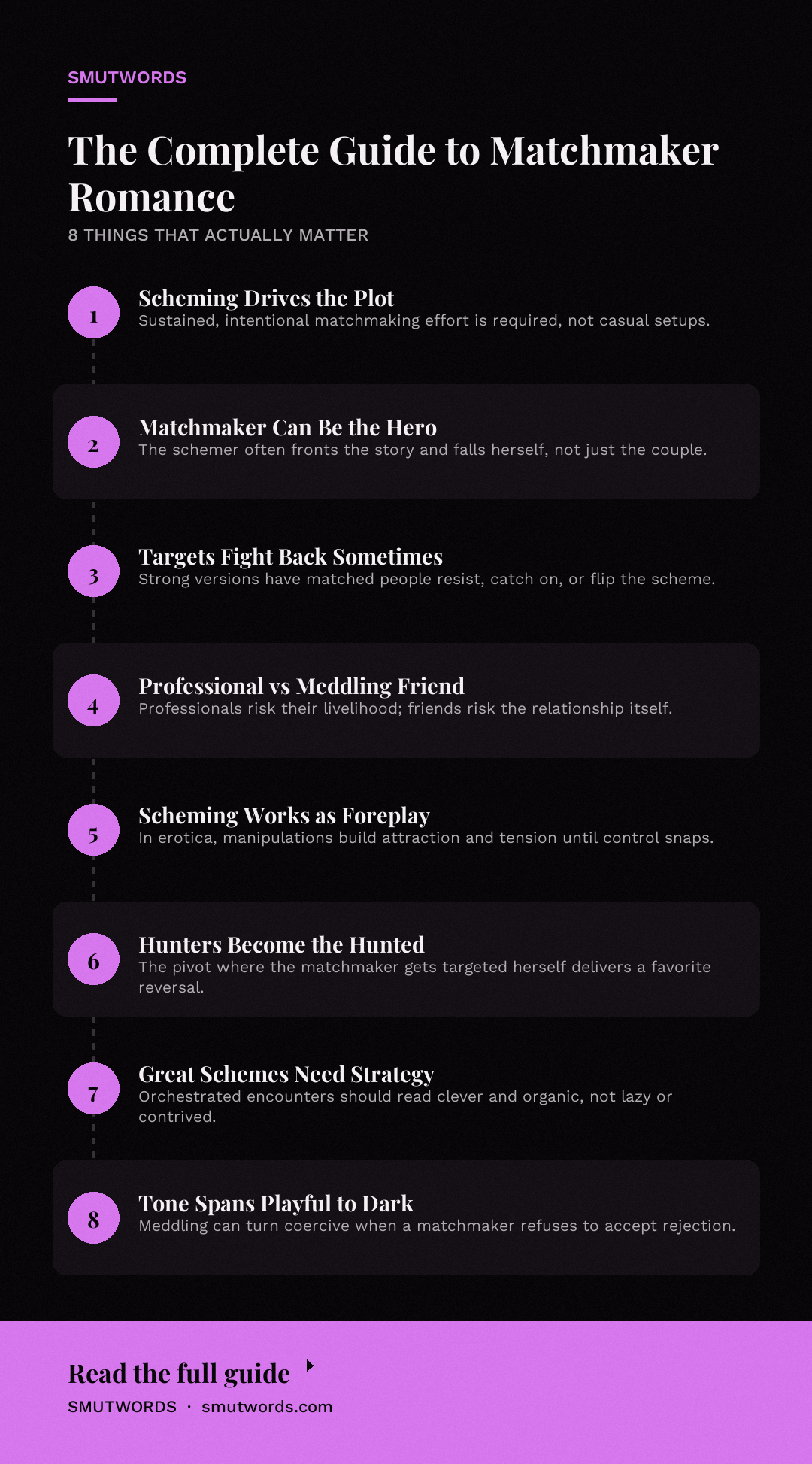
A matchmaker romance is a story where a protagonist actively schemes to bring two people together as a primary plot driver. The matchmaker can be a friend, a sibling, a grandparent, a coworker, or a professional, but the key element is that their deliberate intervention shapes the romantic trajectory of the story. The person doing the matching is not always the protagonist of the central love story, but they are usually the engine that gets it moving.
This trope does not include casual setups or a single blind date arranged at a wedding. It requires sustained, intentional effort. The matchmaker plots, manipulates situations, drops hints, orchestrates encounters, and generally treats the love lives of others as a project. The story wants us to see the machinery of romance being built, not just the finished product.
A common misconception is that the matchmaker is always a secondary character whose own romance is the real story. That is one version, but plenty of books put the matchmaker front and center as the one who falls.
Another misconception involves the target of the matchmaking: many readers assume the person being matched is passive. In strong versions, the targets push back, catch on to the scheme, or turn the tables entirely. Also, a matchmaker romance can be a subplot inside a larger romance, but as a trope it only really earns the label when the scheming is substantial enough to drive significant page time.
The term covers a spectrum from sweet to spicy. A meddling grandmother arranging a meet-cute between her grandson and the local baker can be as much a matchmaker romance as a professional fixer who gets paid to configure a client's love life and then breaks her own rules by wanting him for herself. The defining thread is intentionality and scheming, not how warm or wicked the tone gets.
Where Matchmaker Romance Comes From
Matchmaking as a plot device has roots that go back centuries. Jane Austen's Emma is the ur-text, with its title character famously declaring that she will arrange a match for her friend Harriet, only to discover her own feelings for the man she assumed was meant for someone else. That template, the meddler who misreads everyone's heart including their own, has proven nearly inexhaustible.
In romance publishing, the trope gained steady traction through the 1980s and 1990s as category romance lines like Harlequin and Silhouette churned out variations. The busybody aunt, the well-meaning best friend, and the sibling who cannot stop interfering became reliable fixtures. These characters gave authors a reason to put hero and heroine in the same room repeatedly without relying on coincidence. The matchmaker functioned as a narrative device, a plot-prodding mechanism, and a source of comic relief all at once.
The position of the matchmaker shifted notably in the 2000s and 2010s. The trope moved from the periphery toward the center. Books began to feature protagonists who were professional matchmakers, running agencies or consulting businesses, which gave the scheming a professional veneer and a plausible reason for it to dominate the plot. This era also introduced the self-sabotaging matchmaker with more frequency, the character who is brilliant at fixing everyone else's love life while their own sits in ruins.
The rise of reality dating shows and matchmaking services in popular culture fed back into the fiction. Readers started encountering protagonists who treat romance like a data problem or a logistical challenge, only to be undone by the chaos of actual chemistry. That flavor of the trope, where the matchmaker thinks love is a system they can optimize, remains hugely popular because it sets up a delicious fall.
The trope also tilted toward explicit heat as erotic romance grew as a category. Modern versions of the matchmaker romance do not shy away from putting the schemer in sexually charged situations with the very people they are trying to pair off. The matchmaker falls for the client, the client's intended, or the second target of their own scheme, creating overlaps with Enemies to Lovers and Revenge Romance when the fallout turns hostile.
How It Shows Up in Erotica
When the matchmaker romance lands in erotic territory, the scheming takes on a sharper edge. The matchmaker does not just arrange coffee dates; they engineer scenarios designed to provoke attraction, jealousy, and physical tension. The plotting becomes a form of foreplay, with every manipulation pushing two people closer to a moment where they lose control, and the matchmaker often ends up caught in the crossfire.
The most common variations in erotic romance are worth knowing because they change the flavor of the story significantly.
- The meddling grandmother or relative: A family elder decides two people belong together and schemes shamelessly. This version often runs sweet-to-spicy and uses the relative's interventions to force proximity, though the relative rarely gets their own explicit arc.
- The professional matchmaker: The protagonist runs a matchmaking service and takes on a client or a target. The professional distance gives her a reason to deny her own attraction when the client proves irresistible, and the eventual fall hits harder because breaking the rules is part of her job.
- The fake matchmaker: A character pretends to be arranging a match as cover for their own pursuit. This one leans on the deception angle and creates a ticking clock where the ruse can collapse at any second.
- The self-sabotaging matchmaker: This protagonist is brilliant at pairing off friends and strangers but cannot manage her own love life. The story contrasts her competence outward with her dysfunction inward, and the person she tries to match often turns out to be the one who sees through her and fixes her instead.
- The matchmaker falls for the client: The professional version taken to its logical end. The boundaries break, the arrangement dissolves, and the characters have to decide whether what they built as a business transaction can survive as a real connection.
A strong erotic version of this trope uses the matchmaking as scaffolding for tension. The best scenes show the matchmaker narrating her own scheming while her body betrays her. She watches the couple she is engineering, notices everything about the target she keeps insisting she is indifferent to, and the reader gets to track her denial breaking in real time. The internal monologue is the engine here.
What separates a flat matchmaker romance from a great one is the quality of the scheme itself. A lazy version has the matchmaker announce she will fix things and then the plot simply delivers the couple to each other without her doing meaningful work.
A great version shows the matchmaker thinking like a strategist, reading both targets, adjusting her approach when things fail, and creating plausible social engineering that reads as clever rather than contrived. Every orchestrated encounter should feel like it could have happened organically, even if the matchmaker tipped the scales.
The heat level also depends on whether the matchmaker is inside or outside the physical action. When she is outside, the explicit scenes belong to the couple she created, and her voyeuristic observations add a layer of charge.
When she is inside, the heat belongs to her, and the scheming becomes the setup for her own surrender. The second mode is far more common in erotic romance because the reader usually wants the primary point of view to be the one whose clothes come off.
Enjoyed this? Get a free book.
Join the list and we will send a complete free story straight to your inbox, plus new releases every week after that. No credit card, no catch.
Mismatched desire works especially well here. The matchmaker engineers a scenario between two people, only to realize halfway through that she wants one of them for herself. Alternatively, the person she is trying to match catches on and punishes her by turning the tables, making her the target of his own pursuit. That pivot, where the hunter becomes the hunted, delivers a reversal that readers never tire of.
The tone can run anywhere from playful to punishing. The professional matchmaker story with a dominant client can slide into a power exchange dynamic where the scheme becomes a game of control. The meddling friend version with a possessive bent can move into darker territory when the matchmaker refuses to accept rejection. The trope does not mandate a light touch, and some of the most compelling versions lean into the coercive edge of deciding someone else's love life for them.
Professional Matchmaker vs Meddling Friend
The most useful comparison for readers and writers is between the professional matchmaker and the meddling friend or relative. These two categories cover most matchmaker romances, and they create different kinds of story problems.
The professional brings structure. Her scheming is her job, so her interventions are systematic, measurable, and explainable. The story can justify her spending extravagant time and resources on the match because she gets paid for it.
Her central conflict usually involves breaking her own professional code when she develops feelings for a client. The framework of rules gives the author a clean line to cross.
The meddling friend has no such excuse. Her scheming is pure social aggression wrapped in affection. She has no professional reason to be this involved, so her behavior reads as more invasive and more obviously about her own needs.
Her central conflict tends to be about control and letting go. She meddles because she cannot stand uncertainty, and her own romance only resolves when she learns to trust the process instead of managing it.
Both versions work, and some books blend them by having a professional matchmaker who becomes personally invested and starts behaving like a meddling friend. The distinction matters for establishing stakes.
A professional risks her livelihood. A friend risks the relationship itself. Choose the risk that makes the story hurt more when it fails.
Frequently Asked Questions
What counts as a matchmaker romance?
A story where a character deliberately and repeatedly schemes to pair up two other people, with that scheming driving a meaningful portion of the plot. Casual setups or a single blind date do not qualify. The matchmaker must be an active agent whose interventions change the course of the romance, regardless of whether she ends up involved herself.
Can the matchmaker be the main character?
Yes. In modern erotic romance, the matchmaker is often the protagonist, and the story centers on her own journey toward love rather than the couple she is trying to create. The professional matchmaker who falls for her client is one of the most common structures in the genre.
Is matchmaker romance always a comedy?
No. Many versions lean comedic because failed scheming is inherently funny, but the trope supports serious, even dark treatments. A matchmaker who refuses to accept a loved one's choice can create genuine conflict, and the coercion at the heart of deciding someone's love life for them can carry real weight when the author chooses not to play it for laughs.
What is the difference between matchmaker romance and forced proximity?
A matchmaker romance centers on a character who actively arranges situations to bring two people together. Forced Proximity is a setup where circumstances trap characters in close quarters, like a snowed-in cabin or a shared hotel room, with no deliberate orchestrator required. The two tropes often combine, since a matchmaker frequently fabricates proximity to make her scheme work.
Does the matchmaker always fall in love herself?
No. Sometimes the matchmaker is a secondary character whose scheming creates the central couple, and her own romance, if any, stays in the background. That said, the most enduring versions of the trope, going back to Emma, involve the matchmaker discovering her own feelings as a direct result of her efforts. Readers tend to prefer this version because it makes the schemer earn her own happy ending.
Why do readers enjoy watching someone manipulate others' love lives?
The matchmaker offers a safe entry point for exploring control in romance. Readers can enjoy the fantasy of shaping outcomes without consequences while knowing the narrative will eventually punish the schemer for overstepping. The matchmaker also functions as a stand-in for the reader, someone who is watching two people fall and analyzing every interaction, which mirrors the reading experience itself.
Final Thoughts
The matchmaker romance endures because it dramatizes the gap between what we plan and what we feel. Every scheme is an attempt to impose order on chaos, and every successful story shows that order collapsing in the most satisfying way possible. The schemer wants to control love from the outside, and the narrative punishes her by making her a participant.
The trope also pairs naturally with other structures. A meddling relative forcing proximity between two reluctant lovers shares DNA with free use vs gangbang dynamics in how consent and control get negotiated, and the schemer's elaborate plotting echoes the staged scenarios of taboo roleplay.
For a version that takes the professional framework and pushes it into explicit, high-stakes territory, look for a heroine who runs a high-end matchmaking service and takes on a client she should refuse. The best of these stories make the business of arranging love feel as charged as the love itself.





Loading comments…