Taboo roleplay is the most popular kind of erotica you will never see advertised on a bus. It is the consensual, negotiated acting out of fantasies that involve dynamics real life would rightly call forbidden: a student and teacher, two people raised as siblings, an adult and a much younger partner. The keyword is consensual.
The appeal is not the act itself, which would be harmful or criminal in reality, but the specific, thrilling friction of doing something marked as wrong inside a container that is completely safe. Taboo roleplay lets readers and partners touch the flame of transgression without getting burned, turning social disgrace into the hottest kind of desire.
What Taboo Roleplay Actually Means
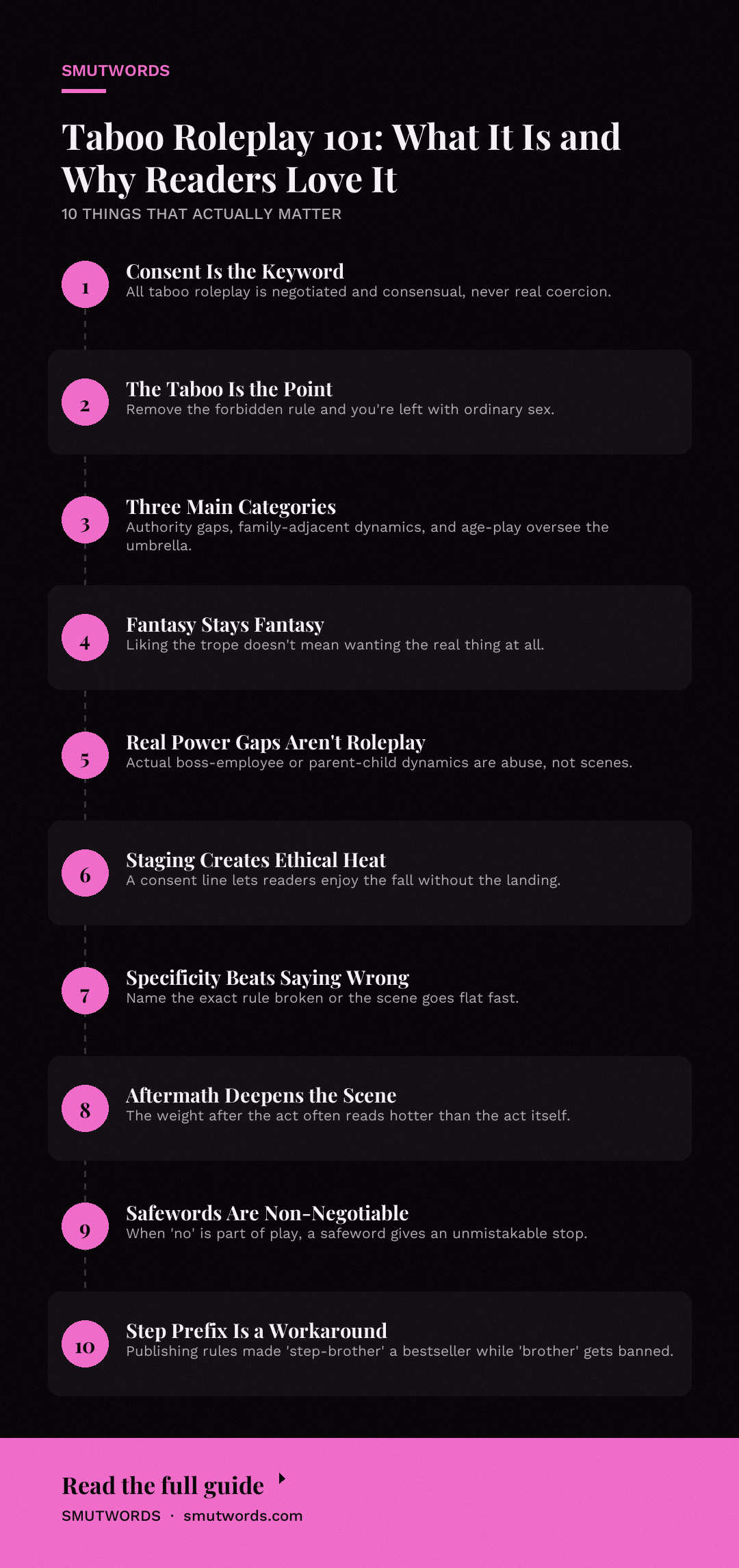
Taboo roleplay is a broad umbrella term for any negotiated scene where the fantasy hinges on a dynamic that would be off-limits, illegal, or socially unacceptable if it were real. The taboo is the point. Take the taboo away and you are left with ordinary sex.
The teacher who grades papers and the student who misbehaves are only charged because of the power gap and the rule being broken, not because of anything inherently erotic about algebra or detention.
There are three major categories under the umbrella, and they often overlap. The first is authority-imbalanced scenarios, like teacher/student, boss/employee, coach/athlete, or doctor/patient. The second is family-adjacent dynamics, most commonly step-sibling or step-parent roleplay, which borrows the frisson of incest without the actual genetic relation. The third is age-play, where adults roleplay as younger than they are.
All three share one structural element: the fantasy requires a rule to break, and the breaking of that rule is what generates the heat.
A common misconception is that liking taboo roleplay in fiction or in bed means wanting the real thing. This is false. The entire structure of the fantasy depends on it remaining a fantasy.
A person who loves step-brother scenes usually has zero interest in their actual step-brother. What they want is the emotional shorthand of closeness, shared history, and wrongness, delivered in a package they can safely discard when the scene ends.
It also does not count as taboo roleplay if one partner is genuinely being coerced or if either partner is underage. The line between fantasy and reality is the entire point of the kink.
When a real power differential exists, like an actual boss and employee or a real parent and child, it is not roleplay. It is abuse. Age-play is strictly for adults playing adults who are pretending to be younger; there is no version where a real minor participates.
Where Taboo Roleplay Comes From
The history of taboo roleplay is largely the history of saying no to one thing so you can say yes to another. As a genre trope, it exploded alongside the popularity of step-sibling and step-parent erotica on platforms like Amazon Kindle in the 2010s.
Self-publishing created a market where readers could search for exactly what they wanted, and what they wanted, in staggering numbers, was to read about a step-brother sneaking into his step-sister's room. Amazon's own content guidelines eventually reacted, punishing authors who wrote about full incest while leaving step-relations in a grey zone that publishers exploited aggressively. The result is a strange publishing landscape where a phrase like "my brother" gets a book banned, but "my step-brother" becomes a bestseller.
Before that boom, the dynamic existed in older forms. The teacher/student romance is a staple of pulp erotica going back decades, and the naughty schoolgirl or the governess seduced by her employer is a Victorian chestnut. The forbidden quality of those pairings was always the draw. What changed is the framing.
Older texts often played the taboos as genuinely transgressive, with real consequences like pregnancy, scandal, or ruin. Modern taboo roleplay fiction is much more likely to stage the scene as overt roleplay within a loving, negotiated relationship, or to write the fantasy so walled off from reality that consequences feel irrelevant.
The rise of the safeword and modern BDSM negotiation culture shifted the ground underneath the genre. Once the kink community established that fantasy and practice were separate categories you could opt into with specific boundaries, authors had a vocabulary for making taboo scenes feel ethical on the page.
A teacher/student scene written in 1980 might read as predation. The same scene written in 2024, with the characters establishing they are both adults and the "teacher" is playing a part, reads as kink. The publishing term for this shift is "staging": the author includes a line that tells the reader, this is a consensual game, so you are free to enjoy the fall without worrying about the landing.
How It Shows Up in Erotica
On the page, taboo roleplay takes two distinct forms. The first is direct fantasy, where the narration treats the scenario as real within the story's world. These are often written in first person to heighten the personal stakes: "I shouldn't want my step-brother, but I couldn't stop watching him." Second person is rarer but appears in more immersive or choose-your-own-path formats.
The second form is overt roleplay, where the couple in the story explicitly agrees to a scene, often in a chapter that shows the negotiation before the action begins. This framing is increasingly common because it lets the author have the taboo thrill and the ethical safety net simultaneously. For a deeper look at how authors handle that negotiation on the page, the way femdom and hotwife romance overlap shows a similar dance between asserting power and obtaining consent.
Strong versions of the trope share three craft elements. First, the author makes the taboo concrete. A scene works when the reader always knows exactly which line is being crossed, and why crossing it matters to the characters.
Second, the author builds tension through anticipation rather than rushing to the act. The best taboo scenes are slow, with the characters circling each other, acknowledging the risk again and again until the moment they decide the risk is worth taking.
Enjoyed this? Get a free book.
Join the list and we will send a complete free story straight to your inbox, plus new releases every week after that. No credit card, no catch.
Third, the emotional stakes are high. Taboo roleplay is rarely casual. It thrives on the sense that this is a one-time thing that might change everything, which is why it pairs so naturally with makeup sex after a fight or the reckless urgency of a one night stand.
The craft of building anticipation before crossing the line is also central to revenge sex fiction, where the charge comes from breaking a different kind of social rule.
Common variations in published erotica include:
- The staged scene: a long-term couple roleplays a taboo dynamic as a way to spice up their routine, often with one partner playing reluctant at first.
- The accidental taboo: characters who genuinely believe they are siblings and then discover they are not, a trope that gives the reader the taboo charge with a built-in excuse to remove it.
- The power-imbalance fantasy: teacher/student, professor/graduate student, boss/intern, where the erotic charge comes from the authority figure surrendering control or the subordinate seizing it.
- The age-play dynamic: an adult partner acts younger, often paired with caretaking or discipline, requiring the most explicit negotiation both in real life and in the framing of the story.
- The forbidden witness: where a third party voyeurism element watches or catches the taboo act, adding a layer of shame and exposure on top of the original wrongdoing. That added layer of being watched is exactly what fuels cuckold voyeur fiction.
What separates a flat taboo scene from a great one is specificity. A character who says "this is so wrong" in the abstract is boring. A character who thinks "if my mother knew I was on my knees for her new husband, she would burn this house down" is compelling. The second version gives the reader the precise texture of the social rule being broken.
Similarly, flat scenes forget the aftermath. A strong scene shows the characters after the act, dealing with the weight of what they did, either leaning into the wrongness or scrambling to pretend it never happened. That aftershock is often more erotic than the act itself. The same principle of using aftermath to deepen a scene appears in marking kink, where the evidence left behind becomes part of the fantasy.
Taboo Roleplay vs Incest Roleplay
These terms are frequently conflated, but they are not the same thing. Incest roleplay is a specific subset of taboo roleplay that involves family dynamics, whether real, step, or adopted. Taboo roleplay is the wider category that includes incest roleplay alongside every other forbidden scenario.
If you read a story about a student and her professor, that is taboo roleplay but not incest roleplay. If you read a story about a step-sister and step-brother, it is both.
The distinction matters for readers searching for content and for authors trying to signal what their book contains. A reader looking for "taboo" might be happy with a boss seducing his assistant. A reader looking for "step-sibling" specifically wants the family angle.
The publishing ecosystem has pushed these categories apart because platforms treat them differently. Amazon's content guidelines, for instance, restrict explicit full incest, which is why the step prefix exists in the first place as a workaround.
This has created the odd situation where "my brother" is banned and "my step-brother" is a bestseller, even though the emotional territory is nearly identical. The packaging matters more than the content. For readers who enjoy the "wrongness" of a creature crossing human boundaries, the same dynamic of forbidden attraction drives human/monster romance.
Frequently Asked Questions
Is it normal to like taboo roleplay?
Yes. Fantasizing about forbidden dynamics is one of the most common kinks in erotica, which is why it dominates bestseller lists. Sexual arousal runs on novelty and transgression, and taboo roleplay delivers both inside a safe container. Liking the fantasy does not indicate any desire to act on it in real life.
What is the best way to bring up taboo roleplay with a partner?
Bring it up outside the bedroom, in a neutral moment, and frame it as a fantasy you want to play with, not a desire you need to fulfill. Use specific language about it being a scene with boundaries and a safeword. Suggest a milder entry point, like teacher/student, if a harsher taboo like step-sibling feels intimidating.
What is a safeword and why is it necessary?
A safeword is a pre-agreed word that stops the scene immediately when either partner says it. It is non-negotiable for taboo roleplay because the scene may involve one partner saying "no" or "stop" as part of the fantasy. Since verbal protests become ambiguous, a safeword like "red" or "pineapple" provides an unmistakable signal that the play has become too intense.
Does liking step-sibling erotica mean I want to sleep with my actual sibling?
No. The step prefix in erotica is largely a publishing workaround for platform content restrictions. The fantasy relies on taboo distance, not on actual family desire. Readers who enjoy these stories are responding to the wrongness of the dynamic, not to a real person in their lives.
What is the difference between taboo roleplay and Consensual Non-Consent (CNC)?
Taboo roleplay is about breaking a social or legal rule of relationship, like a teacher with a student. CNC is about the absence of consent within the scene, where one partner pretends to resist or be taken. They overlap when a taboo scenario includes a resistance element, but a taboo scene can be fully enthusiastic and a CNC scene can involve no taboo dynamic at all.
Why do so many taboo stories include negotiation scenes before the action?
Modern readers and authors use negotiation scenes to separate fantasy from reality on the page. Showing the couple agree on limits and a safeword tells the reader that the taboo act is a consensual game, not a genuine transgression. This framing has become a genre convention that lets authors write darker scenarios while keeping the ethics clear.
Final Thoughts
Taboo roleplay is the fiction of saying the wrong thing at the wrong volume and discovering the whole room liked it. The genre works because it respects the difference between fantasy and reality so absolutely that it can afford to blur them on the page.
For the richest example of a couple negotiating a taboo scene that genuinely changes their relationship, pick up a well-reviewed step-sibling or teacher/student romance from the catalog below and watch how the author stages the consent before the fall. That staging is the whole trick, and once you see it, you will never unsee it.






Loading comments…