A shoe fetish is sexual arousal from footwear: the look, the smell, the texture, the sound, the weight of a heel pressing into a floor or a chest. The shoe is the erotic object, and the person wearing it is often the second half of the equation.
It sits at the exact intersection of ordinary and forbidden that makes erotic writing hum. Anyone can walk past a pair of black stilettos without a thought, and that is the point. For a reader with a shoe fetish, that same object carries a private charge, so the fiction feels like a secret being told out loud.
The short glossary version calls it intense attraction to footwear, focusing on styles like heels, boots, or flats, plus worship, smelling, and domination. True as far as it goes, and about as useful as describing wine as fermented grapes. The real version has texture, hierarchy, ritual, and a long history in printed smut. Below is everything we know after reading hundreds of these scenes and deciding which ones actually work.
What Shoe Fetish Actually Means
The word "fetish" gets used loosely in everyday speech to mean "really into it," and that looseness causes confusion here. In clinical language, a fetish is arousal tied to a specific object, and the object is not optional. A reader who likes a woman in heels is not the same as a reader for whom the heel itself is the point.
Shoe fetish writing serves the second reader. The shoe stops being an accessory and becomes the subject of the scene.
What counts: kissing, licking, or pressing a face against a shoe; smelling worn leather, canvas, or rubber; polishing and buffing; being stepped on or pinned by a sole; the slow ritual of removing or putting on footwear; the click of heels walking toward someone on a hard floor. Also the humiliation and submission angle, where licking a boot is the act of kneeling made physical.
What does not count: a character wearing heels for a night out in a scene with no erotic attention paid to the footwear. That is just a wardrobe choice. The fetish requires focus. The camera, so to speak, has to stay on the object.
A few misconceptions are worth knocking down directly.
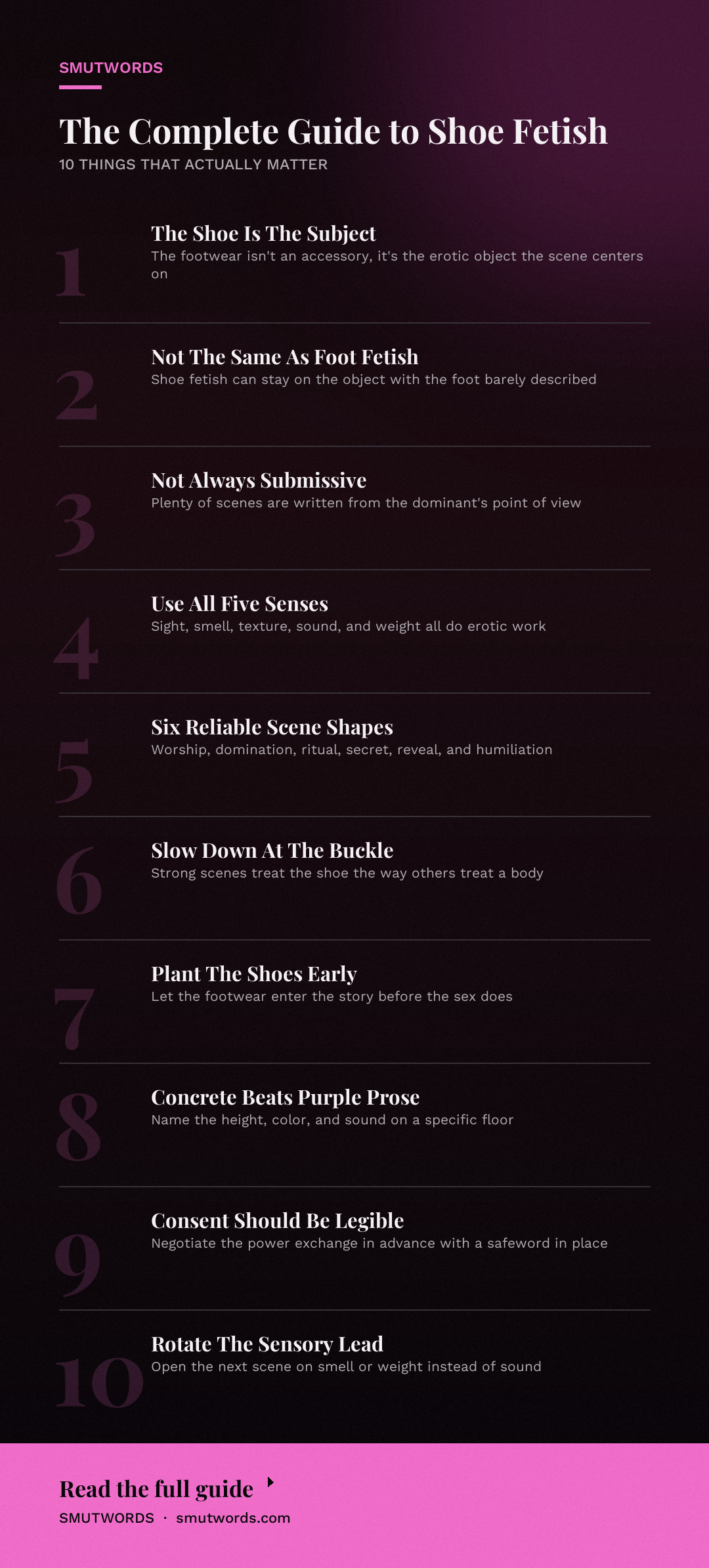
- It is always about feet. There is overlap with foot fetish, and plenty of readers carry both, but shoe fetish writing can center the object with the foot barely described. A character can be fixated on a pair of red pumps and never once mention toes.
- It is always submissive. Plenty of shoe fetish fiction is written from the dominant's point of view, where the shoe is the instrument of control and the wearer governs the scene entirely.
- It requires a specific style. Heels dominate the genre because they photograph well in prose, but boots, ballet flats, sneakers, riding boots, and even work shoes have their own devoted readership.
- It is rare. Footwear is one of the most common fetish objects in existence, which is why it shows up constantly in erotic fiction and barely registers as transgressive anymore.
One more clarification that matters for writers. A shoe fetish scene is built on sensory detail, which means it lives in the same neighborhood as other object and texture-driven kinks. The leather catsuit fetish runs on the same machinery, where the material is doing erotic work that a body part usually does. Readers who like one often like the other.
Where Shoe Fetish Comes From
Footwear has been erotic in Western writing for well over a century, and the trail is unusually well documented because it kept colliding with obscenity law. Victorian erotica leans hard on boots, laced shoes, and stockings, often as a class marker, where the shiny boot belongs to the person with money and power. The shoe in those texts is a symbol of status as much as anatomy. You wanted the boot because you wanted what the boot represented.
By the early twentieth century, the fetish had its own publishing niche. Specialty magazines and mail-order catalogs devoted to heels and boots circulated quietly for decades, and the object of desire was already fully formed: the pump, the thigh-high boot, the stiletto.
The internet then took a long-standing private taste and made it a visible genre with its own conventions and vocabulary. That shift matters more than any single book. Shoe fetish writing evolved from a whisper in the back of a magazine into a recognized tag with thousands of stories filed under it.
The tone of those stories has moved too. Older material leaned on shame and secrecy, treating the fetish as a problem to be caught doing. Contemporary erotica treats it as a preference with rules and etiquette. Modern shoe fetish fiction is just as likely to open with negotiation as with humiliation, which makes it warmer and, frankly, better written.
Fashion fed the genre directly. The stiletto in the 1950s, the platform in the 1970s, the thigh-high boot in every decade since, each one gave writers a fresh object with a fresh silhouette and a fresh sound. The sound is the underrated part. Heels on tile are one of the most reliable audio cues in erotic fiction, and every era has its own vocabulary for it.
How It Shows Up in Erotica
The strongest shoe fetish scenes are patient. They treat the shoe the way other scenes treat a body: undressing it, examining it, giving it a paragraph before anyone touches anything. A flat version skips straight to licking a boot with no buildup, and the result reads like a summary of a scene rather than the scene itself. A strong version slows down at the buckle.
The sensory inventory gives you five channels, and good writers use most of them.
- Sight: the shine, the scuff, the strap cutting across an ankle, the arch of a heel that makes a leg look longer.
- Smell: worn leather, warm rubber, the inside of a boot after a long day. This is where shoe fetish writing overlaps most with body fluid kink, since scent is doing the heavy lifting and sweat is implied.
- Texture: suede against a cheek, the grain of leather under a thumb, the grit of a sole.
- Sound: the click, the scuff, the creak of leather, the thud of a boot heel on a hardwood floor.
- Weight and pressure: a sole pressing into a chest, a heel resting on a thigh, the specific pressure of being stepped on.
Writers who only use sight produce flat scenes. Writers who bring in smell and pressure produce scenes readers bookmark.
The genre has a handful of reliable shapes, and knowing them helps you decide which one your scene is.
- The worship scene. One character kneels and tends to the footwear, often removing it first and working down. The emotional engine is reverence, and the power dynamic is explicit.
- The domination scene. The shoe wearer controls the scene physically, stepping, pinning, or using a heel as an instrument. The footwear is armor and weapon at once.
- The ritual scene. Polishing, lacing, or buckling becomes the erotic act, often with the shoe still on a foot, which keeps the wearer present and in charge.
- The secret scene. A character is aroused by shoes and has to conceal it, and the tension comes from proximity and risk rather than overt action.
- The reveal scene. One partner discovers the preference and responds with curiosity rather than judgment, which is where a lot of contemporary readers are most satisfied.
- The humiliation scene. The shoe is used to lower someone, and licking a sole is the physical expression of a status the scene has already established.
Two dynamics do most of the work underneath all six. The first is power, which can flow in either direction and often flows both ways at once. The second is trust, because offering a foot or kneeling at someone's shoes is an act of surrender that has to be earned. A scene that ignores trust reads as hollow no matter how good the sensory detail is.
When it comes to what separates a scene that works from one that does not, the pattern is consistent. Strong scenes know who holds the power and state it through action rather than announcement. Strong scenes pick one or two sensory channels and go deep instead of listing all five in a single paragraph.
Enjoyed this? Get a free book.
Join the list and we will send a complete free story straight to your inbox, plus new releases every week after that. No credit card, no catch.
And strong scenes give the shoe wearer a personality, since a shoe on a mannequin is a prop while a shoe on a character with a mood is a scene. Weak scenes rush the ritual, overuse adjectives, and treat licking a boot as an ending rather than a beginning.
Word choice is where a lot of promising drafts die. A heel does not need to be "deliciously wicked." It needs to be a specific height in a specific color with a specific sound on a specific floor. The fetish writing that lasts is concrete. Readers remember the black patent pump with the scuffed toe from a novel they read a year ago and forget entire chapters of purple prose.
Variations are wide enough that there is a version for nearly every reader. High heel fetish writing tends to emphasize posture and silhouette. Boot fetish writing leans on leather, lacing, and weight. Flat and sneaker variants trade glamour for intimacy, since the shoe is closer to the everyday and sometimes worn soft.
There is also a strong cross-pollination with material-based kinks in general, the same pull that drives a tattoo fetish or a breast fetish, where a specific feature becomes the organizing principle of the whole scene.
One more craft note on structure. Shoe fetish scenes work best when the footwear enters the story before the sex does. Plant the boots in chapter one. Let the character notice the click in chapter two.
By the time the scene arrives, the shoe has accumulated meaning, and one description of a heel landing on a hardwood floor carries three chapters of tension. Fetish writing rewards setup in a way that plain sex scenes often do not, and shoe fetish is one of the clearest examples.
Writers also get good mileage from the daily-life contrast. The same shoes worn to work, scuffed on a commute, kicked off by a door, are the shoes the scene centers on. The fetish does not require exotic objects. It requires a reader who understands that the ordinary object has been loaded, and a writer who trusts that.
Shoe Fetish vs High Heel Fetish
These two get confused constantly, and the relationship is genuinely one of subset and superset rather than rivalry. High heel fetish is the specific case. Shoe fetish is the general category, and it covers boots, flats, sneakers, sandals, and everything else.
A reader who is only aroused by stilettos has a high heel fetish. A reader who is aroused by footwear across the board has a shoe fetish, and their library probably includes both.
For writers, the practical difference is range. Writing to a high heel fetish means leaning on silhouette, posture, and the specific architecture of the heel. Writing to shoe fetish means you can cast the footwear to fit the character, which is often the stronger choice. A character's shoes tell the reader who they are before the scene begins, and picking the shoe deliberately is half the work of building the dynamic.
Frequently Asked Questions
Is a shoe fetish the same as a foot fetish?
No, though they overlap heavily and plenty of people have both. A foot fetish centers the bare foot: toes, arches, soles, ankles. A shoe fetish centers the footwear itself, and a scene can stay entirely on the object without the foot ever coming into focus. The two are adjacent rather than identical, which is why writers often use one to lead into the other.
Why is shoe fetish so common in erotica?
Because footwear does the work of characterization and power in one object. A pair of heels can signal class, mood, and who is in charge before anyone speaks, and it gives the writer a concrete sensory anchor that is easy to describe and hard to overuse. Shoe fetish writing is efficient in a way that abstract desire is not.
What are the most common shoe fetish variants?
Heels and boots dominate, followed by flats, sandals, and sneakers. The named practices are foot worship, shoe smelling, shoe polishing, and shoe humiliation, and most scenes combine at least two of those. High heel fetish is the single most common specific style within the broader category.
Does shoe fetish fiction always involve domination?
No. Power exchange is common because a shoe is an easy prop for it, but plenty of shoe fetish scenes are tender, curious, or mutual. A scene where one partner asks about the preference and the other answers honestly can be as erotically charged as a scene where someone is stepped on, and contemporary readers are often more interested in the first.
How do writers keep a shoe fetish scene from feeling repetitive?
By changing which sensory channel leads. If one scene opens on the sound of heels on tile, the next should open on smell or weight, and the ritual itself should differ: removing a boot is not the same act as buckling a strap. Rotating the approach and varying the character's emotional stake keeps the material fresh across an entire book.
What about hygiene and safety in a shoe fetish scene?
Clean and worn are two different things, and the writer should be clear about which one the scene is using. Real-world practitioners talk about cleanliness, foot health, and the difference between scent as an element and actual unhygienic contact, and any power exchange involved should be negotiated in advance with a safeword in place.
Forced foot or shoe contact without consent is abuse, and good fiction makes the consent legible rather than assumed. A strong scene shows the negotiation or at least acknowledges it, which also gives you a natural place to build tension. If you want a longer look at how that negotiation plays out on the page, our guide to aftercare meaning in dating and kink covers the part that comes after, and it pairs well with this one.
Final Thoughts
Shoe fetish writing lives or dies on specificity and patience. Name the shoe, place it on a real floor, let the sound land before anyone moves, and let the power flow in whichever direction the characters actually want it to go. Readers come to this tag for the ritual as much as the payoff, and the writers who respect the ritual are the ones readers return to.
If you want to see the dynamic stretched across a full-length book rather than a single scene, spend time with the ranked list below and start with the one that opens on a sound. The rest of the tag will still be here when you finish.






Loading comments…