Most people looking up the aftercare meaning in dating are doing it after a night that ended weird. Something intense happened, someone got quiet, and now you're lying in the dark wondering if you're supposed to say something or just let them sleep.
The answer is that aftercare isn't a kink-only ritual, and it isn't something you earn by having a formal scene with safewords and a contract. It's the catch-all term for the check-in that happens once the heat drops and the bodies come back online.
Casual dating has it. Vanilla sex has it. Every one-night stand where somebody brought water to the bed without being asked is running aftercare, whether they'd call it that or not.
What changed is that the word escaped the dungeon. For a long time "aftercare" lived in BDSM spaces as the mandatory decompression after a heavy scene: blankets, water, praise, sometimes a snack, sometimes just lying there while a sub drops back down to earth.
Then internet dating advice borrowed it. TikTok turned it into a red flag test. Now the aftercare meaning in dating has stretched to cover everything from "he texted the next morning" to "she held me while I cried after my divorce." That's a lot of weight for one word to carry, so this breaks down what it actually covers, where casual dating aftercare and scene aftercare diverge, and how the best erotica writes it when it's written well at all.
What Does Aftercare Actually Mean?
Aftercare is the physical and emotional care given after sex, kink, or any intense intimate experience, meant to help both people come down safely. That's the whole definition.
It includes water and snacks after a scene and also includes the twenty minutes of lying tangled up talking nonsense after a hookup. It covers texting the next day, walking someone to their car, checking in after a rough breakup, and the specific thing you do when your partner's eyes go glassy and you can't tell if it's bliss or overwhelm.
The one thing aftercare is not: a punishment or a reward. It's maintenance, the same way you'd cool down after a hard run instead of just stopping dead.
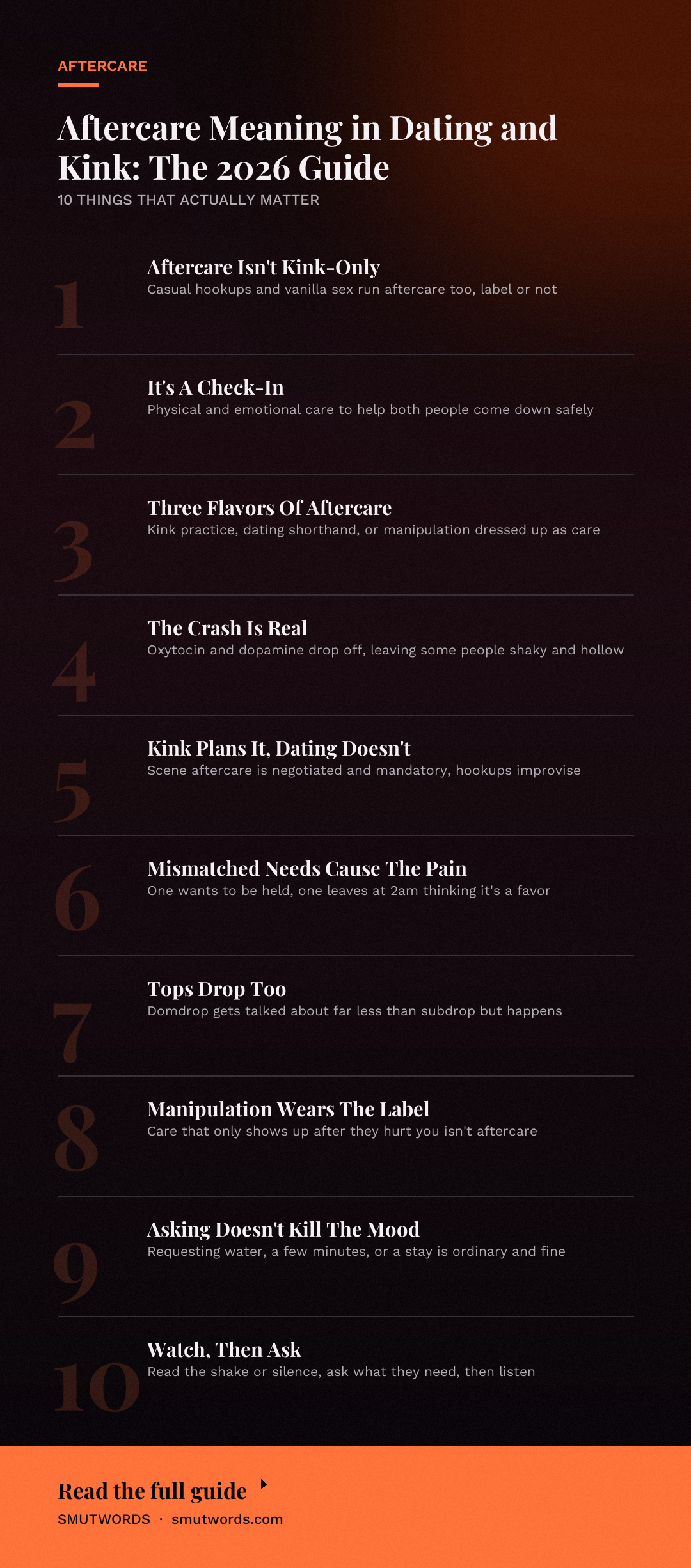
People usually mean one of three things when they say it in a dating context. Keeping those straight saves a lot of confusion.
The three flavors you'll run into
- Aftercare as kink practice: the structured version. Negotiated ahead of time, tied to a specific scene, often with an agreed list of what each person needs afterward because that scene hit hard.
- Aftercare as dating shorthand: the casual version. Cuddling, water, "you good?", a text the next morning. It's the same impulse running looser, without a scene to anchor it.
- Aftercare as manipulation cover: the ugly version. Someone who hurt you and then offered affection to smooth it over so you wouldn't leave. If the "care" only shows up when they've messed up, it's not aftercare. It's a cleanup crew for their own mess.
That last one gets filed under the aftercare label a lot, and it's why some people hear the word and roll their eyes. Fair. But it's worth naming so you can spot it.
What Is Aftercare in Sex, and Does Vanilla Sex Need It?
Someone searching "aftercare sex meaning" usually wants permission. They had great sex, they felt weird an hour later, and they're wondering if something's wrong with them. Nothing is wrong.
Intense sex floods you with oxytocin, dopamine, and endorphins, and when those drop off, some people feel a crash: empty, shaky, suddenly convinced their partner is about to leave even when the evidence says otherwise. That crash is why aftercare exists. It's a buffer between the high and the return to normal life.
Vanilla sex absolutely qualifies. You don't need rope or a title to earn a check-in. A round of sex that left someone trembling needs the same blanket and water as a flogging scene does.
The main difference is that in kink, aftercare is planned and mandatory. In casual dating, it tends to be improvised and optional, which is exactly why it goes missing so often.
If you want a quick way to tell whether a hookup is getting the aftercare it needs, run these three questions.
- Did anyone check in with actual words, not just a vague "that was fun" mumbled into a pillow?
- Did both people get what they needed physically (water, shower, food, sleep, an Uber)?
- Was there any contact or acknowledgment in the hours or days after, appropriate to the relationship?
If all three are yes, nobody's been abandoned. If two or more are no, someone's going home with a hollow feeling they'll probably misattribute to the sex itself.
Casual Dating Aftercare vs. Scene Aftercare
This is where most confusion lives. People read a BDSM guide, try to apply dungeon rules to a Tinder hookup, and it gets weird. The instinct is right; the scale is off.
In a formal scene, aftercare is negotiated before anything happens. You agree on what each person needs, you know the safeword, and you build in time afterward: usually fifteen minutes to an hour of touching, talking, quiet, snacks, whatever. Rigorous, and it works because everyone opted into that frame.
In a casual dating context, none of that scaffolding exists. You met three hours ago. You don't know if she wants a full debrief or if he wants you gone by dawn. So the aftercare defaults to what each person can read off the room.
The mismatch causes most of the pain. One person wants to be held and talked to. The other, having been raised on the "cool girl leaves at 2 a.m." script, thinks leaving quick is doing the other person a favor. Nobody's an asshole here, but somebody ends up staring at a ceiling.
What the well-written version looks like
Good erotica gets this right far more often than mainstream dating advice does, because erotica is in the heads of both characters when the heat drops. The comedown is where the characterization happens. A dominant who buckles the sub into a seatbelt and buys her a burger afterward is doing aftercare.
A casual hookup story where the guy quietly throws the used condom away, refills her water glass, and then asks if she wants him to stay is doing aftercare, just without the label.
The extremes are where erotica also shows what happens when aftercare is missing or weaponized. A marriage in trouble storyline often hinges on the absence of aftercare: years of sex with no catch, no check-in, and the slow realization that the intimacy stopped being mutual somewhere along the way.
Enjoyed this? Get a free book.
Join the list and we will send a complete free story straight to your inbox, plus new releases every week after that. No credit card, no catch.
The reclaiming scene that later repairs it is basically aftercare in a longer form: the conversation, the physical resetting, the promise that certain things won't happen again. That's why the trope lands so hard. The reader recognizes the missing piece before the characters name it.
Why Kink Scenes Take It So Seriously
In the kink world, aftercare isn't optional. It's the last phase of the scene, the same way a landing is part of a flight. Skip it and you risk something worse than an awkward morning: a subdrop that lasts days, or a domdrop on the other side, because tops drop too and get talked about much less.
You can read more about what that crash looks like in The Complete Guide to Subspace, which explains the altered state and the descent back from it.
Because kink involves higher risk, the aftercare is more specific. Cold water and a weighted blanket, or a warm shower alone, or being held and told exactly what happened and why it was okay.
The complete guide to BDSM covers the negotiation side of this in detail, and the general principle holds: the more intense the thing, the more deliberate the recovery has to be. That's true of redemption arc romance too, where the whole arc is someone earning the right to be trusted again. Aftercare and redemption share a shape. Both are repair after damage, and both fail if they're only performed for show.
If the scene involved anything rough, the check-in also needs to cover the physical: marks, bruising, bite marks, blood. Look at what happened, name it, and decide together how you both feel about it now that the heat is off. A stalker romance plot twists this into something darker, where an obsessive character mistakes possession for care. Which is a useful reminder: the aftercare label never excuses the thing that came before it.
Aftercare When Feelings Are Involved
Casual dating aftercare gets more complicated when someone's catching feelings. You can't always say "that was just sex" afterward if one of you is already in deeper, and the standard hookup script doesn't accommodate that. So the aftercare has to expand. It now covers the emotional fallout as well as the physical, because that's what got stirred up.
This is where a lot of good erotica makes its move. The scene is the hookup. The aftercare is where the character realizes they're in trouble, because the care they're being given is more than casual and they can feel the difference.
Watch how a book handles the morning after and you'll know whether it's writing people or props. If the love interest leaves water on the nightstand and a note with their number, that's a tell. If they slip out before dawn with no contact, that's a different tell, and the rest of the book is usually about the wound it opened.
Read closely and you can rank the realism. The erotica that gets aftercare right tends to do these things, in roughly this order:
- The characters check in with actual words, not just a look.
- Someone gets water, food, or a shower, and the detail is specific enough to ground the scene.
- The characters don't pretend the intensity didn't happen. They acknowledge it, even casually.
- The follow-up (a text, a call, a next visit) is shown, not skipped.
That last one is where the published books separate from the draft-quality stuff. It's also worth searching around for what aftercare means in dating questions on forums; the real answers from real people tend to be more specific than any list you'll find in a magazine, and it's a quick sanity check on whether you're being weird or someone else is.
Signs of Good and Bad Aftercare in Real Dating
Since the phrase "aftercare meaning dating" gets searched most often by people uncertain whether they're getting it, here's a short test. The catch is that aftercare is personal.
One person wants to be held. The next wants space. Then there's the hybrid who wants a shower and then a cuddle. None of those is wrong, but the paired person has to learn which one is happening.
Green flags
- They ask what you need and wait for an actual answer.
- They don't treat the check-in as a threat to their reputation or yours.
- They stay if you ask, leave if you ask, and respect what you said.
- The follow-up contact is consistent with the relationship you actually have, not a mixed signal.
Red flags
- They vanish the second they're done, and reappear only when they want something.
- They use cuddling to shut down a conversation that needed to happen.
- They mock you for needing anything at all, then call that honesty.
- They perform tenderness while continuing to hurt you the same way next time.
That fourth one is the one people fall for hardest, because the tenderness is real, it's just not attached to any change. A cyberpunk romance can run an entire plot on that idea: intimacy that's carefully manufactured to keep someone on the line while the actual behavior stays cold. It's an extreme version, but the shape shows up in ordinary dating all the time.
How to Ask for Aftercare Without Killing the Mood
The fear is that asking for care makes you needy. It doesn't. Asking for aftercare is the most ordinary thing in the world, the same as asking someone to use a condom or to slow down.
You can say it before anything happens ("I need a few minutes to come down after, is that okay with you?") or after ("hang on, I need water and five minutes of just lying here"). Both work. Neither is a mood killer, and if one is, the person you're with is telling you something useful.
If you're the one giving aftercare, the skill is reading instead of guessing. Watch for the shake, the silence, the sudden chill. Ask, then listen.
Don't flood a person who needs quiet, and don't leave someone who needs holding. When you don't know, say you don't know and ask. The repair is in the attention, not the script.
If you want the erotic version of all this, you already know where to look. The claiming kink write-up runs straight into the territory where intensity and care have to meet, and it doesn't flinch from either side. Read it as a case study in how erotica handles the drop: the heat, then the hands that stay afterward.
Final Thoughts
The aftercare meaning in dating is simpler than the search results make it sound. It's the check-in after the intensity. Ask what someone needs, give it if you can, and don't skip the part where you find out whether you were on the same page.
If you want to see the whole thing done properly on the page, start with Revenge Sex vs Breakup Sex. It's a masterclass in what happens after sex is used to feel something, and why the morning after is where a story either earns its ending or admits it never had one.







Loading comments…