A snowed in romance traps two people in one place while a storm shuts the world down around them. The roads close, the power flickers, the phones die, and every excuse to leave evaporates with the weather. What's left is a cabin, a motel room, a stalled car, or a drafty farmhouse, and the person you're stuck there with.
Snowed in romance is one of the most reliable setups in the genre because it does two jobs at once. It removes every distraction from daily life.
It also puts a hard clock on the whole thing. The snow will melt. The plow will come. Whatever happens between these two people has to happen now.
What Snowed In Romance Actually Means
The term describes a story where a winter storm forces two characters into sustained close quarters, and that confinement becomes the engine of the relationship. The snow is the plot device. The real subject is what happens when two people run out of reasons to keep their distance.
The name comes from the literal situation: characters are snowed in. Sometimes it's a blizzard locking down a whole town. Sometimes it's a single washed-out mountain road. The scale matters less than the isolation.
For the duration of the storm, the outside world stops existing, and that's the point. The setup is a specific, wintry version of forced proximity, and it leans on the same machinery: no escape, no audience, no way to pretend.
What counts as snowed in romance is fairly broad. A one-night blizzard hookup in a roadside motel counts. A slow-burn week trapped in a cabin with a surly neighbor counts. A holiday romance where a storm strands a stranger at the family estate counts.
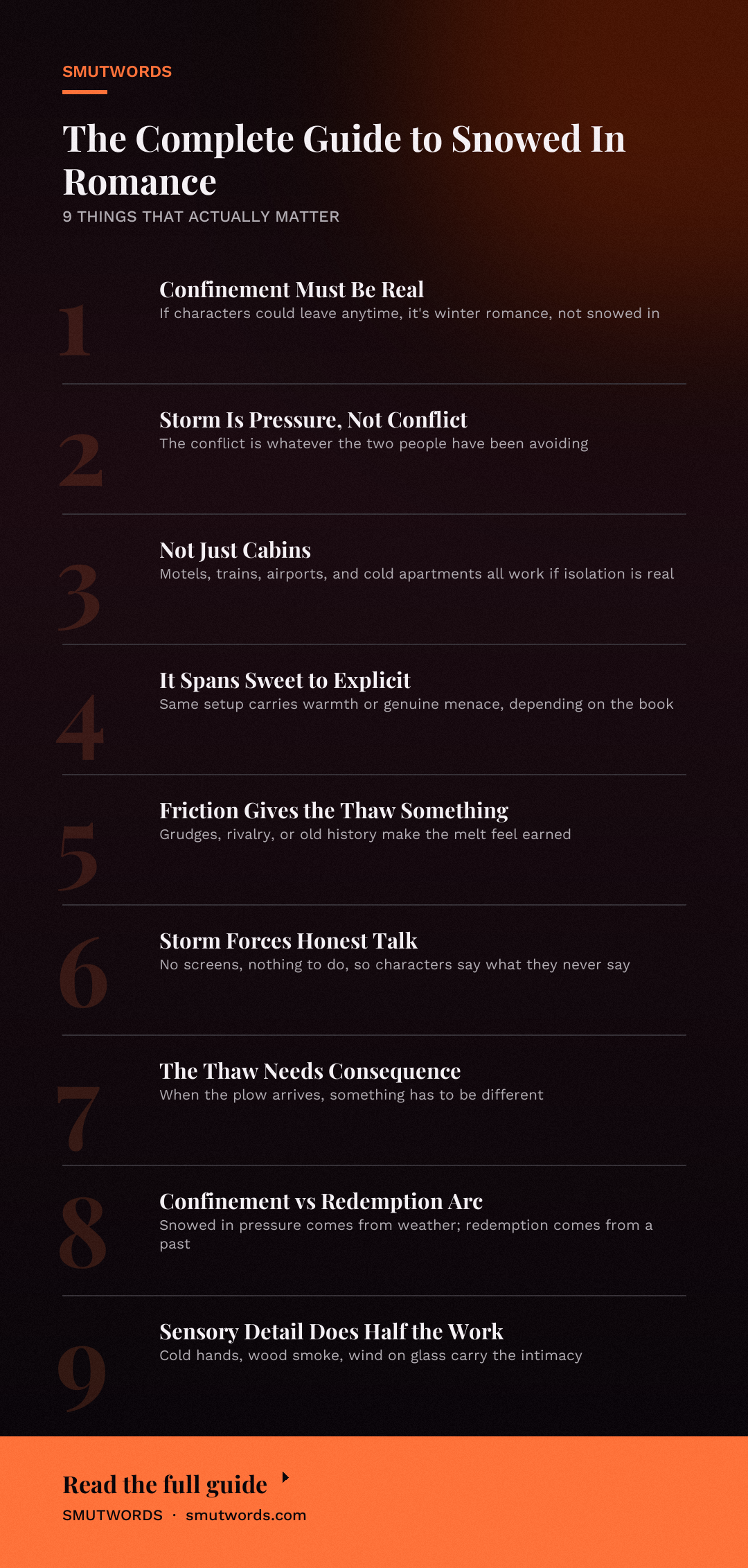
What doesn't count is a story where the snow is just atmosphere. If the characters could leave at any time and simply choose not to, you're reading a winter romance, not a snowed in one. The confinement has to be real, and it has to be imposed from outside.
A few common misconceptions worth clearing up:
- It requires a cabin. Cabins are the classic setting, but motels, trains, airports, bookshops, and apartments with dead heat all work. The requirement is isolation, not timber.
- It's always cozy and sweet. Plenty of snowed in romance is warm and low-angst, but the same setup carries genuine menace in darker books: no heat, no food, an injury, a stranger who isn't safe.
- The storm is the conflict. The storm is the pressure. The conflict is whatever these two people have been avoiding, which the confinement finally forces them to face.
- It only happens at Christmas. Holiday timing is common because the season sells, but January blizzards, Thanksgiving storms, and off-season mountain trips all qualify.
Where Snowed In Romance Comes From
The trapped-together plot is older than the genre itself. Victorian sensation fiction and gothic novels loved a snowbound manor, and the closed-circle mystery has used a storm to seal off a cast of suspects for well over a century. The romance version took that same machinery and aimed it at a single question: what happens when two people who want each other can't leave the room?
Category romance drove the trope into its modern shape. Through the 1980s and 1990s, winter-set titles from the big category lines ran on forced proximity constantly, because the format demanded fast, contained conflict and a storm delivers both for free. The Harlequin-style blizzard book became a recognizable slot on the publishing calendar, and it hasn't gone anywhere since.
The bigger shift came with indie publishing and the holiday reading boom. Once ebooks made seasonal novellas cheap to produce and easy to binge, the snowed in setup exploded into an entire sub-season of the genre. December releases now flood the market with cabin covers, and the trope has grown its own vocabulary: stranded at a cabin, blizzard hookup, snowbound with the grumpy hero, holiday cabin fever.
Two changes stand out in how the trope reads today compared to twenty years ago. First, the heat level has spread out. You'll find snowed in romance at every rating from sweet to explicit, and the spicier end has gotten much spicier.
Second, the storm has become less of a villain and more of a matchmaker. Older versions often used the blizzard for genuine peril. Contemporary books mostly use it as an excuse, a socially acceptable reason for two adults to share a bed. The danger is still there, but it's usually the setup for tenderness rather than trauma.
How It Shows Up in Erotica
On the page, snowed in romance runs on a tight sequence: the arrival, the realization that nobody is leaving, the first night, the escalation, the thaw. The best books know that sequence and play with the order.
The arrival does the heavy lifting. A strong opening puts the two characters together before the storm hits and gives them a reason to already be irritated, attracted, or both.
The road closes. The car won't start. The last room in town has one bed.
The pleasure here is inevitability, and good authors lean into it hard. Readers know what's coming, so the craft is in making the characters resist it in ways that feel real rather than contrived.
What makes a snowed in book work versus fall flat usually comes down to a few specific choices:
- Confinement anyone could undo. If the characters have a working car, cell service, and a stocked pantry, there's no pressure. Weak versions forget to actually trap anyone.
- Instant attraction with no friction. The best snowed in scenes need something to melt. Grudges, old history, a professional rivalry, or plain personality clash give the thaw something to do.
- Generic small talk instead of forced honesty. With nothing to do and no screens, characters should be talking about the things they never talk about. That's where the intimacy comes from.
- Weather that behaves like weather. Storms escalate, power goes out, pipes freeze, hypothermia is real. Specific physical detail sells the whole fantasy.
- A thaw with no consequence. When the plow arrives, something has to be different. Snowed in books that snap back to normal on the last page waste the setup.
Common variations authors reach for:
Stranded at a cabin. The flagship version. Usually a rental mix-up, a broken-down car, or a blizzard that closes the pass. Maximum isolation, minimum outside contact, and often a single bed.
Blizzard hookup. The short, hot version. Often a novella, often one night, often two strangers who never expect to see each other again. The emotional arc is compressed, so the physical one carries more weight.
Enjoyed this? Get a free book.
Join the list and we will send a complete free story straight to your inbox, plus new releases every week after that. No credit card, no catch.
Snowbound with the grumpy hero. The most popular character-driven variant. A hostile, tight-lipped man, usually a lumberjack romance type with an ax and a bad attitude, thawing by degrees under close quarters. The trope pairs naturally with hate to love because the storm gives both characters no exit from the friction.
Holiday cabin fever. The seasonal version, often built around a family gathering, a small-town Christmas, or a work trip gone wrong. Frequently blends snowed in with forbidden affair tropes, where the confinement makes an already off-limits attraction impossible to ignore.
Enemies in a stalled car. Less cozy, more claustrophobic. Two people who can't stand each other, one vehicle, a highway that isn't reopening until morning. This one runs hot fast and works beautifully at novella length.
Snowed in at work. A locked office, a shuttered hotel, a closing shift that turns into a sleepover. Popular in contemporary and in billionaire romance, where the boss and the employee have an obvious reason to be in the same building after hours.
What separates a strong version from a flat one is the honesty. A storm doesn't just keep people in a room. It strips the social armor off them. There's no meeting to get to, no one to perform for, no polite way to avoid the conversation.
The best snowed in books understand that the confinement is an excuse for confession. The characters say the thing they've been not saying for years, and then they act on it.
Pacing matters just as much. The thaw has to feel earned. Two characters who jump into bed on page ten and never talk about why it means anything give the reader a scene, not a story. The strongest books use the first night, or the first real conversation, as the pivot, then let the rest of the storm run on the consequences.
Sensory detail does more work here than in almost any other trope, because the setting is doing half the emotional labor. Cold hands, wood smoke, wet wool, a single blanket, the sound of wind against glass. Get that physical world right and the reader will feel the intimacy before either character admits to it.
Snowed In Romance vs Redemption Arc Romance
These two get confused because they often overlap in the same book, especially in the grumpy-hero version. The difference is what's doing the work.
A snowed in romance uses external confinement to force two people into emotional and physical closeness. The pressure comes from outside: the weather, the closed road, the one available bed. A redemption arc romance uses a character's past and the process of making amends to build the relationship. The pressure comes from within one character's history.
A book can absolutely be both. Plenty of snowed in stories strand a hero with a dark past in a cabin with the one person he wronged, and the storm becomes the space where the apology finally happens.
If you're trying to tell which one you're reading, ask what the central engine is. If the plot collapses the moment the snow melts, it's a snowed in romance. If the story would still stand with the two people in any other setting, the confinement is seasoning, and the redemption is the meal.
Frequently Asked Questions
What is a snowed in romance novel?
It's a romance where a winter storm forces two characters into sustained close quarters, and that confinement drives the relationship. The isolation removes outside distractions and creates a deadline, since the snow will eventually clear and normal life will resume.
Why is snowed in romance so popular?
The setup delivers instant tension without contrivance. Being trapped together is an external, believable reason for two people to share space, and the limited timeframe gives the relationship an urgency that slow-burn stories have to work much harder to build.
Is snowed in romance the same as forced proximity?
It's a specific type of it. Forced proximity covers any situation where characters are confined together, including broken elevators, road trips, and shared hotel rooms. Snowed in narrows that to winter storms and the isolation they create.
Does snowed in romance always involve a cabin?
No. Cabins are the most common setting, but stalled cars, motels, airports, offices, and apartments with no heat all work. What matters is that the two characters are genuinely stuck and genuinely alone.
What's the difference between a snowed in romance and a holiday romance?
Holiday romance is defined by the season and its traditions. Snowed in romance is defined by the confinement, and it can happen in November, January, or the middle of a summer storm on a mountain pass. Many books are both, but neither requires the other.
How spicy does snowed in romance usually get?
It spans the entire range. Sweet versions keep the focus on emotional intimacy and shared body heat. Explicit versions use the confinement and the single bed to move quickly into physical territory. The heat level tracks the imprint and the series rather than the trope itself.
Final Thoughts
Snowed in romance works because it removes everything except the two people who need to face each other. No commute, no group chat, no escape hatch. Just a door that won't open and a conversation that can't wait.
If you want to see the trope at full strength, look for a book that uses the storm to force honesty rather than just to force a bed-sharing scene. Then read it in one sitting on the coldest night of the year. The wind outside is a feature, not a bug.





Loading comments…