Dragon romance is the corner of fantasy romance where the love interest has scales, claws, wings, and often an entire mountain of gold he is not especially interested in sharing. The male lead is a dragon, or a being who shifts between dragon and man, and the story runs on heat, possession, and courtship conducted like a siege.
Readers come for the raw power and stay for the moment that power kneels. If you have ever finished a book and immediately searched for another with a possessive dragon hero, you already know the shape of the subgenre.
This guide covers what the term means, how it grew, what makes the good versions work, and where the whole thing tends to go wrong. Settle in.
What Dragon Romance Actually Means
At its core, dragon romance is a romance subgenre in which a dragon, usually capable of a humanoid or partially shifted form, is the male love interest. The dragon is the hero. The book is structured around his courtship and the heroine's response to it, with fantasy stakes layered on top of the central love story.
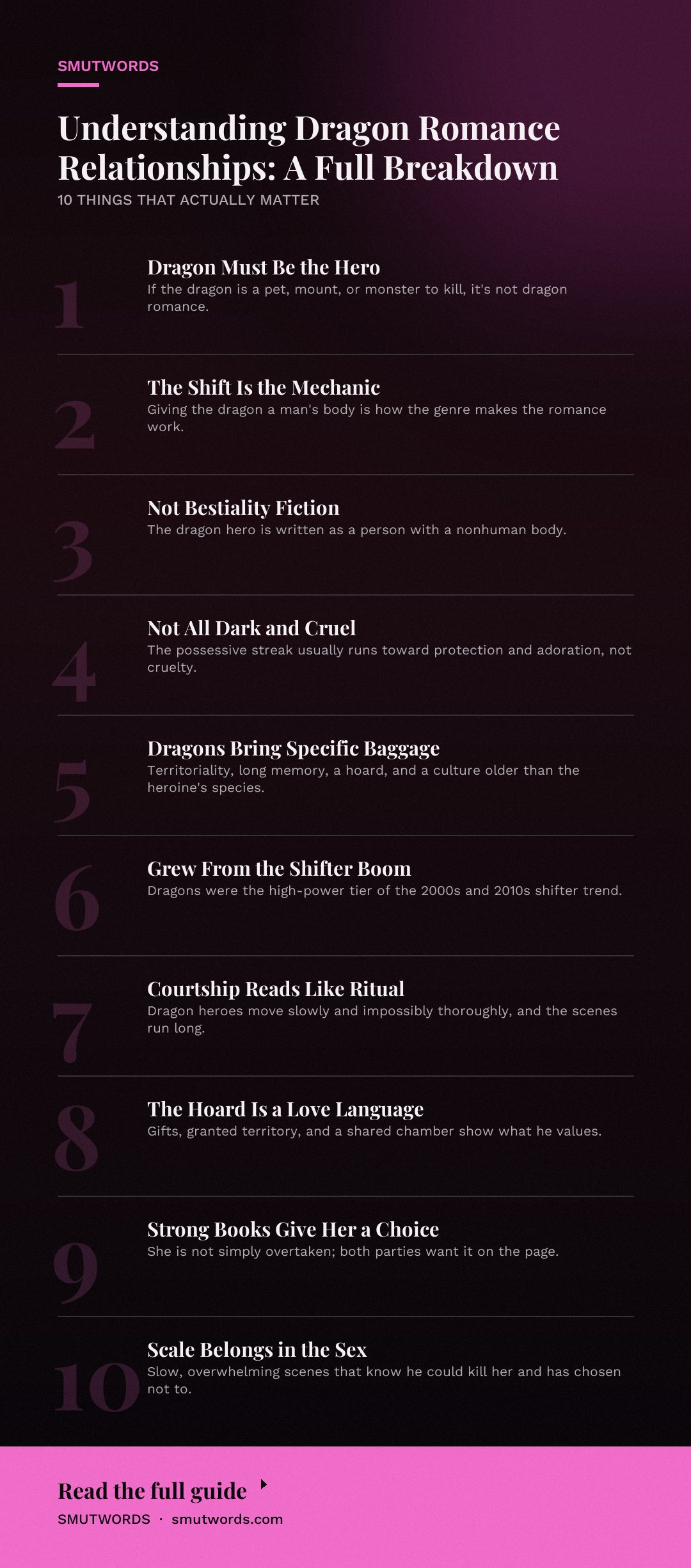
The shift is the defining mechanic. A dragon who stays a dragon for the whole book is a different kind of story, more mythic and often much harder to sustain as a romance. The genre solved this by giving the dragon a man's body when the plot needs one, keeping the beast as a constant threat or promise under the surface.
What counts as dragon romance is broad. Full shifters, half-dragon kings, dragon gods who take flesh, riders bonded to their dragons on a level that has nothing to do with reins. What does not count is a story where a dragon is a pet, a mount with no romantic role, or a monster the heroine is trying to kill. The dragon must be the love interest, not the obstacle.
Common misconceptions
The first is that dragon romance is bestiality fiction. In the vast majority of published work it is not. The dragon hero is written as a person with a nonhuman body, and the intimacy happens in a form the author has made compatible. The genre is clear about this and largely uninterested in arguing the point.
The second is that it is all dark. Plenty of dragon romance is a power fantasy with a devoted, openly affectionate hero who has a hoard and a soft spot. The possessive streak is real. It usually runs toward protection and adoration rather than cruelty.
The third is that the dragon is interchangeable with any monster hero. The dragon brings specific baggage: territoriality, a long memory, a hoard, and a culture that predates the heroine's entire species. Good dragon romance uses that baggage.
Where Dragon Romance Comes From
Dragons have been romantic-adjacent for a very long time. Smaug, Fafnir, and the rest of the Western canon made dragons into greedy, dangerous hoarders, which is exactly the raw material romance needed. The Eastern tradition of serpentine dragons as auspicious, wise, and powerful figures pushed the image further toward something a heroine could plausibly fall for.
The modern subgenre is younger than that inheritance suggests. Dragon shifter romance as a recognizable publishing category emerged alongside the broader shifter boom of the 2000s and 2010s, when wolf and bear shifters proved there was a market for heroes who were men with an animal inside. Dragons were the high-power tier of that trend, and they never really left.
The tone is what shifted. Early dragon romances leaned on the beast as a threat, with the heroine taming a dangerous creature. Later books moved toward a hero who is powerful, intelligent, and often very old, with the conflict coming from politics, fated bonds, or the dragon's inability to express affection like a human.
The rider trope is a more recent force in the category. Once fantasy romance readers were comfortable with a dragon as a partner, authors started exploring bonds between riders and dragons. That opened space for more than one romantic configuration, and for stories where the dragon's loyalty to a rider competes with his loyalty to the heroine.
How the genre's publishing history shaped it
Because the subgenre grew out of indie and digital-first publishing, it has always been unusually willing to go explicit and unusually fast to series. A dragon romance that sells well gets six sequels about the brothers, the other dragon kings, or the rest of the hoard. That structure is baked into how readers now consume the category.
The fated mates convention came along with it. It is the genre's answer to a recurring problem: how do you get a very old, very powerful being to commit to a woman he has known for a week? You tell him the universe already decided. That answer is either a selling point or a hard limit, depending on the reader, and we cover both below.
How It Shows Up in Erotica
On the page, dragon romance does a few specific things well. The most reliable is extended, deliberate courtship. A dragon hero tends to move slowly and impossibly thoroughly, which produces scenes that read like a ritual and often run for twenty pages. The hoard becomes a love language: gifts, territory granted, a chamber lined with everything he owns and now shares.
The dragon romance scene that works best uses the shift as a lever. The heroine is attracted to both forms, and the book lets her want both, sometimes in the same night. The tension between the man and the beast is the engine, and a writer who understands that builds the whole climax around it.
The kink layers vary widely. Dominant dragon heroes are common, and the dynamic is often negotiated, where an extremely old being with no prior interest in human consent learns to ask. That arc, from "I take what is mine" to "tell me what you want," is one of the most satisfying things the subgenre offers.
Readers curious about the wider dominant and submissive frameworks these heroes operate in can find a useful starting point in our guide to figuring out which role fits you.
Enjoyed this? Get a free book.
Join the list and we will send a complete free story straight to your inbox, plus new releases every week after that. No credit card, no catch.
Common variations
- Dragon shifter romance: The hero moves between dragon and human forms at will. The shift itself is the central image and the source of most of the heat.
- Dragon rider romance: A human (or elf, or fae) is bonded to a dragon, and the bond carries a romantic or erotic charge that neither party fully controls.
- Dragon king romance: Political fantasy meets romance. The hero rules a kingdom or a whole court of dragons and has to reconcile his mate with his throne.
- Hoard romance: The hoard is foregrounded. What he owns, what he keeps, what he refuses to give away, and what it means when he gives the heroine the run of the place.
- Fated mates with dragon: The universe has already decided. The couple must accept or navigate a bond that is not up for negotiation.
- Dragon god romance: A mythic, god-tier being takes a mortal partner. Stakes are enormous and the courtship is often ancient and strange.
What separates a strong one from a flat one
A strong dragon romance gives the dragon a real reason to be the way he is. His possessiveness comes from something specific: a hoard he has guarded for centuries, a predecessor who lost everything, a curse that turned him. A flat one just gives the hero an attitude and a set of scales.
Strong books also put the heroine in a real position of choice. She is not simply overtaken. The romance is convincing because both parties want it and neither is reduced to a pawn of the mating bond.
The subgenre is often compared to the mechanics of Alpha/Beta/Omega dynamics because both depend on a bond that supersedes ordinary consent. The best dragon books handle that tension on the page rather than pretending it away.
Intimacy needs scale. A dragon has a bigger body, an older frame of reference, and no instinct for human pacing. Sex scenes that work lean into that scale: slow, overwhelming, and always aware that the person on top could kill the person underneath and has chosen not to.
Finally, the good ones use the hoard. A dragon who owns nothing, cares about nothing, and has no territory is just a man with a transformation problem. The hoard gives him psychology, and being offered a place in it is a real gift on the page.
Avoiding the weak versions
Three problems stack up in the flat versions of the subgenre. The dragon has no personality beyond growl and claim. The heroine's only function is to be claimed. The world is sketched but not built, so the dragon's ancient politics or his court amount to a name and a throne.
If you are reading to find the good stuff, look for a dragon with a culture behind him, a heroine with her own stake in the story, and sex that respects the scale. If you are writing, treat the hoard, the shift, and the courtship as three separate tools and use all of them.
Frequently Asked Questions
Is dragon romance the same as monster romance?
It overlaps, but it is its own lane. Monster romance is a wider umbrella covering minotaurs, orcs, kraken, and everything else with a nonhuman hero. Dragon romance is that, narrowed to dragons specifically and usually with the shifter mechanic intact.
Do I need to read dragon romance in series order?
Sometimes. Many dragon romance series function as connected standalones, each book about a different dragon, so you can start anywhere. A few long-running series build a war or a dynastic plot across every book, and those are best read in order.
Is dragon romance always explicit?
No. The category runs from closed-door fantasy romance through to very explicit work. If heat level matters to you, look at the publisher and at reader reviews rather than the cover, which can be ambiguous.
What is a fated mates dragon romance?
It is a dragon romance where the couple is tied together by an involuntary bond, often magical or biological. The dragon recognizes the heroine as his mate, sometimes immediately, and the plot turns on how she responds and whether she chooses him back.
Are dragon riders always romantic with their dragons?
No. Rider bonds can be platonic, familial, or companionate, and the romance can run between the rider and another human instead. When the bond does carry romance, the book usually treats it as a serious, mutual intimacy rather than a side detail.
Can I read dragon romance if I usually read other fantasy romance?
Yes, and the transition is easy. If you like fae romance or elf romance, you will recognize the machinery: an old, powerful, nonhuman hero, a mortal heroine, and a political world that reacts to their match. Dragon romance just turns the heat and the danger up.
Readers who like their power dynamics negotiated on the page might also get something out of our guide to RACK, which lays out the consent frameworks a lot of these heroes are stumbling toward.
Where do I start if I want a lighter dragon romance?
Look for books described as sweet or steamy rather than dark, and check whether the hero is a shifter to begin with. A dragon king with a bad reputation and a war to run is a different reading experience from a curious dragon who has just discovered he likes one particular human.
Final Thoughts
Dragon romance works because it takes the oldest, most intimidating figure in fantasy and hands him a weakness that is specific and a little embarrassing: one woman who makes the hoard irrelevant.
The subgenre is enormous, and the difference between a forgettable one and one you reread every year comes down to whether the dragon feels like a person with a history. Start with a dragon king book from a long-running series, where the hero has a court to answer to and centuries of attitude to get over. See if it grabs you the way it grabbed the rest of us.




Loading comments…