
Wax play is a kink built on heat, anticipation, and a slow, deliberate drip. A candle is held above bare skin, tipped just enough to release a run of warm wax, and the person underneath feels that first shock of temperature land somewhere they can't predict.
It belongs to the wider family of temperature play and sensation play. In erotica it shows up as a trust ritual, a form of marking, and one of the most visually intimate acts a scene can contain. The appeal isn't the sting of heat alone. It's the control, the ceremony, and that split-second where a bottom has to decide to hold still.
This is the full breakdown: where the term came from, how the kink works on the page, what separates a strong wax play scene from a lazy one, and the safety rules that keep it from being something you'd only ever see in fiction.
What Wax Play Actually Means
Wax play (sometimes called candle dripping, hot wax play, or just candle play) is the practice of deliberately dripping melted wax onto a partner's skin, or having it dripped onto your own. The wax arrives hot but not scalding, cools quickly on contact, and leaves a hard shell that has to be peeled, cracked, or scraped away. Every stage of that process is part of the kink.
The heat is the headline. A drip of wax hits skin at a temperature that registers as a sharp, bright sensation, close to pain but usually just short of it. Then it cools, and the contrast between the burn and the settling warmth is what most people describe as the actual pleasure.
The removal is the third act, and for a lot of readers it's the best part: fingertips peeling wax off a shoulder blade, a dull scrape of a fingernail, the slow reveal of skin that's been hidden.
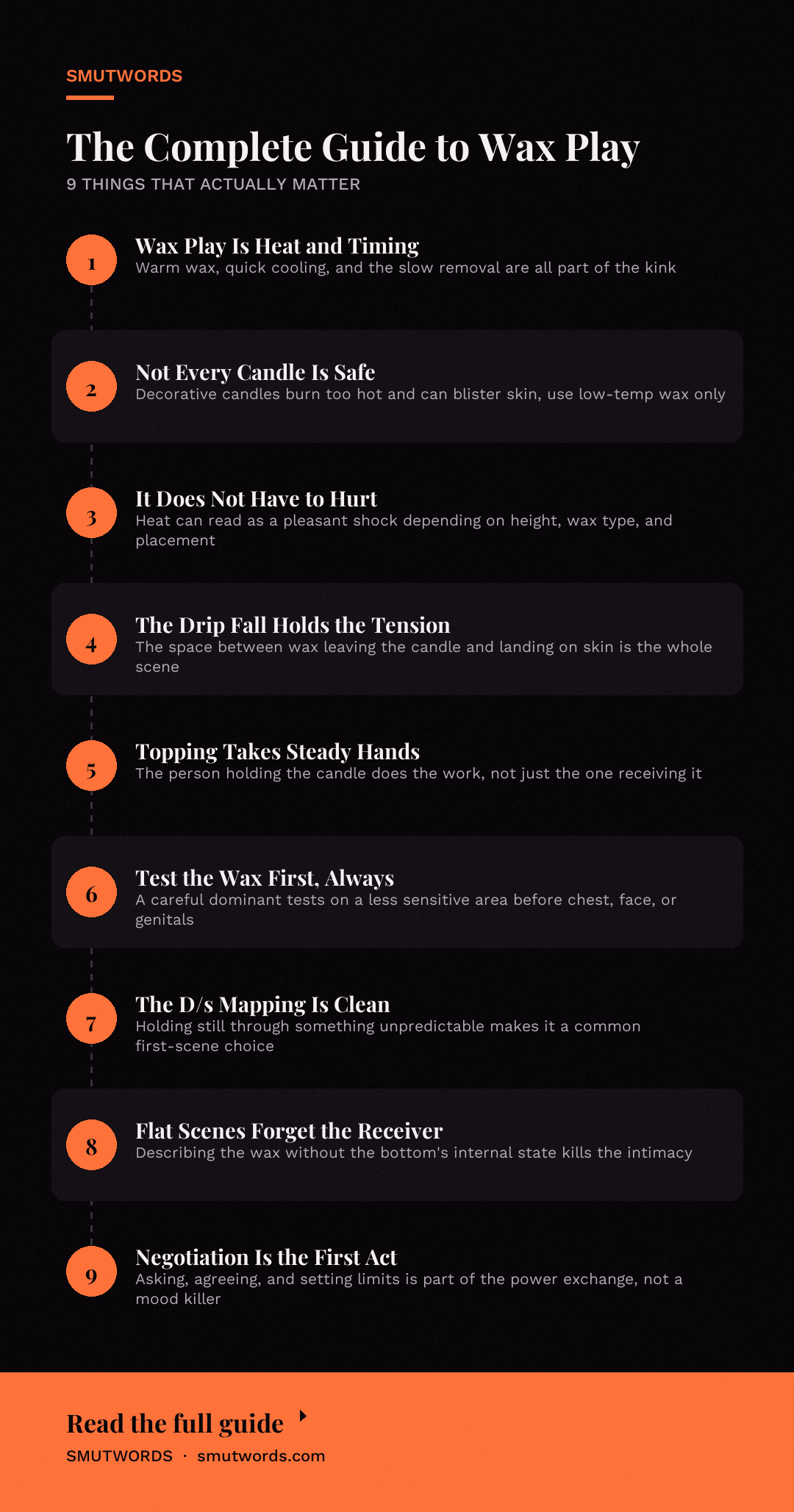
What doesn't count as wax play matters too. A candle from a discount store, a scented pillar candle from a gift shop, a beeswax taper, or anything marketed purely for home decor is not body-safe wax. Those burn hotter and can genuinely blister skin. Paraffin or soy blends formulated for low-temperature melting are the standard, and the term "massage candle" usually points to exactly that product.
It also isn't the same thing as a fire kink or a branding kink, even though the three get grouped together by people who haven't read much about any of them. Wax play is about temperature and texture. The flame never touches skin, and the wax itself is meant to be tolerable, not damaging.
Common misconceptions
- That it has to hurt. Plenty of wax play scenes are almost entirely sensory. The heat can read as a pleasant shock rather than pain, depending on candle type, drip height, and where the wax lands.
- That any candle works. This is the misconception that sends people to urgent care. Low melting point is the whole point.
- That it's always a big scene. Wax play works as a five-minute add-on in the middle of something else, and it works as an hour-long ritual with a full setup.
- That it's purely a submissive act. The person holding the candle is doing the work. Topping wax play requires steady hands, patience, and constant attention to the bottom's reactions.
Where Wax Play Comes From
Wax play as a named kink is relatively modern, but the ingredients are old. Candlelight has been part of seduction writing for as long as there's been writing about seduction. The candle as a symbol of slow-burning desire, of waiting, of a flame someone else controls, predates any organized kink vocabulary by centuries.
The term itself emerged from the BDSM and sensation play communities in the late twentieth century, alongside the broader naming of temperature play as a category. Early coverage treated it as an edge practice, something you read about in a manual rather than a mainstream romance. The kits were homemade. The safety information was passed person to person.
Two things changed that. First, the commercial arrival of low-temperature massage candles in the 2000s, which turned wax play from a DIY project into something you could buy at a spa counter. Second, the rise of online kink communities and later BookTok, which pulled sensation play out of the manual and into the romance novel.
In contemporary erotica, wax play has settled into a specific niche. It rarely headlines a book. It shows up as a scene inside a larger power exchange, often a first scene or an early trust test, because it does something very useful for a writer: it's an intense physical experience that requires almost no equipment and produces a visible, trackable reaction on the page. That economy is why it keeps appearing.
How It Shows Up in Erotica
Wax play scenes are built on slowness. The candle has to be lit, held, tipped. The wax has to travel. The bottom has to wait through the fall.
That interval between the drip leaving the candle and the drip landing on skin is where all the tension lives, and the best writers stretch it on purpose.
Compare that to something like rough sex, which tends to be written in short, clipped sentences and abrupt movement. Wax play runs on the opposite rhythm: long observation, held breath, a single action per paragraph. When a scene like this is rushed, the whole point evaporates.
The variations you see most
- The first-scene test. A dominant uses wax to establish that they'll push and the submissive will hold. Frequently the submissive's first real submission in the book.
- The marking scene. The wax itself becomes the point: a stripe across the chest, a circle over the heart, a pattern laid down like a claim. Strong overlap with ownership and possession themes.
- The sensory overload scene. Wax combines with ice, blindfolds, or restraints, and the bottom loses track of what's coming next.
- The punishment scene. Wax as a consequence or correction, usually in a longer power-exchange arc. This version leans heavily on the fear before the drip rather than the drip itself.
- The soft version. Massage candle, warm oil, no power exchange at all. Just two people and a lot of skin. This is the variant that shows up in contemporary romance more than in kink-specific erotica.
- The power-exchange pressure scene. One partner is restrained and can't see the candle, so every drip lands as a surprise. Frequently written with a degradation kink thread running underneath, if the dominant is also talking.
- The marked-and-watched version. A third party observes, and the wax becomes a display. This pairs naturally with a voyeur husband trope setup.
There's also a version that leans into praise rather than punishment, where every drip comes with low, steady reassurance and the bottom glows under it. That register works because praise kink and pain-adjacent sensation aren't opposites; they're both about attention being poured onto one person at close range.
What makes a wax play scene work
The strong scenes do three things at once. They stay specific about the physical sensation. They stay specific about the bottom's internal state. And they let the dominant's hands do the characterization.
Specificity is the difference between a scene that lands and one that reads like a checklist. "Drops of hot wax" is nothing. "A bead of green wax landing just below the collarbone, beading for half a second before it set" is a moment. The color of the wax, the smell of it, the sound it makes when it hits a saucer during the temperature check, the way the hardened edge catches light: all of it builds the scene.
Internal state is what makes it intimate instead of just procedural. A bottom who is terrified of the next drip and also doesn't want it to stop is a much more interesting head to be inside than one who is simply enduring something. The tension between dread and anticipation is the engine of this kink on the page.
The dominant's hands carry the character work. Steady hands mean patience and control. Impatient hands mean something riskier is being written. Hands that shake mean the dominant is the one who's affected, which is a move a lot of writers deploy to show a character losing composure without saying it.
Flat versions make two mistakes. They describe the wax and forget the person receiving it. Or they skip the setup entirely and jump to the payoff, which strips out the entire suspense structure the kink depends on.
Enjoyed this? Get a free book.
Join the list and we will send a complete free story straight to your inbox, plus new releases every week after that. No credit card, no catch.
Where it overlaps with other kinks
Wax play shows up in the same books as restraint, sensation play, and impact play, and it intersects constantly with use kink, where the whole point is being the object of someone's attention and intention. The bottom isn't just feeling heat. They're being used as a surface, and that's the fantasy for a lot of readers.
There's also a real thread connecting it to the more instinctual, less scripted end of the kink spectrum. A wax scene with a partner who reads reactions by feel, who adjusts height and spacing based on nothing but breathing, has the same logic as feral play: attention so total that words stop being necessary.
The practical detail readers always ask about
Here's the version that appears in advice threads constantly, and it belongs in the fiction too: temperature testing. Any competent dominant in a well-researched scene tests the wax on a less sensitive area before going anywhere near the chest, face, or genitals.
That test is a great piece of characterization. A character who does it is careful. A character who skips it is being written as reckless on purpose, and the reader should notice.
Sensitive areas are the standard caution: inner thigh, breasts, genitals, the face, and any skin that's recently been shaved, sunburned, or broken. Wax on broken skin is a bad idea in fiction and in life.
Cool water or a cool compress nearby is the standard burn kit, and cold water is also the removal tool of choice when wax has cooled onto hair. Ripping a hardened patch off a hairy chest is a real thing that happens and a real thing writers forget about.
Which brings up the other thing that shows up in almost every scene: negotiation. Even a very short scene has some version of someone asking, agreeing, and setting a limit.
If you want a full breakdown of that conversation, there's a good one in How to Tell Your Partner About a Kink Without Making It Weird, and the same beats translate directly into a scene on the page. The negotiation is not a mood killer in good erotica. It's the first act of the power exchange.
Wax Play vs Rough Sex
The comparison readers ask about most is the one between wax play and rough sex, and the honest answer is that they sit at opposite ends of the same spectrum. Both involve deliberately causing sensation that a partner has agreed to. Both require the receiver to trust the person doing it.
The difference is tempo and where the intensity lives. Rough sex is fast and continuous; the intensity comes from momentum and force.
Wax play is slow and intermittent; the intensity comes from waiting and from the concentration of heat in a single point. A scene can carry both, and often does, but a writer who treats them as interchangeable will get the pacing wrong. Sitting still through a drip is a very different experience than being taken hard, and the prose should feel different too.
Frequently Asked Questions
Is wax play dangerous?
It can be if the wrong candle is used. Standard decorative candles burn far hotter than skin can safely take and can cause real burns. Body-safe low-temperature massage candles, a test drip on the forearm or inner wrist, and a cool compress nearby reduce the risk to something comparable to other sensation play. Never use wax on broken, sunburned, or freshly shaved skin.
What kind of candle do you use for wax play?
Low melting point paraffin or soy wax, sold specifically as massage candles or body-safe wax. Avoid beeswax, pillar candles, and anything with heavy fragrance oils, which can irritate skin. Many kink suppliers sell wax in blocks you melt yourself if you want control over the exact temperature.
Does wax play hurt?
It registers as a sharp sensation, closer to a snap than a sustained burn, and it fades within seconds as the wax cools. Whether it reads as pain or pleasure depends on drip height, candle type, and where the wax lands. Wrists, back, and stomach are common starting points; inner thigh, breasts, and genitals are more intense.
How does wax play fit into a D/s dynamic?
It maps onto submission very cleanly because it asks the bottom to hold still through something they can't fully predict. The dominant controls timing, placement, and pressure. That structure makes wax play a common choice for a first real scene in a power-exchange story, since it establishes trust without requiring restraint or impact.
Can wax play be part of a scene with other kinks?
Yes, and it usually is. It pairs naturally with blindfolds, restraint, ice, and temperature play generally, and it layers well with verbal kinks like praise or degradation. The main constraint is pacing: whatever else is happening needs to slow down enough to let the drips land.
What should be in a wax play burn kit?
Cool water or a cool compress, a soft towel, and mild unscented lotion for aftercare once the wax is off. Never use ice directly on skin that's just taken hot wax, and don't apply anything with fragrance or alcohol to freshly treated skin. If a burn blisters, that's a medical issue, not a scene detail.
Final Thoughts
Wax play is one of the few kinks where the equipment is a candle and the entire scene is timing. That's exactly why it works in erotica. Nothing else forces a writer to slow down, to sit in the space between action and reaction, and to make a reader feel a single drop of heat land.
If you want a book that treats sensation play with the patience it deserves, look at the ranked list below and start with the first one that has candle wax anywhere in its first three chapters. You'll know within a page whether the author understood the assignment.








Loading comments…