
Most people who have a kink they've never said out loud have rehearsed the conversation a dozen times in the shower and chickened out in the kitchen. That's normal. The gap between wanting to tell your partner and actually telling them is where this whole thing lives, and the trick isn't confidence.
It's preparation. Knowing how to tell your partner about a kink comes down to three things: picking the right moment, using words that don't make either of you defensive, and being ready for a "huh?" before you get to a "yes."
Nobody's asking you to hand over a printed syllabus. You're opening a door, not delivering a TED talk. But the way you open it changes everything about what's on the other side.
Why the Conversation Feels So Much Bigger Than It Is
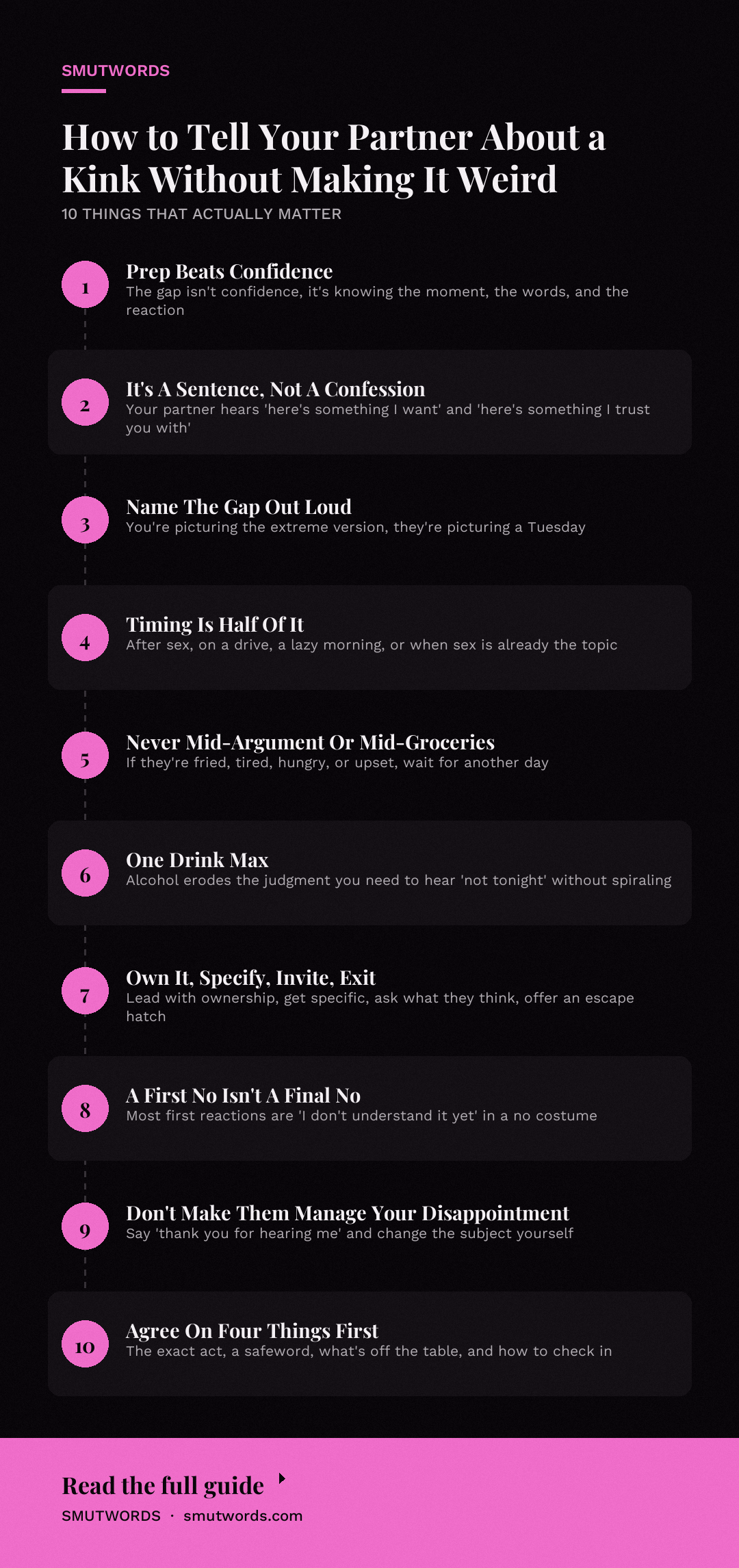
A kink you've been sitting on for years feels enormous from the inside. From the outside, it's a sentence. Your partner mostly hears "here's something I want" and "here's something I trust you with." The fear is usually about rejection of the whole self, not just the specific act. That's why people stall.
There's also the catalogue problem. If your kink has a name, your brain immediately jumps to the porn version, the extremes, the stuff in the darkest corner of the tags. You're picturing the full production. Your partner, hearing it for the first time, is picturing a Tuesday.
Name the gap out loud when you bring it up. "I've been reading about this and I don't want to do the extreme version, I want to try [specific small thing]" lands differently than a vague announcement. Specificity defuses the dread.
Watching kinks on the page first
Fiction is a low-stakes way to test the temperature before you ever say the words. If you've been circling something like mummification or enemies to lovers energy and wondering if it's just you, reading it in a story tells you a lot about what you actually want versus what you just find hot in theory.
Our Breeding Kink 101 walks through a whole category of exactly this. A book can be the rehearsal, so the real conversation goes smoother.
When to Bring It Up (Timing Is Half of It)
There are four moments that work, and one that never does.
- After sex, in the drift. Both of you are relaxed, oxytocin is doing its thing, and honesty comes easier. "Hey, something I've been curious about..." lands beautifully here.
- On a walk or a drive. Side by side, no eye contact, no pressure. Some people can say hard things to a windshield that they can't say to a face. Use that.
- During a lazy weekend morning. Nowhere to be, coffee in hand. Low stakes, no clock running.
- When you're already talking about sex in general. If the conversation is already in the neighborhood, keep walking. Don't change the subject to get there.
The moment that never works: mid-argument, right after a rejection, or the second they walk in the door from work with a bag of groceries in each hand. Read the room. If your partner is fried, tired, hungry, or upset, wait. A kink conversation deserves the same courtesy as any other serious talk.
The alcohol question
A drink can loosen the tongue, but it also erodes the exact thing you need most here: judgment and the ability to hear "not tonight" without spiraling. One glass, maybe. Three, no. You want to remember what they said and how they said it.
How to Actually Say It: Scripts That Don't Sound Like a Confession
You don't need a perfect line. You need a shape. The shape that works is: ownership, specificity, invitation, and an escape hatch for both of you. Here's what that looks like.
The opener
Lead with ownership so it doesn't feel like an accusation or a test. "I've been thinking about something and I want to tell you, and I'm a little nervous about it." That one sentence does a lot. It signals vulnerability, it gives them a heads-up that this is real, and it earns you a few seconds of grace.
The body
Then be specific and low-pressure. "I've been into the idea of [X]. I don't know if I'd actually want to do it, but I like thinking about it, and I wanted you to know."
Notice the honesty about the uncertainty. You're not demanding anything. You're sharing a corner of your head.
The invitation
Ask them what they think, and mean it. "Does that sound like anything to you, or does it sound like a lot?" Give them room to have their own reaction. This isn't a negotiation you win; it's a two-way door.
The escape hatch
End with something that takes the pressure off. "You don't have to answer right now. I just wanted to say it out loud to you instead of keeping it in my head." That last bit matters. People who feel cornered defend; people who feel free actually think about it later.
If it helps to anchor it to something concrete, you can point at the source. "I was reading this book, Free Use Hotel: One Woman, Unlimited Access, and it got me thinking about something I'd never told you." Letting a story do the opening work is legit. It gives you a shared object to talk about instead of putting your whole self on the table at once.
What to Do If They're Hesitant
A first no is not a final no. Most first reactions are actually "I don't understand it yet," wearing the costume of "no." Distinguish the two before you react.
- "Not for me, but I'm glad you told me." This is the healthy version of a no. Accept it, thank them, don't sulk. You've still moved closer.
- "Tell me more about what you actually want." Curiosity, not consent. Answer honestly, keep the pressure off.
- "I don't get it." Confusion, not rejection. This one just needs more information.
- "That's a hard no and I'd rather not hear about it again." Respect it completely. If the kink is non-negotiable for you, that's a bigger conversation about the relationship, but the answer right now is respect.
The single most important move after a hesitant reaction is to not make them manage your disappointment. Your face drops, your voice gets tight, and suddenly they're the bad guy for having a boundary. Don't do that to someone you love. Say "thank you for hearing me" and change the subject yourself.
When it's a yes, slow down
A yes is the beginning, not the finish line. The people who blow up a good thing usually do it by treating a green light as a floor to sprint across. Don't.
Go in stages. Try the mildest version first, check in during and after, and figure out what actually felt good versus what was hot in theory.
Enjoyed this? Get a free book.
Join the list and we will send a complete free story straight to your inbox, plus new releases every week after that. No credit card, no catch.
This is where a lot of couples discover the difference between fantasy and reality. Something like Absolute Surrender reads scorching, and that energy is real, but the lived version needs structure.
Mood, position, timing, the ordinary logistics of bodies. Give yourself room to find out it's not what you imagined. That's information, not failure.
The Boundaries Part, Which Is Not a Disclaimer
Here's where the conversation has to get concrete, and it's the part people skip because it feels like paperwork. It isn't. It's how you get to be wild without anything going wrong, and it's what makes the difference between a fun experiment and someone getting hurt or freaked out.
Before you try anything, agree on four things, out loud, in plain language.
- What exactly you're doing. Not the vibe, the act. "Hands tied in front, no blindfold" is a plan. "Some bondage" is not.
- A safeword. Pick a word that has no place in the bedroom and can't be misheard. "No" and "stop" mean keep going in some scenes, which is exactly why you need a different word that always means all the way off. Both of you get to use it.
- What's off the table. The things that don't get touched even if the moment gets hot. Say them now, not when you're in it.
- How to check in. A quick "color?" and "green" is all it takes. Green is good, yellow is slow down, red is stop everything. One word each, no confusion.
Some things carry genuine risk and you shouldn't improvise them. Anything that restricts breathing, including hands on the throat, is dangerous even between experienced people, and there's no safe way to do it casually.
Heavy restraint where you can't get out, suspension, anything that could cut off circulation, all of that is advanced and high-risk. If a fantasy turns you on, keep it on the page or talk about it in bed without doing it. That's how people who know what they're doing stay in the game.
If you like the dynamic of being told what to do, She Made the First Move: A Dominant Wife Awakening is a good thing to read together. It's a way to point at a fantasy without having to narrate it yourself, and it gives your partner a picture of what you're actually craving.
Reading the Room So You Don't Have to Guess
Communication isn't just the talk before. It's an ongoing thing. Couples who do this well check in mid-scene with a single word, and they debrief after.
Not in a clinical way, just a "how was that for you?" over water and snacks. That aftercare conversation is where you find out what to keep and what to never do again.
Pay attention to the non-verbal stuff too. If your partner says the words right but their body has gone tense and quiet, that's a yellow at minimum. Stop and ask. You'd rather over-check than miss something.
When to bring fiction into it
Shared reading is one of the best underrated tools for this. Reading the same book gives you a low-pressure way to point at exactly the trope, dynamic, or scene that lights you up. Something like The Crimson Breeding Order: An Alien Breeding Ritual Romance gives you language for a fantasy that's hard to describe in your own words.
Or something like Tested by the Tech Alpha, where the dynamic of being chosen and pushed is the whole point. You can say "that part, right there, that's the thing I've been trying to explain" and point at a page. Easier than doing it from scratch.
A lot of people also find that a specific fetish has a name and a whole community around it, and knowing that a name exists makes the conversation with a partner less "here's my secret shame" and more "here's a thing that exists."
If you're into the texture and ritual of what someone wears, our breakdown of lingerie fetish is a good place to get the vocabulary straight. Same with the pull of a partner being wanted by other people, which our article on possessive sex covers from the reader side. Having words for it changes how you both hear it.
Common Fears, Answered Honestly
"What if they think I'm a freak?" A kink is a preference. People have them about food, sleep, music, and how they orgasm. Your partner has at least one thing in their head they've never told you either. Guaranteed.
"What if they tell someone?" That's a trust question, not a kink question. If you genuinely think your partner would use it against you, the problem is the relationship, and no framing fixes that.
"What if they say yes but I hate it in real life?" Then you stop, laugh about it, and add it to the "liked the idea" pile. That pile is normal. Fantasy and reality overlap a lot but not perfectly, and figuring out the difference is the whole point of trying.
"What if bringing it up ruins the vibe?" It won't, if you don't make it a crisis. A relaxed "there's something I've been thinking about" doesn't ruin anything unless one of you turns it into a referendum on the relationship.
Final Thoughts
Start with one small, specific thing, in a moment when neither of you is tired or hungry or already fighting. Say it as an offer, not a test. Keep a safeword in your back pocket even when you're just talking, because the habit is what makes the real thing safe later.
If you want a book to read together as a warm-up, grab The Breeding Spiral: Captured in the Tentacle Alien Incubation Chamber and let the story start the conversation you've been avoiding. You don't have to have it perfectly scripted. You just have to say it out loud.








Loading comments…