In a wingman romance, the hero's best friend, the heroine's closest confidante, or even a meddling sibling serves as the tactical and emotional architect of the central love story. This trope puts a dedicated ally in one protagonist's corner. Someone who nudges, schemes, and occasionally shoves the lovers together until they admit what everyone else already sees.
The wingman romance is a crowd-pleaser because it adds a second voice rooting for the couple. That creates scenes of comic interference, awkward public setups, and the particular tension of a third party who knows the protagonist's secrets before the love interest does. It is the narrative engine for stories about shy characters, oblivious workaholics, and anyone who needs a push past their own fear.
What Wingman Romance Actually Means
A wingman romance is a story structured so that a secondary character actively works to facilitate the romantic relationship between the two leads. The wingman can be the hero's best friend, the heroine's sister, a coworker, or even a surprisingly perceptive bartender. But the role is consistent: this character engineers opportunities, delivers pep talks, and often delivers the crucial line that makes the protagonist realize their own feelings.
The term borrows from real-world dating culture, where a wingman accompanies a friend to a bar or party to help them attract a partner. In fiction, that same concept expands beyond the initial approach. The wingman in a novel might arrange a double date where the real couple gets accidentally paired. They might fake a work emergency so the heroine has to call the hero for help, or simply refuse to let the protagonist bail on a planned outing.
The scope is larger in fiction, but the function remains identical: strategic assistance in the game of love.
What does not count as a wingman romance is any story where the secondary character is merely present during the meet-cute. A friend who happens to be in the same room when the lovers first lock eyes is not a wingman. The title requires active, deliberate interference with romantic results as the stated goal.
The wingman should have scenes of their own where they strategize, question the protagonist's excuses, and express investment in the outcome. Without that agency, you have a bystander, not a wingman.
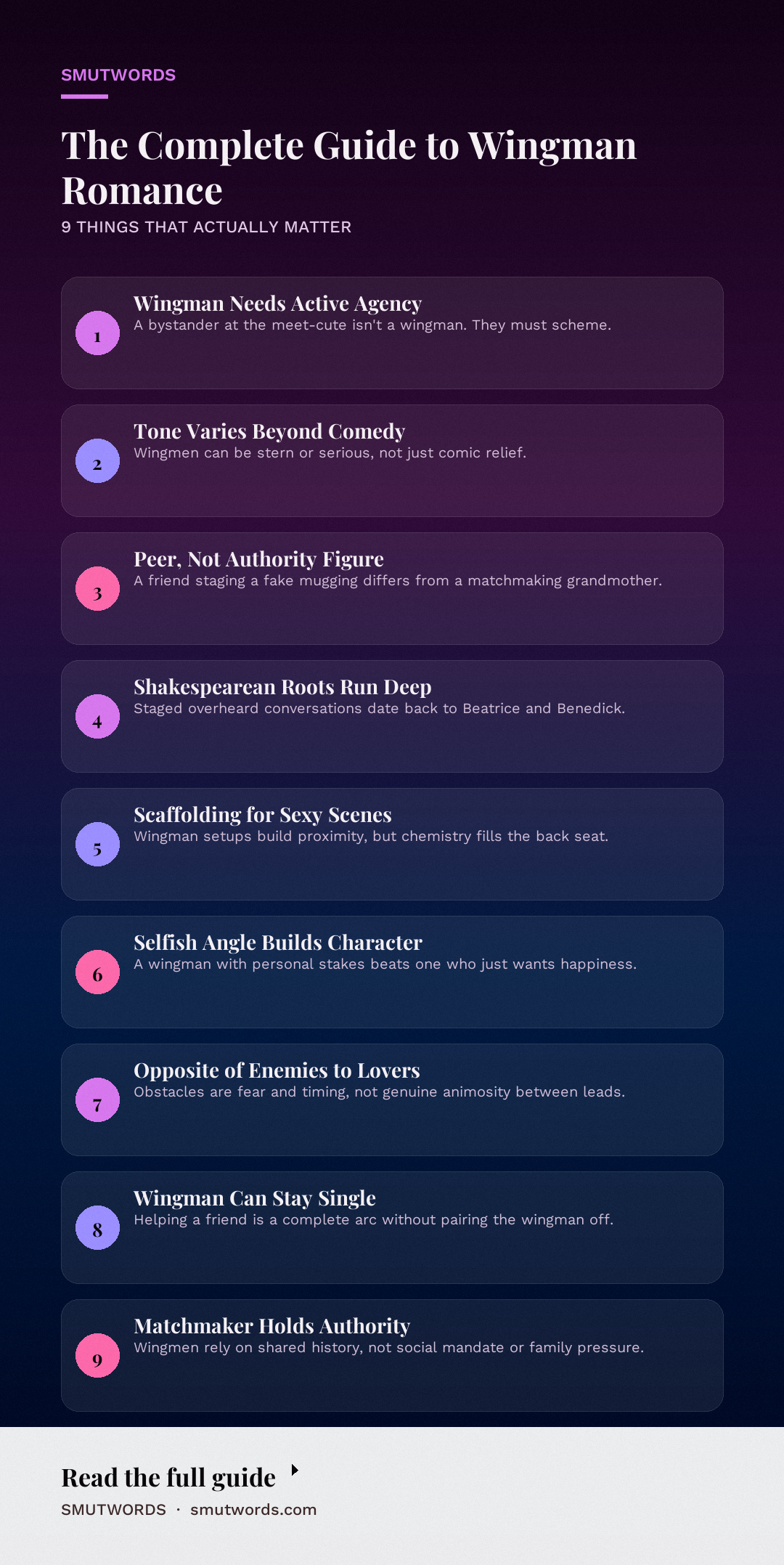
Common misconceptions about the trope include the idea that the wingman must be comic relief. While humor is a frequent byproduct of the setup, strong wingman characters can be serious, even stern.
A military buddy who tells the hero to stop being a coward is a wingman. A best friend who delivers a tearful ultimatum about the heroine's self-sabotage is also a wingman. The trope is defined by function, not tone.
Another misconception is that the wingman always wants the protagonist for themselves. Unrequited love from the wingman is a variant, but it is not the default, and it shifts the story toward a love triangle rather than a pure wingman romance.
The wingman also differs from the matchmaker in that they are usually a peer rather than an authority figure. A grandmother who sets up her grandson is a matchmaker. A best friend who stages a fake mugging so the hero can rescue the heroine is a wingman.
The distinction matters for power dynamics and for the kind of dialogue the story can produce. Peers can be brutally honest in ways that elders usually are not.
Where Wingman Romance Comes From
The wingman romance is a relatively modern trope in published erotica and romance, but its roots run deep in the history of romantic storytelling. The meddling friend who wants the couple together appears in Shakespearean comedy, where characters like Beatrice and Benedick are tricked into admitting their love by friends who stage overheard conversations.
That exact setup—friends pretending to discuss one character's hidden feelings so the other character can hear it—remains a staple of the modern wingman novel.
As a named genre phenomenon, wingman romance gained traction in the late 20th century alongside the rise of romantic comedies. Films of the 1980s and 1990s codified the visual language of the wingman, complete with the shoulder glance across a crowded bar and the hand signal that means "she is coming over."
When romance novels began to lean harder into comedic beats in the 1990s and 2000s, authors imported these cinematic rhythms directly onto the page. Publishers recognized the appeal and started marketing books where the best friend was billed as a feature, sometimes even giving the wingman their own sequel.
The digital self-publishing boom of the 2010s accelerated the trope's visibility. Independent authors flooding the market with genre fiction needed quick ways to signal tone and structure to readers. "Wingman romance" became a useful label, a shorthand that promised low-angst, high-charm storytelling with a built-in comic engine.
Searchable terms like this helped readers find books where the couple would not spend half the novel misunderstanding each other, because a third character existed purely to eliminate miscommunication. The popularity of the trope in gay and lesbian romance is especially notable, since the same friend group dynamics that produce wingman plots often double as chosen family narratives.
A significant shift in recent portrayals involves the wingman's own story arc. Older versions of the trope treated the wingman as a pure plot device, someone who vanished after the couple finally kissed.
Contemporary authors increasingly give wingmen their own emotional stakes, including romantic subplots or the painful realization that they want what their friend has found. This development has blurred the line between wingman romance and ensemble romance, where every member of a friend group gets a book in sequence, a pattern that suits serialized publishing perfectly.
How It Shows Up in Erotica
On the page, a wingman romance scene operates on two tracks: what the wingman does and what the protagonist says about it. The best authors balance both, using the wingman to create physical proximity while using the protagonist's complaints about the wingman to reveal hidden desire.
A hero who grumbles that his friend is an insufferable matchmaker, only to show up to every setup his friend arranges, tells the reader everything about his actual intentions.
The craft of a strong wingman scene depends on the wingman being clever enough to create believable situations. The common move of having the wingman simply say "you two should date" and then walk away is flat. Effective wingman interference requires logistics. Here are the kinds of setups that work best:
Enjoyed this? Get a free book.
Join the list and we will send a complete free story straight to your inbox, plus new releases every week after that. No credit card, no catch.
- The interrupted exit: the protagonist tries to leave a party or event early, and the wingman physically blocks the path or invents a reason why staying is necessary, forcing a conversation with the love interest.
- The manufactured emergency: the wingman texts or calls with a fake crisis that requires the protagonist to ask the love interest for help, such as a car breakdown or a locked-out apartment.
- The intentional double date: the wingman invites the love interest along to something the protagonist planned as a one-on-one with the wingman, converting the outing into a three-person affair designed for pairing off.
- The direct confrontation: the wingman pulls the protagonist aside mid-event and lists every sign the love interest has given, then refuses to let the protagonist dismiss the evidence.
- The accidental reveal: the wingman mentions a private fact about the protagonist's feelings within earshot of the love interest, and the wingman pretends not to notice while the couple scrambles.
What makes a wingman scene sexually charged rather than merely comedic is the gap between the wingman's plan and the physical reality of what the couple does with it. The wingman can engineer a shared taxi, but the steaminess comes from what happens in the back seat during the ride.
The wingman can arrange a weekend cabin trip, but the wet heat of the scene lives in the moment the protagonist and love interest end up sharing a bed because the wingman took the only other room. Wingman setups are scaffolding. The erotic content is the building. A strong author makes the reader forget the scaffolding entirely once the couple touches.
Variations on the trope include the reluctant wingman, who dislikes the love interest but agrees to help for reasons of friendship loyalty, only to discover the pairing works. The double wingman setup is also popular, where both protagonists have friends who are secretly coordinating with each other.
Less common but uniquely satisfying is the antagonistic wingman, where the friend's methods are so aggressive, possessive, or outlandish that they create conflict even as they create opportunity. That version shades into possessive territory, but the organizing principle remains the friend's desire to see the couple unite.
The strongest wingman characters have their own voices and their own reasons for meddling. A wingman who is happily married and wants to share that joy has a different energy from a wingman who is lonely and lives vicariously through the protagonist. A wingman who owes the protagonist a debt of honor brings gravitas.
Flat versions of the trope treat the wingman as a mouthpiece for the author's thesis about love, delivering speeches that no real person would say. The workaround is to give the wingman a selfish angle, even a small one, so their help feels personal. A wingman who wants the protagonist to stop calling them at midnight with dating complaints is a character. A wingman who simply wants everyone to be happy is a greeting card.
Sexual content in wingman romances tends to favor the playful and experimental over the brutal and dark. Because the tone is usually optimistic, the physical scenes often include elements of discovery, laughter mid-encounter, and a sense of two people who have been waiting for each other finally getting to play.
This trope pairs naturally with a Hate to Love dynamic, since the wingman's pushing gives the protagonists excuses to argue into proximity. It also works well with settings that create natural social circles, like the workplace of Office Sex 101: What It Is and Why Readers Love It or the shared spaces of a college campus in a Tutor/Student Romance.
Wingman Romance vs Enemies to Lovers
The most common point of confusion with wingman romance is Enemies to Lovers, but the two structures are nearly opposite in their narrative mechanics. Enemies to Lovers builds romantic tension from direct, ongoing conflict between the two leads. Their dislike is personal, specific, and central to every interaction.
A wingman romance runs on the opposite fuel. The leads often already like each other, or at least are open to each other, and the obstacle is fear, timing, or circumstance rather than genuine animosity.
That distinction matters for pacing. Enemies to Lovers needs the slow burn, the accumulation of grudging respect and sudden attraction over a long arc. Wingman romance can afford a faster start because the wingman exists to compress that timeline. A skilled wingman gets the couple past the "we are just friends" stage in a third of the chapters that an enemies to lovers story would require.
The emotional texture also differs. Enemies to Lovers creates passion from friction, where arguments escalate into embraces. Wingman romance creates tenderness from support, where the couple bonds over being seen and understood by someone who believes in them.
If you are reading for sharp dialogue and contested power, choose Enemies to Lovers. If you are reading for warmth, humor, and the satisfaction of a plan working perfectly, choose wingman romance.
Frequently Asked Questions
What is a wingman romance trope?
A wingman romance is a story where a secondary character, usually a best friend, actively schemes to bring the two main characters together as a couple. The wingman arranges scenarios, delivers advice, and pushes the protagonist past hesitation, functioning as a narrative tool to accelerate the romance.
Does the wingman always end up with someone?
No. In many wingman romances, the wingman remains single by the end of the book, having found satisfaction in helping their friend. Some authors pair the wingman off in a subplot, and a growing number of series give the wingman their own book afterward, but a single wingman is a perfectly complete character arc.
Is a wingman romance always a comedy?
Not always. Many wingman stories have comedic beats due to the setup, but the trope can support drama, angst, or even suspense. A wingman who is protecting a friend from a dangerous love interest brings tension rather than laughs, and the wingman's interference can create real stakes.
What is the difference between a matchmaker and a wingman?
A matchmaker is typically an outsider, often older, who operates with some authority or social mandate. A wingman is a peer and a friend whose help is rooted in personal loyalty and shared history. Wingmen use informal tactics like staged encounters, while matchmakers usually work through introductions and family pressure.
Can the wingman be the antagonist?
Yes. A wingman whose methods are too aggressive, whose motives are secretly selfish, or who tries to control the outcome can become an obstacle to the romance even while claiming to support it. This creates a compelling tension where the protagonist must accept the help without surrendering agency.
Why do readers like wingman romances?
Wingman romances offer a sense of community and external validation that other tropes lack. They let readers see the couple through a third person's admiring eyes, and they remove frustrating miscommunication by adding a character whose job is to clear it up. The result is a satisfying, hopeful reading experience.
Final Thoughts
Wingman romance rewards readers who want their love stories served with a side of loyalty and laughter. It is a trope about trust as much as attraction, about friends who see what the protagonists cannot and refuse to let them waste a chance. The wingman's belief in the couple becomes a mirror for the reader's own hopes, and watching that belief pay off delivers a specific, cozy satisfaction.
For a masterclass in how a best friend can orchestrate a happy ending with style and heart, pick up any recent romantic comedy by a contemporary author who puts the friend group at the center of the story. The wingman will steal every scene they are in, and you will be grateful for it.





Loading comments…