
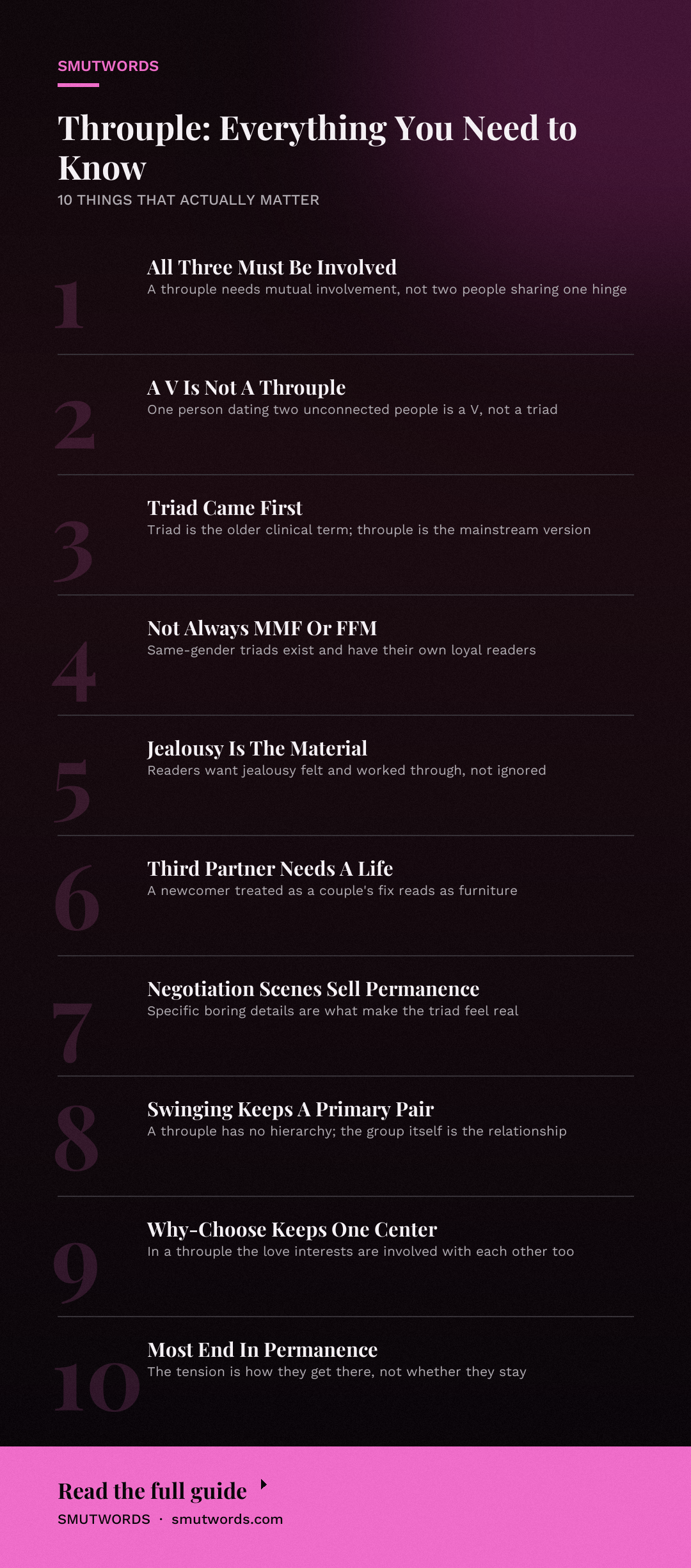
A throuple is a three-person relationship where everyone is romantically and sexually involved with everyone else, and it functions as one closed unit rather than three separate pairings sharing a roof. That last clause does the heavy lifting. Two people dating the same third person who never touches each other is a V, not a throuple, and erotica readers who have been burned by books that mislabel the shape get loud about it in reviews.
The word itself is a portmanteau of "three" and "couple," which is slightly absurd on its face and yet has stuck hard enough that readers type it into search bars by the thousand. What follows is the full picture: where the term came from, how authors actually build these relationships on the page, and what separates a throuple romance that works from one that collapses under its own geometry.
What Throuple Actually Means
The core requirement is mutual involvement. All three partners are in relationship with each other, not arranged around a shared hinge. Each of the three dyads (A-B, B-C, A-C) is a live romantic and sexual connection, and the group as a whole is also a connection. That is six simultaneous relationships if you count the triad itself, which is precisely why the dynamic generates so much story.
A few boundaries worth drawing clearly:
- Throuple (closed triad): three people, mutual involvement, typically exclusive to each other. The group is the relationship.
- V or hinge relationship: one person dates two people who are not involved with each other. Valid, common, not a throuple.
- Open triad: three people in mutual relationship who also see others. Still a triad, no longer closed.
- Threesome: one sexual encounter involving three people. No ongoing romantic commitment implied, though plenty of throuple stories start here.
- Swinging or polycule configurations: broader networks with their own rules, overlapping with throuples but not synonymous.
The term "triad" predates "throuple" by decades in polyamory writing and remains the more clinical option. "Throuple" is the one that went mainstream, showing up in lifestyle journalism around the mid-2010s and then migrating straight into romance and erotica titles where it now sells books on the cover alone.
Common misconceptions are worth naming. Readers sometimes assume a throuple must be MMF or FFM, meaning two of one gender and one of another. It does not have to be; MMF and FFM are simply the most published configurations because they map onto existing genre readerships. Same-gender triads (MMM, FFF) exist in the catalog and have their own devoted audiences.
Another frequent error: assuming a throuple is inherently unstable or a phase. Fiction that treats the third partner as a temporary accessory rather than a permanent member tends to get shredded by readers who came for the fantasy of permanence.
Where Throuple Comes From
The relationship shape is ancient. The word is not. "Throuple" surfaces in English-language journalism and blogs in the mid-2000s and gains real traction in the 2010s as polyamory coverage moved from niche outlets into mainstream lifestyle sections. Romance publishing followed the search traffic, as it always does.
Long before the label, though, the triad was a recognizable structure in erotic literature. Nineteenth-century fiction flirted with it obliquely. Mid-twentieth-century pulp and men's adventure novels used MMF triangles as a staple, usually with the two men in competition rather than in relationship with each other. That version is the ancestor of the modern throuple, and the distance between them is the whole story of how the trope evolved.
The pivotal shift came from two directions at once. First, polyamory writing and community zines in the 1990s and 2000s developed real vocabulary for mutual triads, including negotiation, compersion, and hierarchy. That vocabulary leaked into fiction. Second, fanfiction communities in the 2000s and 2010s normalized the "everyone loves everyone" triad as an ending worth earning, and a generation of those writers moved into professional romance and erotica publishing.
What changed in published erotica is the interiority. Older triangles were about possession and rivalry; the men circled one woman and the tension was who would win. Modern throuple writing puts all three people in bed and in conversation, and the tension becomes logistics, jealousy, fear of exclusion, and the slow work of building something that holds three people instead of two. The genre stopped asking "who gets her" and started asking "how do we all keep this."
There is also a publishing-history layer that matters. Throuple books are comparatively easy to market: one cover, three bodies, a clear promise. They exploded alongside the broader surge in why-choose and reverse harem, which share DNA but differ in a crucial way.
Why-choose usually keeps one protagonist at the center with multiple love interests who may or may not connect with each other. A throuple demands that the love interests connect too, which is a heavier narrative lift and a more specific payoff.
How Throuple Shows Up in Erotica
On the page, throuple stories live and die on the same thing every relationship story lives on: specificity. The geometry is just the setup. What makes a throuple book good is that the author knows exactly who each of the three people is, what each one needs, and where those needs rub against each other.
The strongest versions tend to solve the "two against one" problem early. Any time three people are together, there is a risk that two of them form a temporary coalition that leaves the third watching.
Good authors turn that risk into a tool. They will let a coalition form on purpose, let the excluded partner feel the sting, and then make the group resolve it. That arc, repeated at escalating stakes, is the engine of most successful throuple romances.
Jealousy is the central material and saying so is not a knock. Readers who love throuples are not looking for a story with no jealousy; they are looking for a story where jealousy is felt, named, and worked through rather than ignored.
A throuple where nobody ever feels a flicker of envy reads as flat and slightly dishonest. The fantasy is not the absence of hard feelings. The fantasy is a structure that can hold them.
Sex scenes in throuple books have their own craft demands. Three bodies create real choreography questions, and the best scenes are usually built around attention: who is touching whom, who is watching, who is being watched.
That last element is where throuple writing overlaps with the voyeur husband trope, in which one partner's pleasure is amplified by watching another. In a throuple, the watching rotates, and the rotation itself becomes erotic. Nobody stays a spectator for long.
Common variations authors reach for:
- MFM throuple: two men, one woman, all three involved. The most published configuration. Frequently uses competitive energy between the men that resolves into cooperation.
- FFM throuple: two women, one man, all three involved. Popular in contemporary romance; often leans on the two women's connection as the emotional core.
- MMM and FFF triads: same-gender, mutual. Less common in mainstream publishing, fiercely loyal readership.
- Closed triad with a clear rule set: the group has explicit agreements, sometimes written, and the story turns on those rules being tested.
- Established couple plus a third: the classic entry point. A married pair opens their relationship and the newcomer becomes a permanent member rather than a guest.
- Strangers to throuple: three people meet separately, often in a workplace or small-town setting, and converge.
- Second-chance triad: the three were together once, broke apart, and rebuild.
The "established couple plus a third" version deserves extra attention because it is where a lot of reader frustration concentrates. Done badly, the newcomer is treated as a solution to the couple's problem, a sex toy with feelings, and readers notice immediately. Done well, the newcomer has their own wants that predate the couple, their own life, and their own leverage in the negotiation. The couple has to change too.
Negotiation scenes are a genre staple and function almost as their own subcategory. Three adults sitting down to talk about exclusivity, sleeping arrangements, disclosure to family, contraception, and what happens if someone's feelings shift. These scenes are not foreplay in a literal sense, but they carry real charge for the reader, because they are where the fantasy gets its foundation poured. The best negotiation scenes are specific about boring details, and the specificity is what sells the permanence.
Enjoyed this? Get a free book.
Join the list and we will send a complete free story straight to your inbox, plus new releases every week after that. No credit card, no catch.
What makes a throuple story flat, by contrast, is almost always the same set of failures. The third partner has no interiority outside their attraction to the couple. The two original partners never fight.
Jealousy appears once, gets resolved in a single conversation, and never returns. The heat is evenly distributed because the author is afraid to let one pairing be hotter than another. Readers will forgive a lot, but they will not forgive a triad where one person is furniture.
One more craft note for kink-adjacent throuple stories: the group structure creates unusual openings for power exchange. A dominant with two submissives, or two dominants sharing one submissive, or a triad where the power shifts by scene. Praise and degradation work differently with three because the attention is split and can be weaponized.
A triad that deploys a praise kink with one partner while another watches and waits has a rhythm a two-person scene cannot produce.
For harder-edged dynamics, some authors borrow the structure of a keyholding arrangement and extend it across three people, with the cage or the denial becoming a group ritual rather than a private one. If you want a good example of how kink categories get tangled up with each other, the breakdown of breeding kink vs impregnation kink is worth a read; it is the same problem of readers using one label for two different things.
Throuple vs Swinging
These two get confused constantly, and the confusion is understandable because both involve more than two people. The difference is what the relationship is.
Swinging is typically a recreational or social practice. A couple stays a couple and plays with others, often together, sometimes separately, under agreed rules. The primary partnership remains primary. A throuple is a romantic commitment among three people where the group is the relationship and there is usually no hierarchy placing two partners above the third.
In fiction, that distinction changes everything about the plot. Swinging stories often turn on rules, secrecy, and the thrill of a shared experience outside the relationship.
Throuple stories turn on integration: how three lives merge into one household, one bed, one future. A swinger couple goes home together. A throuple is home.
There is real overlap at the edges. A couple might swing first and then fall into a triad.
Some triads are open and swing together. But if you are trying to figure out which tag to search, the question to ask is whether the third person is a partner or a participant. Partner means throuple.
Frequently Asked Questions
Is a throuple the same as a triad?
Effectively yes, though the register differs. Triad is the older, more clinical term from polyamory writing. Throuple is the casual, mainstream version that dominates book titles and search traffic. A closed triad and a throuple describe the same structure.
Can a throuple be two people plus one who only dates one of them?
No, that is a V or hinge relationship. A throuple requires that all three people are involved with each other. This is the single most common point of confusion, and it is why some readers leave angry reviews on books that use the label loosely.
What does MMF throuple mean versus MFM throuple?
The letter order signals who is involved with whom. MMF usually indicates the two men are involved with each other as well as with the woman. MFM sometimes indicates the men are not sexually involved with each other and only share the woman. Usage is inconsistent across publishing, so check the book's actual content warnings rather than trusting the acronym.
Do throuple romances always have a happy ending?
Most do, because the genre promise is permanence. The tension in a throuple romance is rarely whether they will end up together but how they get there and what it costs. Books that end with the triad dissolving are rare and usually tagged accordingly.
Why do readers seek out throuple stories specifically?
For the expanded emotional and physical dynamics and the negotiation of jealousy, and for the fantasy of a stable relationship that defies monogamous norms while still meeting everyone's needs. The appeal is abundance with structure, not chaos.
Are throuple books always about polyamory as a lifestyle?
Not at all. Many are pure fantasy with no engagement with real-world polyamory communities. Others are grounded and specific. Both approaches work; what matters is whether the author commits to the shape they have chosen.
How does a throuple differ from why-choose romance?
In why-choose (and reverse harem), one protagonist typically has multiple love interests who may not be involved with each other. In a throuple, the love interests are involved with each other too. That mutual involvement is the whole distinction.
Final Thoughts
A throuple works in fiction for the same reason it works in life: it demands that three people show up for each other in ways a pair never has to, and the showing up is the story.
If you want a book that treats the third partner as a real person with real leverage instead of a convenient accessory, start with the catalog's top-ranked throuple picks below and pay attention to which ones let all three people be jealous, difficult, and wanted at once. Those are the ones that hold.
For the mirror image of this problem, where one relationship shape gets mistaken for another and readers end up furious in the reviews, the piece on no strings attached covers the same territory from a different angle.







Loading comments…