
Bear shifter romance is a subgenre of paranormal romance built around a male love interest who moves between human and bear form. He's usually massive, gruff, fiercely protective, and running on instinct, territory, and the drive to claim one mate for life. The appeal sits in that split: a creature capable of tearing a door off its hinges who goes soft for exactly one person.
If you have ever finished a wolf book and thought, that was good but I wanted him bigger, slower to speak, impossible to move, you already understand the market this subgenre serves.
What Bear Shifter Romance Actually Means
The term describes a romance where at least one central love interest has a bear as his second form. That sounds simple. The genre complicates it in about a dozen directions.
The bear can be a curse, a birthright, a clan bloodline, or a military experiment gone right. The human side can dominate or recede. What never changes is the shape of the fantasy underneath.
A bear shifter hero is almost always written as large in both forms, and his size is not incidental. It is the whole argument. He runs hotter than a human, sleeps through winters, heals fast, and carries a territorial instinct that reads on the page as intense focus on one woman. Authors use that focus the way other subgenres use fate, or wealth, or danger.
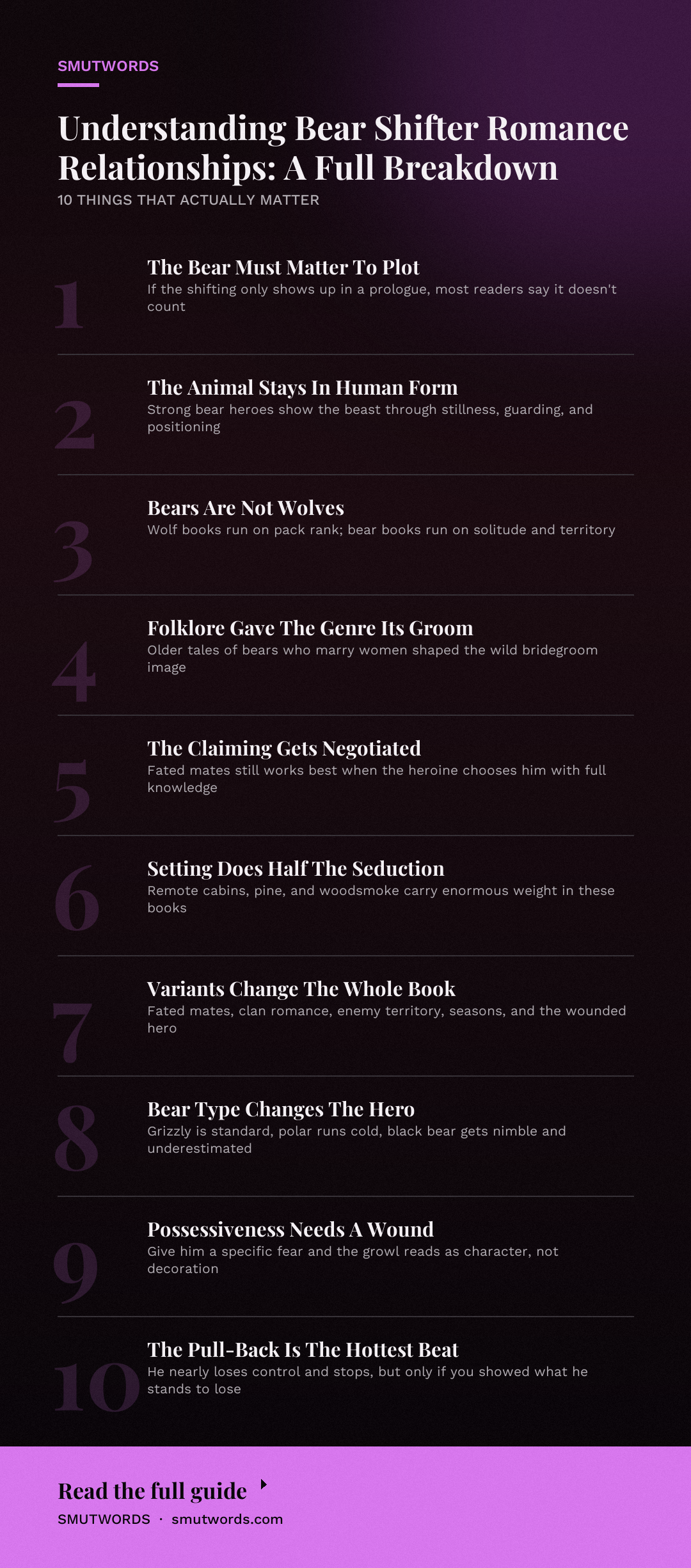
What counts as bear shifter romance, strictly: the shifting needs to matter to the plot, not just appear in a prologue. If the bear only shows up for one fight scene and the rest of the book could be a contemporary office romance with the names changed, most readers will say it does not count.
A strong bear book keeps the animal present in the hero's behavior even when he is in human skin. The stillness before he moves. The way he positions his body between his mate and a door.
What does not count: shape-shifters who happen to be described as bear-like in personality. "He was a big, grumpy bear of a man" is a metaphor, not a subgenre. Nor does a bear shifter who never actually shifts on the page for the entire book, though a few authors pull that off deliberately as a slow reveal.
Three misconceptions come up constantly.
First, that bear shifter romance is just werewolf romance with a bigger animal. The two subgenres share DNA, but they handle pack structure and hierarchy differently, and bear books lean harder into solitude and one-on-one focus.
Second, that the shift is always violent and involuntary. Plenty of authors write it as controlled, even ceremonial. Third, that the subgenre is all raw instinct and no plot. The best bear shifter romances are as carefully structured as any other romance, with a full emotional arc under the fur.
Where Bear Shifter Romance Comes From
Bears have been romantic love interests in Western fiction far longer than the modern subgenre suggests. The oldest layer is folklore: tales across Scandinavia, Finland, and Indigenous North American traditions of bears who walk as men, marry women, and return to the forest. Those stories are not romances in the genre sense, but they gave later writers the central image of a bridegroom who is also a wild animal.
In published romance, the bear arrived on the coattails of the paranormal boom. When vampires and werewolves proved there was a mass market for monster love interests, publishers and indie authors looked at the rest of the animal kingdom. Wolves came first and built the template: mate bonds, packs, alpha hierarchies, scent recognition. Bears were the obvious next step, and by the mid-2000s authors were writing bear clans, grizzly enforcers, and entire small towns of shifters hiding in the mountains.
The indie boom changed the economics. Once self-publishing made it possible to release a bear shifter novella every six weeks and reach readers directly, the subgenre exploded into series: bear security firms, bear construction crews, bear ranches, bear firefighters. You can now find a bear shifter book for nearly every job, state, and season.
The most interesting shift over time is what the bear means. Early versions leaned hard on brute dominance. The hero growled, the heroine trembled, and the resolution was her submission.
Current books keep the size and the growl but give the hero far more interiority: a man who hates what his temper cost him, who has lost people, who is terrified of hurting the one person he wants to keep. The possessive instinct stayed. The emotional vocabulary around it got much richer.
The subgenre has also diversified its bears. Polar bear shifters bring cold, isolation, and a near-white silhouette. Black bear shifters are smaller, quicker, often written as the scrappy one in a clan of grizzlies. Brown and grizzly heroes stay the default, and the size gap between hero and heroine remains one of the genre's most reliable engines, the same one that drives giant romance and size difference romance.
How It Shows Up in Erotica
On the page, a bear shifter romance runs on friction between instinct and restraint. The hero wants to drag his mate to his den and never let her leave. He also wants to be a man she chooses freely. Every good bear scene lives in that gap.
Editors see a lot of bear books, and the strong ones share habits. Here is what separates a bear shifter romance that works from one that reads like a wolf book with search-and-replace.
- The bear is present in human form. Not through internal monologue about "the beast," but through behavior: the way he eats, stands, guards a doorway, goes silent when threatened. Readers should feel the animal in the room before anyone shifts.
- The claiming is negotiated on some level. Fated mates does not mean the heroine has no say. The best books let her choose him back with full knowledge of what he is. A claimed heroine who never hesitates gets boring fast.
- The territory has texture. A remote cabin, a clan lodge, a stretch of national forest. The smell of pine and woodsmoke does enormous work in these books because the setting is doing half the seduction.
- The heat is specific. Temperature, weight, and breath are your best tools. A bear hero runs hot. He breathes slow. He is heavy in a way that should feel steadying rather than crushing, unless crushing is the point.
- The danger is real and external. A rival shifter, a hunter, a developer, a clan dispute. Something outside the couple has to force the hero's protective instinct into the open.
Common variants authors use, and how each one changes the book:
Enjoyed this? Get a free book.
Join the list and we will send a complete free story straight to your inbox, plus new releases every week after that. No credit card, no catch.
- Fated mates. Instant recognition, then the work of building trust after the bond announces itself. This variant often pairs with soulbond mechanics, where the connection carries a physical or psychic weight neither party can ignore.
- Clan romance. The hero exists inside a hierarchy of other bears, with a chief, a territory, and rules about outsiders. This is the bear equivalent of pack mates romance, though bear clans tend to be smaller and less rigid.
- Enemy territory. He is a bear, she is a wolf, or a human, or on the wrong side of a property line. The territorial shifter trope is where this variant gets its teeth, since bears defend space more than they compete for rank.
- Hibernation and seasons. Some authors build the mating and denning cycle into the plot, using winter as a pressure cooker that forces the couple into close quarters. This is where a breeding kink romance angle often enters, framed through shifter fertility and the heat of the season rather than anything human.
- Wounded hero. A bear who lost a mate, a clan, or control of himself. Recovery arcs give the subgenre its best emotional writing because the hero's strength and his damage come from the same source.
Variations by bear type matter more than newcomers expect. Grizzly and brown bear heroes carry the standard template: enormous, territorial, slow to anger and terrible when it arrives. Polar bear shifters are written colder and more isolated, often with a hero whose instinct runs toward starvation and survival. Black bear shifters get to be nimble, funny, or underestimated, which makes them a favorite for friends-to-lovers and second-chance stories.
Where bear books frequently go flat: the hero growls on page one and never develops an interior life. A strong version gives him a specific wound and a specific fear.
He has hurt someone before. He cannot control the shift when he is angry. He believes he does not deserve a mate.
The possessiveness then reads as character rather than decoration. Sex scenes in bear shifter romance tend to emphasize weight, heat, and slow intensity. Authors often build in a partial shift: claws that stay sheathed, eyes that go gold, a growl against her throat. The moment where he nearly loses control and pulls back is usually the hottest beat in the book, and it only works if the reader has already been shown how much he stands to lose by not pulling back.
For writers coming into the subgenre from other monster categories, the rule is simple: the bear is patient. He circles. He waits. He moves once, decisively, when the moment opens. That pacing applies to the plot as much as the bedroom.
It also helps to know what mode you are writing in. A bear shifter romance can be warm and single-relationship, or it can sit beside the moral gray of dark romance vs taboo romance if the hero's possessiveness crosses into genuine control and the book commits to that tension honestly. Readers forgive a lot in a bear hero. They do not forgive a book that cannot decide what it is doing.
Bear Shifters vs Wolf Shifters
The comparison readers make most often is bear versus wolf, and the difference matters when you are choosing your next book. Wolf shifters organize around rank and pack politics: alphas, betas, challenges for leadership, and a strong sense of duty to the group. Bear shifters organize around solitude and territory. A bear hero usually wants distance from other bears more than he wants standing among them.
That changes the shape of the conflict. A wolf book asks whether the heroine fits into the pack. A bear book more often asks whether the hero will risk exposing his mate to a clan, a rival, or the wilderness he calls home.
Wolf heroes are social animals with a hierarchy to defend. Bear heroes are bachelors with a den to protect, and the emotional arc bends toward letting one person inside it.
A related axis runs through hybrid shifter romance, where the hero is mixed or the mate bond crosses species lines. Bear-wolf pairings are the most common hybrids, and they inherit the best of both: the bear's patience and territorial weight with the wolf's pack dynamics and loyalty to a group. If you like the bear but want a busier social world, hybrid and clan-focused books are the natural next step.
The same instinct to protect and claim shows up across other monster subgenres too. A man who cannot breathe underwater but will follow you to any depth is doing bear work in merman romance. A being of enormous patience and older-than-human gravity is doing it in elf romance. The bear version is just the most physical, and the one that leans hardest on body heat and weight.
Frequently Asked Questions
What is bear shifter romance?
It is a paranormal romance subgenre in which a central love interest shifts between human and bear form. The stories typically center on a large, protective, possessive hero who recognizes his mate and has to win her while managing the instincts that come with his animal side. Settings tend toward remote mountains, forests, and clan territories.
Is bear shifter romance the same as werewolf romance?
They are close cousins that share mate bonds, alpha dynamics, and scent recognition, but the social structures differ. Wolf books focus on packs, rank, and leadership challenges. Bear books focus on solitude, territory, and one mate, with the hero usually resisting clan life rather than competing inside it.
Do bear shifter romances always use fated mates?
Most do, but plenty of authors write bear shifters who choose their partner without a magical bond at all. Some books use the mate bond as an instant attraction that still requires courtship and trust to become a real relationship, which keeps the tension alive after the recognition scene.
What is the difference between grizzly, polar, and black bear shifters?
Grizzly and brown bear shifters are the standard: huge, territorial, slow to anger. Polar bear shifters are written colder and more isolated, often with survival-driven instincts. Black bear shifters are smaller and quicker, which authors use for heroes who are underestimated, wittier, or more agile than the clan expects.
Are bear shifter romances spicy?
Generally yes. The subgenre leans into heat, weight, and primal intensity, and many books include partial shifts during sex: gold eyes, claws kept in, a growl at the throat. Explicitness varies by author, and there is a full range from sensual to fully open-door.
Do I need to read a bear shifter series in order?
Most series are built so each book follows a different couple and can stand alone, with an overarching clan or town tying them together. Reading in order gives you the full cast and the payoff of side characters getting their own books, but starting mid-series rarely leaves you lost.
Final Thoughts
Bear shifter romance works because it takes the oldest promise in the genre, being chosen completely by someone strong enough to protect you, and gives it fur, body heat, and a den in the mountains.
If you are new to the subgenre, start with a fated mates book set in a small clan town. It will teach you the shape of the trope in one sitting, and if the hero growls at the right moment, you will be hunting down the rest of the series before the night is over.







Loading comments…