
Most people who've been in the scene a while can tell you the moment it clicks. The sub's answers go quiet and slow. The questions stop.
The dom stops performing and starts steering. Somewhere in there, two people have left the room without going anywhere, and what's left is a pair of headspaces with their own weather systems.
Subspace and domspace get thrown around like everyone already knows what they mean. Plenty of people who've felt both couldn't explain them to a curious partner if their life depended on it. So here's the plain-language version: what each one is, why the brain does it, what goes wrong afterward, and how two adults keep each other upright.
What Is Subspace?
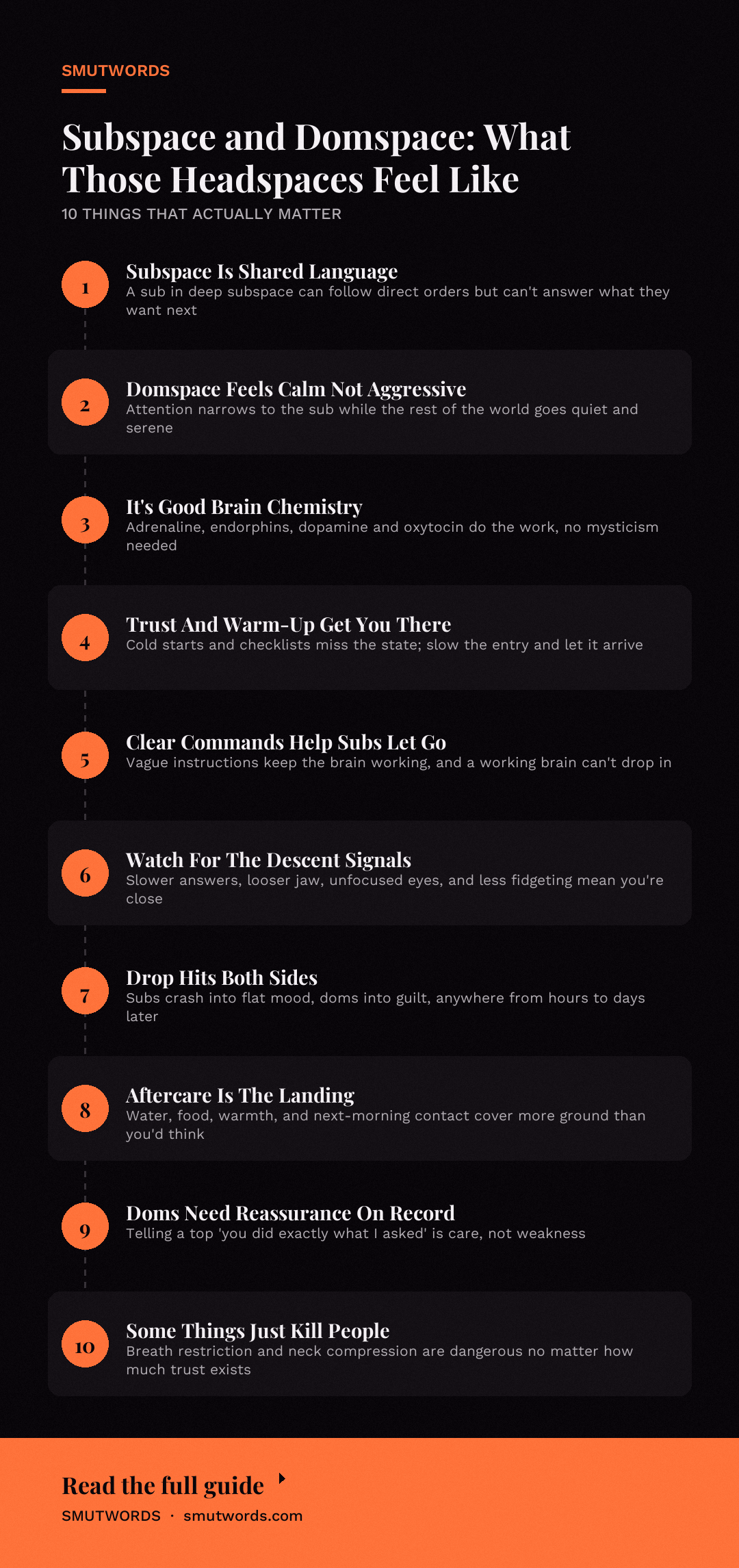
Subspace is the altered state a submissive or bottom slides into during a scene or a long stretch of submission. The clearest sign is that decisions get expensive. A sub in deep subspace can follow a direct instruction fine and can't reliably answer "what do you want to do next." Words come slowly or not at all. Pain tolerance climbs, sometimes dramatically.
Time gets slippery. People describe it as floating, or as watching the scene from a half-step to the side. Some go quiet and dreamy; others get giggly and useless in a way that's weirdly endearing.
A sub who can usually run a board meeting might need help finding the bathroom afterward. That's the shape of it. And subspace isn't one state. It runs a range from a light buzz to deep, unresponsive territory, and the light version is where most people actually live.
You don't need a dramatic scene to get there. A long session of service submission can drop someone gently into it without a single flogger in the room.
What Is Domspace?
Domspace is the top's version of the same phenomenon. The dom gets focused and calm, sometimes unnervingly so. Attention narrows to the sub: their breathing, their posture, the tiny shift in their shoulders when a command lands. The rest of the world goes quiet.
A dom in domspace can feel almost serene. That surprises people who assume the role is all aggression. The pleasure comes from control and responsibility landing well: watching a sub trust you enough to go under, keeping them safe while they're down there, making decisions they've handed to you.
Ask a dom what domspace feels like and you'll hear words like solid and clear. Ask a bad dom and you'll hear words like power trip. The state doesn't make the person. It amplifies whoever was already in there.
Doms get high on their own supply of neurochemistry, and that has consequences we'll get to. For now: domspace is real, it's measurable in how a person behaves, and it carries its own risks precisely because it feels like clarity. Subjectively, it's the opposite of impaired. It's just quietly unreliable.
Why Does It Happen? The Brain Stuff, Briefly
Bodies under intense consensual stress and pleasure pump out a cocktail: adrenaline, endorphins, dopamine, and in the aftermath, oxytocin. Endorphins do a lot of the heavy lifting for the floating, pain-insulated feeling. That's the same system that makes distance runners hit a wall and then find a second wind.
Add to that the cognitive load of submission. Handing over decisions lowers the mental tax, which is a real relief to people who carry a lot of decisions all day. Combine neurochemistry with relief and you've got a state that feels worth chasing. There's nothing mystical happening; it's a body doing something bodies do when you give them the right conditions.
Conditions matter. Subspace is easier to reach with trust, warm-up, and someone paying attention than with a cold start and a checklist. Which is why people who say "I just can't get there" usually aren't broken. They're cold.
Slow the entry down and the state tends to show up on its own.
What Actually Gets You There
The route in matters less than the slope. People reach subspace through pain (impact play), through intensity (restraint, sensory play, role scenes), through service and obedience, through ritual, or through the psychological weight of a dynamic. Domspace tends to arrive alongside, though doms can also slide in from the responsibility side before the play even starts.
A few practical things that make the trip smoother:
- Warm-up before the main event. Jumping straight into heavy intensity skips the ramp and often misses the state entirely. Start light, build, and let the sub's breathing tell you when they're descending.
- Say what you want clearly. Vague instructions keep a sub's brain working, and a working brain struggles to let go. Direct, simple commands give them somewhere to land.
- Watch the signals. Slower answers, looser jaw, unfocused eyes, less fidgeting. These mean you're closer.
- Check in on a simple scale. Traffic lights work because they survive a foggy brain: green, yellow, red. A sub who can't form a sentence can usually say "yellow."
Don't try to rush the deep version in a single evening. Some people reach deep subspace in twenty minutes; plenty take months of practice to get past the shallow end. If you're new to the whole thing, the scene negotiation guide covers the pre-scene conversation that makes all of it possible.
Enjoyed this? Get a free book.
Join the list and we will send a complete free story straight to your inbox, plus new releases every week after that. No credit card, no catch.
The Real Risks: Subspace Drop and Domspace Drop
Nobody talks about the come-down enough, so here it is. Subspace is a high, and highs end. Sub drop is the crash that hits anywhere from a couple of hours to a couple of days afterward: flat mood, tears, anxiety, self-doubt, bone-deep exhaustion. The intensity of the scene doesn't predict the size of the drop, which is unfair but consistent.
Dom drop is the same phenomenon with a different audience. The top comes down off the control high and lands in guilt, second-guessing, and a sudden certainty that they did something wrong. For a dom, the drop often pairs with the fear of having hurt their sub. The sub is fine, the scene went well, and the dom is quietly convinced they're a monster until someone talks them down.
The reason both drops matter is that neither person is in a state to handle it well alone, and both tend to go quiet instead of reaching out. A sub in drop may not believe they deserve care. A dom in drop may not believe they deserve reassurance.
If you're in a D/s relationship and don't have an aftercare plan, you have a hole in your safety net. Some things that actually help:
- Water, food, and warmth are not optional. Electrolytes, something with sugar, a blanket, and physical heat cover a surprising amount of ground.
- Contact. A check-in text the next morning and the morning after. Drops peak at day one or two, not hour one.
- Don't make decisions in the crash. Never end a dynamic, quit the scene, or have the "we need to talk" conversation while either of you is in drop. Wait until the fog clears; the conversation will still be there and it'll be a different conversation.
- Reassurance for the dom, verbatim. Sometimes it's just "you did exactly what I asked, and I'm glad you did." Doms need that on record, and repeating it is not weakness.
Aftercare Isn't Fluff
Aftercare is the deliberate landing: the water, the snack, the blanket, the quiet. It's also the debrief, which can happen later once heads clear. Sometimes it's holding someone while they cry and saying nothing. Sometimes it's close body contact as a kind of reset, and people who love that static affection often find body worship a natural extension of the aftercare ethic.
What matters is that aftercare is designed for the specific people in the room, not copied from a script. A sub who wants to be left alone with a weighted blanket and a dom who wants to hover are both legitimate. Say what you need before the scene, not after, when your mouth has stopped working.
The same logic holds across different dynamics. Service submission relationships run on the same aftercare principles, just at a slower tempo.
Hard Limits, Health, and When to Stop
Some things are not "advanced." They're dangerous, and no amount of trust makes them safe. Breath restriction is one; anything that cuts oxygen to the brain can kill someone in a scene with no warning, and it has.
Unsafe restraint setups are another: rope that compresses a nerve, bondage over a joint, anything around the neck, and any position the sub can't be quickly gotten out of. If you're using mummification or heavy wrap, look up the specific safety protocols for circulation and panic response before you try it, not during.
A hard limit is a stop, not a starting point for persuasion. Negotiate limits while everyone's still got full brain function, write them down, and honor them without relitigating mid-scene. Most people asking about subspace and domspace run into this early, because the very state that makes the experience feel good is the state that makes a person unable to negotiate. That's the whole reason the conversation happens beforehand.
When to stop the scene: slurred speech beyond what you planned for, confusion, a sub who stops responding to their own name, chest pain, or a top losing track of the clock. Stop, get them water and warmth, and don't treat the end of a scene as a failure. Ending early is a success at the only thing that actually matters.
How to Bring It Up With a Partner
Outside the bedroom, in daylight, with clothes on. Something direct and low-drama works best: you've read about subspace, you're curious, you'd like to try a light scene and see how it feels. Exchange hard limits before anything else.
Ask what each of you wants to feel, not just what you want to do. Then pick an easy first step, agree on a safe word, and decide in advance what aftercare looks like for both of you.
This is where fiction earns its keep. Kink-heavy stories do the describing so you can feel the shape of a dynamic before you try one, including the control, the obedience, and the intensity. Read something like Bound to the Galactic Alpha for the command-and-consent dynamic, or Subroutine: Breed Her for the total-control version. The Tentacle Alien Incubation Chamber fantasy runs the same headspace machinery at a much higher volume.
If your taste runs to submission-by-circumstance, Free Use Airplane is the group-control version, and Tales From A High Class Escort covers the ritualized obedience angle. None of these are manuals. They're rehearsals for the feeling, which is exactly what a nervous beginner needs before the awkward real-world conversation.
Final Thoughts
Subspace and domspace are states you can learn to enter, recognize, and come down from. Learn the descent. Learn the signals. Treat the drop as part of the scene rather than a surprise.
If you want a place to start rehearsing the feeling before you try it for real, pick up Bound to the Galactic Alpha and watch how the command-and-trust dynamic holds up under pressure. The fiction is the warm-up. You're the one who does the real thing.








Loading comments…