Big cat shifter romance is the corner of paranormal romance where one or both leads can flip between human form and a full-sized feline: lion, tiger, leopard, jaguar, panther, sometimes a snow leopard or a lynx for readers who want something rarer.
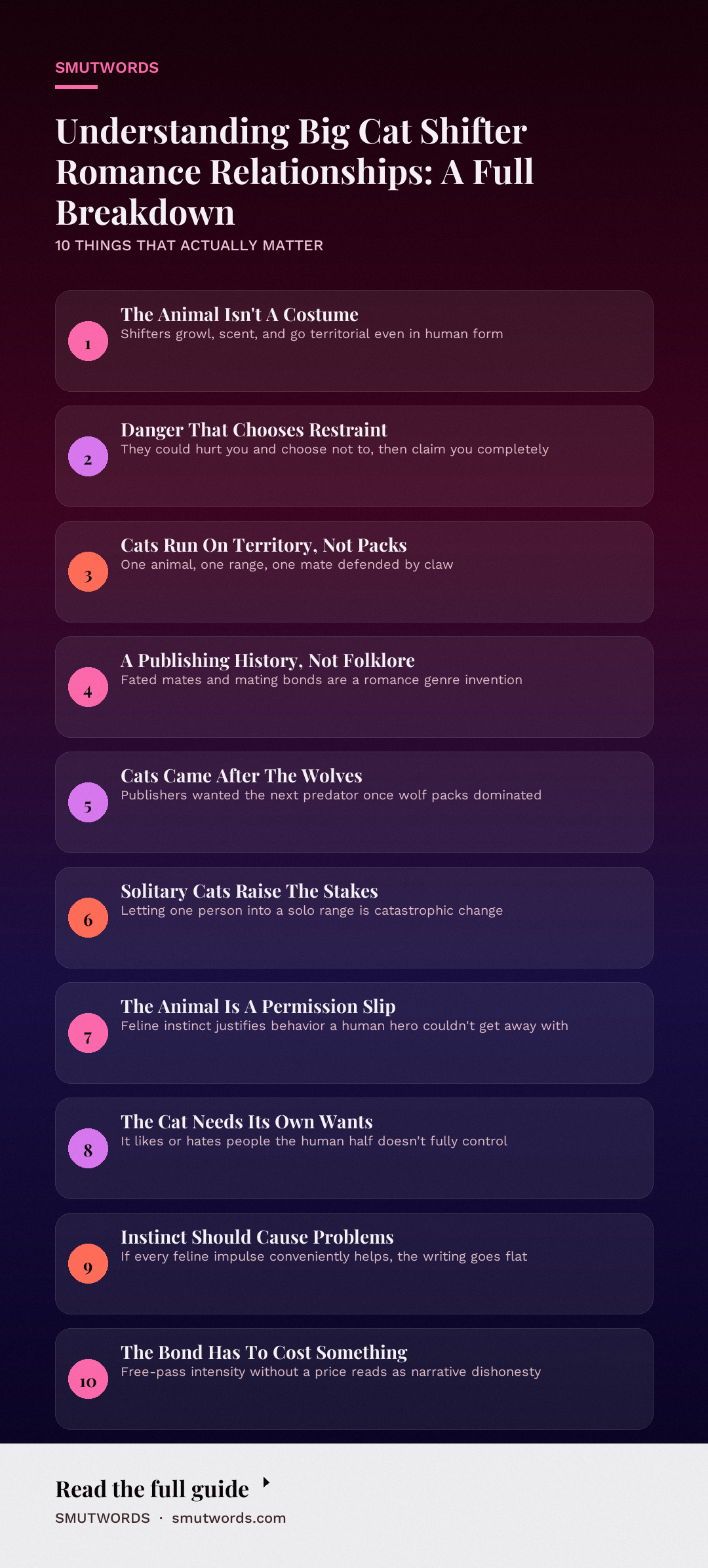
The animal isn't a costume the character puts on. It bleeds through. They growl when jealous, track their partner by scent, get territorial over a couch cushion, and go from cold to predatory the second someone threatens what's theirs. That friction between a civilized person and an animal that does not negotiate is the entire engine of the subgenre.
The appeal sits in a specific contradiction. A big cat shifter hero or heroine is dangerous in a way that is not theatrical: they could hurt you, and they choose, every single time, not to. What they do instead is claim you with a devotion that borders on obsessive.
Being wanted by something wild that picked you on purpose, not by accident, is the fantasy. It is also, for a lot of readers, the version of possessiveness that actually feels safe, because the danger is fictional and the loyalty is total.
What Big Cat Shifter Romance Actually Means
The name is literal. Big cat separates these books from the wider shifter shelf, which includes wolves, bears, dragons, and whatever else an author wants to make walk on two legs. Shifter romance is the broader genre: one or more characters who change form, usually at will or under stress, usually with some animal instinct retained in the human body and mind.
Big cat shifter romance narrows that to felines, and the narrowing matters because the cats behave differently from the wolves. A wolf shifter story cares about the pack before it cares about the couple. A big cat story usually cares about territory, and territory is personal: one animal, one range, one mate, defended by claw if necessary. That single structural difference changes the whole shape of the plot.
What counts:
- A lead who shifts into a lion, tiger, leopard, jaguar, panther, cougar, lynx, or similar large feline.
- Animal traits present in human form: enhanced senses, rumbling vocalizations, instinctive reactions to threat or arousal.
- A romantic bond treated as permanent and, in most versions of the trope, fated rather than chosen.
- At least one scene where the animal form and the romantic or sexual tension intersect.
What doesn't count, or only counts at the edges: a character who is a cat in a magic system but never actually shifts on-page, a story where the feline element is pure set dressing with no behavioral consequence, or a book where the shift exists but the relationship follows a standard contemporary arc with fur added. Readers of this subgenre are not subtle about the difference. They want the animal to matter.
Common misconceptions are worth clearing up. First, big cat shifters are not automatically villains, though dark romance versions lean hard into menace.
Second, the fated mate device is common but not mandatory; some authors write chosen bonds specifically to push back against it.
Third, and this trips up new readers, the feline shifter is not the same thing as a werewolf with a different coat of paint. The instincts are written differently on purpose, and readers notice when an author swaps the research.
Where Big Cat Shifter Romance Comes From
The honest history here is a publishing history, not a folklore history. Shapeshifters show up in myths worldwide, but the specific package readers buy today, a fated mate, a pack or pride structure, and a mating bond that triggers under pressure, is a romance genre invention that hardened into a formula across the 1990s and 2000s.
Werewolves got there first and got there loudest. The early paranormal romance boom was dominated by wolf packs, and the pack structure gave authors an easy way to write hierarchy, loyalty, and an alpha who answers to no one. Publishers noticed the appetite and started looking for the next animal. Big cats were the obvious move: same predator energy, different social math.
Felines don't live in packs the way wolves do, and that turned out to be a feature rather than a bug. A solitary predator raises the stakes of the bond. If a lion shifter's entire worldview is built around defending a range alone, then letting one person inside that range is a catastrophic structural change to his life.
Wolves can afford to share. A leopard cannot, narratively speaking, and romances run on exactly that kind of pressure.
The subgenre split further as it grew. Pride-based series imported wolf-pack architecture onto lions and ran with the hierarchy. Solitary-cat series leaned into stalker intensity and a hero who has been alone so long he has forgotten how to be otherwise. Around the 2010s, indie publishing and ebooks blew the category open: self-published series, long-running lion shifter sagas, and Kindle Unlimited catalogs made this one of the most reliably crowded shelves in romance.
The shift over time has mostly been in the heroines. Early entries cast the human woman as the one being claimed, sometimes with little to do but survive the claiming. Modern big cat shifter romance regularly gives the woman her own animal, which changes the power balance completely. Two predators circling each other is a different book than one predator and one target, and a lot of the best recent work lives in that shift.
How Big Cat Shifter Romance Shows Up in Erotica
On the page, the feline elements do specific work. A good author uses the animal to justify behavior that would read as unhinged on a human hero and reads as instinct here: scenting a partner across a room, following her home without asking, refusing to let another man stand within arm's reach. The animal is a permission slip for intensity, and the craft question is whether the author earns that permission or just cashes it.
There's also a real overlap with primal play, the kink where the chase and the catch are the point. Big cat shifter romance is essentially the fictional version of that dynamic with a built-in excuse. The chase scene, where the shifter's control slips and the partner runs, is a staple for a reason.
The mating bond is the other load-bearing device. A bond scene works when it's treated as an event the characters cannot undo, with consequences for the rest of the book. When it's just a single passionate scene and then the plot moves on, the shape of the story deflates.
Soulbond fiction runs into the same trap, and the authors who solve it do so by making the bond expensive: it costs something, it changes something, and it can't be shrugged off in the next chapter.
Common variations authors use:
Enjoyed this? Get a free book.
Join the list and we will send a complete free story straight to your inbox, plus new releases every week after that. No credit card, no catch.
- Pride series. A group of lion or leopard shifters with a leader, a hierarchy, and a woman entering that structure from outside. Political, high drama, lots of pack dynamics even when the word "pride" is doing the work.
- Solitary mate. One cat, one human, no support system, maximum obsession. Often the darkest version of the trope.
- Both shifters. Two animals, two sets of instincts, and a fight for dominance that doubles as foreplay.
- Enemy prides. Forbidden territory crossings, rival alphas, the tension of a bond forming across a line that shouldn't be crossed.
- Reverse harem and polycules. Borrowing from pack mates romance structure, where the female is shared among multiple shifters in one pride.
- Hybrid and mixed shifter casts. Where the feline lead's bond complicates a group that includes other species, covered in more detail under hybrid shifter romance.
What separates a strong version from a flat one comes down to whether the animal has a personality of its own. In flat books, the cat is a power-up: it appears during fight scenes and sex scenes and behaves like a costume change.
In strong books, the animal has preferences the human half doesn't entirely control. It likes or hates specific people. It gets restless in enclosed spaces. It wants the partner even when the human half is being stubborn about it. That gap between what the man thinks he wants and what the animal has decided it needs is where the tension lives.
Another marker of quality: whether the shifter's instincts create problems or solve them. If every feline impulse conveniently makes the hero better at protecting and better at sex, the writing gets boring fast.
The good scenes are the ones where the animal causes the trouble, a growl that scares off a friend, a territorial reaction that humiliates the partner in public, a loss of control that has real consequences. Intelligence is not the same as control, and the best versions of this trope know the difference.
There's also the matter of how far the author pushes toward the animal form during explicit scenes. The spectrum runs from pure human bodies with animal instincts driving the action, up through partial shifts, claws and eyes and vocalizations, to full-on creature encounters in some of the darker indie titles.
Readers have preferences and authors usually signal early which version they're writing, which is the right move. Note for anyone writing this: the territorial shifter trope is the mechanism, and it needs a genuine threat to the shifter's range, not just a vague sense of unease, or the possessiveness reads as unmotivated.
The consent question is also sitting under every one of these books, and the authors who handle it best do it explicitly rather than by hand-waving. A mating bond that a character cannot refuse is a dark premise. Some books lean into that, and some give the human partner a real off-ramp and a real choice. Both versions exist.
The version that fails is the one that wants credit for the intensity while pretending the bond had no cost. Readers pick up on narrative dishonesty faster than they pick up on anything else, and this subgenre is unforgiving about it.
What Makes Big Cat Shifters Different From Wolves
This comes up constantly, so it's worth a section. Wolf shifter romance runs on communal hierarchy: alphas, betas, an entire society with rules. Big cat shifter romance runs on individual claim: one animal, one range, and a mate who now lives inside it.
The communal version generates political conflicts. The individual version generates obsessive ones.
There's also a sensory difference in how authors write the animal. Wolves are usually depicted as loyal above all, protective of the group, formal about rank. Big cats get written as lazy until they aren't: lounging, watching, and then explosive in a way that makes the earlier stillness read as a coiled threat in retrospect. A great tiger shifter spends the first half of the book doing almost nothing, and it's terrifying, because you know what's under it.
Readers looking for gothic or mythic intensity with a different flavor might find angel romance or elf romance scratches a related itch, but the mechanics differ: those are usually about otherness, while big cat shifter romance is about animality, the human lead falling for the part of their partner that has no interest in being civilized.
Frequently Asked Questions
Is big cat shifter romance the same as werewolf romance?
No, and readers will absolutely tell you the difference. Wolf shifter books are built around packs and hierarchy. Big cat shifter romance is built around territory and one-to-one bonding. The plot engine is different, the social structure is different, and a shifter with wolf-pack logic clumsily dropped into a feline book reads as researched from the wrong animal.
Do the mating bonds always mean the characters end up together?
In the vast majority of books, yes. The bond is usually presented as permanent and irreversible, though some authors write rejected bonds or second-chance versions where the first mate died or the bond was refused and has to be renegotiated. The fated element is a feature, not a rule.
Which big cats show up most often?
Lions, leopards, tigers, jaguars, and panthers dominate, with leopards and lions leading by a considerable margin. Snow leopards, cougars, and lynx appear in rarer, more niche series. Species choice usually maps to personality: lions for arrogance and authority, leopards for stealth and intensity, tigers for a slow-burn reveal of just how dangerous the hero is.
Are big cat shifter books always dark?
No, though the shelf leans toward higher heat and higher intensity than standard contemporary romance. You'll find lighter, comedic versions alongside full dark romance with captivity, forced bonds, and rival prides. Series usually signal the tone clearly in the blurb and the first few chapters, so readers aren't surprised.
What does an author need to get right for this trope to work?
The animal has to be a character with its own preferences, not a power-up that shows up for fight and sex scenes. The territorial instinct needs a real threat or it reads as unmotivated. And the bond either has to cost something or the book needs to be honest that it's a dark premise, not a free pass on consent.
Where should a new reader start?
Start with a pride-based series if you want structure and ensemble cast, or a solitary-mate standalone if you want a concentrated dose of obsession. Both are common entry points, and the two styles read very differently, so it's worth sampling one of each before committing to a long series.
Final Thoughts
Big cat shifter romance works because it gives a reader the fantasy of being chosen by something dangerous, and then lets the danger stay dangerous. The cats don't get domesticated by love. They get loyal, which is a very different thing, and a much more interesting one.
The next time you're in the mood for it, look for a tiger shifter hero who spends most of the book standing still. He's watching you. He hasn't moved yet. That's the whole point.





Loading comments…