
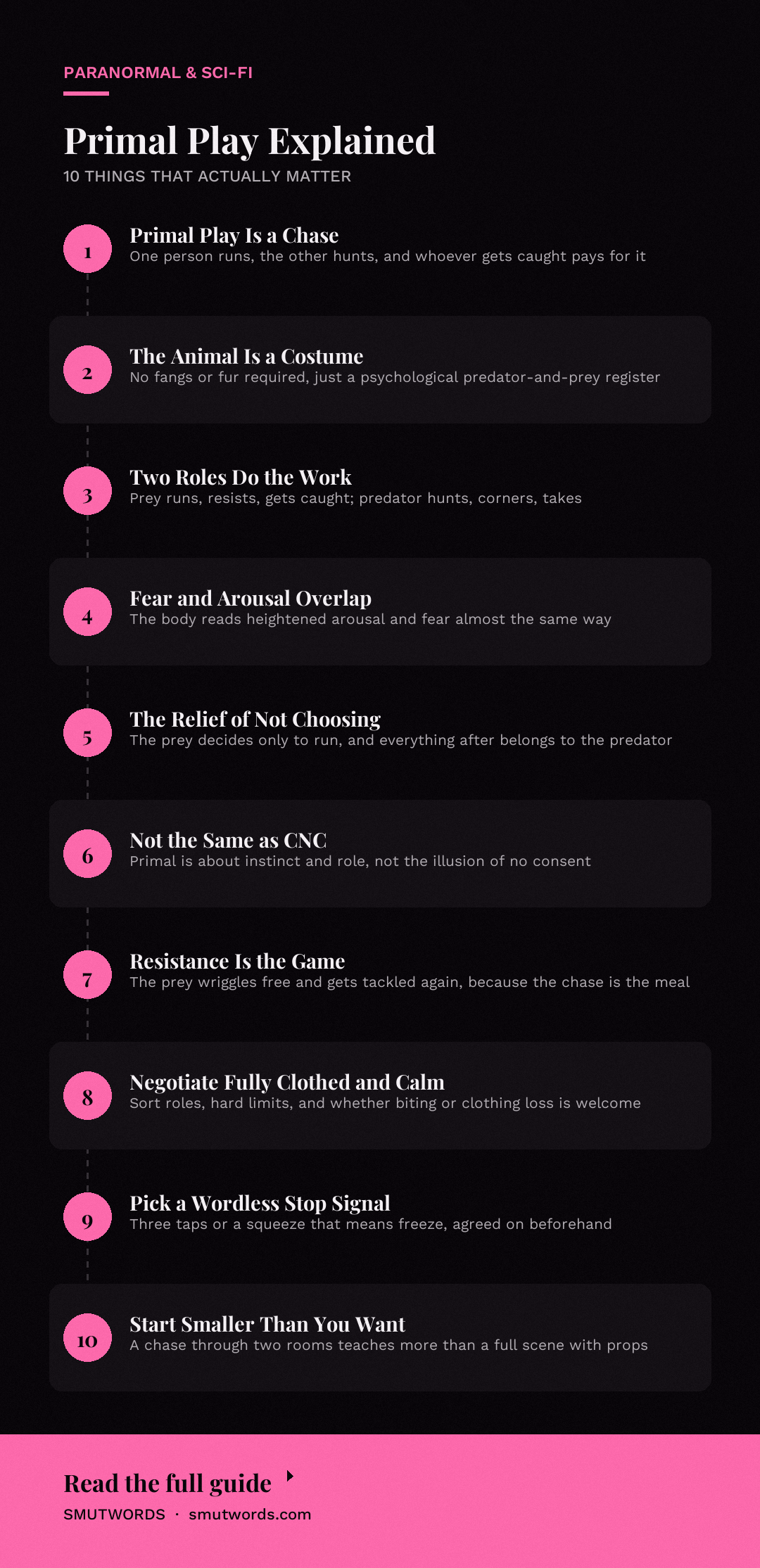
Primal play is the kink where the sex is a chase. One person runs, the other hunts, and whoever gets caught pays for it. If you've read a fated-mates shifter book and felt your pulse spike during the scene where the wolf finally corners his mate against a tree, you already understand the appeal on instinct.
Primal play kink explained in plain terms is this: adults, fully consenting, acting out predator-and-prey dynamics that our bodies seem to recognize long before our brains catch up. No fangs required. No fur. The animal is a psychological costume, and it fits better than most people expect.
The fantasy borrows its grammar from the same place fated-mates and shifter romance borrows theirs. Something older than language takes over. The prey runs because running is thrilling. The predator hunts because the catch means something.
That's the whole engine, and once you've felt it working in fiction, the jump to wanting it in bed is a small one.
What Primal Play Actually Is
Primal play is a kink built around instinct, with one partner taking the role of hunter and the other the role of prey. Sometimes it's a chase across the house, sometimes it's a wrestling match on the floor, sometimes it's a growling, biting, scratching scramble with no chase at all.
The label covers a wide range, and that range is why the kink confuses newcomers. There's no universal script the way there is with something like rope bondage, where the tie itself is the point.
The defining feature is the animal register. During primal play, partners often drop language entirely and communicate through sound and body. Growls, bites, pinning, the scrape of nails. Sounds ridiculous written out.
Feels anything but ridiculous when you're the one pinned.
Two roles do most of the work:
- Prey. You run, you resist, you get caught. The pleasure is in the losing, and in the specific moment where losing stops being a fear and becomes a relief.
- Predator. You hunt, you corner, you take. The pleasure is in the single-minded focus, in wanting something so completely that nothing else in the room exists.
Plenty of people switch between the two depending on mood. Plenty more stay on one side for good. Neither is a personality test, whatever the internet tells you.
Why the Chase Fantasy Hits So Hard
Ask anyone sane and they'll tell you being hunted is a nightmare. Primal play works because it strips the danger out and leaves the adrenaline. Your body doesn't fully distinguish between the two when the heart starts going. Heightened arousal looks a lot like fear on a physiological readout, and primal play exploits that overlap on purpose.
There's also the relief of not choosing. In a chase scene, the prey doesn't decide when things happen. They decide only to run. Everything after that belongs to the predator.
If the negotiation happened before the scene started, that handing-over is the actual erotic payload. Chasing that feeling is why readers tear through novels with any hint of a mate instinct, why the wolf who hunts his mate down before he marks her has become a genre staple.
The mate bond and marking explained piece on this site goes into how that dynamic works on the page, and it maps almost one-to-one onto how it works in the bedroom.
Fiction is where most people meet this kink first. A book like Zorgon's Pet runs on exactly that current, a hunter and his captured prize, the prey's resistance melting into want because the body in the story already knows how this ends. Readers finish chapters like that and start wondering what the real version would feel like. That curiosity is usually the first brick.
Primal Play vs. CNC and Rough Sex
The terms get tangled constantly, so let's untangle them. Primal play overlaps with consensual non-consent and with plain rough sex, but it's not identical to either.
Rough sex is about intensity. Pulled hair, hard grips, a little soreness the next day. CNC is about the illusion of no consent, where partners act out a scenario in which one party says no and the no doesn't function as a real stop.
Primal play is about instinct and role. You can have primal play with very little physical roughness at all, just two people growling at each other on a bedroom floor. You can also stack all three together, which a lot of people do.
The distinction that matters most: primal play usually involves resistance as a game. The prey wriggles free and gets tackled again. The predator doesn't win immediately, because the chase is the meal. That push-and-pull separates it from most other forms of power exchange that move fast toward the conclusion.
Enjoyed this? Get a free book.
Join the list and we will send a complete free story straight to your inbox, plus new releases every week after that. No credit card, no catch.
If the hunt ends in ten seconds, nobody had any fun.
How It Works in Romance Fiction
The genre has been writing primal dynamics for decades without always using the term. Any scene where a character's control snaps and something animal takes the wheel is primal-adjacent. The shifter books do it best because they externalize the animal.
Shifter romance explained covers how the beast and the human share one body, which is exactly the tension primal play is built to recreate: the civilized self negotiating with the one that wants to bite.
Sci-fi works it differently, more often through environment than biology. A hunt across a hostile colony, a predator species with a rut cycle, a human stranger who triggers something territorial in a creature that shouldn't want a human at all.
Planet Of Orgasms plays the environment-as-aphrodisiac angle hard, and The Heir of Two Worlds gets the classic result of a predatory alien mate: the whole book turns on the question of what happens once the hunt succeeds. If you want the alien side of this trope at maximum dose, Alien Heatwave is a first-contact hunt, and Bred Beneath the Bio Domes drops the chase into a sealed biome where there's nowhere to run and the running wasn't the point anyway.
Notice the pattern in every one of those. The chase is foreplay. The capture is the plot. The aftermath is where the book lives.
The best versions spend real page time on the prey's decision to stop running once the predator has proven he can catch her. Primal play in fiction is rarely about who wins. It's about how surrender starts to feel like arrival.
Primal Play in the Bedroom: The Practical Version
Real primal scenes look less cinematic than the books. Your living room floor is not a moonlit forest. Someone still has to decide who's running first. That said, the mechanics are simple once you accept that the negotiated parts happen before anyone growls.
A few things that separate a scene people remember from one they'd rather forget:
- Negotiate when you're fully clothed and calm. Roles, hard limits, whether biting and scratching are welcome, whether clothing survives, and whether either of you has a knee that will betray you at a sprint.
- Pick one stop signal that works without words. A safe word is standard, but in a scene that runs on sound and body language, a physical tap works better. Three taps with the hand, or a squeeze that means freeze, agreed on beforehand.
- Manage the space, not just the mood. Chasing across stairs, in a kitchen, or through a room with a glass coffee table turns adrenaline into an ER visit fast.
- Communicate after. The predator especially needs it. Primal play can be more emotionally loaded than it looks, and checking in on both sides is what keeps it fun.
- Start smaller than you think you want. A chase through two rooms teaches you more about your dynamic than a full scene with props.
The physical language is where primal play pays off. Pinning, being pinned, biting, being bitten, growling instead of talking. If your taste runs toward the more intense end of that spectrum, the vocabulary overlaps with knotting explained, which covers the fantasy's more physical specifics for anyone who wants it.
Common Questions People Have About Primal Play
Do you need to be into BDSM to enjoy primal play?
No, but the skills transfer. Primal play borrows the negotiation, safe word, and aftercare habits of BDSM without requiring you to learn the gear. Many people who've never tied a rope still get a lot out of a scene that's purely instinct and role.
What if you want to be the prey?
That's most of the point of the fantasy, and it's exactly why it plays so well in fiction. The prey decides to run, and that decision is the consent that makes everything after it erotic. If you like books where the heroine makes that call, you probably already know what you want from a partner.
Is it the same as being stalked?
No, and the difference matters. Primal play is a scene you've agreed to with someone who is already in your life. A stalker romance is a different genre, a different fantasy, and one where the chase and the partner are the same without your consent. Separating them in your head is healthy; mixing them in real life is not.
Why does it show up alongside breeding kinks so often?
Primal play and the breeding kink share the same root: instinct overriding reason. The chase itself is often about being caught and claimed, and a claim in erotic fiction usually carries offspring in its wake. If that thread is your thing, breeding kink explained and impregnation kink explained are the deep dives to pair with this one.
Does it work if you're both switches?
Especially well. Switching mid-scene, where the cornered prey turns around and becomes the predator, is one of the most popular versions of the kink. It maps neatly onto any romance where power shifts during a fight, enemies to lovers included, and the enemies to lovers glossary entry spells out the dynamic that primal scenes are basically doing in the physical register.
The books keep finding fresh mileage in this because the fantasy has room. A hunt in a mountain town, a hunt in space, a hunt where the predator's own wolf is the thing he can't outrun. If you want a big stack to work through, the 50 best paranormal and sci-fi books list on this site is a solid starting shelf.
Final Thoughts
If you want the clearest version of this dynamic on the page, start with Milked in the Moonpit, which runs the chase instinct through a ritual scenario that keeps the prey caught in more ways than one. Read it, notice which moments make you stop reading for a second, and you'll know which side of the hunt you're on.







Loading comments…