
The bull dynamic is a relationship structure in erotic fiction where a dominant third party, the bull, is brought into an existing couple's sex life to satisfy one partner while the other watches, waits, or joins in on the margins. The bull takes the alpha role: bigger, hungrier, more sexually confident than the man he's replacing in bed. The cuckold partner gives up sexual access on purpose, and that surrender is the entire engine of the story.
Read enough of it and you notice the mechanics repeat with almost ritual precision. Read closely, though, and you see how much range the form actually holds, from comedies of humiliation to slow-burn romances where the third party becomes something closer to a co-conspirator than an intruder.
What Bull Dynamic Actually Means
The term comes from animal husbandry by way of porn and romance publishing: a bull is brought in to breed, and everyone involved agrees to that purpose. In fiction, the word describes both a role and a relationship shape. The bull is the man with sexual access. The cuckold is the man whose access has been revoked or shared by choice.
The partner in the middle, usually a wife or girlfriend, is the one whose desire drives the whole arrangement forward.
The bull dynamic is not the same thing as a love triangle, even though both involve three people. A love triangle runs on indecision and competing claims on one person's heart. The bull dynamic runs on a settled hierarchy. There is no ambiguity about who is in charge of the bedroom, and the tension comes from watching that hierarchy hold, strain, or collapse.
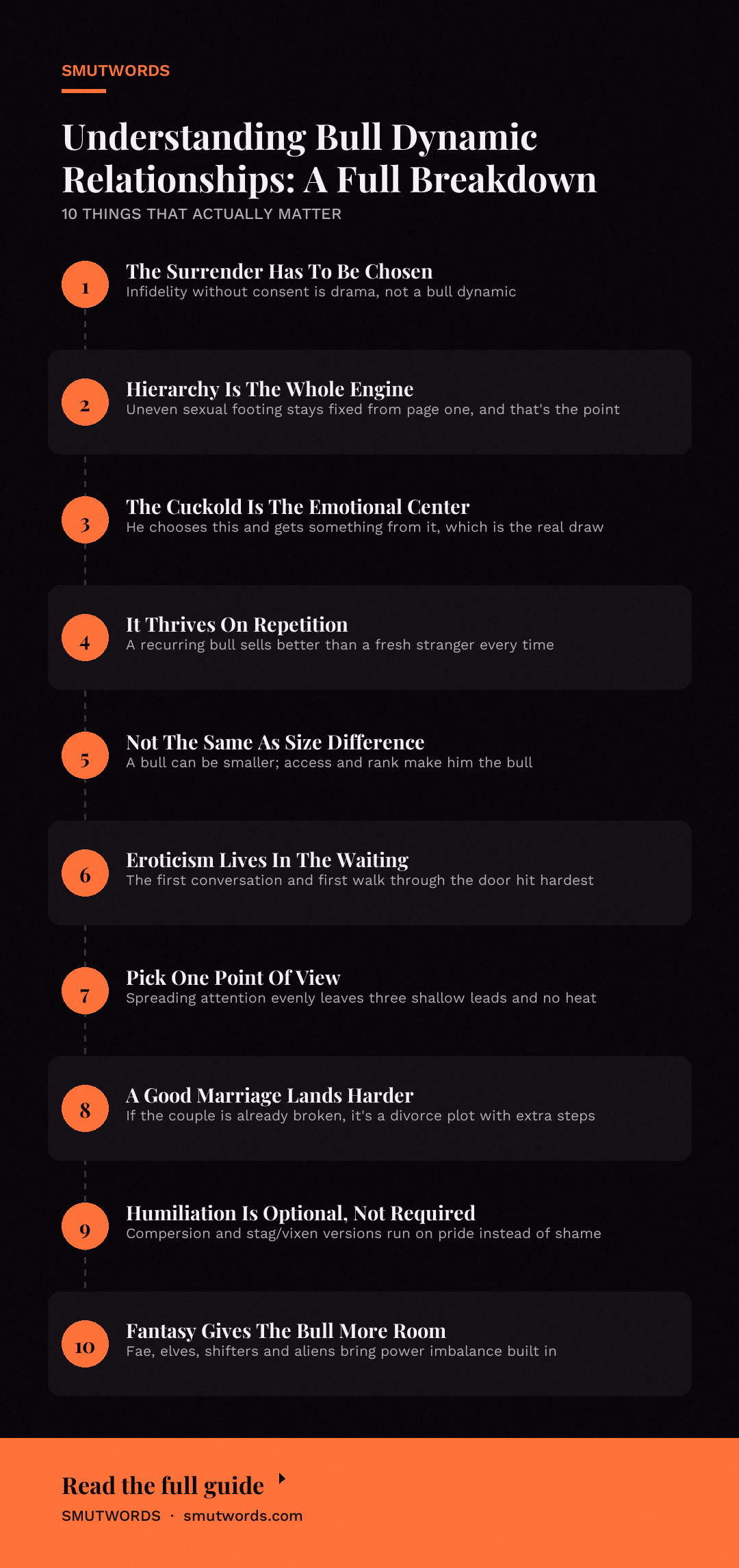
It's also not simply a threesome with a domineering guest star. In a threesome scene, all three parties usually have roughly equal sexual footing by the end. In a bull scene, the footing is deliberately uneven from the first page and stays that way. The bull's advantage is the point.
Common misconceptions cluster around the cuckold's role. Readers new to the dynamic sometimes assume the cuckold is passive, pathetic, or being victimized. The better-written versions make him the emotional center of the story: he is choosing this, he is getting something out of it, and his desire is often the most complicated thing on the page. The humiliation and the pleasure are braided together, not stacked in opposition.
A few things that don't count, so the edges are clear:
- A scene where one partner cheats without consent and the other is devastated. That's infidelity drama, not a bull dynamic. The surrender has to be chosen.
- A dominant who simply tops both partners equally. Without the hierarchy among the men, the specific charge of the bull role disappears.
- A one-off guest appearance with no continuing relationship. The bull dynamic works on repetition and return, which is why it thrives in series and serial fiction.
Where Bull Dynamic Comes From
The fantasy has deep roots in cuckold literature, which stretches back centuries across folklore and bawdy storytelling, but the word "bull" as a named role is a much more recent publishing phenomenon. It migrated from porn vocabulary into written erotica in the 1990s and 2000s, then into mainstream romance with the hotwife boom of the 2010s.
Ebook publishing did most of the heavy lifting. Once self-publishing made niche erotic categories profitable, "cuckold" and "hotwife" became their own searchable shelves, and writers figured out fast that a recurring bull character sold better than a fresh stranger every time. A named bull gives readers someone to anticipate. He becomes a feature, not a plot device.
The portrayal has shifted in a few visible ways over that span. Early versions leaned hard on degradation and often ended with the cuckold humiliated and the marriage in ruins. Contemporary versions more often end with the couple stronger, more communicative, and more honest about their desires.
Therapy-speak has crept in. Aftercare scenes are now common in the kinkier corners of the genre, and the bull himself has gotten more interiority: he has a backstory, sometimes a conscience, occasionally a rival.
The other shift is genre drift. The dynamic now shows up well outside contemporary romance.
You find bull-adjacent structures in pack mates romance, where an alpha's claim on a mate echoes the same hierarchy. You find them in alien breeding trope stories, where the third party is a conquering outsider and the surrender is species-level rather than domestic. The vocabulary changes. The shape doesn't.
How It Shows Up in Erotica
The craft question with a bull dynamic is almost always the same: whose head are we in?
Point of view determines which version of the story the reader gets. From the cuckold's perspective, the book becomes a study in ambivalence, jealousy and arousal firing at once, every sound from the next room doing double duty as torture and gift.
From the partner's perspective, it becomes a story about appetite and what it costs to admit to it. From the bull's perspective, rarer but potent, it becomes a story about power, appetite, and the strange intimacy of being let inside a marriage and then asked to leave. Strong versions pick one and commit. Flat versions try to spread the attention evenly and end up with three shallow leads and no heat.
The second craft lever is pacing the reveal. A bull dynamic builds on anticipation more than on the sex itself. The couple's first conversation about it, the first time the bull walks into the house, the first time the cuckold hears something through a wall: those beats carry more charge than any explicit scene that follows. Editors who read a lot of this genre will tell you the same thing, which is that the eroticism lives in the waiting.
The third lever is the couple's prior relationship. The dynamic lands harder when the marriage or partnership is genuinely good before the bull arrives. If the couple is already broken, the story turns into a divorce plot with extra steps. If they're solid, the bull becomes a stress test that reveals something true, and that revelation is the emotional payoff.
Common variations writers reach for:
Enjoyed this? Get a free book.
Join the list and we will send a complete free story straight to your inbox, plus new releases every week after that. No credit card, no catch.
- Watching husband. The cuckold stays present in the room, sometimes in a chair, sometimes bound, always watching. The voyeurism is the kink.
- Stag and vixen. The cuckold is an active participant in the arrangement, more compersion than humiliation. He's proud, not ashamed.
- Breeding bull. The bull's role is reproductive. This variant slots neatly into size difference romance territory, where physical contrast intensifies the hierarchy, and into breeding-focused alien stories where the outsider's seed is the whole plot.
- Shared wife. The surrender is temporary and recurring, often on a schedule. The bull is a fixture in the couple's calendar.
- Bull as catalyst. The bull isn't the point. He's the thing that cracks the couple open and forces a long-overdue conversation. This is the variant that gets the most literary respect, and the one most likely to show up in a series with a slow arc.
What separates a strong bull dynamic from a flat one usually comes down to whether the bull has a personality beyond his anatomy. The best bulls in the genre are charming, a little dangerous, and clearly enjoying themselves. The worst are walking measurements.
Readers remember the bull who plays nice with the cuckold for a while before reminding him who's in charge. Nobody remembers a set of stats.
The cuckold's interior voice is the other make-or-break element. If he's only allowed to be embarrassed, the story goes stale within a chapter. If he's allowed to be embarrassed and turned on and furious and grateful, sometimes in the same paragraph, the story has somewhere to go. The genre's best books are interior monologues with sex scenes hung on them, not the reverse.
Bull Dynamic vs Size Difference Romance
These two overlap often enough that readers sometimes assume they're the same thing. They aren't. Size difference romance describes a physical contrast between two partners, and the dynamic is driven by that contrast: one partner is smaller, the other larger, and the eroticism lives in how they fit together and how the mismatch plays out in bed, in public, in daily life.
The bull dynamic is a relationship structure. Not a physical one.
A bull can be the same height as the cuckold. He can be smaller. What makes him the bull is the sexual access and the hierarchy, not his measurements.
The two often stack, especially in breeding and shifter-adjacent stories, because size reinforces hierarchy on the page. A writer leaning only on size to sell the bull role is a writer who's skipped the harder work. The rest of the list comes down to relationship mechanics, not bodies.
Worth saying plainly: the dynamic also shows up in fantasy genres where the third party is something other than a man. Fae and elf variations lean on the same structure with an immortal outsider as the bull, and the power imbalance comes from age and magic as much as from muscle.
Fae romance especially likes the arrangement, because faerie bargains are the genre's native way of writing a chosen surrender. Elf romance does it with the same outsider-catalyst logic and a longer lifespan for the jealousy to curdle against.
None of it is a strict bull story, but the gear works the same way.
Frequently Asked Questions
What is a bull in a relationship?
In this genre, a bull is the dominant third party a couple brings in, usually to have sex with one partner while the other watches or participates on the sidelines. The word comes from animal breeding and carries that connotation even in domestic settings. In real life, the role is defined entirely by what the couple has agreed to and nothing else.
Is a bull dynamic the same thing as cuckolding?
They overlap but aren't identical. Cuckolding is the broad fantasy of watching your partner with someone else. The bull dynamic is the specific structure where that third party takes a named, dominant role and the hierarchy between the two men is the central feature. Every bull story is a cuckolding story, not the other way around.
What's the difference between a cuckold and a stag?
Attitude, mostly. A cuckold in the classic version leans into humiliation and submission; he's being shown what he can't do.
A stag is proud of his partner and gets off on her having a good time without the degradation angle. The scenes can look identical from the outside. The interior monologue is what separates them.
Why is the bull always written as more dominant?
Because the dynamic runs on a hierarchy that has to be legible from page one. If the two men are evenly matched, there's no surrender, and the cuckold's choice stops meaning anything. The bull's dominance is a structural load-bearing wall in the story, which is why he's written the same way across subgenres even when the specific vocabulary changes.
Does the cuckold have to be humiliated for a bull dynamic to work?
No. Plenty of strong stories run on compersion or on the cuckold's own pleasure at watching, with no degradation angle at all. Writers who use humiliation tend to earn it by making sure the cuckold's desire is doing the narrating, not the writer's judgment. The turn-on has to be his, not the author's.
How does this dynamic work in fantasy and paranormal romance?
Fantasy settings give the third party more room to be genuinely other: fae, elves, shifters, and aliens all slide into the bull role easily because they already come with built-in power imbalances. Alien breeding trope stories are the clearest example, since the outsider's claim on the couple's future is the whole premise.
Does the real-life version of this dynamic require the cuckold's consent?
Yes, and ongoing consent from every party, including the woman in the middle. In real practice, this dynamic runs on explicit boundaries: what the bull is and isn't allowed to do, what the couple will and won't share, and a clearly stated way for anyone to call a stop. Erotica compresses those conversations for pacing. Real arrangements live or die on them.
Final Thoughts
The bull dynamic rewards writers who understand that the hierarchy is a promise, and the whole book is about whether the promise holds. If you want to see the structure at its most controlled, pick up a title where the bull is a recurring character across multiple books and watch how the author paces his returns. That's where the form shows its bones.






Loading comments…