Grumpy/sunshine is the romance trope where one character wakes up irritated at the sun and the other one is the sun. A brooding, clipped, emotionally armored love interest gets paired with a warm, chatty, relentlessly optimistic one, and the whole book runs on the friction between them until the grump's walls come down.
It is one of the most reliably satisfying dynamics in romantic fiction, and it shows up everywhere from small-town contemporaries to monster breeding romance to office rom-coms with a scowling boss and an assistant who brings him homemade muffins he claims not to want.
The appeal is simple and a little feral: readers want to be the exception. The grumpy/sunshine trope sells the fantasy that one specific person's warmth is enough to crack a lifetime of coldness. The reward for all that patience is a love interest who is soft only for you.
What Grumpy/Sunshine Actually Means
At its core, the trope is a two-hander built on contrast. One protagonist is closed off, blunt, often rude, occasionally outright hostile to the world. The other is open, generous with affection, quick to smile, and irritatingly unbothered by rejection. The engine of the story is the collision between those two temperaments.
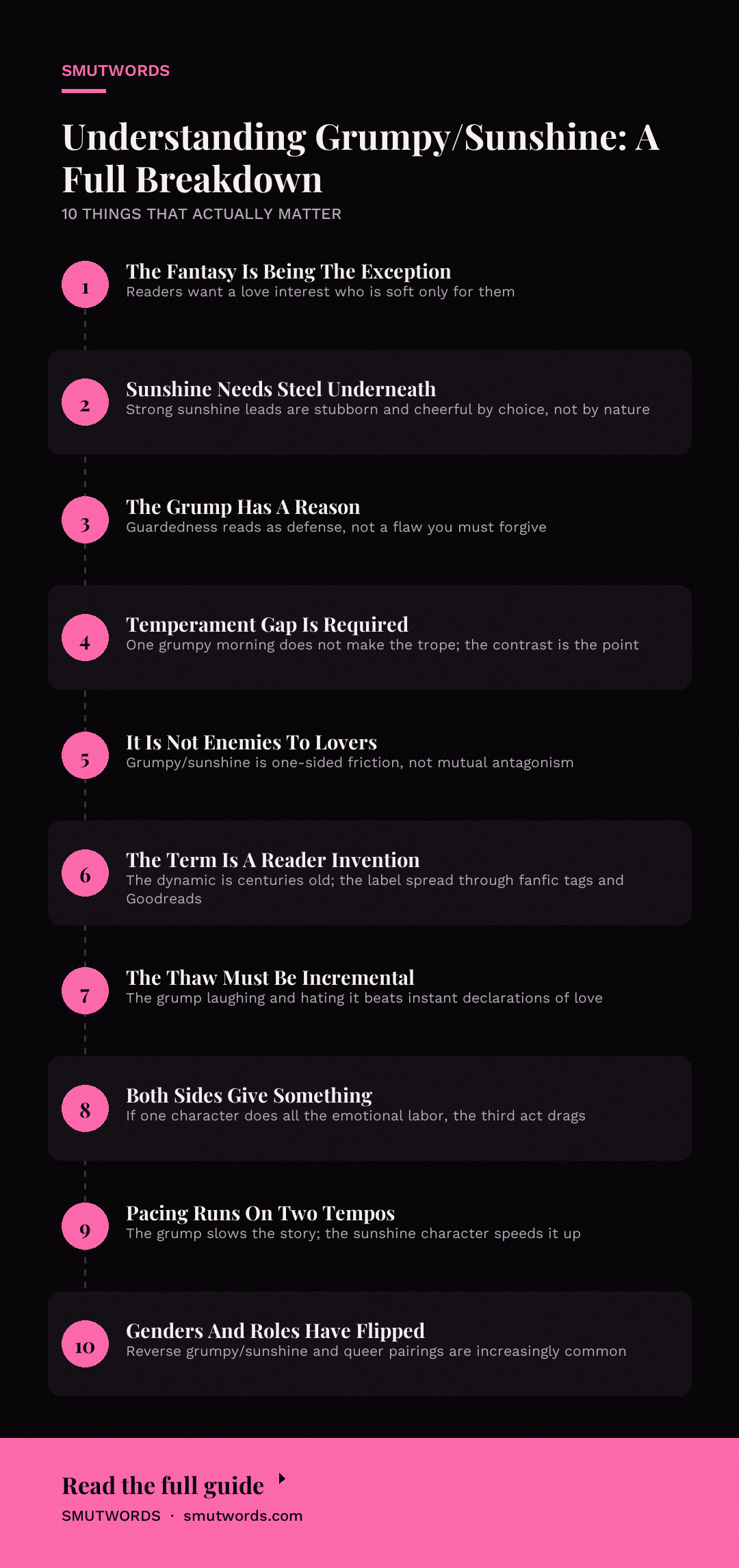
The "sunshine" character is not simply nice. A strong sunshine lead has steel underneath. They are stubborn, they have their own problems, and their cheerfulness is often a coping mechanism rather than an absence of pain. The best versions of the trope make the sunshine's optimism a choice, which is why the grump's eventual softening feels earned instead of magic.
Likewise, the grump is not a monster. They are guarded, wounded, or overworked, and their rudeness reads as a defense mechanism rather than a personality flaw the book is asking you to forgive. When the trope is written well, you understand why the character built the wall before you watch it come down.
What counts as grumpy/sunshine
- One lead is notably cold, terse, or irritable; the other is notably warm, expressive, or upbeat.
- The contrast is the point. The book leans into the mismatch instead of smoothing it over early.
- The sunshine character's persistence is a plot driver, not a background detail.
- The grump's thaw is gradual and specific. You can point to the exact scene where they laugh for the first time.
What doesn't count
A single grumpy morning does not make a grumpy/sunshine book. Neither does a couple where both leads are prickly but one smiles more often. The trope requires a real temperament gap and a story that keeps returning to it.
The trope also gets confused with enemies to lovers, and the two overlap, but they are not the same thing. Enemies to lovers runs on mutual antagonism and a power struggle. Grumpy/sunshine runs on one-sided friction, where the sunshine character simply refuses to be an adversary. You can have both at once, and plenty of books do, but the emotional machinery is different.
Where Grumpy/Sunshine Comes From
The dynamic is old. You can trace it through nineteenth-century fiction, where stern, emotionally constipated men get paired with lively, feeling women who thaw them by sheer force of personality. Jane Austen's Darcy reads as a proto-grump, and the entire marriage-plot tradition that followed her leaned on the same contrast: cold reserve meeting warm vitality.
As a named, recognizable trope, though, grumpy/sunshine is a product of the modern romance publishing boom. The label itself spread through reader communities, fanfiction tags, and Goodreads shelves in the 2010s, then migrated into publisher marketing copy once the industry noticed readers were searching for it by name. That is the honest history: the dynamic is centuries old, but the term is a reader-driven invention that became a sales category.
The evolution since then has been mostly in who gets to play each role. Early versions skewed heavily toward a stern man and a bubbly woman. Contemporary romance has flipped the genders, queered the pairing, and pushed the sunshine character into roles that used to be reserved for the grump, like the hard-nosed executive who softens for exactly one person.
The grump has also gotten younger and hotter, trending away from "emotionally unavailable scold" toward "traumatized sweetheart with a bad attitude."
There has also been a shift in how the thaw is portrayed. Older versions treated the sunshine character's job as fixing the grump. Newer books are more careful: the grump does their own emotional work, and the sunshine character's role is to make that work possible by refusing to leave.
How It Shows Up in Erotica
On the page, grumpy/sunshine is a pacing tool as much as a character dynamic. The grump slows the story down. They hesitate, deflect, snap, and pull away.
The sunshine character speeds it up. They close distance, ask direct questions, and keep reaching. The push-pull between those two tempos is what makes a slow burn feel slow and an eventual payoff feel explosive.
In explicit scenes, the contrast does a lot of heavy lifting. A grump who is verbally restrained and physically reverent is a very specific, very popular flavor. So is the inverse: a character who is cold to everyone else and shockingly uninhibited behind a closed door.
The trope gives an author a built-in reason for a character to be rough with the world and tender with one person, and readers eat that up because the tenderness reads as exclusive.
Editors see a lot of flat versions. The flat grump is rude for no reason and thaws on schedule. The flat sunshine is cheerful with no interior life, which makes them a cheerleader instead of a character. The fix is almost always specificity: give the grump a reason for the armor, and give the sunshine a private cost for wearing that much optimism.
Enjoyed this? Get a free book.
Join the list and we will send a complete free story straight to your inbox, plus new releases every week after that. No credit card, no catch.
Common variations that work
- Grumpy boss, sunshine employee. Power imbalance plus forced proximity. The tension is professional before it is personal.
- Grumpy small-town loner, sunshine newcomer. Common in lumberjack romance and the wider cozy contemporary space.
- Grumpy bodyguard or soldier, sunshine civilian. Common in soldier romance, where the grump's guardedness has a professional rationale on top of a personal one.
- Grumpy dad, cheerful nanny. Domestic, tender, and usually slower burning. The kids are often the first ones the grump softens for.
- Two grumps, one sunshine. A love triangle variant where the sunshine character is the emotional hinge between two closed-off leads.
- Reverse grumpy/sunshine. The cheerful one is the hardened one underneath, and the scowling one is the secret romantic. Increasingly common.
The genre setting changes the texture of the trope without changing its bones. A grumpy/sunshine pairing in cyberpunk romance reads colder and more dangerous, with the sunshine character's warmth framed as a liability. The same pairing in a motorcycle club romance reads hotter and more territorial, with the grump's hostility doing double duty as protectiveness.
Grumpy/sunshine also pairs naturally with almost any premise that requires two people to be stuck together. A secret identity romance uses the trope to build a gap between who the grump thinks the sunshine character is and who they actually are. A marriage-of-convenience or marriage in trouble plot uses it to explain why the couple stopped talking in the first place. The bull dynamic is another place the same asymmetry shows up, with one partner's steadiness absorbing the other's chaos.
What makes a strong version work
The strongest grumpy/sunshine books give the sunshine character a reason to keep reaching that has nothing to do with the grump. They are warm because that is who they are, not because they have been assigned a repair job. When the warmth is unconditional, the grump's eventual choice to accept it feels like a real change instead of a reward for persistence.
The strongest versions also let the grump give something back. A trope where one character does all the emotional labor gets exhausting by the third act. The books readers return to are the ones where the grump's loyalty, steadiness, or willingness to burn the world down for one person is the thing that saves the sunshine character in return.
And the thaw has to be incremental. A grump who goes from monosyllables to declarations of love in one chapter reads as a plot convenience. A grump who laughs at something the sunshine character says in chapter nine, hates that they laughed, and thinks about it for two days is a character.
Grumpy/Sunshine vs Enemies to Lovers
These two get tangled up constantly, so it is worth separating them. Enemies to lovers requires mutual antagonism. Both characters are fighting, both have something to lose, and the arc is about moving from opposition to alliance.
Grumpy/sunshine is asymmetrical. Only one character is fighting. The sunshine character's defining move is that they will not engage in the war, which is exactly what drives the grump up the wall. The grump has no one to fight, only someone to resist.
You can stack them. Plenty of books open with genuine enemies and resolve into a grumpy/sunshine rhythm once the animosity burns off and what is left is one irritable person and one patient one. But if a book's central conflict is that both leads hate each other, that is enemies to lovers, and the grumpy/sunshine label is doing extra work it does not need to do.
There is also real overlap with redemption arc romance. Some grumps are grumpy because they have done something terrible and cannot forgive themselves, which turns the thaw into a forgiveness story. That is a heavier book than the average grumpy/sunshine read, and it lands differently.
Frequently Asked Questions
What is the grumpy/sunshine trope?
It is a character pairing where one lead is cold, irritable, or emotionally closed off and the other is warm, cheerful, and persistent. The story follows the slow dismantling of the grump's defenses, usually interleaved with plenty of sexual tension and a hard-won emotional payoff.
Is grumpy/sunshine the same as enemies to lovers?
No. Enemies to lovers needs hostility from both sides. Grumpy/sunshine only needs it from one, because the sunshine character's refusal to fight back is the trope's defining feature. The two dynamics can appear in the same book, but they are not interchangeable.
Why do readers love grumpy/sunshine so much?
Because it flatters the fantasy of being the exception. The grump is rude to everyone and soft for one person, and that exclusivity is the hook. It also offers a hopeful story about difficult people being lovable without having to become different people first.
Can the grumpy character be a woman?
Absolutely, and the reverse-grumpy variation is one of the fastest-growing versions of the trope. A scowling, overworked heroine who melts for a soft, sunny love interest hits the same beats from the other direction, and the sexual dynamic reads just as charged.
Does grumpy/sunshine work without explicit sex scenes?
Yes. The trope runs on emotional contrast and proximity, so it functions in closed-door romance just as well as in explicit smut. The tension is built from small moments of contact and retreat, and those land regardless of how much happens on the page.
What makes a grumpy/sunshine book bad?
When the sunshine character has no life outside of fixing the grump, or when the grump's hostility is never addressed. A thaw that arrives without the character doing any real work reads as wish fulfillment with no stakes, and readers notice immediately.
Final Thoughts
Grumpy/sunshine works because it is one of the few tropes that gives you both a slow burn and a guaranteed payoff. You know the wall comes down. The whole pleasure is in watching how, and how badly the grump resists on the way.
It plays well across settings, from a snowy small town to a corporate high-rise to a haunted forest with a scowling monster who cannot stand how much he likes the human who keeps showing up at his door. If you want a version where the grump's coldness has a genuinely dangerous edge to it, start with Stalker Romance: Everything You Need to Know and work outward from there. The thaw hits harder when the wall was built for a reason.







Loading comments…