
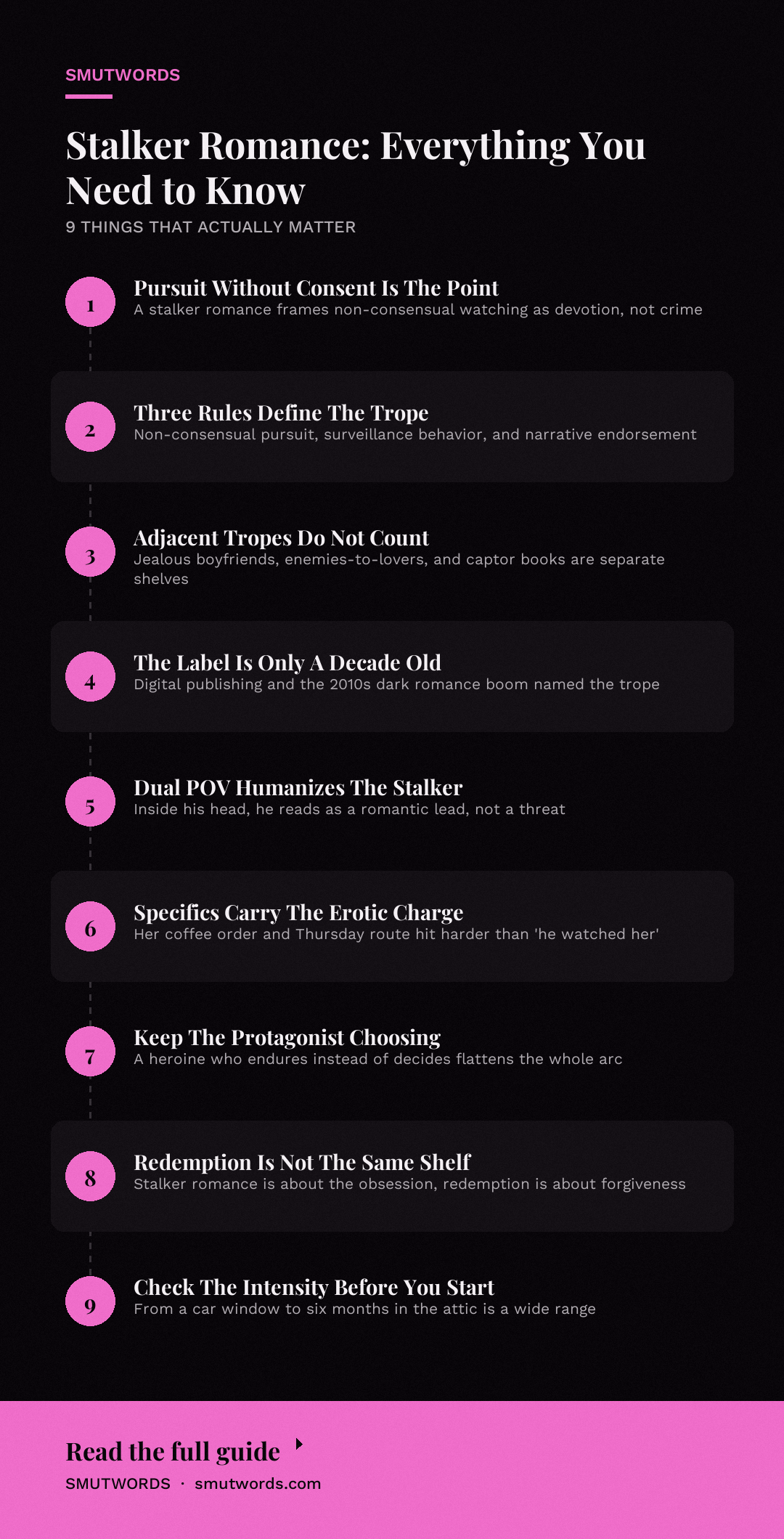
A stalker romance is a romance novel where the love interest watches, follows, tracks, or otherwise pursues the protagonist without consent, and the story frames that pursuit as devotion rather than crime. The obsession is the point. He knows her schedule, her apartment layout, the name of her cat.
She finds out, and instead of filing a police report, she feels wanted. Stalker romance lives inside dark romance and shares DNA with possessive-hero and forced-proximity stories. Its defining feature is surveillance: the plot runs on one person knowing far more about the other than they've been given.
That's the fantasy on offer, and it's a durable one. The genre sells the idea of being so singularly desired that someone reorganizes their entire life around you. The taboo supplies the charge a normal courtship can't. It outsells almost everything adjacent to it, and it has for years.
What Stalker Romance Actually Means
The term borrows its name from the legal and cultural concept of stalking: repeated, unwanted attention that induces fear. Romance flips the emotional valence. In a stalker romance, the attention stays unwanted on paper, but the protagonist's interior reaction shifts from fear to arousal to attachment across the arc. By the final act, the watching has been reframed as a love language.
What counts as stalker romance depends on three things working together:
- Non-consensual pursuit as a structural engine. The love interest acts without permission, and that acting drives the plot. If he asks her out and she says yes, that's a different book.
- Surveillance or proximity-seeking behavior. Following, watching, tracking a phone, showing up uninvited, installing cameras, memorizing her routine, or inserting himself into her life under a false identity.
- Narrative endorsement. The book treats the obsession as love, or as something that becomes love. This is the load-bearing wall. A thriller with the same plot, where the stalker is the villain and gets arrested, is not a stalker romance.
What doesn't count is worth stating plainly, because the term gets stretched. A jealous boyfriend who checks her texts once is not a stalker romance. An enemies-to-lovers story with a hostile first act isn't either, no matter how intense the hostility.
Neither is a captor romance where the woman never leaves the house; that's captivity, a related but separate shelf. Stalker romance specifically requires the pursuit to happen across space, with the protagonist moving through her ordinary life while someone shadows it.
The most common misconception is that the whole genre is one flavor. It isn't. There's a wide gap between a book where he watches her from a car and one where he's been living in her attic for six months, and the readership for those two books overlaps only partly. The intensity dial matters as much as the trope itself.
Where Stalker Romance Comes From
The obsession plot is old, but its life as a named, marketed category is young. Gothic fiction ran on it for two centuries: the brooding man with a secret, the woman who senses she's being watched, the house that keeps its own counsel. Wuthering Heights and Rebecca both traffic in a possessive fixation that reads as romantic because the prose insists it is.
What changed is the marketing. Through the 1980s and 1990s, the possessive hero was an accepted feature of category romance, but publishers didn't label it. The behavior was there (the hero who buys her building, the hero who has her followed for her own safety) and it was sold under the generic banner of a strong alpha male. Readers had no word for it, so they traded recommendations by describing the plot instead of naming the trope.
The label arrived with digital publishing and the dark romance boom of the 2010s. Independent authors, publishing directly and without a marketing department to answer to, wrote the obsession more explicitly and named it honestly in their metadata. Once "stalker romance" became a searchable phrase, it turned into a genre marker with its own expectations, cover conventions, and reader communities.
Traditional publishing followed about five years behind. The big houses now publish the same dynamic with softer language on the back cover.
Two adjacent developments shaped the current version. First, the rise of dual-POV dark romance let authors show the stalker's interiority directly, which makes him legible as a romantic lead rather than a threat. Second, the popularity of morally gray love interests across fantasy, motorcycle club, and mafia romance normalized the idea that the man's ethics don't have to clear a bar for the book to work.
The genre has also gotten more careful. Early examples often played the surveillance for pure menace and let the heroine's fear stand unexamined. Recent books tend to spend more page time on her internal conflict, her agency in choosing to stay, and the moment she stops being a target and starts being a participant. That shift is a craft improvement, not a moral correction: it makes the arc land harder.
How It Shows Up in Erotica
On the page, stalker romance is a machine for building tension out of information asymmetry. He knows where she is. She doesn't know he knows. Every scene carries that gap, and the erotic charge lives in it.
Strong versions handle the reveal as a structural beat, not a twist. There's usually an early scene where she notices something small (a jacket on her chair, a text from a number she didn't give out), and the book lets her notice it without resolving it. Then the watching escalates in visible steps.
Then the confrontation. Then, crucially, the negotiation: what she wants now that she knows.
The strongest books in this trope do a few things consistently.
- Ground the surveillance in specifics. Not "he watched her," but the coffee she ordered, the third-floor window, the fact that he knows she takes the long route home on Thursdays. Vagueness kills the frisson. Detail creates it.
- Keep the protagonist active. The flat version has her as a passive object of pursuit. The version that sells has her making choices: confronting him, testing him, using him, deciding to stay. Even a submissive heroine needs volition, or the book stops being romance and starts being a case study.
- Let the danger be real inside the fiction. If his obsession has no cost, there's no stakes, and no stakes means no payoff. He should lose something. She should be genuinely afraid at least once, and the fear should be honored rather than waved away.
- Earn the reframe. The leap from "this man is a threat" to "this man is my person" is the whole arc. A single grand gesture doesn't earn it. A pattern of behavior she can interpret, plus her own hunger for the intensity, does.
Common variations change the flavor without changing the skeleton. In mafia and organized-crime settings, the watching comes with institutional power, which raises the stakes and gives the love interest legitimate authority to make surveillance look like protection. That framework overlaps heavily with motorcycle club romance, where the club functions as a surveillance apparatus with a patch.
In rockstar and celebrity settings, the obsession is filtered through fame: he tracks her because thousands of strangers already track him, and the asymmetry of who gets watched is part of the erotic architecture. See rockstar romance for how that plays out on tour.
Enjoyed this? Get a free book.
Join the list and we will send a complete free story straight to your inbox, plus new releases every week after that. No credit card, no catch.
Tech-forward versions lean on phones, cameras, and location data. Here the trope runs close to cyberpunk romance, where the surveillance is ambient and the question becomes who owns whose data. Military and security settings give the love interest a professional excuse for tracking skill, which is the engine of a lot of soldier romance.
Monster and paranormal versions externalize the instinct. A creature that hunts by scent, that marks territory, that cannot stop tracking its mate, maps the stalker dynamic onto biology. That's the territory of monster breeding romance, and it's one of the cleanest fits for the trope because the obsession requires no justification within the world.
The scenes themselves run a predictable range. Watched-from-a-distance scenes build arousal through the protagonist's awareness of being seen, which is close kin to exhibitionism and voyeurism. Confrontation scenes are where the power flips and the sex usually starts, because the moment she calls him out is the moment the asymmetry breaks.
Post-reveal scenes are where the book either succeeds or collapses. If she capitulates instantly, the tension evaporates. If he abandons the obsession entirely, the fantasy evaporates. The good ones find the middle, where she gives him a rule and he keeps it, or breaks it and pays a price she set.
One craft note about consent on the page. The genre's whole premise requires the initial acts to be non-consensual, but the sex itself usually stays within a consensual frame, or goes deliberately into non-consent fantasy territory with clear signals.
Authors who blur that line carelessly, without the internal scaffolding that tells the reader what game is being played, lose readers fast. The related problem shows up in degradation kink versus humiliation kink, where the same act reads as hot or as cruelty depending entirely on how the scene frames it.
A note on what makes a flat version, since it's easier to name than the good one. Flat stalker romance has a love interest with no interior life, a heroine with no reaction beyond blushing, and surveillance with no consequences. It reads as a list of behaviors rather than a relationship. The fix is almost always the same: give her something she wants that he can provide, and make him want something she hasn't decided to give.
Stalker Romance vs Redemption Arc Romance
These two get lumped together constantly, and the confusion is real. Stalker romance is about the obsession itself: the watching, the pursuit, the fact that the love interest's behavior would be criminal in the real world. Redemption arc romance is about a character who has done something wrong and the story of how they earn their way back into the reader's and the protagonist's good graces.
Most stalker romance includes a redemption element, because the love interest's behavior needs to be reframed, and reframing is what redemption does. But the two aren't the same. A book can be a redemption arc without any stalking: an ex-con, a former villain, a man who ruined her family. And a stalker romance can skip redemption entirely, with a love interest who never apologizes and never needs to, because the book treats the obsession as already justified.
If you're choosing between shelves, the question is what the book is actually about. If the tension comes from whether he can be forgiven, it's redemption. If the tension comes from whether she'll let herself want what's watching her, it's stalker romance.
Frequently Asked Questions
Is stalker romance the same as dark romance?
Stalker romance is a subset of dark romance, which is a broad umbrella covering captivity, blackmail, mafia, and morally gray love interests of every kind. Not all dark romance involves stalking, and stalker romance can technically exist outside dark romance in lighter contemporary settings, where the obsession stays short of anything physically threatening.
Why do people read stalker romance?
The core appeal is being wanted beyond reason. Someone who knows your routine, your favorite drink, and the exact minute you leave work is someone for whom you are the center of the universe, and that intensity is the fantasy. The taboo provides the thrill, and the guaranteed safety of fiction lets readers enjoy the danger without the actual risk.
Does stalker romance always have a happy ending?
The romance genre contract generally requires one, and most stalker romance delivers: the couple ends up together, with the obsession integrated into the relationship rather than punished. Some authors write endings where the heroine leaves, but those books are usually marketed as dark fiction or romantic suspense rather than romance, precisely because the ending breaks the contract.
What's the difference between a possessive hero and a stalker?
A possessive hero wants exclusivity and gets jealous; his behavior often stays inside the relationship. A stalker love interest pursues before and outside the relationship, gathering information the protagonist didn't volunteer and appearing where he wasn't invited. Plenty of books have both, which is why the terms get used interchangeably, but the surveillance is the stalker's signature.
Is stalker romance only written in first person?
No, but first person and dual point of view dominate, because the trope depends on access to interior thoughts. Dual POV in particular lets the reader into the love interest's head, which is where the obsession gets humanized. Third-person stalker romance exists and works, but usually leans harder on dramatic irony to create the same effect.
Where can I find stalker romance recommendations?
Look for tags like obsessive hero, dark romance, possessive male lead, and forced proximity, which tend to cluster around this trope on every major romance retailer. Reader communities on social platforms are also reliable, since the trope has a devoted following that reviews and ranks titles by intensity level.
One related trap worth naming: readers often arrive here looking for a specific intensity and get handed something far harsher, or far milder, than they wanted. Check the content warnings. They exist for exactly this reason, and the range within stalker romance is wider than the single label suggests.
If the obsession plot is your entry point into forbidden dynamics generally, forbidden love covers the broader cultural ground this trope sits on. And age gap smut versus age gap romance addresses the power-imbalance question that shows up in almost every stalker romance with a significant age difference between leads.
Final Thoughts
Stalker romance works when the book takes the obsession seriously: specific, escalating, consequential, and paired with a protagonist who chooses rather than merely endures. Skip the version where the love interest is a checklist of creepy behaviors with no interior life and the heroine is a mannequin. Start with the books readers keep recommending for the reveal scene, the one where she finds out and the floor drops, and see whether the rest of the arc earns that moment back.






Loading comments…