
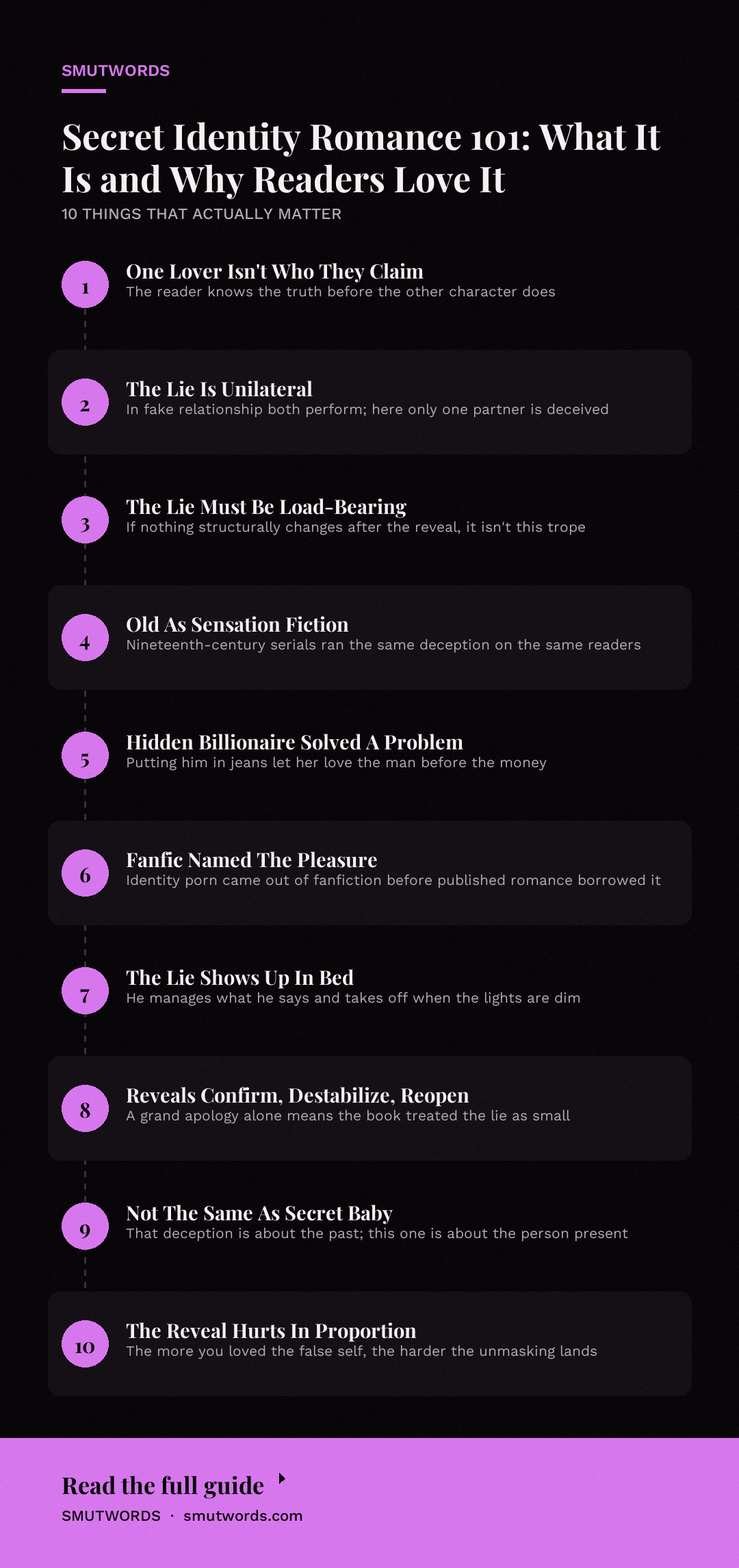
Secret identity romance runs on one structural promise: at least one lover is not who they claim to be, and the reader knows it before the other character does. The hidden billionaire slumming it in a dive bar. The masked vigilante who keeps his voice low so his girlfriend won't recognize it. The crown prince posing as a bodyguard, the spy who gives a fake name at a hotel bar and means every word he says after it.
The relationship is real. The identity holding it up is not. That gap is where the tension lives, and it is why secret identity romance has been a dependable engine of erotic and romantic fiction for well over a century.
What Secret Identity Romance Actually Means
The term covers a specific dramatic structure, not just any story where someone has a secret. The defining feature is that the concealment is about who the person is at the level of name, status, or role, and that the relationship is built on the false version.
If the secret is "I have a wife" or "I'm actually broke," that's a different trope. If the secret is "I am not the person you think I am when you touch me," you're in the right territory.
Genre readers often use "identity porn" for the specific pleasure of watching two people fall for versions of each other that don't exist on paper. The term migrated from fanfiction communities into wider romance and erotica discourse, and it captures the appeal well: the erotic charge comes from the doubled awareness, the reader knowing what the characters don't.
What counts:
- A concealed name or role. A billionaire using a first name only. A superhero with a civilian job. A royal traveling without the title.
- A relationship built on the false persona. The other character falls for the version in front of them, and that version has real traits, just not the whole picture.
- A reveal with consequences. When the truth comes out, the betrayal is about trust, not just surprise.
What doesn't count: a character with a private hobby, a hidden ex, or a job they simply haven't mentioned yet. A secret identity reorders the entire relationship once it drops. If nothing structurally changes after the reveal, the story wasn't using the trope, it was decorating with it.
The most common misconception is that this is the same as a fake relationship. It isn't. In a fake relationship, both parties agree to perform a couple they aren't.
In secret identity romance, one person is performing a self they aren't, usually without the other's knowledge, and often while genuinely falling in love. The lie is unilateral. That asymmetry is the whole point.
Where Secret Identity Romance Comes From
The trope's publishing history is older than most readers assume. Nineteenth-century sensation fiction leaned on it constantly: the mysterious stranger with a title no one can verify, the governess who turns out to be an heiress, the nobleman who works as a tutor to be near the woman he can't court openly.
Those novels ran in serials and were devoured by the same readership that would eventually pick up mass-market paperbacks, and the pleasure was identical. The reader sat in on a deception the heroine couldn't see.
Twentieth-century pulp and comic publishing took the structure and made it a genre fixture. Superheroes gave it a permanent home with the civilian-versus-costumed divide, which introduced a specific erotic problem: the lover who knows one half of a person and wonders why he keeps disappearing. Spy fiction added its own version, where the false identity isn't a costume but a professional requirement, and the romance has to survive the same lie that keeps the spy alive.
Category romance absorbed all of it in the 1980s and 90s. The "hidden billionaire" variant became an industry staple because it solved a commercial problem: readers wanted enormous wealth and the fantasy it enables, but they also wanted the heroine to love the man rather than the money.
Putting him in jeans and a borrowed truck for the first two hundred pages let her fall for him before the bank account did its work. That same logic powers a lot of lumberjack romance, where the rugged surface often hides a past life the heroine doesn't learn about until she's already invested.
The digital era changed the trope's center of gravity. Fanfiction communities built entire archives around it, and the term "identity porn" came out of that writing culture, where masked heroes, undercover agents, and double lives got examined from every angle the source material left open.
Published romance followed. Contemporary secret identity romance now borrows techniques that fanfic writers developed first, especially the interior monologue of the person maintaining the lie, which lets readers sit inside the anxiety of the deception rather than just watching it from outside.
How It Shows Up in Erotica
On the page, the trope does mechanical work. It creates a pressure system that keeps every scene loaded, because even a quiet dinner has a second layer under it. Editors who read a lot of these books tend to evaluate them on three things: whether the lie is load-bearing, whether the reveal pays off the tension that was built, and whether the physical scenes use the deception instead of ignoring it.
A strong version makes the lie present in the sex. The first time they sleep together, he has to manage what he says, what he takes off, what she'd notice if the lights were brighter.
A weak version lets them have a completely untroubled encounter and retroactively claims the secret mattered. The reader feels the difference immediately. Deception that only exists in dialogue is a costume the scene never asks the character to wear.
Authors reach for a handful of recurring structures:
- The slow-burn unmasking. One detail slips at a time. A wallet, a scar, a phone call in another language. The reader assembles the truth a few chapters before the lover does.
- The known-but-unspoken version. One party figures it out and doesn't say anything, turning the dynamic into a mutual deception. This variant pairs naturally with enemies to lovers, since the silent knowledge carries resentment.
- The forced reveal. Someone else blows the cover, usually at the worst possible moment, and the couple never gets the controlled confession they were both planning.
- The double reveal. Both lovers are hiding something, which can land as a genuine twist or collapse into farce if the pacing slips.
- The professional liar. Spy and assassin variants where the false identity predates the relationship and cannot be dropped even after the truth comes out.
The reveal is the section editors flag most often, because it's where secret identity romance either earns its length or wastes it. The best reveals do three things in quick succession: they confirm what the reader already half-knew, they destabilize the trust the couple built, and they open a path back that requires real effort rather than a grand apology.
If the apology is enough, the book treated the lie as small. If the apology isn't enough, the book remembers that she fell for a person who was inventing himself in real time.
Enjoyed this? Get a free book.
Join the list and we will send a complete free story straight to your inbox, plus new releases every week after that. No credit card, no catch.
Craft-wise, the trope rewards restraint early and honesty late. The masked hero who keeps his voice flat for eighty pages becomes uninteresting if he never strains against it. Give him one moment where the fake self cracks and says something true he'd never say as himself. That crack is what readers remember, and it's what they're chasing when they search for the trope.
Writers working in speculative versions tend to layer this with other genre machinery. Cyberpunk romance makes the false identity literal with handles, implants, and personas you can buy, while the masked vigilante framework sits closer to superhero and paranormal fiction.
In both cases, the mechanics of concealment become part of the erotic vocabulary, since the thing being hidden is often the body itself. Readers coming from forbidden love territory will recognize the same engine running: the obstacle isn't a rival, it's the situation the couple is stuck inside, and every tender moment has to happen around it.
The corporate variant is more grounded and just as common. A CEO who trades his suit for a bar shift to escape press attention meets a woman who has opinions about rich men. She likes the version pouring her drink.
When she finds out, the question is whether the version she liked was a costume or the man underneath it. Books that answer "costume" squander the trope. Books that answer "both, and that's the problem" tend to get re-read, which is the most reliable sign the deception was written with care.
One more axis worth naming: the power of the reveal depends on how much the reader loved the false self. If the persona was genuinely charming, complicated, and specific, the unmasking hurts in the best way. If the persona was a cardboard version of the hero, the reveal feels like the book finally getting to the point. The trope's reward scales directly with how convincingly the lie was lived.
Secret Identity Romance vs Related Terms
The single most common confusion is between secret identity romance and the fake relationship trope, and the difference is worth stating plainly because it changes how a book reads. In a fake relationship, two people agree to perform a couple they aren't, and both know it. In secret identity romance, one person hides who they are from a partner who believes the relationship is genuine.
Fake relationship is a shared performance. Secret identity is a private one, and the other character's consent to the situation is the thing being withheld.
The second confusion is with secret baby, which sounds adjacent but sits in a completely different emotional register. A secret baby is a child concealed from a parent, usually after the relationship has already ended.
The deception is about the past and its consequences. Secret identity romance is about the present and the person standing in front of you. Same word "secret," different machinery entirely.
Then there's the case where the trope overlaps with the undercover profession. Where a spy or soldier hides their job, the dynamic sits between secret identity romance and a plain soldier romance, and the book usually resolves whichever pressure is stronger.
If the secrecy is what drives the plot, it's a secret identity story. If the danger and the deployments are, it's a soldier story that happens to have an undercover element. The line is soft, and good books blur it on purpose.
Frequently Asked Questions
What is secret identity romance?
A romance or erotic story where one or both lovers conceal their true name, status, or role, and the relationship develops with the partner believing a version of them that isn't complete. The reveal and its fallout form the story's emotional center. The trope covers billionaires hiding their wealth, masked heroes with civilian lives, spies and royalty traveling incognito.
Is secret identity romance the same as a fake relationship?
No. A fake relationship involves two people mutually agreeing to perform being a couple, with both aware. Secret identity romance is one-sided: the partner believes the relationship and the person are real, and the deception is theirs alone. The asymmetry is what gives the trope its particular sting at the reveal.
Why do readers love this trope so much?
It delivers two pleasures at once: the tension of watching someone fall for a person they don't fully know, and the anticipation of a reveal the reader can see coming. The reader sits inside a secret the characters don't share, which makes even ordinary scenes feel loaded. Many readers describe this as identity porn, a term that came out of fanfiction culture.
What are the most common variants?
The hidden billionaire who hides his wealth, the masked hero maintaining a civilian life, the royal traveling without the title, the spy or undercover agent whose false name is professionally required, and the double reveal where both lovers turn out to be hiding something. Some authors also run the known-but-unspoken version, where one party figures out the truth and says nothing.
What makes a strong reveal?
The reveal should confirm what the reader half-suspected, destabilize the trust the couple built, and open a path back that requires more than a grand apology. Strong reveals also hurt in proportion to how much the reader loved the false version of the character. A flat reveal happens when the hidden persona was never interesting enough to miss.
Is this trope only for rich or famous characters?
No. The status gap is a common flavor, but the trope works with any concealment of identity: a cop working undercover, a teacher with a past life, a musician using a stage name. What matters structurally is that the relationship is built on a version of the person that doesn't fully exist. Status just makes the eventual fallout more public.
Final Thoughts
Secret identity romance lives or dies on whether the lie is worth the length of the book. When the hidden self is genuinely compelling and the reveal forces both people to rebuild the trust they thought they had, the trope delivers a kind of tension almost nothing else in the genre can match.
Start with a book that takes the reveal seriously rather than treating it as a plot errand, and you'll understand why this structure has survived more than a century of publishing. The list below has the strongest examples currently on SmutWords.






Loading comments…