
Most people use "degradation" and "humiliation" like they're the same word, and most of the time nobody gets hurt by the mix-up. But if you're actually trying to negotiate this stuff, the difference matters. The two kinks run on completely different fuel. Get them confused in the middle of a scene and you'll find out fast which one your partner wanted and which one just landed wrong.
Here's the short version before we get into it: degradation is about being made lesser, and humiliation is about being made small in front of someone. Sometimes the audience is just the two of you. Sometimes the whole point is that someone else could be watching. The gap between those two things is where most of the negotiation actually happens.
Degradation vs Humiliation Kink: The Actual Difference
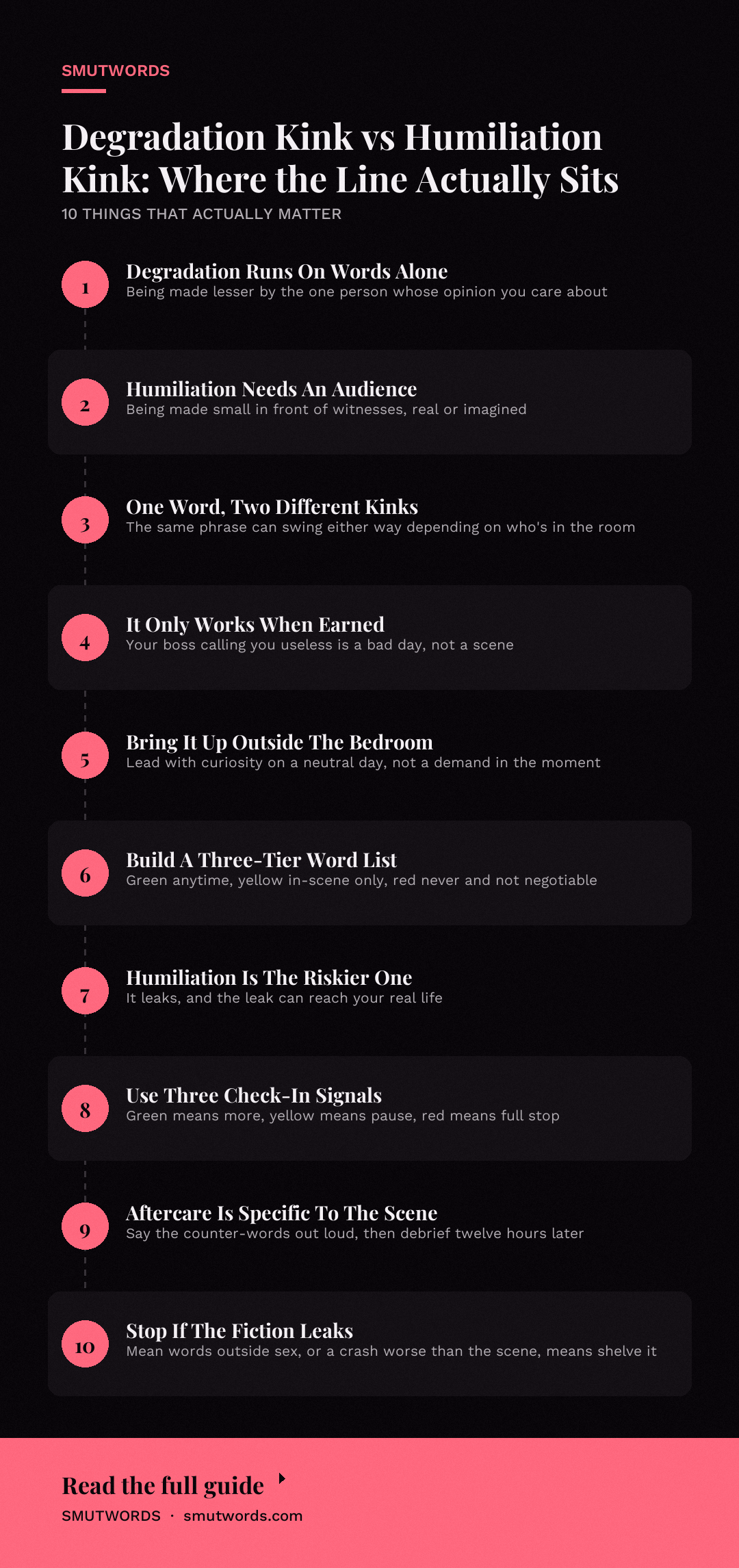
Degradation kink is verbal and internal. It's the "you're such a filthy little thing" register, where the turn-on comes from the words themselves and the way they reframe you. You're being told you're worth less, dumber, sluttier, more pathetic, and somewhere in your nervous system that reads as good.
The audience is the person saying it, and the person hearing it. Two people, one hot exchange.
Humiliation kink adds witnesses. Not always real ones, but the scene is built around the idea that someone else is present, or could be, or knows.
Public tasks you'll never actually do but have to consider. Being made to say something embarrassing out loud. Writing something down. Wearing something under your clothes. A photo that stays deleted but the threat of it doesn't.
The turn-on is the exposure, the social drop, the "everyone knows" feeling.
That's the cleanest way to split them:
- Degradation: told you're worthless (by the one person whose opinion you care about)
- Humiliation: made to feel worthless in front of a real or imagined audience
- Overlap: "Crawl over here and beg me for it" can be either, depending on whether anyone else is in the room or on the phone
Plenty of people want one and not the other. A sub who loves being called a dumb little whore in bed may go completely cold at the suggestion of wearing a collar to a dinner party. The first is intimacy with a mean streak. The second is social risk.
Different appetites, different limits, and they get negotiated separately even if you do both.
Why People Get Off On Being Treated Like Shit
The classic explanation is "it's the opposite of how they're treated in real life, so it's cathartic." There's something to that. Plenty of people in high-pressure jobs, the ones who have to be competent and composed all day, love being told they're stupid and useless at nine o'clock at night. But that's only half of it, and it makes degradation sound like a coping mechanism instead of a kink.
The other half is that it only works when the person saying it has earned the right to say it. Your boss calling you useless is a bad day. Your boyfriend calling you useless in bed, while he's holding you down, is a completely different chemical event. The degradation is safe because it's coming from someone who's going to hold you afterward and who you've explicitly handed the script to.
There's also a control-release thing. Being told what you are can be a huge relief if you spend your life deciding what you are. You get to stop running the machine for a minute.
On the top side, the appeal is usually about permission. Being the one who gets to say the thing you'd never say out loud, and watching your partner's body respond to it, is its own kind of power exchange.
If you like that dynamic generally, you'll probably like it in fiction too. Which is part of why any scene with cuffs or rope tends to pair well with a verbal power exchange. The hardware and the language scratch the same itch.
How To Bring It Up Without Sounding Like A Weirdo About It
Bad news first: there is no way to bring up "I want you to call me a pathetic little cumdump" that feels casual. You're going to have to say it out loud and then sit in the silence for four seconds while your partner processes. This is survivable. The four seconds are not the worst part of your life.
The trick is to bring it up outside of sex, ideally on a day neither of you is trying to start anything. A few openers that actually work:
- "I had a thought about something I want to try. You don't have to say yes tonight."
- "Is there anything you've wanted to say to me in bed that you've held back because you thought it would be too much?"
- "I read something about dirty talk and it made me wonder if there's a version of it we'd both like."
- "I want to try being meaner, verbally. Can we talk about what words are fine and what ones are a hard no?"
Notice none of those are "I want you to degrade me." You can say that too, but lead with the curiosity, not the demand. Your partner may have no idea this is a thing, or they may have a strong aversion because someone in their past used similar language with real cruelty and no off switch.
If you're the one being asked, you're allowed to say no and you're allowed to say yes but only to specific words. Most people find the second one easier than they expected once they've seen their partner's face light up.
Word Lists, Better and Worse Than You'd Think
The single most useful thing you can do before a degradation scene is build a word list. It sounds unsexy. It's not. It's the difference between a scene where you're both surprised and delighted and a scene where your partner freezes and you have to guess why.
Split the list into three tiers.
Green: say it any time, no warning needed
Common picks are slut, whore, dirty, needy, brat, little thing, slave if you're role-playing that dynamic. These are the words your partner has heard a hundred times and gets off on hearing again.
Yellow: fine in-scene but only when things are already going
Usually the sharper stuff. Pathetic, stupid, broken, used, worthless. Hot in the middle of an intense moment, jarring if dropped in cold. Some people also put their own real-life insecurities here, if they enjoy having them weaponized in a limited way.
Red: never, not negotiable, not even as a joke
Usually real trauma words, family references, anything to do with weight, appearance, disability, race, or specific things an ex said that stuck. This list is allowed to be long. It's allowed to be weird. You don't have to explain every entry, you just have to say "that one's a red."
Enjoyed this? Get a free book.
Join the list and we will send a complete free story straight to your inbox, plus new releases every week after that. No credit card, no catch.
You'll want a separate list for the humiliation side, because the words are different. Humiliation runs on exposure language: someone knowing, someone seeing, someone finding out. If that dynamic appeals to you, and you like the fiction version of "someone could see this," the secret baby trope is basically humiliation-adjacent in novel form. Different context, same nervous-system response.
Why Humiliation Is The Riskier Of The Two
Degradation, done right, is contained. It's two people in a room. The words are hot and then they stop.
Humiliation leaks. If you're playing with the idea of other people knowing, the leak is the point, and that leak can escape the room in ways that affect your real life. A few real risks worth naming:
- Public tasks. If it involves leaving your home or doing anything where a real stranger becomes aware, you've pulled non-consenting people into your scene. Don't. Keep imagined audiences imagined.
- Photographs and screenshots. Even if you're sure they'll be deleted, treat anything digital like it will someday be seen. It can be.
- Real-life shame hangover. Humiliation drops harder than degradation. The next-morning crash is real, and it's different from the degradation version. Plan for it.
- Your partner's actual reputation. If a humiliation scene requires your partner to do something embarrassing in front of a shared friend group, you're spending real social capital, not fantasy capital.
None of this means don't do it. It means slow down and be specific.
Safe Words And The Sliding Scale
You need a safe word, and if you're doing degradation scenes you almost certainly need a secondary check-in word. "Stop" and "no" are often part of the hot talk, and if you actually need to stop, you shouldn't have to fight through your own scene language to get there.
Use a three-signal system:
- Green: keep going, in fact more
- Yellow: pause, adjust, checking in but not ending the scene
- Red: full stop, no questions, immediate aftercare
Pick words that will never naturally come up in dirty talk. "Red" is fine. So is a number, or a pet name that means something to nobody else. The stupid ones are "no" and "stop" unless you're doing consensual non-consent, and even then, agree on a real off-switch word that would never get said in-scene.
If you're also doing any physical restraint in the same session, run the verbal plan first. Starting with cuffs or a soft rope setup takes practice on its own, and stacking it on top of a brand-new verbal scene is a lot of new variables at once. Learn one toy before you add another.
Aftercare For A Scene That Made Someone Cry
Degradation and humiliation scenes end in a crash more often than people expect. The brain doesn't always get the memo that you were pretending. You can end up genuinely shaky, sad, or embarrassed about what you liked two hours ago. This is normal and doesn't mean anything is wrong with you.
Aftercare is specific to what actually happened.
- Verbal repair. If you were called worthless, say the counter-words out loud. "You're not. I don't think that. I love you." Ten times if you need to.
- Physical closeness. Blanket, water, warmth, skin. The chemistry you burned through takes a minute to rebalance.
- Debrief the next day. Not immediately. Give it twelve hours. Then ask what worked, what didn't, what words should get promoted or demoted on the list.
- Check for the leak. If the humiliation side got close to something real, talk about that. It might be fine. It might be the thing that hit hardest. Both are okay, and both are worth saying out loud.
Skip aftercare and you'll notice it six days later when your partner brings it up out of nowhere, hurt, and you can't figure out why the conversation went sideways.
Common Mix-Ups And Where People Go Wrong
First mix-up is degradation and humiliation themselves, which you've now cleared up. Here are the others.
Mistaking it for abuse. Real abuse has no off switch, no consent, no aftercare, and no word list. If you can't distinguish the two, you're not ready to play with this.
Thinking it means you hate your partner. The opposite, usually. You're doing this because the trust is high enough that you can pretend together, and the pretending only feels good because the trust is underneath it.
Assuming the top knows the script. They usually don't. Most people who are good at this have been handed a specific list by their partner and have practiced the delivery. Nobody improvises "worthless" out of love and gets it right the first time.
Using the words in the grocery store. Keep degradation in the bedroom unless you've explicitly agreed otherwise. Walking past the produce aisle and hearing "hey, slut" is not the same as hearing it in bed, and your partner will not thank you.
Letting the fiction bleed into the real relationship. If your partner starts saying the mean words outside of sex because it's become a habit, that's a sign the scene needs a fence.
For readers who like the emotional shape of this dynamic in novels, the most obvious version is enemies-to-lovers with an edge, or a redemption arc where someone starts cruel and earns their way back. Same nervous-system machinery, lower stakes, and a hundred percent less cleanup.
When To Stop The Scene And When To Stop Entirely
Stop the scene in the moment if you see any of these: your partner goes quiet and starts nodding without talking, they stop responding to check-ins, they say "yellow," they flinch at a specific word that isn't on the green list, or your own gut says something's off even if they're saying green. Trust the gut. End it, do aftercare, debrief later.
Stop the kink entirely for now if it's starting to leak into the real relationship, or if one of you is finding the aftercare crash harder to shake than the scene is worth, or if the words that used to be hot are starting to land as real. All of those are reasons to shelve the scene for a season, recommit to the vanilla stuff, and revisit later with a fresh list. That's not failure. That's the system working.
Final Thoughts
If you've read all this and want the fictional version before you try the real one, the closest thing in our catalog to a degradation dynamic with an actual arc is anything built on a "he starts rough and ends devoted" shape, and the pack-mates fiction tends to run it hard.
The honest recommendation is: read one of the pack mates romance stories, notice which specific lines make your stomach flip, and bring those exact lines to your partner as a starting word list. Cheaper than a mistake, and you'll come to the conversation already knowing what you actually want.








Loading comments…