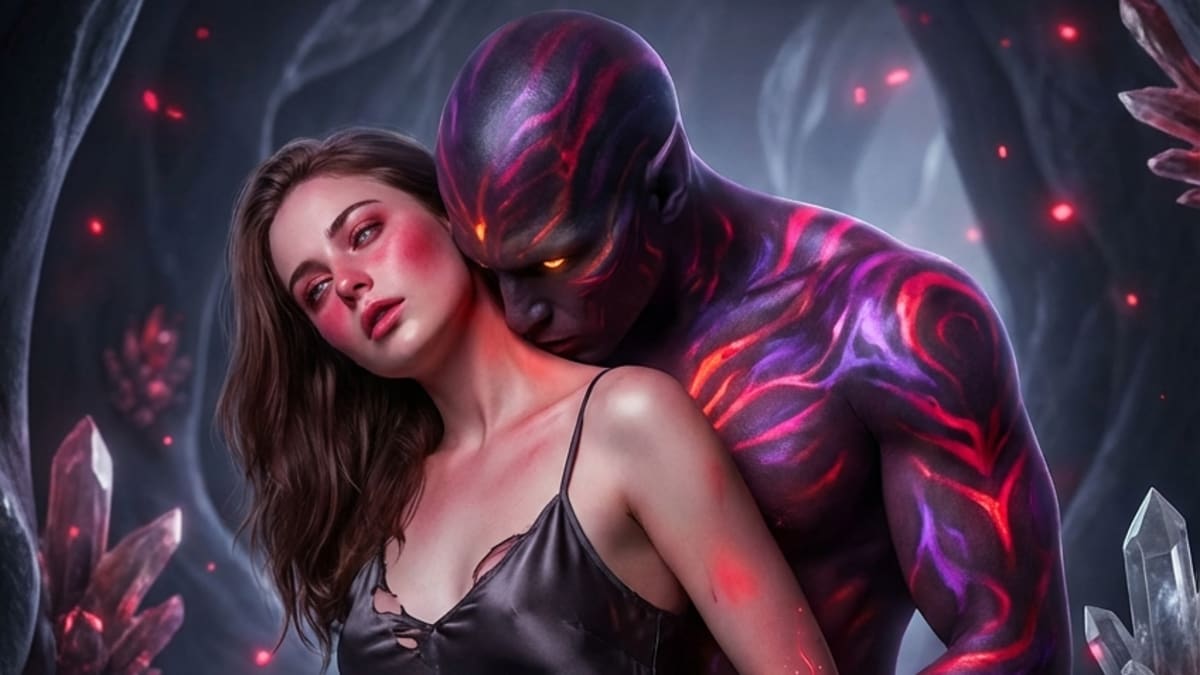
Fairy romance is the subgenre where at least one love interest is fae: a creature of the courts, the hollow hills, the bargains and debts that outlive the people who made them. The mortal falls for something that will not age the way they age, cannot lie the way they lie, and considers a century a short courtship. That gap is the engine.
Everything readers love about fairy romance, from glittering Seelie courts to feral Unseelie hunters to a single bloody-handed bargain struck at midnight, runs on the tension between a love that feels inevitable and a world that has rules about who is allowed to keep it.
It sits inside the broader fantasy romance shelf, but it has its own gravity. The stakes are rarely just "will they end up together." They are "will the bargain kill her," "will the king find out," "will he give up immortality to stay," "will she survive the crossing at all."
Fae love interests are dangerous on purpose. The appeal is that the danger is not a phase the hero grows out of. It is the whole point.
What Fairy Romance Actually Means
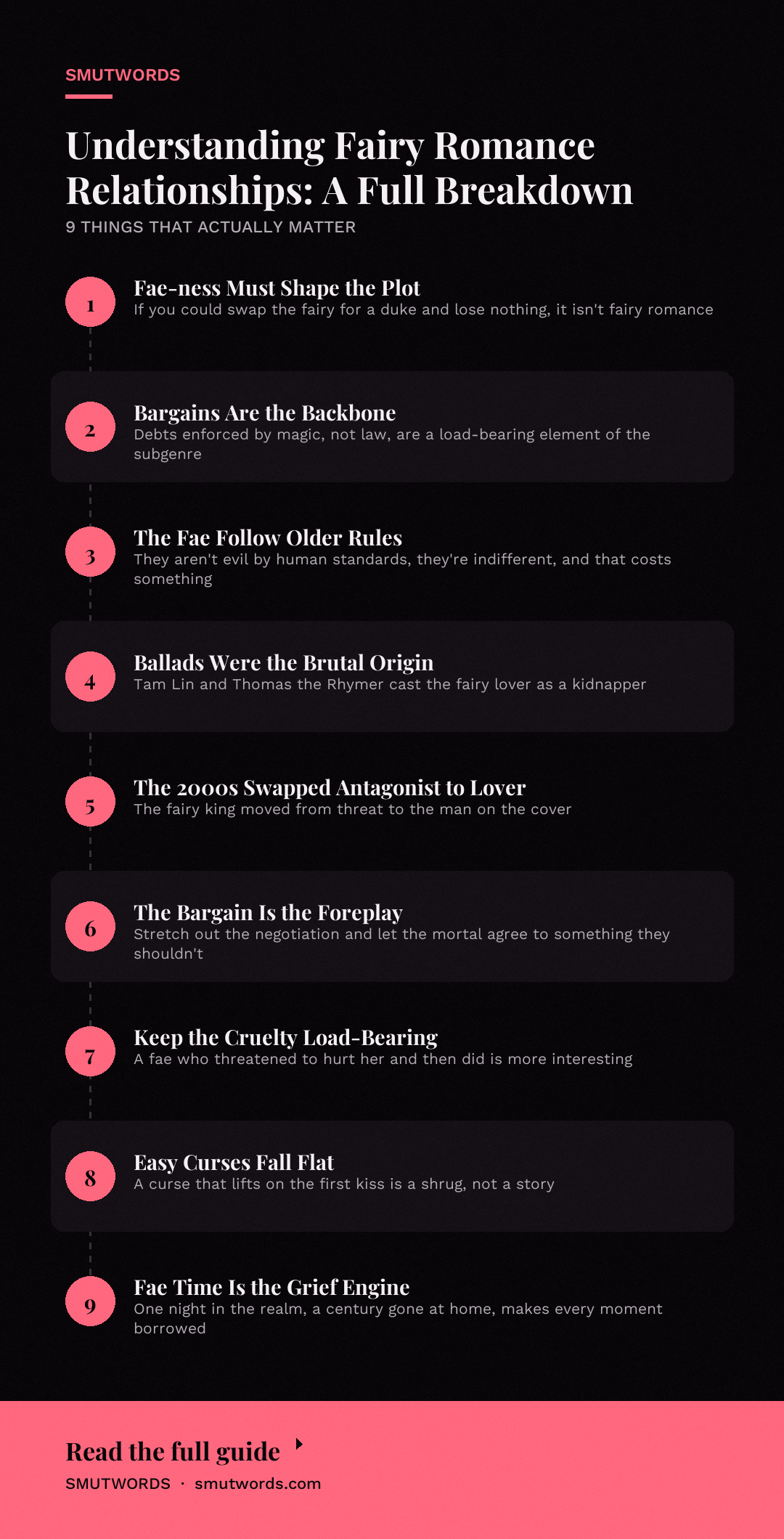
The term covers a lot of ground, so it helps to say what it is before saying what it is not. A fairy romance is a romance novel or story in which a fae character is a central love interest, and the fae-ness of that character shapes the plot rather than just decorating it. If you could swap the fairy for a duke and lose nothing, it is not really fairy romance. It is a historical with wings.
Fae, in this context, is the modern romance-novel umbrella for the old folkloric peoples: the Seelie and Unseelie courts, the sidhe, the Tuatha Dé Danann, the aos sí, the good neighbors, the fair folk. Authors borrow from Irish, Scottish, Welsh, and English folklore, then bend it hard.
Sometimes the fae are tall, cold, and beautiful. Sometimes they are insect-winged and strange. Sometimes they are closer to monsters with a crown on. All of that counts.
What does not count, at least not by the strict definition most readers use: a story where the "fairy" is really an angel, a vampire, or a shifter with pointed ears painted on.
Genuine fae romance usually involves at least one of a few load-bearing elements. Courts with politics. Bargains with teeth. Iron as a weakness. An inability to lie. A realm that runs on different time. Tithes, debts, or curses that have to be paid.
A quick mental checklist for whether you are reading the real thing:
- Bargains and debts. Someone owes someone, and the debt is enforced by magic, not law.
- Court politics. Seelie or Unseelie, Summer or Winter, a throne somebody wants.
- Iron, salt, rowan, or cold iron. A material weakness the fae cannot shrug off.
- Truth-telling. The fae cannot lie, so every word is a trap and every promise is a weapon.
- Time slippage. A night in Faerie costs you a decade, or a century costs you an afternoon.
- Crossing between worlds. A threshold, a door, a hill that opens.
The most common misconception is that fairy romance is just "romance with fairies in it," interchangeable with any other paranormal creature. It is not. The fae come with their own moral logic.
They are not evil by human standards. They are following rules older than humans, and the rules do not care whether you cry. That indifference is what makes the romance so loaded. When a fae chooses a mortal anyway, the choice costs something real.
Where Fairy Romance Comes From
The honest history here splits in two, and the interesting part is the second one. The folkloric roots run back centuries: the ballads of Tam Lin and Thomas the Rhymer, where a mortal is claimed by the Queen of Faerie and has to be won back; the stories of changelings left in place of human babies; the fairy bride who cannot stay once a taboo is broken.
Those tales are old, and they are brutal. The fairy lover in a ballad is usually a kidnapper, and the ending is usually a death.
But fairy romance as a publishing category is young. It is largely a child of the 2000s and 2010s, when paranormal romance exploded and readers who had burned through vampires and werewolves wanted a new creature to fall for.
Fae were a natural next step, because they were already in the water supply. Everyone grew up with fairy tales. The courts could be reimagined as factions. The magic could be reimagined as a power system. The cruelty could be reimagined as a love interest's tragic flaw rather than a reason to run.
Two shifts matter most. The first was the move from fairy as antagonist to fairy as protagonist's love interest. In the old ballads, the fairy queen is the threat. In modern fairy romance, the fairy king is the man on the cover.
The second was the move toward courts and politics as a substitute for fairy-tale whimsy. The best-known modern versions did not just give readers a beautiful immortal. They gave them a whole society with laws, factions, and a throne to fight over. Once that happened, the subgenre could support series, not just standalones, and it did.
More recently, the pendulum has swung back toward the strange. After years of tall, elegant, coldly handsome fae kings, a chunk of the market wanted fae who actually feel nonhuman. Insectoid wings. Too many teeth. A beauty that is genuinely unsettling to look at. That strain of the subgenre sits closer to monster romance than to fantasy, and it is growing.
How It Shows Up in Erotica
On the page, fairy romance has a distinct texture that separates it from other creature romances. The craft problems are specific, and so are the solutions. If you are reading fairy romance for the sex, this is the section where you can see why some of it works and some of it falls flat.
The bargain as foreplay
The single most common structure is the bargain. A mortal wants something, a fae offers it, and the price is a kiss, a night, a name, a year, an oath. What makes this work is not the deal itself but the negotiation.
A good writer stretches that scene out, lets the fae stay perfectly polite while the terms get worse and worse, and lets the mortal agree to something they should not. The sex that follows is a contract fulfilled. That is the thrill. The consent is real, hard-won, and expensive.
This is where fairy romance overlaps with restraint kink. A bargain is a binding. A fae's word holds you in place the way leather does.
If you are new to that dynamic and want to see how the physical version is written and handled, Your First Restraints: Cuffs, Rope, or Ties? is a good companion read. The non-magical version of "you agreed to this" is a rope or a cuff, and the emotional voltage is the same.
Cruelty that stays cruel
Weak fairy romance softens its fae too fast. He is dangerous in chapter one and domesticated by chapter ten, all teeth traded for sweetness. Strong fairy romance keeps the cruelty load-bearing.
A fae who said he would hurt you and then hurt you is more interesting than a fae who said he would and then didn't. The love does not erase what he is. It coexists with it. Readers who stay in this subgenre stay for exactly that: the sense that she is sleeping with something that could kill her and chooses not to, not something that has been rendered safe.
Enjoyed this? Get a free book.
Join the list and we will send a complete free story straight to your inbox, plus new releases every week after that. No credit card, no catch.
Curses and the emotional payoff
Curse-breaking is the other default plot engine, and it is usually where the emotional payoff lives. She has to do something for him. He has to lose something for her.
A curse that breaks only through an impossible act of love is a machine for forced devotion, and it works because it makes the romance the plot, not a subplot. The trap is when the curse is easy. A curse that lifts on the first kiss is a shrug. A curse that costs a body part, a memory, or a century is a story.
Time, the fae trump card
Fae time is the grief engine. One night in the realm, one hundred years gone at home. A love interest who has already lived four thousand years and is bored by everything except this one mortal. A mortal who will wrinkle and die while he stays exactly this.
The best fairy romance uses that asymmetry to make every tender moment feel borrowed, which makes it feel urgent, which is why the sex reads hotter than it has any right to.
Nonhuman bodies and size in the scene
Fae are usually tall, and many authors lean into it. A seven-foot Unseelie against a five-foot mortal is a visual the prose keeps returning to, and the logistics become part of the heat. That dynamic is doing the same work as any other size difference romance, just with pointed ears and a throne room.
Fae can also be physically strange in ways that would not work for a shifter or an elf: wings, claws, glowing eyes, a voice that makes you obey. Any fae who is that far from human is measured against one question, and it is the same question that runs through Monster Romance vs Alien Romance. How alien is he allowed to be before the romance stops working?
Courts, packs, and found family
Fae courts function as a social structure the couple has to survive. That is a similar job to the one done by pack dynamics in shifter romance, except the fae version is crueler and more political. A pack accepts you or expels you. A court schemes.
The Unseelie king has advisors who want your lover dead. That pressure is what turns two people into a unit, which is why courts, like packs, are one of the most reliable machines for forcing intimacy in fantasy romance.
Soulbonds and oath magic
Fae romance loves a magical tie that cannot be cut. A marriage bond, a blood oath, a bargain that fuses two lives. This is functionally a soulbond, dressed in thorn and moonlight.
The scene where the bond snaps into place is usually the book's peak, because it turns "I want you" into "I cannot be anything other than yours," which is the exact emotional fantasy the subgenre sells.
What separates strong fairy romance from flat
Two things, mostly. First, a genuine cost. Something is actually given up, and it hurts, and the book does not take it back.
Second, a love interest who stays fae. He is not a human boyfriend in a glamour. He is a creature with a different ethics, and the heroine has to love the whole thing or walk.
Books that remember this are the ones readers reread. Books that forget it are the ones they finish and cannot remember by the following week.
Fairy Romance vs Fae Romance
Worth a short detour, because the two labels are used almost interchangeably and readers get confused about whether there is a difference. Around some corners of the romance internet, fairy romance carries a lighter connotation: fairy-tale retellings, whimsy, wings, sugar, the Disney association. Fae romance carries a darker one: courts, cruelty, bargains, the sidhe. In practice, though, the two terms point at the same shelf.
Publishers use them inconsistently. A book marketed as fairy romance can be as vicious as anything labeled fae romance, and vice versa. The real distinction readers should watch for is not the label on the cover. It is whether the love interest is folkloric fae (courts, bargains, iron) or something adjacent that borrows the aesthetic.
Elf romance is the neighbor worth noting here, because elves and fae get mixed up constantly. If the character has pointy ears and immortal good looks but the world runs on Tolkien logic rather than court logic, you are likely reading elf romance, not fairy romance.
Frequently Asked Questions
What is fairy romance in books?
A romance where a fae or fairy is a central love interest and the fae world shapes the plot. Expect courts, bargains, magical debts, and a love that has to survive rules older than humanity. It sits under fantasy romance and overlaps heavily with paranormal romance.
What is the difference between fairy romance and fae romance?
The labels are used interchangeably by most readers and publishers. Fairy romance can sound lighter and more fairy-tale, fae romance darker and more courtly, but you will find sweet books under both and vicious ones under both. Judge the individual book, not the tag.
Is fairy romance the same as fairy tale retelling?
Usually not, though they overlap. A fairy tale retelling adapts a specific story like Cinderella or Beauty and the Beast. Fairy romance invents its own fae characters and world. Some books do both, retelling a folk ballad like Tam Lin while building an original court around it.
Why are fae love interests so dangerous in these books?
Because the folklore they are built from is dangerous. The fae cannot lie but will use every true word as a trap, they enforce bargains without mercy, and they do not share human morality. That danger is the appeal. The romance only works if the danger is real and stays real.
Are fairy romance books spicy?
Some are, some are not. The subgenre spans the full heat range from fade-to-black to explicit. In the spicier end, the bargain, the bond, or the curse is usually what drives the sex scene. The magic is the foreplay.
What fantasy creatures are most similar to fae in romance?
Elves, angels, and certain shifters. Elves share the pointed ears and immortality but not the courts or the bargains. Angels bring the immortal-cold-otherworldly note without the trickster logic. If you like fae, those are the closest aisles to wander into next.
Final Thoughts
Fairy romance rewards a certain kind of reader. The one who wants the danger to stay dangerous, the bargain to cost something real, and the immortal love interest to remain a little bit terrifying even after he falls.
If you have been reading around the subgenre and want the purest version of that bargain-and-court dynamic, seek out a book built around a single unbreakable deal struck between a mortal and a fae king, where the price of it climbs with every chapter. That is where the subgenre is sharpest, and where you will finally see why readers never tire of it.






Loading comments…