
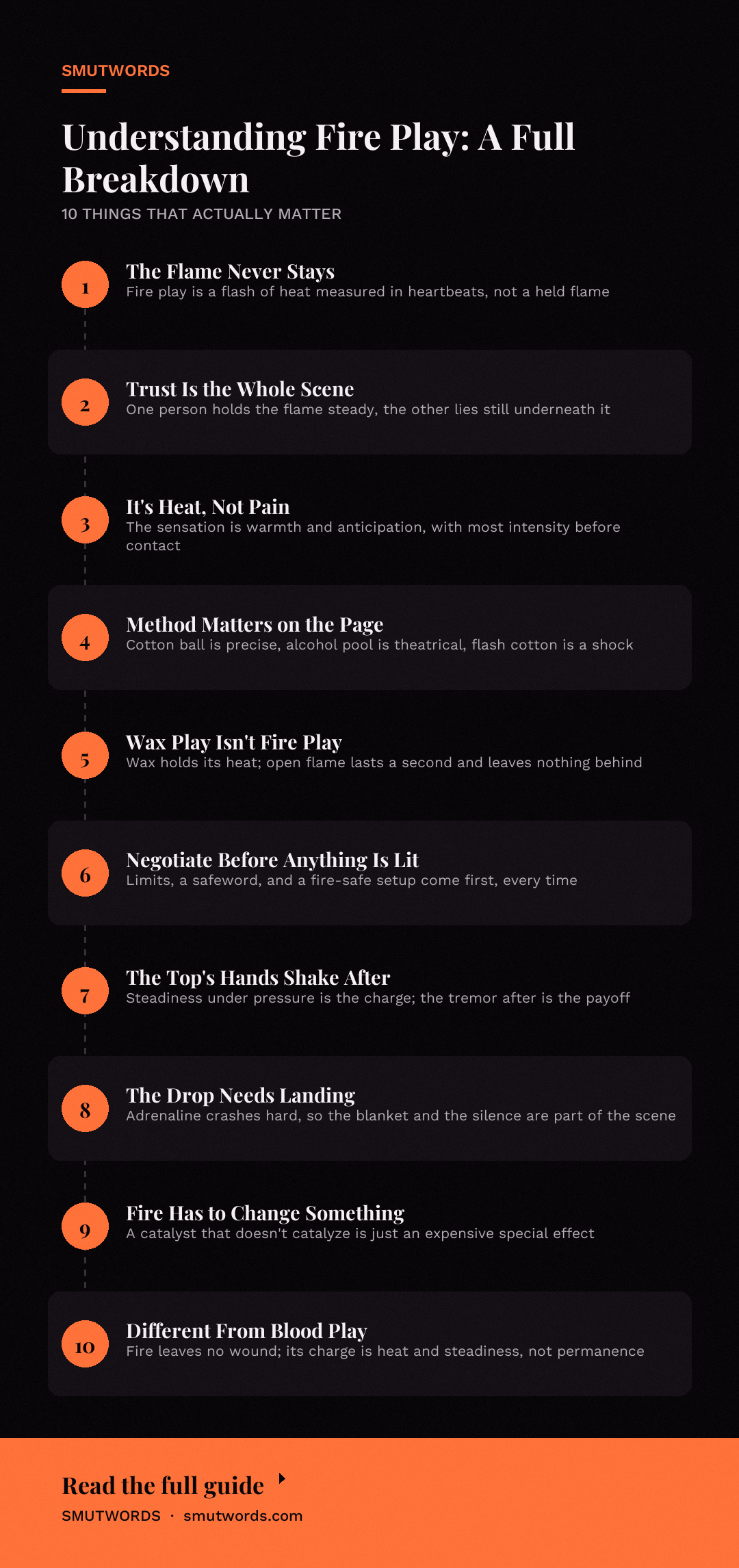
Fire play is a BDSM edge practice in which a Top briefly brings controlled flame or intense heat to a bottom's skin, most often by touching a lit, soaked cotton ball to the body or by dotting an area with alcohol and setting it alight for a second or two before it burns out. The flame never stays. That's the whole architecture of it: a flash of heat, a held breath, a hand steady on the back of a neck.
In erotica, fire play is the scene that sorts casual partners from serious ones. It asks for a kind of nerve and stillness that nothing else in the dungeon quite demands.
Readers come to it for the image first: a small blue-orange flare against bare skin in a dim room, the Top's face lit from below, the bottom's eyes closed. Then they stay for what the image means.
A person who can hold a flame steady over someone they care about, and a person who can lie still underneath it, are saying something to each other that a spanking bench can't say. The trust is the entire point of the scene, and both characters know it going in.
What Fire Play Actually Means
The name is literal. Fire play covers any consensual kink activity where controlled flame or fire-generated heat is applied to the body as sensation. The most common version in both real dungeons and fiction is the cotton-ball method: a ball of cotton soaked in high-proof alcohol, held on a wand or hemostat, lit, and touched quickly to the skin so the flame goes out on contact and leaves a pulse of heat behind.
A second common version involves painting a patch of skin with alcohol and lighting it, letting the small flame run out on its own. Fire cupping uses flame to create suction inside glass cups that are then placed on the body.
Flash cotton, a treated cotton that burns almost instantly, produces a quick bright flare with very little sustained heat. None of these involve holding a flame against skin for any length of time. The burn is measured in heartbeats.
What doesn't count matters too. Wax play, where hot candle wax drips onto skin, is a related temperature practice but not fire play, and the two get lumped together constantly. Ice play, menthol, and cold metal are temperature play's other wing.
A fire scene in fiction that's doing its job will usually be specific about which method the Top uses, because each one feels different on the page: the cotton ball is precise and intimate, the alcohol pool is wider and more theatrical, the flash cotton is a shock.
The common misconception is that fire play is about pain. It's mostly about heat and anticipation. The sensation is a sudden bloom of warmth, sometimes a brief sting, often followed by a cool draft as the air moves over heated skin. Most of the intensity lives in the seconds before the flame touches down.
Where Fire Play Comes From
Fire play's history as a written kink is shorter and thinner than its history as a practice. Fire cupping and moxibustion, the burning of dried mugwort near or on the skin, are ancient medical traditions across Asia, and modern kink communities borrowed the cupping version directly. The alcohol-and-cotton method spread through real-world BDSM education circuits in the 1990s and 2000s, when safety-focused play workshops formalized it into a teachable skill with rules.
Erotica picked it up later and slower than it picked up spanking, rope, or collaring. That's partly a safety problem: publishers and editors have historically been cautious about depicting fire on skin without a warning, and partly a logistics problem, since fire play needs a specific setting and props that don't translate as easily to a bedroom scene as a belt does.
The shift happened in indie and self-published BDSM romance, where authors could write the full ritual without a publisher's caution note. Fire play started showing up as a milestone scene, the one that marks a relationship crossing from experimenting to committed. It also migrated into dark romance and mafia romance, where the flame reads as danger and devotion at once.
Contemporary portrayals have gotten more technical over time. Early versions were vague about method (a candle, a match, some fire) and recent ones tend to name the alcohol, the wand, the wet towel on the nightstand. That precision is what makes the scene land for readers who know the practice.
If you want the broader frame these books sit inside, our breakdown of scene play covers how negotiated kink scenes get structured on the page, negotiation, build, peak, and landing.
How It Shows Up in Erotica
Fire play scenes are almost always short on the page. The flame itself takes up a paragraph or less. What takes up space is everything around it: the negotiation, the setup, the Top's hands doing something careful and boring (wetting a towel, checking a lighter, clearing the floor) while the bottom watches and gets more nervous, and then the aftermath, when the adrenaline crashes and someone needs a blanket.
That shape is why fire play works so well as a relationship marker. It has a before and an after, and the after is where the emotional payload lands. A writer who understands the practice will give you the Top's hands shaking slightly after the flame is out, once the bottom can't see. That detail does more work than any description of the fire itself.
Enjoyed this? Get a free book.
Join the list and we will send a complete free story straight to your inbox, plus new releases every week after that. No credit card, no catch.
The strongest versions of the trope share a few habits:
- Specificity about method. Naming the alcohol percentage, the hemostat, the wet towel, the metal tray. Precision reads as competence, and competence is the whole erotic charge of a fire scene.
- The Top's steadiness under pressure. The scene is a test, and the test is watching someone with a lit object in their hand stay calm. Writers who show the Top's internal count, their breath, their focus, make the fire feel dangerous without ever making it feel reckless.
- The bottom's stillness as a choice. Lying still is the bottom's active contribution. Interior monologue during the flame, a count, a mantra, a deliberate relaxing of the shoulders, turns passivity into a performance of trust.
- Negotiation before anything is lit. A real scene includes a conversation about limits, a safeword, and a fire-safe setup. Skipping this doesn't make a scene hotter; it makes it feel like the author didn't do the reading. Our guide to consent negotiation lays out how to write that conversation so it reads as tension rather than paperwork.
- Landing the drop. Adrenaline scenes produce a crash, and fire play produces a hard one. A scene that ends at the last flame and skips the blanket, the water, the held hand, the silence, ends in the wrong place. See aftercare for the full vocabulary of what comes after.
Common variations authors use:
- The milestone scene. Fire play as the first truly serious thing a couple does together, often proposed by the more experienced partner and accepted with visible fear. This is the default version in BDSM romance.
- Fire cupping as body worship. The Top places heated cups along the bottom's back and the scene becomes about marking and tending the body. It pairs naturally with the kind of attention we wrote about in muscle worship, since both are about a partner's devoted focus on a specific body.
- Fear play crossover. The flame is used less for sensation and more for the psychological charge of being near something dangerous while restrained. This version leans on mummification-style restriction, since immobility is what makes the fear land.
- Flash cotton as a shock beat. A quick bright flare used to startle, often early in a scene to set the tone before anything else happens.
- Wax play crossover. A scene that moves from flame to dripping candle wax, using the same candle for both. This is the most commonly blended version and the one most likely to blur the terms.
What makes a flat version: fire as decoration. If the flame appears, does nothing in particular, and vanishes, the scene has wasted its most expensive prop. The fire has to change something between the characters, a confession, a decision, a line crossed. A catalyst that doesn't catalyze is just a special effect.
Real-world fire play carries genuine burn and fire risk. Scenes call for a fire-safe space, a wet towel and a fire extinguisher within reach, hair tied back, confirmed limits, and an agreed safeword before anyone lights anything.
Fiction that acknowledges this earns credibility; fiction that ignores it reads like the author has never watched someone check a room before a scene. It's the same discipline that separates a good wooden paddle scene from a lazy one: the tools are dangerous, and the care taken with them is the erotic content.
Fire Play vs Blood Play
Both are edge practices that get grouped under the same "extreme" umbrella, and readers new to kink romance sometimes conflate them because both involve a substance on skin and both read as the deep end of a character's willingness. They're different practices with different risks and very different scenes on the page.
Blood play involves cutting or piercing to draw blood, and its erotic charge is about permanence, marking, and the sight of something usually hidden. Fire play leaves no open wound and its charge is about heat, danger, and steadiness under pressure. A fire scene can be over in ninety seconds with nothing but a warm patch of skin to show for it. A blood play scene carries a visible mark into the next chapter.
If you're reading a book where a character is nervous about infection risk and aftercare for a wound, you're in blood play territory. If the nervousness is about the Top's hand staying steady with a lit object, fire play.
Frequently Asked Questions
Is fire play actually safe?
It carries real burn and fire risk, which is why real-world scenes use fire-safe spaces, wet towels, fire extinguishers, confirmed limits, and a safeword before anything is lit. Done with training and care, the cotton-ball method produces brief heat rather than injury. Fiction should show that preparation, because it's part of the scene's tension.
What's the difference between fire play and wax play?
Wax play drips melted candle wax onto skin and the heat is sustained by the wax itself. Fire play uses open flame for a second or two and leaves nothing behind. The two are often combined in the same scene, which is why readers mix them up, but the sensation and the risk profile are different.
Why is fire play such a big deal in BDSM romance?
Because it asks for a specific kind of trust: the bottom has to lie still and the Top has to stay steady with something dangerous in their hand. That exchange reads as proof of a real connection, so authors use fire play as the scene that marks a relationship becoming serious.
What is fire cupping?
Fire cupping uses a flame briefly inside a glass cup to create suction, then places the cup on the skin. It leaves circular marks and a deep pulling sensation. In fiction it tends to appear as a body-focused, almost ceremonial variation rather than a fear-based one.
Do you need a safeword for fire play?
Yes, and it needs to be agreed before anything is lit, along with limits about where flame can go, how long it stays, and what stops the scene. A safeword is the one piece of gear that has to be in place before the lighter comes out.
Can fire play be part of a larger scene?
It usually is. Fire play often opens or punctuates a longer scene, paired with restraint, sensation play, or impact, and followed by dedicated aftercare. Our guide to impact play aftercare applies almost word for word here, since the adrenaline crash works the same way.
Final Thoughts
Fire play earns its place at the serious end of kink fiction because it can't be faked. The scene only works if both characters have already decided to trust each other, and the flame just makes that decision visible. If you want a book that handles it with the precision the practice deserves, start with a BDSM romance where the fire scene arrives late, after the negotiation and the history have done their work, and pay attention to what the Top's hands do once the flame is out. That's where the story actually lives.





Loading comments…