
A lactation kink is sexual arousal or deep intimacy built around breastfeeding, breast milk, or the act of nursing a partner. Sometimes it's about the milk itself. Sometimes it's about the latch, the letdown, the swelling weight of a full chest, or the quiet power exchange of one person feeding another from their body.
The term covers a wide range of interest, from readers who get a thrill from a single milky scene to people who live in what's often called an adult nursing relationship (ANR). What ties every version together is the same thing that makes it work on the page: a body doing something primal, giving, and a little forbidden, all at once.
What Lactation Kink Actually Means
The name is pretty literal. Lactation is the biological process of producing milk; a lactation kink is erotic interest in that process, in the milk it produces, or in the act of nursing. "Kink" here is doing its usual broad job. It can describe a fantasy someone never wants to act on, a recurring image they seek out in books, or a real practice they share with a partner.
What counts: arousal from a nursing partner, from the taste or texture of breast milk, from watching someone's chest leak or swell, from the physical sensation of a letdown, or from the nurturing and surrender dynamics wrapped around feeding. What also counts is the quieter stuff, like a partner coaxing milk out during sex or a character being told to stay latched.
What doesn't count, or at least sits outside the term: a reader simply enjoying a nursing scene for its tenderness with no erotic charge. Lactation kink is specifically about the erotic or intimate charge.
The confusion usually comes from people assuming it means one narrow thing. It doesn't. It's a whole family of interests that share a theme.
A few misconceptions worth clearing up now:
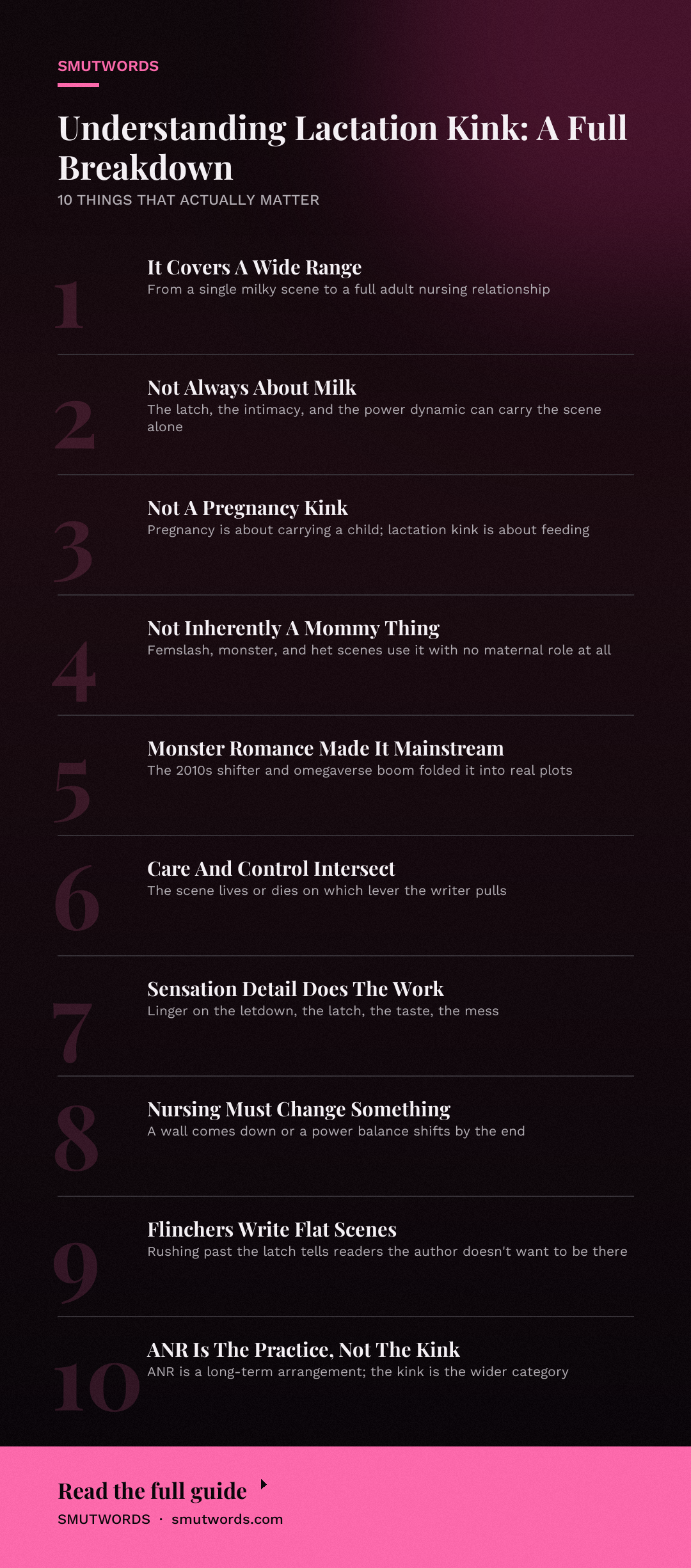
- It's not always about actual milk production. Plenty of readers are into the latch, the intimacy, and the power dynamic, and the milk is almost incidental. Others fixate on the milk itself. Both are lactation kink.
- It isn't the same as a pregnancy kink. They overlap sometimes, but pregnancy is about carrying a child; lactation kink is about feeding. One can exist with zero interest in the other.
- It's not inherently a mommy thing. The "mommy" label shows up, sure, but so do femslash pairings, monster and shifter books, and het scenes where the nursing has nothing to do with a maternal role.
- It's not rare in erotica. Search any monster romance catalog and you'll find it. It's a fixture, not a fringe curiosity.
The reason it keeps pulling readers is the same reason it pulls people in real life. There's a specific blend of vulnerability and care in it that's hard to get from any other act. One person is exposed, giving something from their body, and the other is receiving in a way that's almost childlike and almost dominant at the same time. That tension is the engine of the whole kink.
Where Lactation Kink Comes From
This isn't a kink with a tidy origin story, and anyone who tells you otherwise is guessing. What we can track honestly is its life as a publishing phenomenon, and that story is a few decades deep.
Lactation imagery has been in erotic writing forever in one form or another. Nursing shows up in classical literature, in folklore about witches and demons and suckling creatures, in the vampire tradition where feeding from a body is both violent and intimate. But the specific, reader-facing genre of lactation kink content is more recent. It grew alongside two bigger shifts in how erotic fiction worked.
The first was the rise of kink-specific publishing in the late twentieth century, when mail-order erotica and specialty presses gave niche interests their own shelves. Once there was a market for feet, for spanking, for bondage, there was a market for milk.
The second was the internet, which turned scattered individual interest into visible communities almost overnight. Lactation kink forums, adult nursing relationship discussion boards, and inducement guides all started clustering together in the 1990s and 2000s, and that's really when the vocabulary we use today (ANR, inducement, milk play) got locked in.
The big shift came with the monster and paranormal romance boom of the 2010s. Shifter books, alien romance, fae and demon romance, and all the omegaverse-adjacent stuff that followed made lactation a natural fit. A nonhuman hero producing milk, or a mate whose body responds to a claimed partner, let authors fold this kink into a plot instead of treating it as a standalone scene.
That's when lactation kink went from a specialty interest to something that could show up in the middle of a mainstream-feeling romance novel. Today it's carried by an overlapping crowd: the monster romance readership that expects it, the omegaverse crowd that treats it as part of the established biology, and the breeding kink crossover audience. Two kinks that share a surprising amount of real estate, those last two. Then there are the readers who just want the specific tenderness it delivers and don't care what shelf it sits on.
On the real-world side, adult nursing relationships have their own research and community infrastructure, including published work on the health and emotional factors involved when a couple nurses long-term without a baby in the picture.
What's evolved most is the framing. Early lactation content leaned hard on shock value, on the taboo of it. Modern erotica often uses the same taboo charge but buries it in emotional stakes.
The nursing isn't there just because it's scandalous. It's there because it means something specific about the relationship, and the writer is usually more interested in that meaning than in the shock.
How It Shows Up in Erotica
This is where a guide earns its keep. If you're writing it, or trying to figure out why one scene lands and another reads as flat, the craft comes down to a handful of real decisions.
The first is where the milk comes from, in a plot sense. A character who's just given birth, a shifter whose body responds to a heat cycle, an alien with unfamiliar anatomy, a human who induces lactation intentionally, a fantasy species with no explanation needed because the world already established it. Each choice changes the tone of the scene.
The postpartum version carries exhaustion and tenderness. The intentional, consensual inducement version carries deliberate intimacy, where two people chose this. The nonhuman version gets to skip biology class altogether and just make it true. Authors who pick the source of the milk deliberately get a much stronger scene than authors who hand-wave it.
The second is the power dynamic. Lactation kink sits right at the intersection of care and control, and the scene lives or dies on which lever the writer pulls. Common variations:
- Nurturing dominant. One partner is soothed, held, and fed, and being fed is the surrender. The feeder holds the power quietly, without ever naming it. This is the most common shape in contemporary romance.
- Care as reward. Nursing is something a character earns or is granted by a partner with authority. A captive, a mate, an omega, a beloved subordinate. The reward framing turns feeding into a gift that carries weight.
- Taboo shock. The scene plays up the "we shouldn't" charge, often with someone discovering the attraction or walking in on it. This is the most direct descendant of the earlier, shock-forward era, and it still sells.
- Playful and domestic. Sometimes it's just two people who are into it and the scene treats nursing like any other shared kink. Casual, warm, low on melodrama. More writers should do this version and fewer do.
- Primal and instinctive. The nursing happens because the bodies demand it. This is where lactation kink overlaps most with primal play and the more instinct-driven corners of monster romance.
The third decision is the texture. This is a kink where sensation detail does all the work. The weight of a full chest, the sting of a letdown, the warm pull of a latch, the taste (sweet, thin, sometimes reported as faintly almondy), the mess.
Enjoyed this? Get a free book.
Join the list and we will send a complete free story straight to your inbox, plus new releases every week after that. No credit card, no catch.
A strong scene slows down and lingers on how it feels to be the person nursing and how it feels to be the person being nursed, in that order or in alternating beats. A flat scene writes "he latched on" and moves to the next plot point.
What makes a strong version work, in editorial terms:
- The nursing changes the relationship. Something is different after. A wall comes down, a power balance shifts, a secret gets held between two people who can't un-know it.
- Both partners have a clear internal reaction. Even if one is silent, the reader needs to know what it's costing or giving them.
- The taboo is specific. Generalized "this is so wrong" does nothing. The specific wrongness (a mate bond, a forbidden age gap, a captive situation, a species difference) is what gives the scene its charge.
- The biology, however invented, gets respected. If the world says shifter milk does something, the scene should follow its own rules. Readers notice when an author forgets the lore they built.
What makes a flat version fail, just as consistently:
- The nursing is bolted on. You could delete it and the scene wouldn't change. That's the tell that the kink isn't doing any structural work.
- The internal experience is skipped. Bodies move, nobody feels anything specific, and the scene reads like a checklist item.
- The writer flinches. A lactation scene that's embarrassed about itself, that rushes through the latch and cuts to the next beat, tells the reader the author doesn't actually want to be here.
One craft note that's easy to miss: this kink pairs unusually well with a lot of neighboring tropes. The pairings are where some of the best writing happens.
Nursing as part of a larger power exchange reads differently than nursing inside an omegaverse pack dynamic. It also reads differently than nursing inside a harem romance where one character is the center of a group's care. If you want to see how sibling dynamics of domination, jealousy, and devotion get built out in a relationship book, the same craft instincts apply to a nursing scene that carries possessive weight; there's a good breakdown of it in Possessive Sex vs Jealousy Kink: What's the Real Difference?.
There's also a version of this kink that gets underused: the one where the nursing happens inside a group. A pack, a crew, a polycule.
When more than one person is present, the feeding stops being a two-person exchange and becomes a statement about who belongs to whom. That's closer in structure to what readers seek out in an orgy scene than a private one. Same act, completely different emotional shape.
And a note for writers working the monster lane specifically: lactation kink in that territory usually rides shotgun with the size and biology stuff readers already showed up for. If you're writing a scene where a partner's body does something unfamiliar and pleasurable, the moves are the same ones that make a monster cock kink scene land. The writer has to commit to the anatomy as real, not as a gag.
Lactation Kink vs Related Terms
Two comparisons come up often enough to be worth drawing clearly.
Lactation kink and primal play aren't the same thing, though they overlap. Primal play is about instinct, animalism, and the surfacing of a less-civilized self. Lactation kink can run primal, especially in shifter books, but it can just as easily be quiet, domestic, and entirely human.
If you want the fuller picture of the instinct side, we've covered it in What Is Primal Play? A Reader's Complete Guide, and the glossary entry for feral play is the shorthand version. The relationship is real, but it's a subset, not a synonym.
Lactation kink and adult nursing relationship (ANR) are also frequently confused, and the difference is mostly scope. ANR is a specific long-term practice between partners, with its own logistics around inducement, supply, and routine.
Lactation kink is the wider category that includes ANR and every fantasy, one-off scene, and reader-only interest that never becomes a practice. If you're reading a book, you're almost always reading the kink. If you're talking to a couple who nurses regularly, you're talking about an ANR.
One comparison that gets made but doesn't hold: lactation kink and swinging. They both involve bodies and trust and consent, and that's where it ends. Swinging is about partner exchange; lactation kink is about what one body gives another. No real overlap.
Frequently Asked Questions
Is a lactation kink common?
More common in reading than people admit out loud. It shows up routinely in monster romance, omegaverse, breeding kink crossover content, and femslash, and it has active real-world communities built around adult nursing relationships. If you're into it, you're in a much bigger crowd than the silence suggests.
Can a lactation kink happen without pregnancy?
Yes, in fiction and in real life. Many books induce lactation on purpose as part of a mateship or breeding arrangement, and some human couples induce it deliberately over weeks or months. In fantasy and paranormal settings the character's anatomy just works that way, no pregnancy required.
What is adult nursing relationship (ANR)?
It's an ongoing, consensual arrangement where one partner regularly nurses another, usually with real induced milk production. It sits inside the broader lactation kink category but comes with its own practical side, like routine, supply, and health considerations for both people involved.
Is it okay to try a lactation kink in real life?
With clear communication, yes. Before anything happens, both partners should talk through comfort levels around bodily fluids, hygiene, any relevant health factors (including medications and their effect on milk, and any risk to a nursing infant if one is in the picture), and what the arrangement actually looks like day to day. Talk first, adjust as you go, stop whenever someone wants to stop.
What's the difference between lactation kink and a breeding kink?
They overlap heavily and get lumped together, but they're distinct. Breeding kink centers on the act and fantasy of getting someone pregnant. Lactation kink centers on milk, nursing, and the feeding itself. Plenty of books use both at once, which is exactly why readers mix them up.
Why do so many monster and shifter books include lactation?
Because the genre already sells nonhuman biology and mate bonds, so lactation fits without any explanation debt. A shifter or alien hero whose body responds to a claimed partner lets the writer use the kink for intimacy and possession at the same time, which is the exact emotional note these books are built to hit.
Final Thoughts
Lactation kink rewards the reader who goes past the surface. The scene is rarely about the milk alone. It's about what one body giving to another does to the people involved, and the books that understand that are the ones that stay with you. Pick up a title where the nursing carries real emotional stakes, where the power between the two characters actually shifts because of it, and you'll see the whole kink in a different light.








Loading comments…