
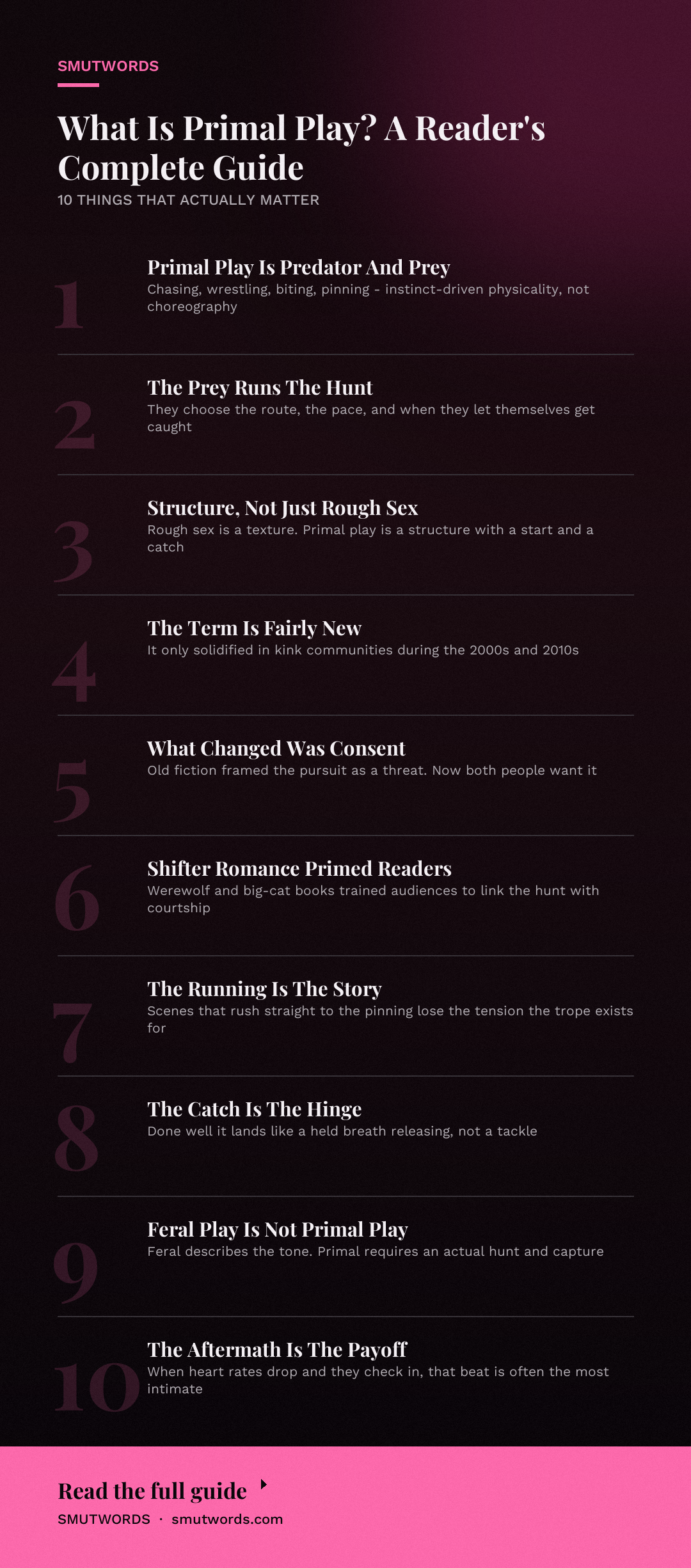
Primal play is a kink built around predator-and-prey dynamics: chasing, wrestling, biting, pinning, and the kind of raw, instinct-driven physicality that strips away conversation and social polish. There is no elaborate prop list and no choreography. Two people agree on a hunt, and then one runs.
The thrill lives in the pursuit, the catch, and the surrender that follows. It lands harder than almost any other kink because the body does most of the talking. If you have been circling the term wondering whether it means something specific or is just a vibe, it means something specific, and this guide covers all of it.
What Primal Play Actually Means
The name says the whole thesis. Primal play takes the parts of sex that happen below language, the growl, the grab, the scramble across a room, and builds a scene around them on purpose. Partners take on predator and prey roles, though which person wears which label can shift mid-scene or flip entirely from one session to the next.
What counts: pursuit with real physical effort, consensual struggle, teeth, nails, weight, breath, and a finish that feels earned rather than performed. What does not count: a couple who growls during ordinary missionary. Primal play is a distinct container with a beginning, an escalation, and an end.
Plenty of people carry a misconception that primal play is just rough sex with a cooler name. Rough sex is a texture. Primal play is a structure.
The chase has a start, the catch has a moment, and the surrender has a shape. A scene that skips the pursuit and jumps to the grappling is missing its own engine.
Another common mistake is assuming the prey holds no power. In a well-built scene, the prey runs the hunt. They choose the route, the pace, and the moment they let themselves get caught, and the predator reads every signal in real time. The chase is a conversation conducted entirely through the body.
That is also why readers respond to it so hard. It creates intensity and vulnerability in the same breath, and it taps into raw power and surrender without needing a single line of negotiation dialogue on the page. The result is cathartic and deeply visceral, and it usually leaves both characters more exposed than any conversation would have.
Where Primal Play Comes From
Primal play as a named kink is younger than most of the practices it borrows from. The term itself only solidified in kink communities in the 2000s and 2010s, when online forums and lifestyle events needed a label for scenes that did not fit neatly under dominance and submission, bondage, or impact play. People were already doing it. They just needed a word for the thing where the whole scene is a hunt.
Its literary roots run much deeper. Romance and erotica have staged chase-and-capture dynamics since long before anyone called them primal. The Gothic novels of the eighteenth and nineteenth centuries built entire plots on a woman fleeing something that wanted her, and the genre never stopped enjoying the run.
What changed is consent. Older fiction often framed the pursuit as a threat the heroine barely escaped. Contemporary primal play frames it as something both people want, negotiated in advance and enjoyed together.
The bigger shift came with the self-publishing boom of the 2010s. Indie romance authors could write the chase in explicit, unapologetic detail without a publisher asking them to soften it, and readers rewarded them for it. Shifter romance deserves a lot of credit here. Werewolf and big-cat books spent a decade training readers to associate the hunt with courtship, and when authors started writing human characters with the same feral instincts, the audience was already primed.
Dark romance pulled primal elements into its own territory next, often pairing the chase with a captor or enemy-to-lovers arc. Monster romance picked it up around the same time, since a nonhuman love interest makes the predator role feel literal rather than metaphorical. If you want to see how far that branch has stretched, the guide to demon romance relationships shows what happens when the hunt involves something that is not pretending to be tame.
Today the trope shows up across the entire genre, from small-town contemporaries to full post-apocalyptic romance, where a collapsed world makes the survival instinct feel built into the setting. The vocabulary has settled. Predator and prey, hunting play, chase play, animalistic roleplay, feral dynamics: all of these point at the same territory.
How It Shows Up in Erotica
On the page, primal play is a pacing decision before it is a sex decision. The strongest scenes spend real estate on the pursuit. A look across a room, a head start, the sound of feet on gravel, a hand catching a wrist at the last second. Readers need to feel the distance closing, and authors who rush straight to the pinning lose the exact tension the trope exists to deliver.
Sensory writing carries these scenes. Sound does more work than description: breathing, footsteps, fabric tearing, a body hitting a wall. Skin-level detail matters too, the cold air on bare legs, sweat cooling on a back, the specific pressure of a hand on a throat that is not squeezing. Primal scenes run on texture, not dialogue, and a writer who leans on banter during the chase will flatten it.
The catch is the hinge of the whole scene. Done well, it lands like a held breath releasing. Done badly, it reads as a tackle. The difference is usually interiority: a beat of the prey character's thought right before contact, wanting it and dreading it at once, decides whether the reader feels the collision in their own chest.
From there, the surrender phase is where primal play separates itself from other power-exchange kinks. There is no collar, no rope, no negotiated protocol, which means the surrender has to be earned purely through physicality. Many authors use a single word or gesture to mark the shift, a growled "mine" or a hand relaxing on a wrist, and that small signal does the work a whole contract would elsewhere.
Common variations authors reach for:
- Full hunt: a genuine head start and pursuit across a house, woods, or city street, with the catch as the centerpiece.
- Territorial pinning: no chase, just a sudden grab and press against a wall, all weight and teeth and no running.
- Shifter literal: one or both partners actually transform, so the predator role is physical fact rather than metaphor.
- Role reversal: the character who appears submissive in daily life becomes the predator once the scene begins.
- Bonded chase: the hunt happens between established partners, often as a ritual they return to, loaded with history instead of novelty.
- Rival chase: two characters in a power struggle use the hunt to settle something neither will say out loud.
Flat primal scenes tend to share a few habits. They treat the chase as foreplay to skip. They make the prey a passive prize instead of an active participant.
Enjoyed this? Get a free book.
Join the list and we will send a complete free story straight to your inbox, plus new releases every week after that. No credit card, no catch.
They also forget the aftermath, when heart rates drop and characters check in on each other. That is often the most intimate beat in the entire chapter. A strong version lets the savagery end and the tenderness land right after, and that contrast is the payoff.
Physical safety belongs on the page too, at least in the texture of the scene. Writers who show a character tapping twice or saying a prearranged word mid-wrestle are writing better primal play, because it keeps the dynamic believable without defanging it. Consent that is negotiated before the hunt and honored during it is what makes the surrender feel chosen instead of staged.
The same principle applies to other edge-adjacent kinks, and posts like breeding kink vs impregnation kink make the same point about how clarity sharpens the fantasy rather than dulling it.
One more craft note: primal play pairs beautifully with voyeurism. Someone watching the hunt from the edge of the scene adds a second layer of tension. If you want that dynamic spelled out, our guide to voyeurism in erotica covers how to write a witness without breaking the chase's intensity.
It also mixes well with why choose romance, where multiple love interests can each occupy a different role in the hunt, and with use kink when the predator-prey frame runs inside an otherwise negotiated arrangement.
Primal Play vs Feral Play
These two terms get used interchangeably in review spaces, and they should not be. They overlap, but they are not the same thing, and knowing the difference helps you find the books you actually want.
Feral play describes the register: wordless, animal, unpolished. There is no required chase. Two characters can be feral on a couch with nobody running anywhere, all growls and biting and ruined composure.
Primal play requires the hunt. The pursuit is the plot, and the capture is the point.
So a scene can be feral without being primal, and it can be primal with stretches that are not especially feral, like the calculated stalking before a chase begins. If you came looking for biting and growling and no running, feral play is your term. If you want the head start and the catch, you want primal play.
It is also worth separating primal play from plain old rough sex, though the two often travel together. Rough sex describes the intensity of the contact. Primal play describes the structure around it. A book can deliver one without the other, and the best ones deliver both while keeping the chase legible from start to finish.
Frequently Asked Questions
What is primal play in simple terms?
It is a consensual kink where partners act out a predator-and-prey scenario, usually with chasing, wrestling, and biting. The point is the raw instinct-driven physicality and the surrender that comes after the catch. It works best between people who have agreed on limits and a safeword before anything starts.
Is primal play the same as CNC?
They overlap but are not identical. Consensual non-consent is a broader framework for scenes that simulate a lack of consent. Primal play describes the predator-prey dynamic itself, which can be framed as CNC or as mutual play between eager partners. Many scenes use both labels, but neither one requires the other.
What are the safety rules for primal play?
Negotiate before the scene, agree on a safeword and a physical signal for moments when speech is not practical, and clear the space of anything a running body could hit. Chasing and wrestling carry real injury risk, so shoes, terrain, and furniture placement all matter. Check in after the scene as well, since the intensity can leave both people needing reassurance.
Do both partners have to want the same role every time?
No, and many experienced pairs switch roles between sessions. Others keep a fixed dynamic for years because the consistency is part of the appeal. What matters is that the roles are chosen rather than assigned by assumption, since a prey who did not agree to run is not playing at all.
What is the difference between primal play and feral play?
Feral play covers the animalistic tone: biting, growling, losing language. Primal play covers the hunt itself, with a chase and a capture. A scene can be feral with no pursuit at all, which is why the two terms show up in different book descriptions even though they share a fanbase.
Why do readers find primal play so intense?
Because it removes the social layer. There is no small talk, no performance, and no way to hide behind politeness when someone is physically running you down. That exposure creates the catharsis readers describe, and the tenderness afterward hits harder for coming right on the heels of something so raw.
Does primal play always involve sex?
No. Some people practice it as a standalone physical scene and stop at the catch, and some scenes are the lead-in to sex rather than a substitute for the rest of it. On the page, most authors build the hunt into a broader sexual arc, but the chase itself is the draw.
Final Thoughts
Primal play rewards writers who understand that the running is the story and the catch is the payoff. It rewards readers who want their romance stripped down to breath and weight and instinct.
If you want a book that builds an entire relationship out of that dynamic, start with a shifter romance where the predator does not have to pretend to be civilized, and pay attention to how the author handles the moment after the catch. That beat is where you find out whether they actually understand the kink or just enjoy describing a tackle.






Loading comments…