
Long distance romance is a love story where the couple spends most of the book apart, and the relationship has to survive the miles anyway. They talk on the phone at 2 a.m., they text things they'd never say out loud, they count down to a visit that costs three months of savings. When they finally get a hotel room, they fuck like it's the last night on earth.
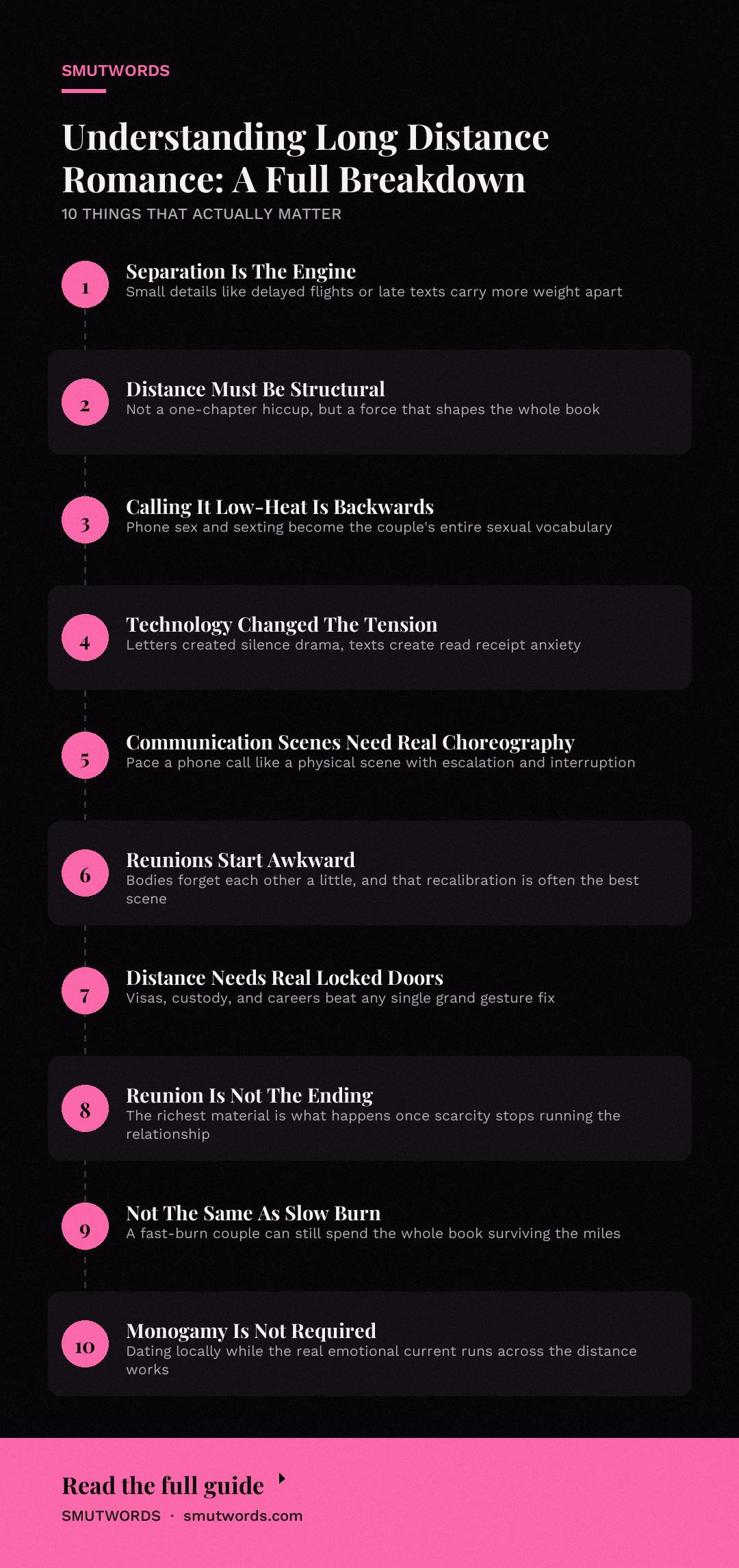
The separation is the engine. Every mundane detail (a voicemail, a delayed flight, a package that arrives two days late) carries more weight than it would if the characters lived in the same zip code, and that's exactly why readers keep coming back to long distance romance.
It's one of the most durable tropes in the genre because it's fundamentally about wanting. The couple already knows they want each other. The story is about whether wanting is enough to hold a thing together when you can't touch the person you want.
What Long Distance Romance Actually Means
The term describes any romance where geographic separation between the main couple is a structural feature of the plot, not a temporary hiccup resolved by chapter three. The distance can be a few hundred miles or a few thousand. What matters is that it's persistent enough to shape how the characters relate to each other.
Where the name comes from is straightforward: the phrase entered romance publishing vocabulary the same way "enemies to lovers" did, as a reader shorthand that eventually became a marketing category. You'll see it on retailer tags, in reader Facebook groups, and in author newsletters as a filter readers use to find exactly the ache they're in the mood for.
What counts
- The couple is separated for the majority of the book by geography, not by misunderstanding or a breakup.
- Communication (calls, texts, letters, emails, voice notes) does real narrative work. It's not just filler between visits.
- The distance is a genuine logistical problem with consequences: money, visas, jobs, family obligations.
What doesn't count
A couple who lives in the same city but has a busy week is not long distance. A couple separated for one chapter before a grand gesture reunion is not long distance. A couple in different countries who never speak and just pine silently is closer to unrequited love than this trope, because the relationship has no active texture.
The most common misconception is that long distance romance is low-heat by nature, since the characters can't touch each other. That's backwards. Some of the filthiest, most explicit scenes in the genre happen on the page in this trope, because phone sex, sexting, and the anticipation problem of not being able to finish what you started become the entire sexual vocabulary of the couple for most of the book. The anticipation foreplay dynamic is the trope's beating heart.
Another misconception: that the couple has to be monogamous and pining. Plenty of strong versions have one or both characters dating locally while the real emotional current runs across the distance, and the guilt or honesty around that is a legitimate source of tension.
Where Long Distance Romance Comes From
The trope has roots in the epistolary novel, which has been a publishing format since the 1700s. Letters as a romance device predate the romance genre itself.
What's specific to modern long distance romance is the way technology changed the texture of the separation. Two centuries ago, a letter took weeks to arrive and the drama was about silence. Now a text takes two seconds and the drama is about read receipts, typos, phone anxiety, and the specific dread of a reply that comes in too fast or not at all.
In romance publishing specifically, the trope went through a few recognizable phases:
- The wartime and military phase. Deployment romance has been a staple since at least the mid-twentieth century, and it remains one of the most popular variants. The stakes are baked in: the separation is mandatory, dangerous, and out of the couple's control.
- The pre-internet pen pal phase. Later twentieth-century books leaned on letters, and the tension came from the lag. You couldn't clarify a misread tone for two weeks. Entire plots turned on a sentence that landed wrong.
- The digital phase. Around the 2000s and accelerating through the 2010s, texting, video calls, and online-first relationships became the default. This is where the trope got its current reputation for being extremely hot despite (or because of) physical separation.
- The contemporary logistical phase. Recent years have produced more books about the boring, brutal logistics: visa paperwork, time zone math, the cost of flights, and the question of who moves. These versions are less swoony in premise but often more devastating in execution.
The publishing shift that matters most: editors used to treat long distance as a temporary complication on the way to a same-city happy ending. Now the trope is frequently the entire premise, and the resolution is either one person relocating or the couple deciding their arrangement works as-is. Both endings are accepted by readers now in a way they weren't twenty years ago.
How It Shows Up in Erotica
The craft problem with this trope is simple to state and hard to solve: how do you build heat when the characters can't share a room for most of the book? The writers who do it well solve it in one of a few ways, and the ones who do it badly rely on one of the same ways without doing the work.
Communication as the sex scene
The strongest long distance books treat a phone call or a sexting exchange as a full scene with its own escalation, interruption, and climax. That means pacing it like a physical scene. The characters get turned on, things build, someone is close, something disrupts it (a roommate walking in, a bad connection, a crying baby next door), and the interruption costs them something.
Flat versions of this write the phone call as a summary: "They talked until 3 a.m. and it was incredible." That's a note to the reader, not a scene. The fix is showing the specific line that undid them, the specific pause, the specific thing they admitted because the distance made it easier to say.
The visit structure
Many books organize the plot around planned visits. This is where the trope earns its reputation for intensity. A weekend together after four months apart carries a specific charge: scarcity makes everything urgent and slightly feral.
Good versions lean into the awkwardness too, because the first hour of a reunion after a long separation is genuinely weird. Bodies forget each other a little. Small habits have changed. The characters have to recalibrate before they can fuck like they've been imagining, and that recalibration is often the best scene in the book.
Strong visits also have an expiration date visible from the first page. The reader knows exactly how many hours are left, and so do the characters, and that knowing changes how they spend them.
Enjoyed this? Get a free book.
Join the list and we will send a complete free story straight to your inbox, plus new releases every week after that. No credit card, no catch.
Common variants authors use
- Military deployment romance. Separation is compulsory and dangerous. Communication is rationed. The emotional stakes include the possibility the person doesn't come back.
- Online-first or pen pal romance. The couple meets through text, forums, or letters before meeting in person. Often overlaps with childhood friends to lovers when the correspondence started young.
- Work-mandated separation. A job, tour, or contract keeps them apart. Often overlaps with celebrity romance, since fame is one of the most reliable engines of forced distance.
- Long distance friends to lovers. They were close for years before either admitted it. The distance is old; the wanting is new.
- Forced proximity by distance. A less common inversion where the separation creates a kind of closeness. They tell each other things they'd never confess face to face.
- Immigration and visa romance. The distance is bureaucratic. The story is about paperwork, patience, and sometimes a marriage in trouble subplot if the couple marries for practical reasons before the feelings catch up.
What makes the strong versions work
The best books in this trope are specific about the ordinary details of separation. Not "she missed him" but the exact thing she missed: the way he hummed while making coffee, the specific sound of his keys in the door, the smell of his jacket that had faded by week three. The trope dies when the distance is generic.
They also give the couple a genuine reason to be apart that isn't easily solved by one grand gesture. If a single well-timed flight could fix everything, the reader will spend the whole book wondering why nobody booked it. The best versions lock the door: visas, custody agreements, careers that can't relocate, family members who need care. Real constraints produce real ache.
And they resist the temptation to make the reunion the ending. The reunion is often the midpoint. What happens after the couple has to figure out how to keep a relationship alive when it's no longer running on scarcity is where the richest material lives. This is one of the few tropes where the "and then what" question gets asked honestly, and books that answer it well have a staying power the purely swoony versions don't.
Craft-level note: secondary characters carry more weight in this trope than most, because they're often the only people the main characters can talk to about the relationship. The best friend who's tired of hearing about the same phone call is a useful pressure valve, and a book that skips that outlet tends to make the couple feel isolated in a way that reads as flat rather than romantic.
Long Distance Romance vs Childhood Friends to Lovers
These two tropes get confused often, mostly because they overlap constantly in practice. The confusion is worth clearing up because the emotional engines are different.
Childhood friends to lovers runs on shared history and the fear of ruining a friendship. The couple knows each other completely. The tension comes from a line they've been dancing around for years.
Long distance romance runs on scarcity and logistics. The couple often meets as adults, and the tension is about whether the relationship can hold across geography and time. If you want the full breakdown of the friends-to-lovers side, SmutWords has a full guide: Childhood Friends to Lovers 101.
The overlap version, where childhood friends become long distance adults who finally admit it, is one of the most reliable setups in the genre. If you're writing that combination, the distance usually serves the friends-to-lovers arc by giving both characters room to change into people who can actually do the relationship.
Frequently Asked Questions
Is long distance romance the same as a slow burn?
No, though they often get shelved together. A slow burn is about delayed physical or emotional consummation. Long distance romance is about geographic separation. A book can be both, but it can also be a fast-burn long distance story where the couple is fully committed by chapter four and the rest of the book is about surviving the miles.
Why do readers find this trope so hot when the couple barely touches?
Because anticipation does more work than contact when it's written well. The reader sits inside the wanting for hundreds of pages, and every small contact (a voice note, a shirt that smells like someone, a hotel key card) gets amplified by everything that came before it. That amplification is the trope's core appeal.
Does long distance romance always end with one person moving?
Not anymore. Older books almost always resolved the separation by relocating one character. Contemporary versions increasingly end with the couple choosing to maintain the arrangement, or with a compromise that isn't simply "one person gives everything up." Readers are more tolerant of unresolved geography now than they used to be, as long as the emotional commitment is clear.
What's the most common mistake writers make with this trope?
Making the distance generic and solvable. If the couple is apart for reasons the reader can poke holes in ("just take the flight, dude"), the whole book deflates. The separation has to be locked in by real-world constraints that neither character can simply override with a grand gesture.
Can long distance romance work as a subplot in a different trope?
Absolutely, and it often does. It's a common complication layer in motorcycle club romance, secret baby plots, and redemption arc romance, where the separation is the practical consequence of something the characters did to each other. It also pairs naturally with ghostwriter romance and prince/princess romance, both of which frequently require the couple to be in different places for long stretches.
How explicit do long distance books usually get?
It varies wildly. The trope has developed a reputation for being explicitly hot because the communication scenes do so much sexual work, and a well-written phone sex scene can carry as much heat as a full physical scene in a book where the couple shares a bed every night.
If that specific dynamic interests you, SmutWords has a deeper piece on it: Praise Dynamic Relationships covers a related communication-driven kink that shows up often in the same books.
Final Thoughts
Long distance romance works because it forces the writer to make every interaction count, and forces the reader to sit in the ache instead of skipping past it. The best versions understand that separation isn't a delay before the real story. It's the story, and the reunion is just one scene inside it.
If you want a single book to start with in this trope, look for the ones where the couple's phone calls are written as full scenes with their own choreography, and where the reason they can't just hop on a plane is specific enough to make you wince. That's where the trope earns its keep.







Loading comments…