A medieval romance drops lovers into an era where a single wrong word at court could cost a head, where a marriage could seal a kingdom's fate, and where a knight's vow mattered more than his life. It is a romance plot set in the Middle Ages, often featuring knights, castles, lords and ladies, with the central love story woven into a backdrop of court intrigue, warfare, or quests.
The hero is frequently a noble warrior or a man of lower rank proving his worth, while the heroine may be a lady of the keep, a healer, or a spirited commoner. Readers return to this genre again and again because the stakes feel physically heavy. Honor, duty, and survival press against every glance and whispered promise.
What Medieval Romance Actually Means
A medieval romance is a specific subgenre of historical romance set roughly between the 5th and 15th centuries, usually in Europe, and most commonly in England, Scotland, or France. The setting is more than decor. The medieval world dictates what the characters can do, say, and want.
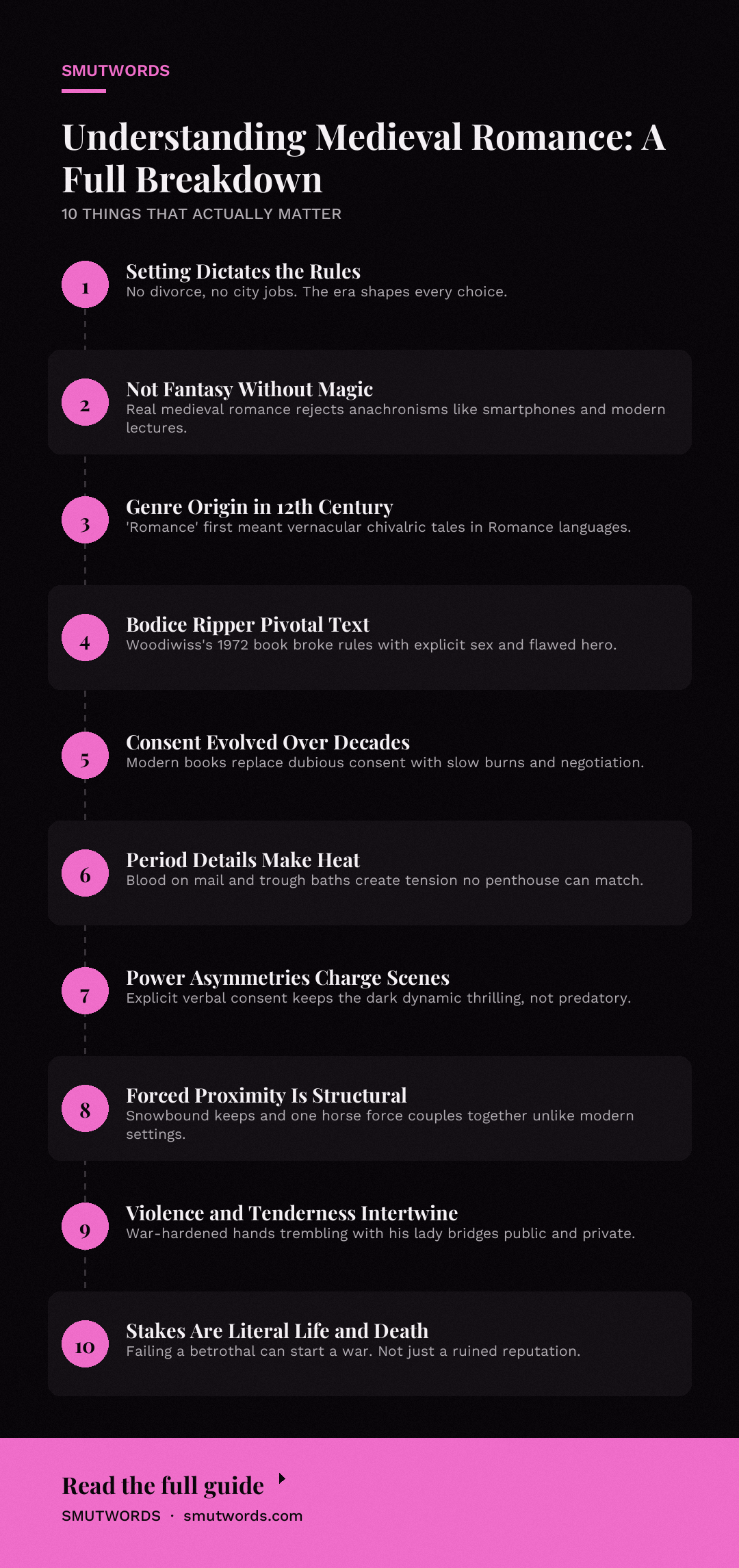
A heroine cannot simply file for divorce or take a job in the city. A hero cannot easily walk away from his liege lord to chase a feeling.
What counts as medieval romance in practice? The core ingredients are a historical setting before the Renaissance, a central romantic relationship that drives the plot, and a narrative that respects the constraints of the era. That means arranged marriages, feudal obligations, limited literacy, and the constant threat of violence. The love story happens inside those walls, not in a modern fantasy of the past where everyone thinks like a contemporary person.
Common misconceptions run thick here. Some readers assume medieval romance is just "fantasy without magic," but genuine historical medieval romance rejects anachronistic conveniences. A heroine does not whip out a smartphone or lecture a knight on modern feminism. She operates within her world's logic.
Another misconception is that the genre is all chaste longing and courtly love poetry. The actual published field contains plenty of explicit heat, from the wedding night to stolen moments in garderobes. The genre also differs from high fantasy romance. If a wizard casts a spell or a dragon appears, that is fantasy romance with a medieval flavor.
Medieval romance stays grounded in the historical record, even when that record is loose. A story with a fictional king and invented castles can still qualify if the customs, dress, and political structures feel authentically pre-modern.
Where Medieval Romance Comes From
The term "romance" actually traces back to this very setting. In the 12th century, "romance" referred to vernacular tales of chivalry written in the Romance languages, as opposed to Latin. These stories starred knights on quests, often for a lady's favor, and they are the direct ancestors of the modern genre.
Marie de France's lais, Chrétien de Troyes's Arthurian tales, and the anonymous "Sir Gawain and the Green Knight" all established the DNA that erotic romance writers still pull from.
But the publishing phenomenon of medieval romance as a mass-market genre is younger. The 1970s saw the rise of the "bodice ripper," a label that originally described historical romances with forced seduction plots, many set in the Middle Ages. Kathleen Woodiwiss's The Flame and the Flower (1972) is the pivotal text, a medieval-set story that broke the category's rules with explicit sex, a heroine who was not a virgin princess, and a hero who was genuinely flawed.
From that eruption, medieval romance split into recognizable veins. The 1980s and 1990s gave readers the Highland romance, pioneered by authors who moved the action north to Scotland and traded elegant English courts for rugged clans, kilts, and misty glens. This variant became so dominant that many readers now pick up a "medieval" romance expecting tartans and brogues.
The English keep and the Highland fortress offer different flavors of the same core fantasy: a ruthless world where one person's devotion becomes the only safe harbor.
The genre has shifted noticeably in the last two decades. Older medieval romances often leaned on dubious consent, with heroes who pushed past a heroine's protests. Contemporary medieval romance has largely cleaned up those dynamics, replacing coercion with slower burns, arranged marriages where attraction grows, and explicit negotiation within the constraints of the era. That evolution matters because readers still want the high stakes of the past without the uglier assumptions that older writers treated as normal.
For a modern example of how a similar fantasy of isolation and raw masculinity plays out in the present day, readers often enjoy Lumberjack Romance. The connection is not accidental: both offer a rugged, dangerous man, a remote setting, and a woman who must adapt to survive.
How It Shows Up in Erotica
Medieval romance in its erotic form does not just set a love scene in a castle. The setting changes the mechanics of desire on the page. A knight who returns from battle with blood on his mail, who washes off in a trough while his lady watches, carries tension that a corporate CEO in a penthouse cannot replicate. The physical world is dirtier, more tactile, and more immediate.
There are several reliable scene structures that strong medieval erotica deploys. Knowing these helps a reader find the version they want.
- The wedding night consummation: a political marriage where both parties are strangers, and the first touch is loaded with duty, fear, and curiosity. The author can play this as tentative discovery or as raw, immediate claiming.
- The forbidden interlude: a lady and her husband's knight, a nun and a mercenary, a servant and the visiting lord. The danger of discovery heightens every moan and whisper.
- The siege aftermath: defenders and attackers in the same keep, with adrenaline and relief colliding into desperate sex against the nearest wall.
- The banner tournament: weeks of competition where the victor earns a lady's favor, and sexual tension builds in parallel with the jousting.
- The healing scene: a heroine who tends a wounded knight's body, her hands moving from professional to personal as the fever rises.
What separates a flat medieval erotic scene from a memorable one is the integration of period authenticity. A modern reader knows that medieval people bathed less frequently, and a good author either addresses that head-on or inverts it. A hero's grime and sweat can be a feature, not a bug, if the heroine's response feels honest.
A heroine who has never been alone with a man before will register his physicality with overwhelming intensity, which gives an author a built-in excuse for heightened sensation.
The heat in medieval erotica also leans heavily on the power asymmetries of the era. A lord who can legally do nearly anything to a peasant woman creates a dark, charged dynamic that modern readers either find thrilling or unsettling. The genre has responded by making consent explicit and verbal even when the historical context makes it awkward.
A heroine who tells her captor exactly what she will and will not do, and a hero who respects that line, keeps the fantasy alive without reproducing the predatory patterns of older books.
Forced proximity is baked into the genre, since medieval characters cannot simply leave the castle when things get awkward. A snowbound keep, a shared chamber for a visiting retinue, or a journey with only one horse all force the couple together. That mechanism, which builds tension so well in Forced Proximity, is practically a structural pillar of medieval romance rather than an optional trope.
The emotional arc matters as much as the physical contact. The medieval romance hero frequently carries a wounded past: a dead first wife, a fall from favor, or a betrayal that hardened him. Watching that man soften only for his lady is one of the genre's greatest pleasures.
Enjoyed this? Get a free book.
Join the list and we will send a complete free story straight to your inbox, plus new releases every week after that. No credit card, no catch.
This dynamic shows up across erotic fiction as the Grumpy Hero Soft for Her. The medieval stakes of lifelong oaths and deadly politics just make the softening land harder.
A strong medieval romance also remembers that warfare and sex were intertwined. The same man who leads a charge and kills without hesitation can be torn between that violence and his desire to be tender with his wife.
Good authors let the contrast bleed into the bedroom. His hands, hard from sword grip, tremble when they touch her. She sees the blood under his nails and still chooses him.
That bridging of public violence and private softness is what makes the genre feel like more than costumed contemporary romance.
Medieval Romance vs Historical Romance
The most common source of confusion is not between medieval romance and any other kink or trope. It is between medieval romance and historical romance as a whole. Historical romance by its widest definition covers any romance set before the author's present day, which in practice usually means the Georgian, Regency, or Victorian eras in England. Medieval romance is one slice of that bigger pie, and the distinction matters for reader expectations.
Regency romance, the most popular sibling, features ballrooms, carriage rides, and verbal sparring that ends in a kiss behind a potted plant. The stakes are social: a ruined reputation, a forced marriage, a duel. Medieval romance trades all that for mud, blood, and outright warfare.
The hero is more likely to offer his sword than his alibi, and the heroine's worst fate is not spinsterhood but a forced marriage to a villain with legal rights over her body.
For readers trying to choose, the question is about energy. If you want quick jokes, witty banter, and the rush of a scandalous dance, pick up a Regency. If you want the weight of chainmail and the tug of feudal duty, go medieval.
The pacing is different, the physicality is grimmer, and the romantic gestures carry a literal life-or-death dimension. A dance at Almack's will not get anyone killed. Failing to honor a betrothal contract with a powerful lord can start a war.
The boundary line also runs between medieval romance and fantasy romance, as noted above. If the story includes dragons, magic systems, or wholly invented races, it is no longer medieval romance in the strict historical sense. Many readers love both and bounce between them regularly. The key is knowing which contract the book is honoring.
Since medieval romance so often pairs a noble hero with a commoner, or a lady with a knight of lower birth, the class clash sometimes carries real weight. This is a cousin to the social barriers in more contemporary caste-driven books, but here the barriers are literal law.
A lord marrying a peasant's daughter in some periods could be stripped of his title. That external pressure makes the couple's choice to be together genuinely costly, which is why the genre thrives on it.
Frequently Asked Questions
Is medieval romance historically accurate?
Most published medieval romances take significant liberties with dates, events, and customs. Authors pick and choose anachronistic details for plot convenience or reader comfort. A well-researched book will feel authentic in texture, but it is still fiction. If you want strict history, read a textbook.
What is the difference between medieval romance and Highlander romance?
Highlander romance is a subgenre of medieval romance that specifically sets its story in Scotland. It features clans, lairds, and often the English-Scottish border conflicts. The hero usually speaks with a Scots burr and the landscape is misty, violent, and deeply romantic. Not all medieval romance is Scottish, but the Highland variant is so popular it sometimes dominates the category.
Why are marriages of convenience so common in medieval romance?
In the Middle Ages, marriage was often a political tool rather than a personal choice. Arranged marriages between noble families secured alliances, land, and heirs. That real historical practice gives authors a natural engine for forced proximity and slow-burn love. Two strangers bound by legal and religious vows must find a way to share a bed and a life, which is a perfect setup for erotic tension.
Do medieval romance books have explicit sex scenes?
Some do and some do not. The genre includes everything from sweet, closed-door kisses to full-on explicit erotic scenes. The "bodice ripper" era set a precedent for graphic content that persists today. Check the book's heat level rating or read reviews if you want a specific degree of explicitness.
Are there medieval romances with diverse characters?
Yes, though they are less common than the default white European cast. Some authors set stories in Moorish Spain, the Byzantine Empire, or along the Silk Road. These books are growing in popularity as readers seek out medieval settings beyond the English and Scottish norm, and they offer a richer view of the era's actual diversity.
What makes a good medieval romance hero?
He should be competent in his world, whether that means fighting, ruling, or protecting, and he should face a specific obstacle to love. Many are grumpy, battle-worn, and emotionally closed off. When the heroine breaks through, the effect is powerful because of the man's inherent strength. Cowardly or indecisive heroes do not belong in this genre.
How is this connected to the fantasy romance I see online?
Medieval romance shares DNA with fantasy romance, which often borrows castles, knights, and feudal politics but adds magic and otherworldly creatures. If the romance stays historically grounded with no supernatural elements, it is medieval romance. When sorcery or dragons arrive, it becomes monster romance territory or straight epic fantasy romance.
Final Thoughts
Medieval romance endures because it puts love in a world where every choice matters. The best stories do not just dress modern couples in costumes. They build a setting where a single kiss can violate a treaty, where divorce is not an option, and where loyalty to a spouse may mean betraying a king. That pressure creates drama, and the drama creates heat.
For readers ready to start, pick up a book that honors the genre's authentic pleasure: high stakes, high heat, and a hero whose sword arm is matched only by his devotion. The finest examples of the form will leave you looking at your own modern conveniences with new appreciation for the luxury of simply choosing who to love.





Loading comments…