
A royal romance is a love story built around a relationship with a monarch or heir to a throne: a prince, princess, king, queen, duke, or the spare nobody expected to matter. The protagonist is usually an outsider, someone with no title and no protocol training, who ends up in the orbit of someone whose entire life is scheduled, scrutinized, and owned by a nation.
What follows is a collision between private desire and public duty, and the reader gets to watch two people figure out whether love can survive a crown. Royal romance is one of the oldest engines in the genre, and it still outsells almost everything else in the palace-adjacent aisle.
What Royal Romance Actually Means
The term describes both a setting and a power dynamic. The setting is monarchical: palaces, estates, titles, a court with its own rules and its own gossip economy.
The power dynamic is the real draw. One partner holds institutional authority, generational wealth, and the ability to end a conversation with a single word. The other partner holds almost none of that, at least at the start.
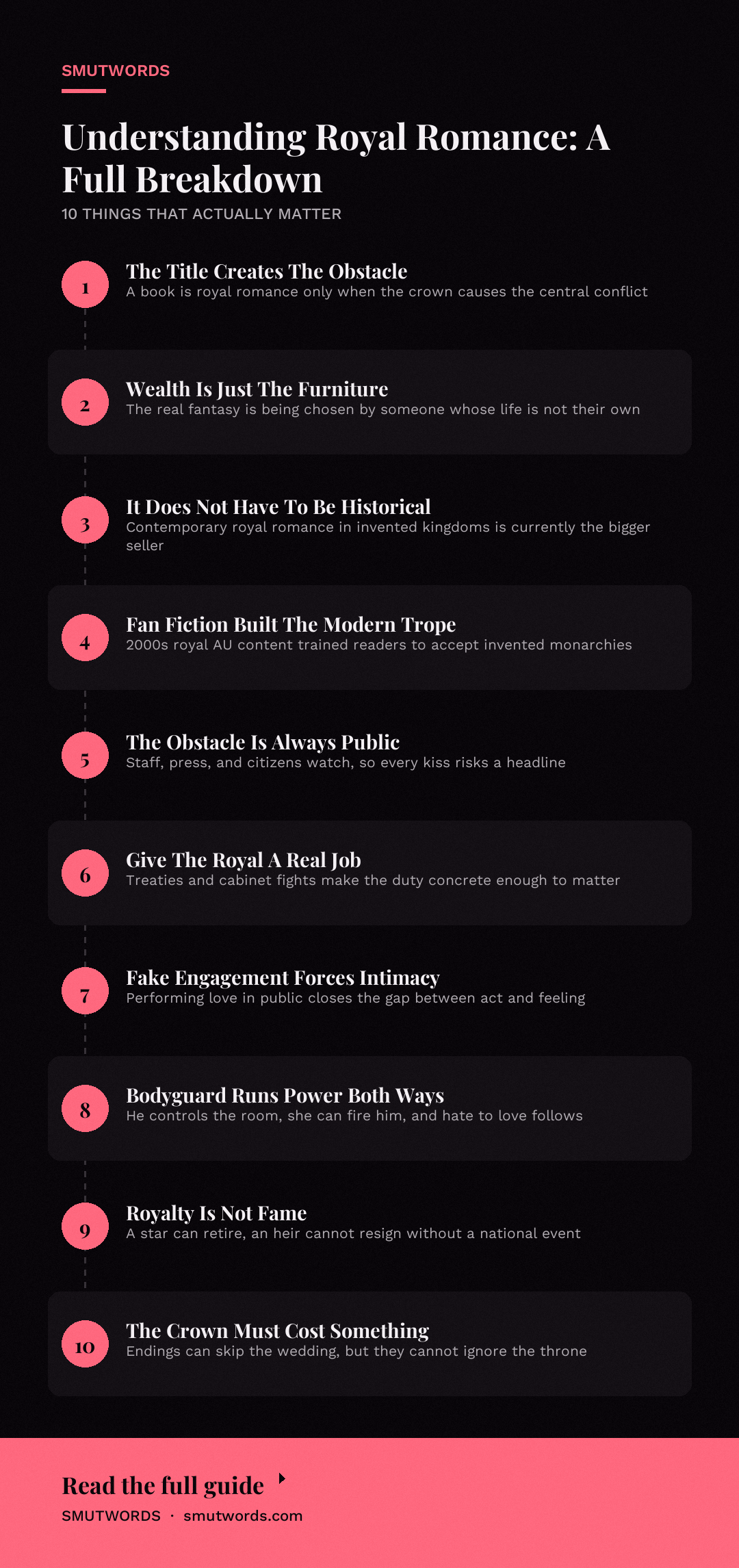
A book counts as royal romance when the title itself creates the central obstacle. If the love interest happens to be rich and the money never complicates anything, that is a billionaire romance wearing a coronet. If the royal status generates the conflict, the stakes, or the reason the couple cannot simply be together, you are reading the real thing.
What does not count: a character called "prince" who behaves like a standard brooding CEO, kingdoms that exist only as scenery, and stories where the crown is resolved in a single conversation and never mentioned again. The title has to cost something.
Two misconceptions come up constantly. The first is that royal romance requires historical settings. It does not. Contemporary royal romance set in fictional European kingdoms is one of the most reliable subcategories in publishing, and it sells to readers who would never pick up a Regency.
The second misconception is that the fantasy is about wealth. The wealth is furniture. The fantasy is being chosen by someone whose choices are supposed to belong to other people.
That distinction matters because it explains why the trope survives across decades of changing taste. The specific luxury goods change. The fundamental tension, a person who cannot freely give themselves, does not.
Where Royal Romance Comes From
Royal romance is older than the modern genre. Fairy tales, courtly love poetry, and the nineteenth-century sensation novels all ran on the same premise: a person of no rank loved by a person of the highest rank. Cinderella is a royal romance with the serial numbers filed off. So is half of Arthurian literature.
In category romance publishing, the modern form hardened in the second half of the twentieth century. Harlequin and its competitors built entire lines around sheikhs, princes, and Mediterranean kings, and those books were not subtle about it. The cover copy promised a kingdom and a wedding, and the books delivered both on a tight page count.
The next shift came with the internet. Fan fiction communities in the 2000s produced enormous volumes of royal AU content, taking characters from existing properties and dropping them into fictional monarchies. That wave trained a generation of readers to accept invented kingdoms, invented succession laws, and invented national holidays as long as the emotional logic held up.
When those readers started buying original books, publishers noticed. Contemporary royal romance as it exists now is partly a response to real-world royal news cycles. Every major royal wedding, every scandal, every documentary about a family that would rather not be discussed, sends readers looking for fictional versions they can control.
The fictional kingdom is a feature, not a bug. It lets the author invent a monarchy without the baggage of a real one, and it lets the reader enjoy the pageantry without the ethical friction of a specific living family.
Indie publishing pushed the evolution further. Without category length limits, authors started writing 400-page royal epics with full succession subplots, parliamentary intrigue, and multiple points of view. The trope stopped being a premise and became a whole architecture.
How It Shows Up in Erotica
On the page, royal romance does three jobs at once. It creates an imbalance of power, it creates a reason the couple cannot be together, and it creates an audience. That third one is what separates royal romance from most other forbidden-love setups.
In a typical arranged-marriage or forbidden-affair story, the obstacle is private. Two people, one secret.
In royal romance, the obstacle is public by default. There are staff, advisors, press, and citizens watching. Every kiss is potentially a headline.
Every argument can become a constitutional crisis. The heat comes from the fact that these two people are never actually alone, even when they are naked.
Strong versions of the trope lean into that exposure. The best scenes are usually the ones where the couple steals privacy: a service corridor, a guest cottage, a car with tinted windows, a balcony just out of sight of the cameras. The reader feels the risk because the author has established who is watching.
Strong royal romance also gives the royal partner a real job. Heirs and monarchs in flat books spend their days attending galas and staring out of windows. In good ones, they are managing a sovereign wealth fund, negotiating a treaty, handling a scandal their sibling caused, or fighting their own cabinet. Duty has to be specific for the conflict to land.
Common Variations Authors Use
These are the shapes you will see most often, and each one changes the emotional math.
- Modern royal romance. A fictional European kingdom with phones and paparazzi. The obstacles are press attention, succession law, and public approval ratings.
- Historical royal romance. Usually set in a real or lightly fictionalized past. The obstacles are dynastic marriage, gendered power, and the impossibility of divorce.
- Fake royal engagement. Two people pretend to be a couple for political or publicity reasons, then stop pretending. The failure point is always the same, and readers show up for it anyway.
- Royal marriage of convenience. A real wedding, a real contract, and two people who agreed to terms they cannot actually honor.
- American in the palace. The protagonist is a commoner from a country with no monarchy, which makes every ritual absurd and every rule negotiable in her eyes.
- Bodyguard royalty. The love interest is hired to protect the royal, which means the power imbalance runs in two directions at once. He has the physical control; she has the authority to fire him.
- The spare. Not the heir, not expected to rule, which is exactly why he or she can get away with more and lose everything faster.
The bodyguard variation deserves its own note because it is where royal romance overlaps most heavily with undercover romance. You get proximity, secrecy, professional obligation, and a hierarchy that makes the attraction feel like a violation of the job description. It is also the version most likely to produce a hate to love arc, since the guard usually resents the assignment before he falls for it.
Enjoyed this? Get a free book.
Join the list and we will send a complete free story straight to your inbox, plus new releases every week after that. No credit card, no catch.
Fake engagement and marriage of convenience are the two versions where enemies to lovers mechanics show up most often. The couple starts on opposite sides of a negotiation, and the negotiation is what forces them into the same room for weeks.
What Makes a Strong Royal Romance Work vs a Flat One
The single biggest difference between a book that works and one that does not is whether the crown is a person or a prop. In flat books, the monarchy is explained once and then ignored. In strong ones, it is basically a third character with its own opinions, its own schedule, and its own ability to ruin everything.
Author-to-author variation is wide here, and it is worth reading across it. Some writers treat the kingdom as a fantasy of order: the palace has rules, the rules create safety, and the romance is about being the one exception.
Others treat it as a machine that grinds people down, and the romance is the only humane thing inside it. Both work. What does not work is being vague about which book you are writing.
Heat level varies enormously in this trope, and it is not a proxy for quality. Some royal romances are closed-door and would still out-sell most explicit ones, because the tension is doing the work. Others are extremely explicit and use the secrecy of the palace to justify situations that would be implausible anywhere else: long stretches of unobserved time, private apartments, staff who are loyal enough not to mention anything.
If you are writing this trope, the practical advice is unglamorous. Decide what country this is, even if you never name it. Decide who inherits, what the succession law says about marriage, and who has the power to approve or block a wedding.
Decide what the public knows and what the press will print. These are the levers that make every scene afterward feel inevitable rather than arbitrary.
The exterior package matters too, and readers in this genre notice it. A story built around an ascension gala or a state dinner can use wardrobe as a weapon, and the same detail-in-service-of-power instinct that drives fetish writing about what someone is wearing applies here. The dress is not decoration. It is a message to a room full of people the protagonist cannot trust.
Royal Romance vs Celebrity Romance
These two get compared constantly, and the confusion is real. Both involve a partner who belongs to the public. Both involve press attention. Both involve an outsider negotiating a world with its own rules.
The difference is where the power comes from. A celebrity romance runs on fame, which is voluntary, deniable, and can be walked away from.
A royal romance runs on inherited authority, which is none of those things. A movie star can retire. An heir to a throne cannot resign without causing a national event.
That distinction changes the ending. Celebrity romance can resolve with the couple moving somewhere quiet. Royal romance usually has to resolve with the couple accepting the institution, or with the royal partner genuinely giving it up, which is a much bigger narrative cost.
There is also a difference in the kind of scrutiny. Fame gets you tabloids. Royalty gets you constitutional lawyers. If the book treats its royal characters exactly like celebrities in tiaras, that is usually the tell that the author has not decided which story they are writing.
Frequently Asked Questions
What is royal romance, in one sentence?
A romance in which the protagonist falls for a monarch or heir, and the title itself creates the primary obstacle to the relationship. Palace politics, public scrutiny, and duty to a nation are usually the engine.
Is royal romance the same as prince and princess romance?
Royal romance is the broader category, covering kings, queens, dukes, and heirs to thrones. A prince or princess romance is the most common subcategory inside it, usually focused on characters who are not yet ruling. Most royal romances are also prince or princess romances, but not all of them.
Do royal romances have to be historical?
No, and the contemporary version is currently the bigger seller. Modern royal romance typically uses an invented European kingdom so the author can control the laws, the press, and the succession without contradicting real-world facts.
Why do readers like the fake royal engagement so much?
Because it forces intimacy before either character admits to wanting it. The couple has to perform being in love, which means proximity, rehearsed touches, and a public audience for private feelings. The gap between the performance and the reality is where all the tension lives.
Is royal romance always explicit?
No. Heat level in royal romance runs from closed-door to explicit, and the trope does not depend on either. The gender and orientation of the characters vary just as widely. What stays constant is the public-versus-private pressure on the couple.
What is the "American in the palace" variation?
It is a royal romance where the outsider protagonist comes from a country with no monarchy, which makes every ritual confusing and every rule open to challenge. It is a reliable way to explain protocol to the reader without stopping the story.
Can a royal romance end without a wedding or a crown?
It can, and some of the strongest ones do. The happy ending can be the protagonist accepting the institution, the royal partner giving up the title, or the couple finding a version of public life they can both live inside. What the ending cannot do is ignore the crown entirely.
Final Thoughts
Royal romance endures because it hands the reader a fantasy with real teeth: being wanted by someone whose life is not their own, and watching two people negotiate the impossible. The palace is a setting. The crown is the conflict.
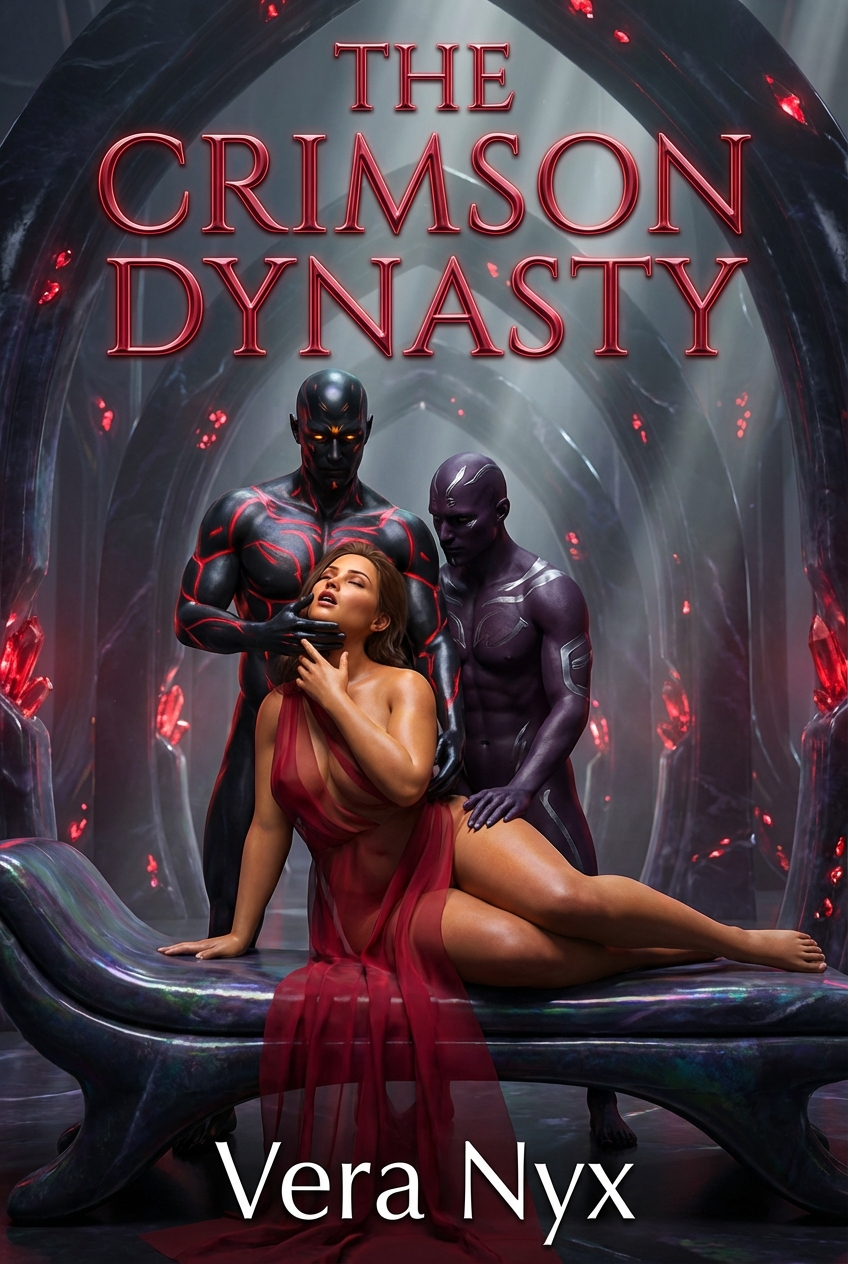
If you want one book to see how the trope works at full power, start with the catalog's top-ranked royal title below. Read it with an eye on how often the author reminds you who is watching, because that is the machinery underneath every good one of these.






Loading comments…