
Undercover romance is the subgenre where at least one lover is living a lie for a living: a cop running a long con, an intelligence agent on assignment, a private investigator working a case, a journalist hiding their real name. The relationship builds while the cover identity holds.
Which means every dinner, every hookup, every whispered confession happens inside a structure that is going to collapse.
The thrill comes from that countdown. The reader knows, even when the characters don't, that the truth is coming, and that when it lands it will either detonate the relationship or prove it was real all along.
It sits at the intersection of two engines: romantic tension and narrative jeopardy. Most romance novels run on one or the other. Undercover romance runs on both at once, and that's why it punches above its weight in the genre, showing up everywhere from category romantic suspense to dark contemporary to mafia and MC fiction.
What Undercover Romance Actually Means
Strip away the spycraft and the definition is simple: one or both people in the central relationship are operating under a false identity, and real feelings develop while the pretense is still active.
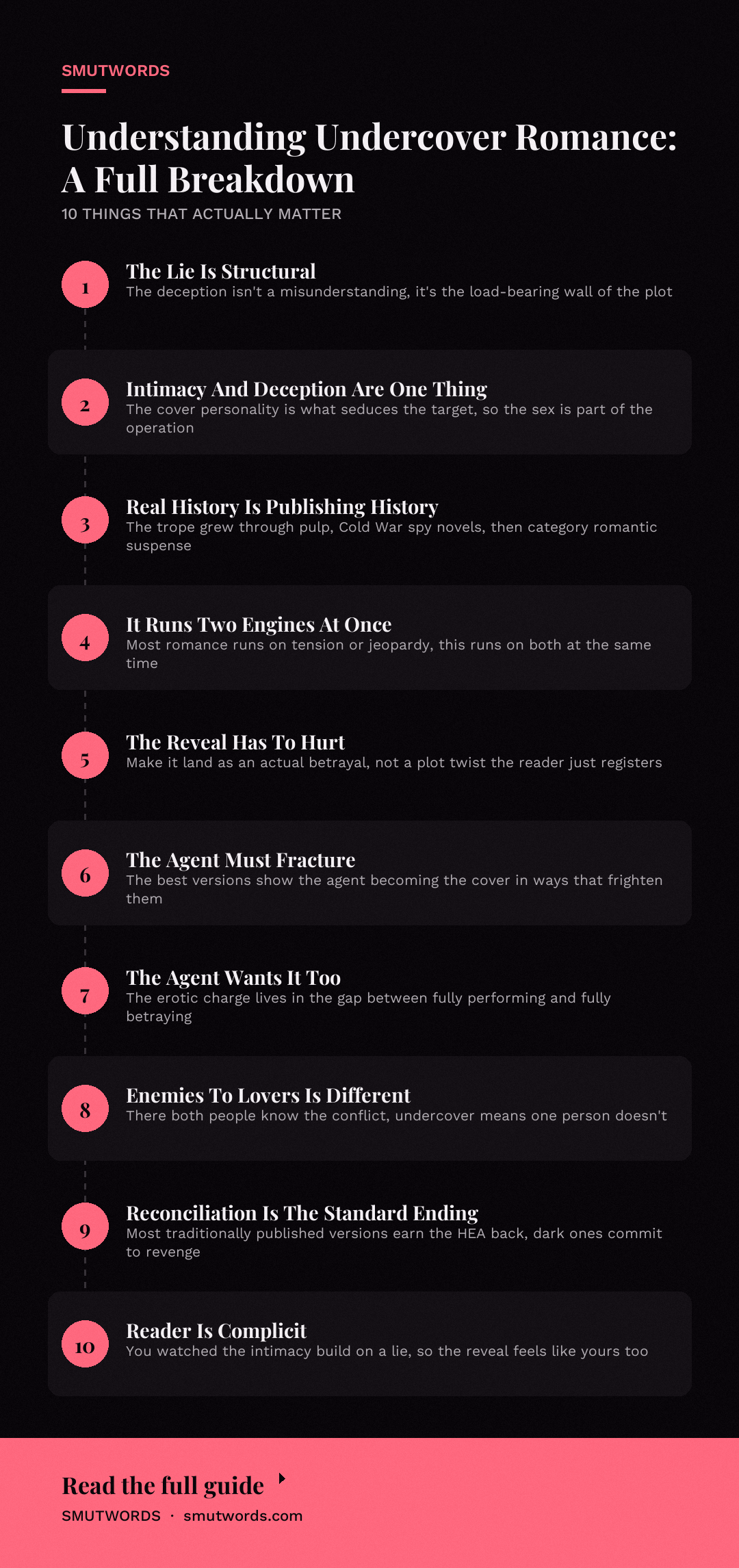
The deception isn't a misunderstanding that gets cleared up in chapter four. It's structural. The load-bearing wall of the whole plot.
The name is descriptive rather than literary in origin. "Undercover" comes from police and intelligence work, and the term migrated into romance publishing in the mid-twentieth century alongside the broader romantic suspense boom. By the 1980s and 1990s it was appearing in titles and back-cover copy as a shorthand signal: someone here is not who they say they are, and it's going to matter.
What counts:
- One lover is on active assignment, investigation, or infiltration while the relationship develops.
- The false identity is ongoing, not a one-night lie or a costume.
- The intimacy is real, or feels real, but it's happening inside the deception.
- The reveal is a plot event with consequences, not an offhand confession.
What doesn't count, even though it gets lumped in: a former agent whose assignment ended years ago. An ex-cop who never lied to the love interest. A bodyguard who's open about the job. A character with a secret past but no active cover.
The most common misconception is that undercover romance is just romantic suspense with a badge. It isn't. Suspense can exist without any deception between the lovers.
The lie between them is what makes this trope what it is. If you want the broader category, start with bully romance, which shares the antagonism but none of the secrecy.
Where Undercover Romance Comes From
The honest answer is that the real history here is publishing history, not spycraft history. Undercover operations have existed as long as police forces and intelligence agencies have, but the fiction trope has its own separate lineage that runs through romance and erotica specifically.
The 1930s and 1940s pulp era established the ingredients: the hard-boiled detective, the femme fatale, the identity that turns out to be a cover. Those stories were rarely romances, but they trained readers to expect sexual tension between the investigator and the investigated. That tension is the ancestor of the whole subgenre.
The 1950s and 1960s brought the Cold War spy novel. Somewhere in that period the romance publishing industry noticed that a large share of its readers were women who liked the spy novels as much as the espionage.
Category romantic suspense emerged, and by the 1970s and 1980s it had become a distinct and reliable market. Undercover assignments became standard domestic settings: a female agent falling for her target, a male cop falling for a suspect, a witness and a handler slowly ruining each other.
The portrayal shifted noticeably across those decades. Early versions treated the deception almost entirely as external jeopardy: the lie existed to put the lovers in danger from outside parties.
In the 1990s and 2000s, authors began treating the lie itself as the central betrayal, so the emotional stakes of the reveal often outweigh the physical stakes. Contemporary versions treat the moment of exposure as a genuine emotional catastrophe for the deceived party, and the reconciliation has to earn its way back.
The recent mafia and MC boom has moved the trope further, because there the undercover agent is usually embedded in a criminal organization. That puts the agent in a permanent double bind: betray the organization and betray the lover, or betray the job. Female authors writing in that space have pushed the trope harder into moral gray territory than mainstream romantic suspense ever went.
How It Shows Up in Erotica
On the page, undercover romance does specific structural work that authors ignore at their peril. The whole reason the trope hits is that the intimacy and the deception are the same thing. The cover personality is what seduces the target.
The sex is part of the operation, or feels like it might be, which makes it dangerous in a way that ordinary eroticism can't replicate.
A well-built undercover romance usually runs through a predictable beat structure, and the good ones make that structure feel inevitable rather than mechanical:
- The establishment of the cover. The agent gets the assignment, and the reader learns immediately what the lie requires.
- The first contact. The two meet inside the fiction of the cover. Attraction is immediate and inconvenient.
- Escalation of intimacy. They get closer in ways the agent didn't plan for. Often this includes physical intimacy before emotional intimacy, which is where the erotic charge concentrates.
- The double life strain. The agent starts lying to everyone, including themselves, and the plot punishes them for it.
- The reveal. Cover blown, truth at last, and the betrayed party has to decide whether any of it was real.
- Reconciliation, or revenge. The ending either earns back the trust or commits to a darker resolution.
Common variations authors lean on:
Enjoyed this? Get a free book.
Join the list and we will send a complete free story straight to your inbox, plus new releases every week after that. No credit card, no catch.
- Cop undercover. The agent is law enforcement, often infiltrating a crime ring. The love interest is a criminal or close to one.
- Spy vs. spy. Both lovers are operatives, each lying to the other. This is the most tense version because neither can trust the other at all.
- Mafia infiltration. The agent is embedded in a family and falls for a member, usually a son or a daughter who has no idea about the operation.
- Journalist undercover. The agent is a reporter hiding their real purpose, often exposing the very world their lover lives in.
- Revenge-driven cover. The cover isn't for the job at all, it's a personal vendetta, which often shades into a redemption arc romance once the lover realizes what's actually happening.
What separates a strong version from a flat one comes down to a few specific decisions. First, the cover has to have a reason beyond convenience. If the agent could just tell the truth and end the deception, the trope collapses.
Second, the intimacy has to mean something to the agent, not just the target. If the agent is coldly using the target the whole time and only grows feelings at the end, the reader never feels the risk.
Third, and this is the one that gets fumbled most, the reveal has to hurt.
The best authors make it land as an actual betrayal, not a plot twist. The reader should feel the deception in their chest, not just register it as a narrative event. That's the difference between an undercover romance that works and one that feels like a spy thriller wearing a love story as a costume.
The erotic charge also depends on the agent's ambivalence. If the agent is fully in the cover, the sex is a performance. If the agent is fully aware of the assignment, the sex is a betrayal in progress.
The most interesting version lives in the gap between those two, where the agent genuinely wants the target and also has to lie about something critical. That ambivalence is what a competent author writes into every scene of physical intimacy.
It's also why undercover romance tends to be a heavier read than most tropes at the same heat level. For a contrast case, look at praise kink, where the dynamic runs on reassurance rather than concealment. Different machinery entirely.
Related dynamics crowd in constantly. The cop falling for the criminal tends to shade into enemies to lovers once both sides realize the other is the enemy. In some executions, the professional antagonism is so thick that hate to love is the better label. Undercover assignments inside military or paramilitary settings often overlap with soldier romance to the point that the two subgenres share a shelf.
There's a specific craft move worth naming. Strong undercover romance doesn't just tell the reader what the agent is hiding; it shows the agent becoming the cover personality in ways that frighten them. The lie has to threaten the agent's sense of self, or the trope stops doing its best work. That internal fracture is what makes the deception feel costly rather than convenient, and it's the detail that separates the genre's best examples from its forgettable ones.
Undercover Romance vs Enemies to Lovers
The two get confused constantly, and it's worth separating them because the emotional machinery is genuinely different. In an enemies to lovers story, both parties know where they stand. They're enemies openly, and the arc moves them toward love through proximity, forced cooperation, or grudging respect. The conflict is out in the open from the first page.
In undercover romance, one person doesn't know they're in a conflict. The deception is hidden. The love interest thinks the relationship is real, and the agent knows it isn't, or knows it's complicated. That asymmetry is the whole engine.
The two often combine, particularly in mafia and espionage settings. When they do, the enemies-to-lovers element usually emerges after the reveal: the betrayal exposes the two as adversaries, and then they have to work back toward each other. But they're distinct, and if you're tagging your TBR carefully, undercover means someone is lying and enemies-to-lovers means both people know exactly who they're dealing with.
Frequently Asked Questions
Is undercover romance the same as romantic suspense?
No. Romantic suspense is a broader category that includes mysteries, thrillers, and any romance with a suspense plot. Undercover romance is a specific trope within it, defined by the deception between the lovers. You can write a romantic suspense novel with no undercover elements at all, and you can write an undercover romance with almost no other suspense, though few authors do.
What's the most common ending for undercover romance?
Most traditionally published versions end in reconciliation: the betrayed party eventually forgives the agent because the feelings were real, and the relationship survives the reveal. Darker contemporary versions, especially in mafia and MC subgenres, sometimes commit to a permanent break or a revenge arc instead. The HEA is standard, but the path back is long and often brutal.
Do both main characters usually know about the cover?
In most undercover romance, one person knows and one doesn't. The whole trope depends on that asymmetry. The spy vs. spy variant is the common exception, where both people are operatives and each is hiding something from the other, which produces a different and more complicated emotional dynamic.
Is undercover romance always dark?
Not always, but it skews darker than the average category romance because the deception is a defined emotional harm. Some lighter romantic suspense plays it as a workplace comedy with a big lie at the center, where the reveal is embarrassing rather than devastating. Most readers come for the darker version, and the biggest books in the subgenre tend to lean that way.
What's the difference between undercover romance and a spy romance?
They overlap heavily. Spy romance usually refers to stories in the espionage world, often with international settings and high-stakes plotting. Undercover romance is defined by the deception between the lovers, which can happen in a spy story or in a much more grounded context, like a cop working a local case or a journalist hiding their real name.
Why does the reveal always feel so devastating?
Because the reader has been complicit. They've watched the intimacy build knowing it was built on a lie, which means the reveal lands as a shared betrayal rather than a plot twist. The best authors lean into that complicity and make the moment of exposure feel like it belongs to the reader as much as to the deceived lover.
Final Thoughts
Undercover romance works because the lie isn't a complication in the relationship. It's the foundation of it, and watching the foundation crack is the whole point. The reader gets the fantasy of being desired by someone dangerous, and the honesty of knowing that the desire comes with a cost. It's a trope that rewards authors who take the emotional damage seriously and punishes the ones who treat the cover as a costume.
If you want to see the trope at its most effective, look for books where the reveal lands as a betrayal the reader feels in their body, where the agent's internal fracture gets as much page time as the operation, and where the reconciliation has to be earned line by line. Start with any well-regarded mafia infiltration novel and work outward; the subgenre's best examples are usually in that space right now.








Loading comments…