
A scent fetish is sexual arousal from smell: a partner's natural body odor, their sweat, their hair, their skin, the specific perfume they wear, the way a worn shirt still carries them hours later. It is one of the most common and least discussed kinks in erotica, partly because it is nearly impossible to render on a screen and enormously powerful on a page.
Scent fetish writing is about intimacy at a distance of inches, the moment a character breathes someone in and loses their train of thought. It assumes that attraction is chemical before it is visual, and it treats the nose as a primary sex organ. That premise is exactly why the kink has quietly become one of the most requested dynamics in long-form erotic romance.
What Scent Fetish Actually Means
A scent fetish involves intense arousal from a partner's natural body odor or from specific fragrances, including perfume, pheromones, or the smell of sweat, often fixating on a particular spot like the neck, underarms, or genitals. That definition is accurate but narrow. In practice the term covers a spectrum, and most people who have it do not experience it as a single switch that flips. It is closer to a channel that is always slightly open.
The clinical language for smell-based arousal is olfactophilia, and the fixation itself is sometimes called an olfactory fixation. Neither term shows up much in fiction, and neither should. What matters for readers is the distinction between a scent kink and the ordinary role smell plays in everyone's sex life.
Everyone notices how a partner smells. A scent fetish is what happens when that noticing becomes the main event. It helps to separate what counts from what does not:
- Natural body odor: unwashed skin, the back of the neck after a long day, sweat dried on a collarbone, scalp oil, the specific musk of someone who has been working or dancing or sleeping.
- Applied fragrance: perfume, cologne, scented lotion, hair products, laundry detergent clinging to a shirt. The scent belongs to the person because they chose it and it lingers on them.
- Proximity and residue: a pillow that still smells like them, a hoodie borrowed and not returned, a hand pressed to a mouth after touching someone else.
- Not a scent fetish: enjoying a candle, liking a partner's shampoo, or finding a specific flower pleasant. Those are preferences. A fetish carries a charge, and the charge is sexual.
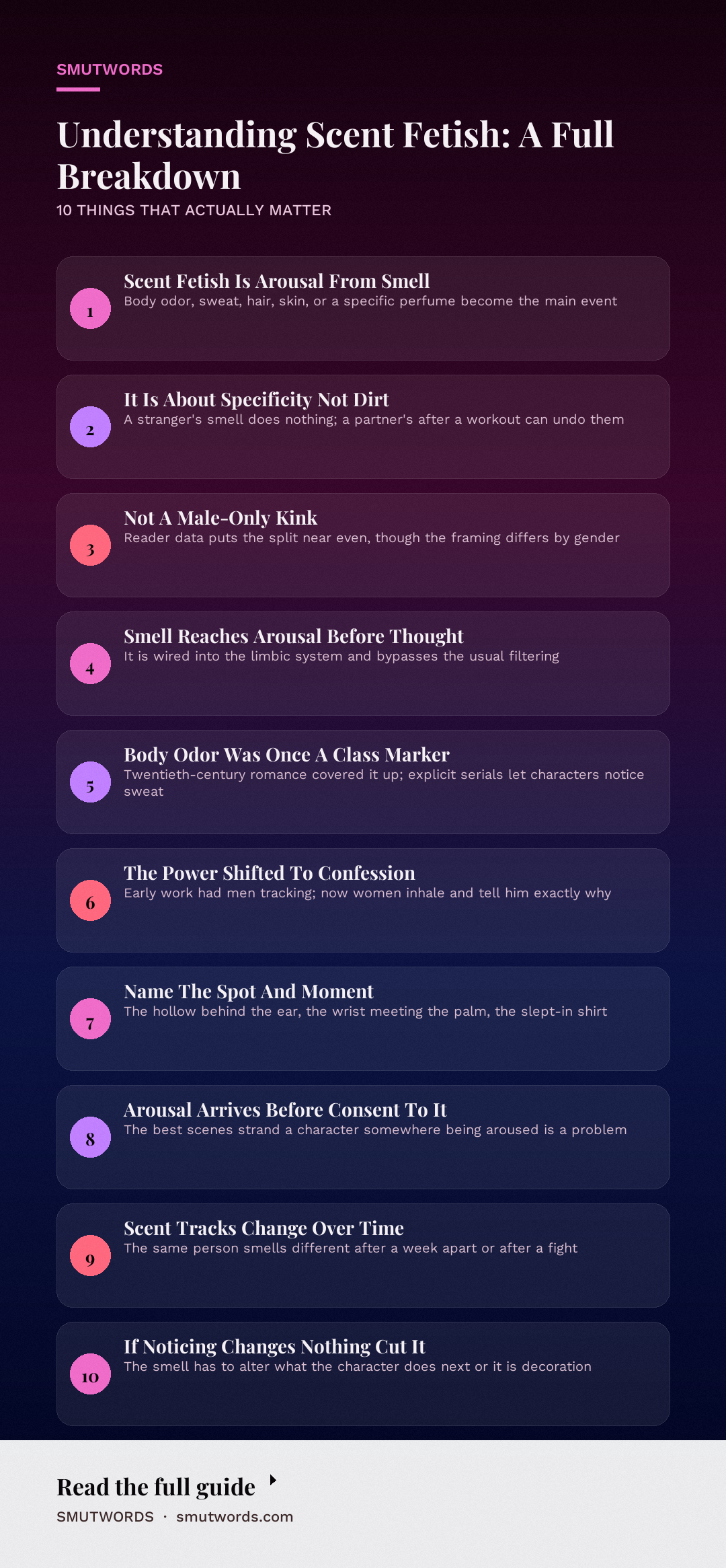
The most common misconception is that this kink is really about hygiene, or the absence of it. It is not. The turn-on is not dirt; it is specificity. The smell of one particular person, at one particular moment, in one particular state.
A stranger's body odor does nothing for someone with this kink. Their partner's body odor after a workout can undo them entirely. Location matters too, which is why so much scent writing fixates on the neck, the underarms, the inner thigh, the crease where the leg meets the hip, and the genitals themselves.
A second misconception: that this is a male-only kink. Reader data and letter volume suggest the split is closer to even, though the framing differs. Male characters in scent erotica tend to be written as hunters, tracking.
Female characters tend to be written as knowers, reading a partner's mood and history off his skin. Both framings work, and the best scenes use the second.
Where Scent Fetish Comes From
Smell is the oldest sense, wired directly into the limbic system, bypassing the thalamus that filters everything else. That anatomy has been used to justify scent kink as primal for as long as anyone has written about it, and in erotica the claim is usually delivered as a line of dialogue rather than a footnote.
The genre is not interested in the neuroscience. It is interested in the fact that smell reaches memory and arousal before conscious thought can catch up. That is a narrative gift.
In published erotica the trope has a real history, and it is a history of status. For most of the twentieth century, body odor in mainstream romance was something to be managed, covered, or apologized for. Heroines were powdered and fresh. Heroes smelled like soap and leather and whatever the author wanted readers to associate with masculine respectability.
See how the leather fetish carries that same association, a material chosen less for how it feels than for what it signals. Scent served the same purpose: it was a class marker, not a sexual one.
The shift came in two waves. The first was the rise of the explicit serial in the 1990s and 2000s, where writers working with fewer editorial constraints started letting characters notice sweat instead of pretending it did not exist.
The second was the online era, when kink communities began naming things that had always existed, and readers who had never had language for their own arousal from smell found it in a tag, a forum thread, or a story archive. The word came after the experience, which is usually how it goes.
Where scent fetish writing has evolved most is in who gets to do the smelling. Early versions almost always put the man in the tracking role, nose to the heroine's neck, growling about how she smells like she wants him.
Contemporary work has widened that considerably. Now the woman inhales. Now the man comes home and finds his partner has been wearing his shirt all day, and she tells him exactly why. The power shifted from observation to confession, and the genre got better for it.
There is also a growing wing of scent writing that leans into materials rather than bodies. Rain on hot asphalt, cigarettes in the cold, a new book, gasoline, the inside of a helmet. Those stories usually sit closer to a petrichor kink than to body odor fixation, and the two get filed together because the wiring overlaps. Both are about a smell that arrives before the person does.
How It Shows Up in Erotica
On the page, scent fetish does something no other kink can do as efficiently: it lets a character know something about another person without being told. A scene can use smell to convey exhaustion, illness, arousal, fear, loyalty, or the fact that someone was with somebody else last night, all without a word of exposition. That is why editors love it and why weak writers overuse it.
Here is what the strong versions do differently from the flat ones.
The fixation is specific, not general
Amateur scent writing says "he smelled incredible." Professional scent writing names the spot and the moment. The hollow behind the ear. The place where a wrist meets a palm. The faint sour-sweet of a shirt that has been slept in two nights.
Specificity is what turns a description into a kink. Readers with this fetish are not looking for a mood, they are looking for the exact coordinates.
The reaction is involuntary and slightly inconvenient
The best scent scenes put the character in a situation where being aroused is a problem. Standing in a crowded elevator. Shaking a hand at a work function. Sitting next to someone on a plane for six hours.
Enjoyed this? Get a free book.
Join the list and we will send a complete free story straight to your inbox, plus new releases every week after that. No credit card, no catch.
The arousal arrives before consent to be aroused, which is the actual mechanism of the fetish and the reason it reads as chemistry rather than choice.
It is used to track change over time
Scent is a timeline device. A character notices their partner's skin smells different after a week apart, or after a fight, or after a long day with a new boss. The smell is the same person in a different state. Writers who understand this use scent the way other writers use dialogue, to show the interior weather of a relationship moving.
It pairs with other kinks rather than replacing them
Scent rarely stands alone in a scene, and it should not. It layers. A lingerie fetish scene gets sharper when the garment is described as already worn, still carrying her.
A body fluid kink scene gains a whole second register when the character can smell what has happened rather than only see it. A wet and messy fetish scene almost always carries a scent component whether the writer names it or not.
The common variations authors reach for:
- Worn clothing: a partner's shirt, underwear, or scarf, worn or held, sometimes sniffed openly and sometimes not.
- Post-exertion scenes: after a workout, a run, a shift, a dance floor. Sweat as evidence of effort.
- Sleep and morning writing: the flat, warm, unfiltered smell of a body that has been in bed for eight hours.
- Marking: scent left on a partner deliberately, or noticed on them afterward.
- Perfume play: the applied scent as a gift, a claim, or a shared ritual, sometimes with the character choosing a fragrance specifically to be recognized.
- Denial and separation: scenes built entirely around absence, where the smell is on an object, not a person.
The failure mode
The flat version of scent writing treats smell as decoration. The character notices a smell, the author writes one adjective, and the scene moves on. Nothing is at stake.
The reason scent fetish fiction succeeds or fails is almost never the smell itself. It is whether the smell changes what the character does next. If the noticing does not alter the scene, cut the noticing.
The hygiene question, handled honestly
When scent play involves sweat or unwashed skin, keep hygiene in mind and discuss boundaries around intensity or odor to avoid discomfort. This is not a moral note, it is a craft note. Scenes built on heaviness need an off-ramp: a shower afterward, a joking line, a negotiation before.
The best writers put that negotiation in the scene itself, because a character who says "I want you like this, don't shower yet" is doing something far more erotic than a character whose preferences are simply narrated.
Practical points worth getting right in fiction:
- Body odor intensity varies with diet, hormones, medication, heat, and stress. A character's smell can change for reasons the partner cannot identify, which is useful.
- Perfume fades in stages. Top notes burn off within an hour; what lingers on skin at midnight is not what someone smelled at the door.
- Skin holds scent differently than fabric. Cotton keeps it. Wool keeps it longer. Silk keeps it less and shows more. See where a latex fetish creates a different problem entirely, since the material holds almost nothing and has its own smell to compete with.
- Any character who wears gloves all day has a specific hand smell by evening, which is a detail almost nobody writes and everybody notices.
Scent Fetish vs Foot Fetish
These two get confused more than they should, and the confusion is instructive. A foot fetish centers on a body part: the shape, the arch, the toes, the act of touching or kissing or worshipping. Smell is often present, but it is secondary.
In a scent fetish scene, the foot is not the point. The smell of the foot, or of the shoe, or of the sock, is the point, and the same arousal would apply to a wrist or a neck.
The easiest test is what happens if you swap the body part. If you can substitute a different location and the scene still works, you are reading scent. If the scene collapses without the specific anatomy, you are reading a body-part kink that happens to include an olfactory detail. Most writers blend the two, which is fine, but knowing which one is carrying the scene tells you what to spend your sentences on.
Frequently Asked Questions
Is a scent fetish the same as a pheromone fetish?
Close but not identical. Pheromone fixation is narrower, focused on the chemical signals people supposedly detect unconsciously. A scent fetish is broader and covers perfume, sweat, skin, hair, and clothing. Most readers use the terms interchangeably, and most fiction does not bother to separate them.
Is this kink common?
More common than the lack of discussion suggests. Surveys of sexual interests routinely place smell-based arousal in the top tier of reported paraphilias, and reader engagement with scent-heavy scenes far outpaces the number of stories tagged for it. Many people have it without naming it.
Can a scent fetish be about a specific person only?
Very often, yes. The fixation frequently arrives with one partner and does not transfer. That is a common pattern in scent writing and one of the reasons the kink reads as romantic rather than purely physical. The smell is a signature, and a signature belongs to one person.
How do I write a scent scene without it sounding gross?
Specificity and consent. Name the exact location, the exact moment, and the exact register of the smell, then let the character want it openly rather than endure it. Readers find described desire far more appealing than described odor. The grossness problem is almost always a phrasing problem, not a subject problem.
What about perfume and cologne specifically?
Perfume play is a recognized variant and gets its own scenes. The dynamic is usually about chosen identity: someone picks a scent, someone else learns to recognize it, and the recognition becomes a form of possession. A character who wears the same fragrance for years and then switches is making a statement, and good writers treat it that way.
Where does breath fit into this?
Breath is a scent kink in miniature. It is warm, it is specific to a person, it is only available at close range, and it carries everything the person ate, drank, or did that day. Slow-exhale moments near a mouth or ear are some of the most reliable beats in the genre for exactly this reason, and they do not require anything exotic to work.
Final Thoughts
Scent fetish writing rewards attention more than any other kink in the catalog, because the sense it depends on cannot be shown. It has to be built out of memory and proximity and the small, inconvenient moment when someone realizes they are breathing a person in on purpose. Write that moment well and the rest of the scene handles itself.
For a book that gets the whole mechanism right, start with His Scent on Her Skin, which builds an entire relationship out of one character learning another person's smell and then having to live without it. If you want the broader kink vocabulary first, the leather fetish and breast fetish entries cover how material and anatomy fixations get written, and the leg fetish entry is a good study in how a specific body focus turns into a full scene.






Loading comments…