
A contract marriage is a romantic arrangement with paperwork: two people marry for a reason that has nothing to do with love, sign terms that spell out what each of them gets, and then spend the length of the book discovering that the terms were the easy part. The deal might be a green card, an inheritance clause, a boardroom vote, a public image repair, or a lease neither of them can afford alone.
What makes it one of the most durable engines in romance and erotica is the built-in clock. A contract marriage has an end date, and every chapter between signature and expiration tightens the screw.
Readers come for the friction between what the contract says and what the bodies in the room keep doing. You can find the full short definition in our glossary, but this guide goes further: where the trope came from, how it plays out on the page, which variants work, and what separates a contract marriage that sizzles from one that reads like a legal memo with kissing.
What Contract Marriage Actually Means
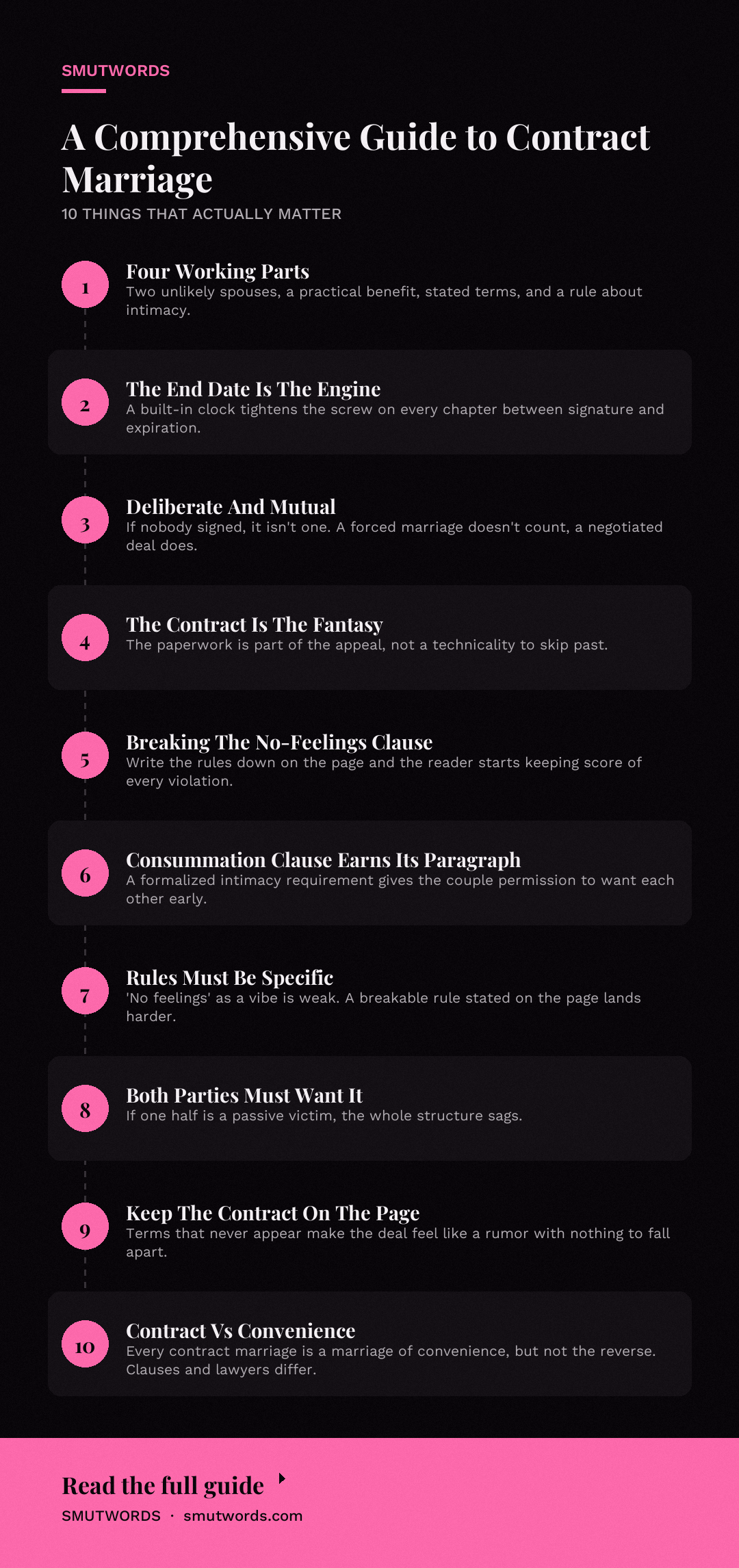
Strip it down and a contract marriage has four working parts. Two people who would not otherwise marry. A stated practical benefit for at least one of them, usually both. Explicit or implicit terms covering duration, money, living arrangements, and public behavior.
Then there's the last part: a rule about intimacy, whether that's a strict no-touching clause or a vague "we'll keep it separate from the arrangement" that collapses by chapter six.
The name itself is modern publishing shorthand. "Marriage of convenience" is the older, broader term that goes back centuries in literature, covering anything from dynastic alliances to two spinsters pooling a household. "Contract marriage" narrows it to stories where the agreement is actually negotiated, often on the page, with something resembling deal terms. The paperwork is part of the fantasy.
What counts as a contract marriage and what doesn't comes down to whether the arrangement is deliberate and mutual. A forced marriage isn't one, because nobody signed. A green-card marriage between strangers who met at an immigration lawyer's office absolutely is. So is a business merger with a wedding attached, and so is the classic billionaire clause: marry me for a year and I'll pay off your mother's medical debt.
Common misconceptions are worth clearing up. A contract marriage doesn't require a virgin heroine, a cruel husband, or a cold arrangement that thaws only at the last chapter. Plenty of contemporary versions have both parties fully aware of their attraction on day one and using the contract as an excuse to avoid admitting it.
The trope also isn't inherently chaste. Some of the filthiest books in the category use a "consummate the agreement" clause as a direct route to the bedroom.
Where Contract Marriage Comes From
The marriage of convenience is old, but the contract marriage as a recognizable modern trope belongs to twentieth-century category romance.
Mid-century publishers needed a plot engine that could fit a hundred and eighty pages and guarantee forced proximity between two people who couldn't simply walk away. Marriage was the most efficient device available. The hero and heroine get a shared house, a shared bed, a public role to perform, and a socially acceptable reason to be alone together at all hours.
From the 1950s through the 1980s, the standard version ran on money and duty. A secretary marries her boss to keep his custody of a child, or a woman agrees to a paper marriage to inherit her grandfather's estate. The terms were rarely negotiated on the page. The hero announced the arrangement and the heroine had little room to argue, which reads very differently now than it did then.
The shift came in the 1990s and 2000s, when the heroine started getting her own lawyer, her own terms, and her own reasons. The contract became a two-sided negotiation, and the negotiation itself turned into foreplay. By the 2010s, indie publishing and Kindle Unlimited had pushed the trope into every subgenre you can name, from small-town ranch romance to cyberpunk romance, where the deal might involve a corporate citizenship clause rather than a green card.
The other major shift is heat level. Category romance kept the contract marriage largely behind closed doors for decades. Contemporary erotica took the same structure and made the terms explicit, sometimes literally: intimacy schedules, consummation clauses, rules about what the couple is and isn't allowed to do with each other, and a running tally of which rules got broken first. The paperwork got filthier, and the genre got better for it.
The trope's publishing history also explains its durability in celebrity romance, where a PR marriage between two public figures is one of the most reliable setups in the category. Fame makes the public image clause feel inevitable rather than contrived.
How It Shows Up in Erotica
On the page, a contract marriage does specific work. It manufactures proximity, it manufactures a deadline, and it manufactures a set of rules that the couple can either obey or break. Every one of those is an erotic engine, and the best authors run all three at once.
Start with the terms themselves. A strong contract marriage puts the agreement on the page in concrete detail: three hundred and sixty-five days, separate bedrooms on paper, a public appearance every other week, no visible marks, no emotional confessions, no falling in love.
That last clause is the funniest and most useful one in the genre, because it is the one the couple is guaranteed to break. When an author writes the rules down explicitly, the reader starts keeping score, and every violation lands harder.
The consummation clause deserves its own paragraph. A lot of erotica uses a contract that formalizes sex, whether as an heir requirement, a "get it out of our systems once" agreement, or a scheduled intimacy obligation. This gives the couple permission to want each other before either will admit it.
The scene where two people who claim to feel nothing sit on the edge of a bed discussing the logistics of a legally mandated orgasm is one of the specific pleasures the trope exists to deliver. It is also where the grumpy hero soft for her dynamic tends to surface, since the husband who wrote the coldest clause is usually the first to break it.
The bed situation matters more than it should. Separate bedrooms that share a wall. One bed at the hotel because the press is watching. A cold marriage that has to look warm at a gala, which means standing close, touching a waist, kissing for the cameras.
Enjoyed this? Get a free book.
Join the list and we will send a complete free story straight to your inbox, plus new releases every week after that. No credit card, no catch.
Forced touch with an audience is its own subcategory of tension, and it pairs well with the touch her and die trope when one party starts defending the other against family or business rivals before either of them has admitted anything.
Common variations authors use
- The green card marriage: immigration deadline, government interviews, memorized answers about how they met, and a rehearsal dinner they have to fake their way through.
- The inheritance clause: a will that requires a spouse, a family estate on the line, and relatives circling the marriage like sharks.
- The business merger: two companies, two boardrooms, one wedding, and a prenup with more pages than the vows.
- The public image contract: a celebrity or politician whose reputation needs rescuing, marrying into respectability or scandal, with an NDA and a stylist.
- The protected arrangement: a marriage that gives one party safety from a stalker or abuser, which shades naturally into stalker romance territory when the threat is external and the protector is the husband.
- The time limit: the strictest and most effective version, where the clock is visible and the last page is the expiration date the couple has been dreading.
- The repeat offender: a couple who already married and divorced each other once and are now signing a second contract, which lands close to marriage in trouble but with the paperwork as a fresh start.
What makes a strong version work
The best contract marriages share three traits. First, the practical reason has to be genuinely pressing. A heroine who agrees to a year of marriage to save her father's farm reads as a person making a choice. A heroine who agrees so the book can have a premise reads as set dressing.
Second, both parties have to want the marriage and not just tolerate it. The tension comes from two people who both know the deal is working and both know it's ending. If one half of the pair is a passive victim of the arrangement, the entire structure sags.
Third, the rules have to be specific, and specific rules have to break on the page. "No feelings" as a general vibe is weak. "No sleeping in the same bed after the first night" is a rule that can be broken at two in the morning during a thunderstorm, and the reader knows it the moment it's stated.
Where it goes flat
The most common failure is the contract that only exists in the summary. If the terms never appear on the page, the deal feels like a rumor, and the reader has nothing to watch fall apart. The second most common failure is a contract with no visible end date. An arrangement with no deadline stops being a pressure cooker and becomes a roommate situation.
The third is a couple who fall in love at chapter three and then spend the rest of the book lying about it. That's a long way to walk on a story that has already told you the ending. Good authors keep the practical stakes alive to the final act, so that the admission of love actually costs something.
One more thing: the trope reaches its best version when the physical writing is as precise as the legal writing. A scene where an author knows exactly where the husband's thumb rests during a fake smile for a photographer does more than any epilogue. The genre's best sex writing has always understood that the aftermath of a rule being broken is where the heat lives, and the same discipline applies to verbal degradation or praise in more explicitly kinky books.
Contract Marriage vs Marriage of Convenience
These two get used interchangeably, and mostly they are, but there's a useful distinction for readers deciding what they want. A marriage of convenience is the wider category: any marriage arranged for practical benefit. A contract marriage is the subset where the terms are explicitly negotiated and treated as a deal, with a duration and an exit.
Put another way: every contract marriage is a marriage of convenience, but not every marriage of convenience is a contract marriage. A Victorian marriage of convenience where the heroine simply needs a husband to keep her reputation doesn't involve anyone drafting clauses. A contract marriage has a page count, a signature, and a lawyer.
There's also a boundary worth drawing with hate to love. Contract marriages often carry hate-to-love energy, but the dislike is not what the story is about. The love is what the story is about. The hate is just how the couple survives the awkwardness of living together before the rules start cracking.
If the central conflict comes from genuine loathing that has to be undone, that's a different engine running the same chassis.
And a note on childhood friends to lovers: plenty of authors marry these together by having the couple sign a deal because of old loyalty. It works beautifully, but it shifts the emotional weight from stranger-danger to had-it-all-along. Different flavor, same contract.
Frequently Asked Questions
What is a contract marriage in romance?
A romance plot where two people marry for a practical reason with an agreement that sets out terms, usually a duration, money, and rules about intimacy or public behavior. The story follows the couple as the arrangement wears them down into real feelings.
Is a contract marriage the same as a fake marriage?
Not quite. A fake marriage usually means the pair present themselves as married without legal paperwork. A contract marriage involves an actual marriage, sometimes a legal one and sometimes a staged one, with written terms. The overlap is huge, and plenty of books use both labels.
Do contract marriage books always have a breakup before the happy ending?
Most do, and it's usually the contract's end date arriving before either party has confessed. The third-act breakup in this trope tends to take the form of one person walking out rather than a fight, so the other can chase. It's one of the more satisfying patterns in romance when it's done with real stakes.
How much heat does a contract marriage book usually have?
It runs the full spectrum from closed door to explicit erotica. Erotica versions often use an intimacy clause, a consummation requirement, or a "one night to get it out of our systems" agreement to move the couple into bed early.
Why do readers love contract marriage stories so much?
The structure does the work. The couple is forced together, the deadline prevents the story from ever going slack, and every rule the couple writes down is a promise to the reader about how it will be broken.
What's a good starting point for someone new to the trope?
Look for books where the contract is written on the page in the first five chapters and the couple are both active participants in negotiating it. That combination is the clearest signal of a strong version.
Final Thoughts
Pick a contract marriage where the negotiation is half the foreplay, the terms get written down, argued over, and broken badly. Once you've read a great one, the whole subgenre snaps into focus.
Want to see exactly how the rules break? Head to the ranked list below and pick the one where the contract runs out at midnight.







Loading comments…