
The argument in the group chat started, as these things do, over one specific scene. A book-club friend insisted that a hero who has been actively cruel to the heroine for 300 pages can be redeemed by a single soft look in chapter 31. Someone else called that a cop-out.
The grumpy sunshine vs enemies to lovers debate never quite dies. Both tropes run on friction, both end in the same tender collapse, and readers keep mistaking one for the other on the strength of a moody cover and a blurb that says "sparks fly."
The difference matters, because the two deliver completely different payoffs once the hero finally softens, and reading one while expecting the other is how you end up furious at a book that did exactly what it promised.
Grumpy/Sunshine: Friction With a Low Ceiling
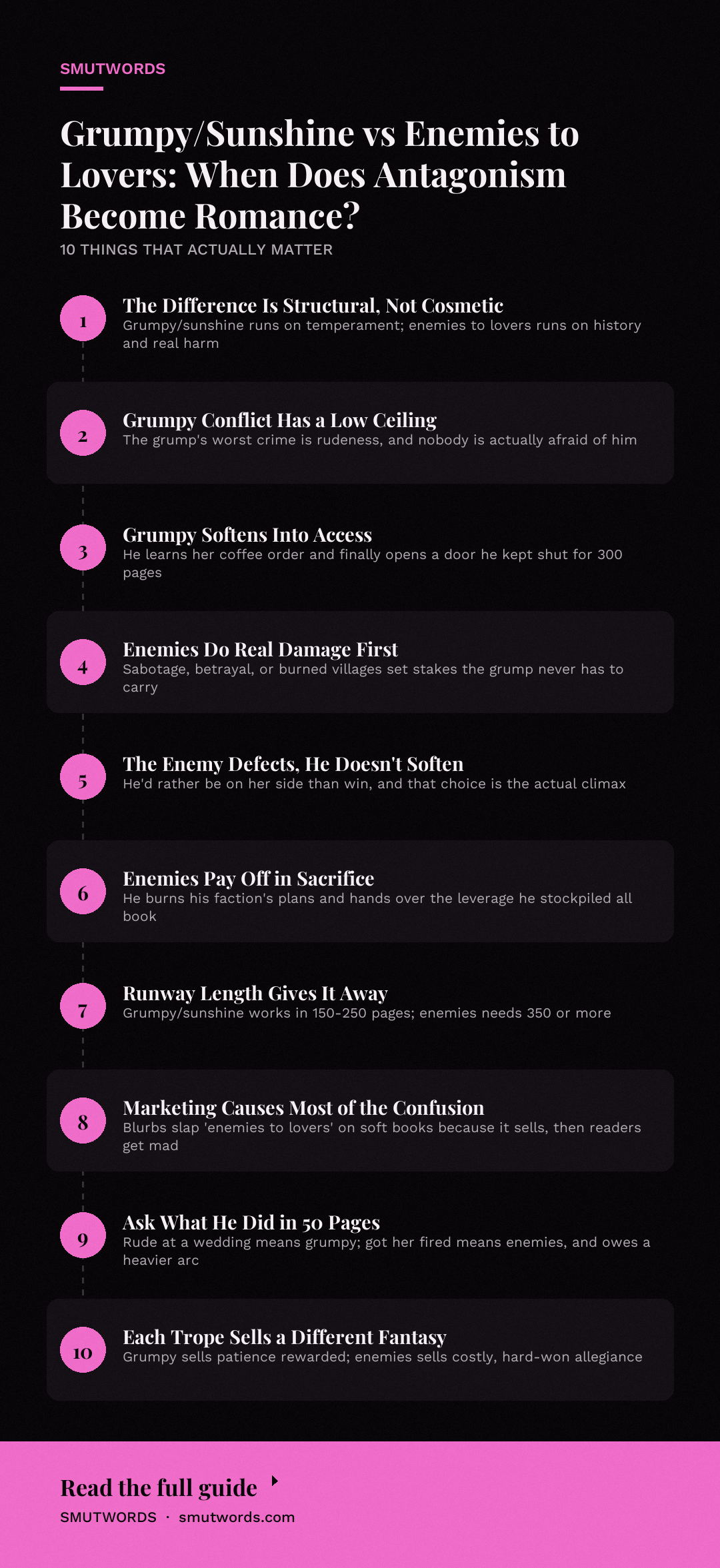
Grumpy/sunshine runs on temperament, not history. The grump is short with the barista, allergic to small talk, permanently braced for someone to annoy him. The sunshine talks to strangers, brings pastries nobody asked for, and takes the grunt as a personal challenge. The conflict is that he's prickly and she's warm, and roughly 80 percent of the tension is watching him lose the argument with himself about whether he's allowed to smile.
There's usually a reason for the scowl, and it's rarely a war crime. His ex left. His restaurant went under. His father was cold to him, and he decided feeling things is inefficient.
The backstory exists to make the grump sympathetic, not to make him a threat. Nobody in a grumpy/sunshine novel is genuinely afraid of the hero. Annoyed, yes. Aroused by his forearms and his refusal to be charmed, constantly.
The friction is surface-level on purpose, which is why grumpy/sunshine is the comfort read of the antagonism family. You know from chapter two that the ice is going to crack. The pleasure is in the timeline, not the outcome.
The Softening Payoff
When a grump softens, the payoff is domestic. He learns her coffee order. He shows up to the thing he said he'd never attend. He says one sentence, at the end, that lands like a brick because he's been rationing words for the entire book.
The climax of a grumpy/sunshine is often a small gesture delivered with enormous reluctance, and that's the point: the reward is access. You spent 300 pages with a closed door and now the door stays open for you.
It's the same access fantasy that runs through a lot of power exchange, minus the contract. The grump hands over a specific kind of control when he softens, and the heroine gets to be the one who was trusted with it.
Enemies to Lovers: Friction That Leaves a Mark
Enemies to lovers operates on a much sharper premise: these two people have done real damage to each other, or represent something the other genuinely despises, and the attraction is a problem they resent.
In office settings, that means they've sabotaged each other's pitches for two years. In fantasy, it means his army burned her village, or her faction has been hunting his family. In a stalker romance, the antagonism curdles into obsession and the reader has to decide whether that's the fantasy or the red flag. The stakes of the enmity are structural, not cosmetic.
This is why enemies to lovers rewrites you while you're reading it. The heroine spends the first act furious, the second act confused, and the third act horrified to discover that the person she hated is the only one who ever took her seriously.
The hero's journey is the mirror image. He doesn't soften so much as he defects. The enmity collapses because he realizes he'd rather be on her side than win against her, and that defection is the actual climax of the book, not the sex scene that follows it.
The friction is also political. Power dynamics are baked into the premise, and the author has to do real work to make the defection believable. That's why the best entries in this subgenre run long and slow. You can't defect in 40 pages.
The Softening Payoff
When an enemy softens, the payoff is sacrifice. He burns his own faction's plans. He takes the bullet, gives up the title, hands over the leverage he spent the whole book stockpiling. The heroine earns something a grumpy/sunshine could never deliver: the knowledge that she was worth more to him than everything he'd built his identity on.
That's a heavier payoff, and it's why people cry at the end of good enemies to lovers and merely grin at the end of good grumpy/sunshine. Both are valid. The mistake is expecting the wrong one.
A Side-by-Side Comparison
If you're trying to figure out which trope you're actually reading, or which one you're in the mood for, line them up on the axes that matter:
- Source of conflict: temperament and mood (grumpy/sunshine) versus history and ideology (enemies to lovers).
- Level of real harm: annoyance, rudeness, a slammed door versus sabotage, betrayal, violence on the page.
- What the reader fears: he'll never open up (grumpy) versus they'll destroy each other before they figure it out (enemies).
- What the softening looks like: a small private gesture versus a public, costly sacrifice.
- Length of runway: 150-250 pages is plenty versus 350+ pages, minimum.
- Forbidden-word proximity: "grumpy" heroes usually own a small business or a failing restaurant versus "enemy" heroes often own a private army or a rival kingdom.
- Physical threat to the heroine: zero from the hero versus explicit, and the fantasy depends on how the author handles it.
Notice that the two tropes can overlap: an enemy can also be grumpy, and a grumpy hero can be a former rival. The distinction is structural, not cosmetic, and it shows up in how the softening lands.
Why Readers Keep Confusing Them
Market positioning is the culprit. Cover designers slap a scowling jawline on everything and blurb writers love the phrase "enemies to lovers" because it moves units. Books that are actually the softer trope get marketed as enemies to lovers to ride the trend, and readers who wanted the heavy payoff get a hero whose worst crime was being rude about the appetizers.
Enjoyed this? Get a free book.
Join the list and we will send a complete free story straight to your inbox, plus new releases every week after that. No credit card, no catch.
The reverse also happens, less often but more painfully. A genuine enemies-to-lovers book gets sold as a "spicy rom-com" and the reader isn't warned about the chapter where the hero's army does something unforgivable. That's how you get the one-star reviews. It's a marketing problem dressed up as a craft problem.
Subgenre cycles matter too. During the alien abduction boom, writers imported the grumpy/sunshine dynamic into hostile settings and the lines got blurrier. If you're curious how that plays out, the alien abduction romance guide is a good place to see hostility that's staged for the reader's pleasure rather than the heroine's suffering.
Same thing goes for ogre romance, where the hero is physically terrifying and emotionally just a grump who hasn't been hugged enough.
Which One Are You Actually Reading?
Quick test. Ask yourself what the hero has done to the heroine in the first 50 pages, and whether any of it had lasting material consequences for her life.
If the answer is "he was rude to her at a wedding and she's annoyed," you're in grumpy/sunshine. If the answer is "he got her fired, got her sister arrested, or conquered her homeland," you're in enemies to lovers, and the book owes you a heavier redemption arc to make it work.
Here's what each trope is doing to the reader, at a craft level:
- Grumpy/sunshine gives you the pleasure of being right about him before he knows it. You the reader see the softness in chapter 3. You spend the rest of the book waiting for him to catch up.
- Enemies to lovers gives you the pleasure of being wrong about him, then right in a different way. You start the book believing his cause is legitimate. You end it realizing you've switched sides.
- Grumpy/sunshine resolves with access. He lets her see the parts he doesn't show anyone.
- Enemies to lovers resolves with allegiance. He picks her over everything he was.
- Grumpy/sunshine can run on a single POV and still work.
- Enemies to lovers almost always needs both POVs, because the reader has to see him choose to defect.
If the second test keeps telling you enemies to lovers when you wanted grumpy/sunshine, put the book down and pick something lighter. No shame in it. The tropes are siblings, not twins, and the wrong one in the wrong mood will ruin the book for you.
The Fantasy Each Trope Is Really Selling
Grumpy/sunshine sells the fantasy that patience is rewarded. That being warm to someone who is cold to you is not wasted effort. That underneath the scowl is a person who has been waiting for someone to not give up on him. It's an enormously reassuring idea, and it's why readers come back to the trope when they're exhausted from real-world conflict.
Enemies to lovers sells a harder, more expensive fantasy. That the person who has hurt you, or whose values you despise, can be brought around by a force bigger than either of you.
That your enemy's loyalty, once won, is worth more than a friend's because he actually had to forfeit something to give it. That reconciliation is possible at a scale that matters. It's a political fantasy as much as a sexual one, and that's why so many readers find it more satisfying than it has any right to be.
Both tropes depend on the heroine's willingness to keep going back. The best books in either category do something with that ambivalence.
A marriage in trouble book in the grumpy/sunshine family has the heroine coming back to a husband who's gone cold, and the softening is him finally explaining the coldness. A marriage in trouble in the enemies family means they're already married and one of them has been secretly working against the other's interests for years, which is a very different novel.
Reading Recommendations by Trope
If you know which payoff you want tonight, save yourself the mis-marketed misfire and pick accordingly.
For grumpy/sunshine, the fantasy can tilt explicit fast. He Paid Him to Fuck Me goes hard on a hero who is gruff where it counts and tender where it counts more, which is the trope working at full volume. For something on the fantasy-spectrum end, Lured by the Lizard Beast runs the scaled, terrifying grump who turns out to be the most attentive person in the book.
For enemies to lovers, you want something where the hostility has real teeth. Free Use Casino builds its tension out of a controlled adversarial setting, which is the closest analog to an enemies dynamic in a single location. If you're in the mood for a heavier emotional register, Permission Slip is one of the more interesting takes on who holds the power and who has to earn it back.
And if you want the softer trope with a broader cast, Shared Without Shame plays the grump card in a story that's more about acquisition than antagonism.
For the stalker-adjacent corner of enemies to lovers, read the safeword guide before you start. The books that handle that dynamic well are usually explicit about the negotiation, and the ones that aren't are worth skipping.
Bored by both tropes and want one that trades on long history rather than fresh friction? childhood friends to lovers is the third sibling in the family and gets less attention than it deserves.
Final Thoughts
Pick the trope by the payoff you want, not the blurb. If you want access, the small moment where a prickly man finally lets someone see him, start with He Paid Him to Fuck Me tonight. If you want defection, the hard-won allegiance of someone who actually had something to lose, save that for a night when you've got room to be wrecked by it.






Loading comments…