
A corset fetish fixates on the garment itself: the rigid bones, the tight lacing, the dramatic transformation of a natural waist into an exaggerated hourglass. In fiction and in private practice, the appeal is rarely just the undergarment. It is the ritual of confinement, the visible evidence of discipline, and the delicious tension of a body held in strict shape until someone decides to let it out.
The corset fetish is one of the oldest documented clothing kinks, and it shows no sign of loosening its grip on the erotic imagination.
What Corset Fetish Actually Means
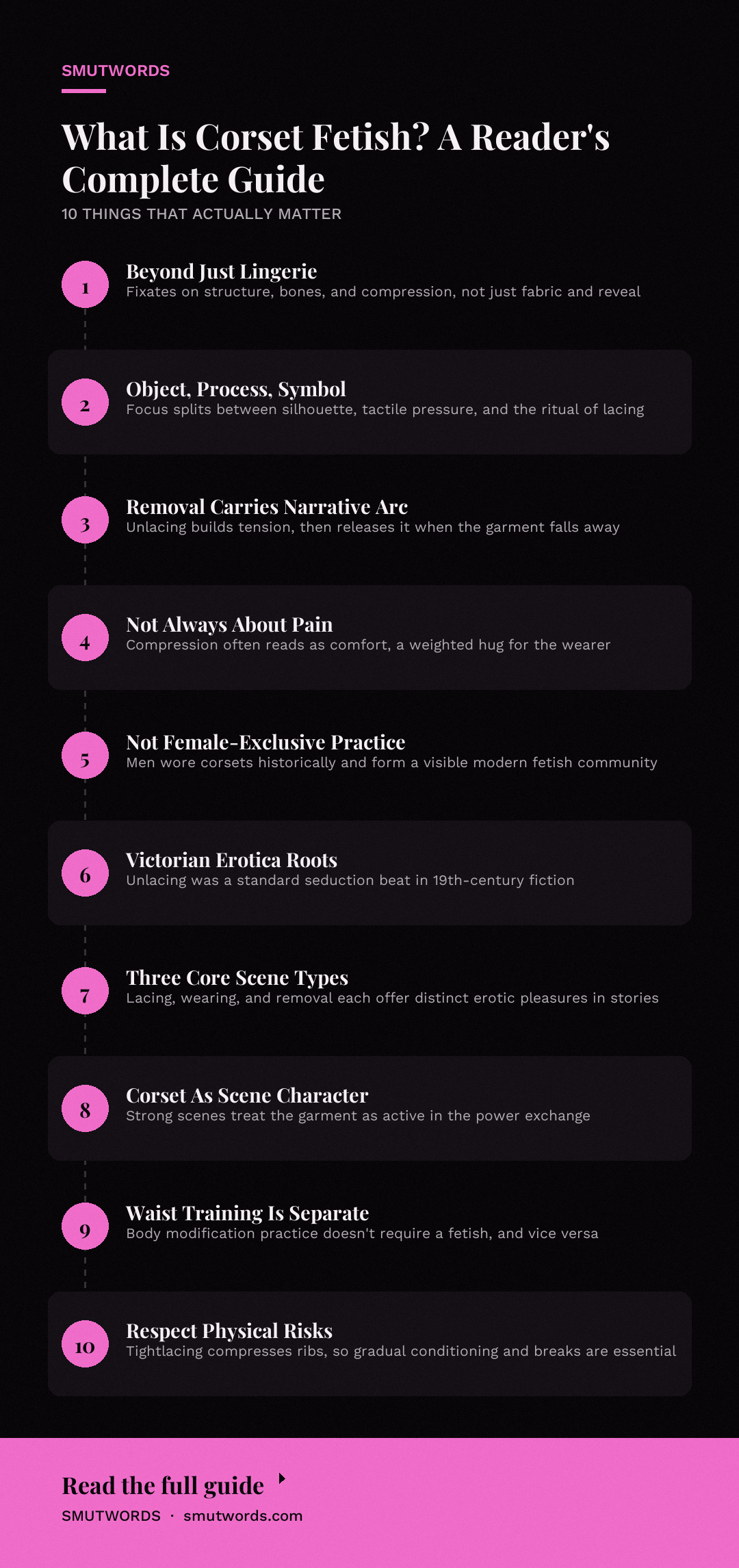
A corset fetish is an erotic fixation on the corset as an object, a process, and a symbol. Unlike a general lingerie fetish, which centers on the visual appeal of delicate fabrics and their role in seduction, the corset fetish goes deeper into structure. The person with this kink is often drawn to the engineering of the garment: the steel bones, the stiff panels, the laces that pull everything into place.
The fixation can break down into several distinct focuses. Some people are drawn to the visual silhouette, the extreme curve that a tightly laced waist creates. Others are drawn to the tactile experience, the pressure and compression of the garment against the torso. Still others focus on the ritual of lacing itself, the slow, deliberate tightening that transforms the wearer's shape inch by inch.
The fetish extends to the act of removal as well. The unlacing of a corset has a built-in narrative arc: tension builds with each tug of the laces, and release comes when the garment finally falls away. This give and take, the tightening and the loosening, makes the corset a uniquely versatile prop in erotic fiction.
It is important to distinguish a corset fetish from simple costume appreciation. Wearing a corset to a historical reenactment or a themed party is not inherently fetishistic. The fetish emerges when the garment becomes a source of arousal in itself, separate from the person wearing it. The corset stops being clothing and starts being a tool of transformation.
It might be the lacing scene that does it, the sound of the laces sliding through the grommets, or the visual shock of a waist reduced by several inches.
Common misconceptions abound. A corset fetish is not automatically about pain. For many, the compression is a comfort, a weighted hug that grounds the wearer in their own body.
It is also not always about female-presenting bodies. Corsets have been worn by men throughout history, and male corset fetishists are a substantial portion of the community.
Finally, a corset fetish does not require waist training. Many people with this kink own a single corset for occasional wear, while others never wear one at all and prefer to worship the garment on a partner or simply to read and write about it.
Where Corset Fetish Comes From
The corset fetish has a longer and more storied history than almost any other clothing kink. The garment itself dates back to the 16th century, when it was known as a pair of bodies, but its erotic charge began to build in earnest during the Victorian era. This was the period of the wasp waist, when tightlacing pushed the female silhouette to extremes that seem almost impossible to modern eyes.
Victorian pornography and erotic literature frequently featured the corset as a central prop. The act of unlacing a woman's corset was a standard prelude to intimacy in the fiction of the era, a narrative beat that signaled impending seduction. The corset was also a marker of respectability, which made its removal all the more potent. The woman who unlaced for a lover was granting access not just to her body but to her private self.
The fetish persisted through the 20th century, surviving the decline of the corset as everyday wear. Stages and screens kept the garment alive. Burlesque performers made the slow reveal of the corset a cornerstone of their act.
Pin-up photography of the 1940s and 1950s featured corseted women as a standard pose. The garment remained a shorthand for vintage glamour and controlled sexuality.
The modern corset fetish community is deeply indebted to two figures: Mr. Pearl, the London-based corsetier who famously reduced his own waist to under 20 inches, and the revival of interest in historical costuming that the internet made possible. Social media and dedicated forums have allowed enthusiasts to share techniques, purchase custom garments, and discuss the practice of waist training in ways that were previously limited to a small circle of practitioners.
In the publishing world, the corset fetish found a strong home in historical romance and erotic historical fiction. The genre's need for period detail gave authors ample reason to describe lacing scenes in exhaustive detail. Over time, the corset became a recognized trope in its own right, a shorthand for a heroine who is physically constrained by her society and must break free, or who willingly submits to a lover who takes control of the laces.
The popularity of the form echoes the broader appeal of submission and control that kink negotiation often addresses in contemporary settings.
How It Shows Up in Erotica
In erotic literature, the corset fetish appears in three primary scene types: the lacing, the wearing, and the removal. Each offers distinct pleasures, and the strongest stories often combine all three across a single scene or an entire book.
The lacing scene is the slow burn. An author who knows the craft stretches this moment across pages. The focus is on the process: the shift of the fabric across the shoulders, the first pull of the laces, the incremental tightening that steals breath and reshapes the torso.
A strong lacing scene includes sensory details, the rasp of the cord through the grommets, the heat of the wearer's skin through the layers, the audible gasp when the waist pulls in another inch. The lacing is rarely silent. Dialogue, whispered encouragement, and the dominant partner's commentary on the progress of the transformation all intensify the moment.
The wearing scene is about the tension of containment. The corseted character carries herself differently. Her breathing is shallower, her posture straighter.
The author must remember that a tightly laced corset restricts movement and air, so the character's physical experience changes. She feels every shift of the bones, every press of the fabric.
Enjoyed this? Get a free book.
Join the list and we will send a complete free story straight to your inbox, plus new releases every week after that. No credit card, no catch.
The erotic charge here comes from the contrast between the rigid exterior and the soft body straining against it. A skilled author shows the way the corset makes the wearer hyper-aware of her own skin.
The removal scene is the payoff. Unlacing reverses the ritual at a different pace. The laces are pulled loose, the tension releases, and the body spills out of the hard shell.
In fiction, this moment is often the prelude to the first touch of bare skin. The reveal has been earned by the preceding restraint.
Several variations on the classic scene keep the trope fresh:
- The transformation arc. A character is corseted by a dominant lover or a skilled dresser, and her gradual reshaping is the story's core.
- The public secret. A character wears a corset under ordinary clothing, carrying her hidden structure through the world. The fetish lives in the knowledge that no one else can see.
- The forced wear. A character is required to wear a corset as discipline or training, whether in a historical context or a modern power exchange dynamic.
- The corset as collar. The underbust corset, which stops below the bust, operates less as lingerie and more as a piece of restrictive gear. It is simpler in silhouette but allows for more coverage, which appeals to a different set of fantasies.
- The waist training narrative. The slow, months-long process of reducing the waist serves as a story of devotion and control, often spanning the entire book.
What makes a strong version of the corset fetish work versus a flat one comes down to specificity. A writer who says "she wore a corset" and moves on has missed the point. The reader wants the lacing, the tightening, the way the garment changes the shape of a breath. Let the reader feel the restriction and the reward of release.
Conversely, a scene that only describes the mechanics without the emotional or psychological charge reads like a technical manual. The corset fetish works best when the garment is a character in the scene, an active participant in the power exchange between the people involved.
Read alongside related clothing kinks like the glove fetish, which centers on the covering of the hands, or the leather fetish, which often trades in similar themes of structure and discipline, the corset occupies a unique middle ground. It is wearable, visually striking, and physically transformative in a way that no other garment quite matches.
Corset Fetish vs Waist Training
The confusion between a corset fetish and waist training is real and worth untangling. Waist training is the practice of wearing a corset regularly over a prolonged period to produce permanent or semi-permanent changes to the waist measurement. It is a body modification practice with concrete goals. A corset fetish does not require waist training at all.
Many people with the fetish enjoy the aesthetic and tactile aspects of the corset without any interest in reducing their measurements.
The two can overlap. A waist trainer may develop a fetish through the intimate daily ritual of lacing, or a person with a strong fetish may decide to pursue waist training to enhance the visual effect. But they are separate phenomena, and conflating them leads to two practical errors in fiction.
The first error is assuming that all corseted characters are pursuing long-term body modification. The second is ignoring the real risks of prolonged tightlacing, which include rib compression, reduced lung capacity, and digestive issues.
When a story includes waist training as a narrative element, responsible authors acknowledge the physical stakes rather than treating the practice as effortless. Real-world corset play involves genuine physical risks like rib compression and breathing restriction, so communication and gradual, consensual wear with breaks are essential. This is true both for real practitioners and for characters in a story.
Frequently Asked Questions
Is a corset fetish the same as a lingerie fetish?
No, though the two frequently overlap. A lingerie fetish centers on delicate, revealing garments and the visual and tactile appeal of the fabric. A corset fetish goes deeper into structure, compression, and transformation. The corset is lingerie, but its defining features are its rigidity and its active reshaping of the body.
Is wanting to wear a corset every day a sign of a fetish?
Not necessarily. Daily wear can stem from body image goals, posture support, or comfort in compression. The line into fetish territory is crossed when the garment itself becomes a source of arousal. If the act of lacing or the feeling of the corset against the skin produces sexual excitement, that points toward a fetish.
Why does tightlacing make some people feel aroused?
The arousal comes from a combination of factors. The physical pressure can be stimulating, and the ritual of lacing creates anticipation. There is also the psychological charge of control and submission, whether the wearer is lacing themselves or being laced by a partner. The visual transformation and the heightened body awareness that the corset creates compound the effect.
What is an underbust corset, and why do some prefer it?
An underbust corset stops below the bust, leaving the breasts uncovered or separately supported. Because it does not compress the ribcage as high, it allows greater comfort and mobility while still shaping the waist. Enthusiasts who prefer the underbust style often value the cleaner lines and the way it pairs with other garments. It also allows for more modest covering and works well under clothing.
Can men have a corset fetish?
Yes. Men have worn corsets throughout history, and male corset enthusiasts form a visible community. The fetish can focus on wearing the garment, on seeing a partner wear it, or on the aesthetics of corsetry regardless of the wearer's gender. The corset fetish is not tied to any single gender expression.
Is corset play dangerous?
It carries genuine risks if done carelessly. Tightlacing compresses the ribs and limits lung capacity, which can cause dizziness, shortness of breath, and, over the long term, rib deformities and digestive problems. Safe practice requires gradual conditioning, regular breaks, and careful listening to the body. Anyone pursuing real-world corset play should research thoroughly and consult with experienced practitioners.
Final Thoughts
The corset fetish endures because it captures a fundamental erotic tension in a single garment. It is hard and soft, restrictive and revealing, historical and immediate. In fiction, it offers authors a built-in structure for scenes of control, anticipation, and release. For readers, the slow tug of the laces never gets old.
For the best modern example of how a corset fetish plays out across an entire narrative, look to the historical romance subgenre, where the lacing scene is a beloved set piece. A standout is the work of authors who treat the corset as a full participant in the power dynamic, not a costume piece. Start with a book that opens on a dressing scene and let the tension build from there.







Loading comments…