
Couple swap is a partnered arrangement in which two established couples trade partners for sex, either in the same room or in separate pairings, with everyone consenting in advance. In erotica, a couple swap is less about the physical mechanics than the emotional ones: jealousy, compersion, voyeurism, and the negotiation scenes where four people say out loud what they want.
It sits on the ethical non-monogamy shelf next to swinging. The best stories treat the swap as a pressure test on a relationship rather than a simple excuse for a foursome.
What Couple Swapping Actually Means
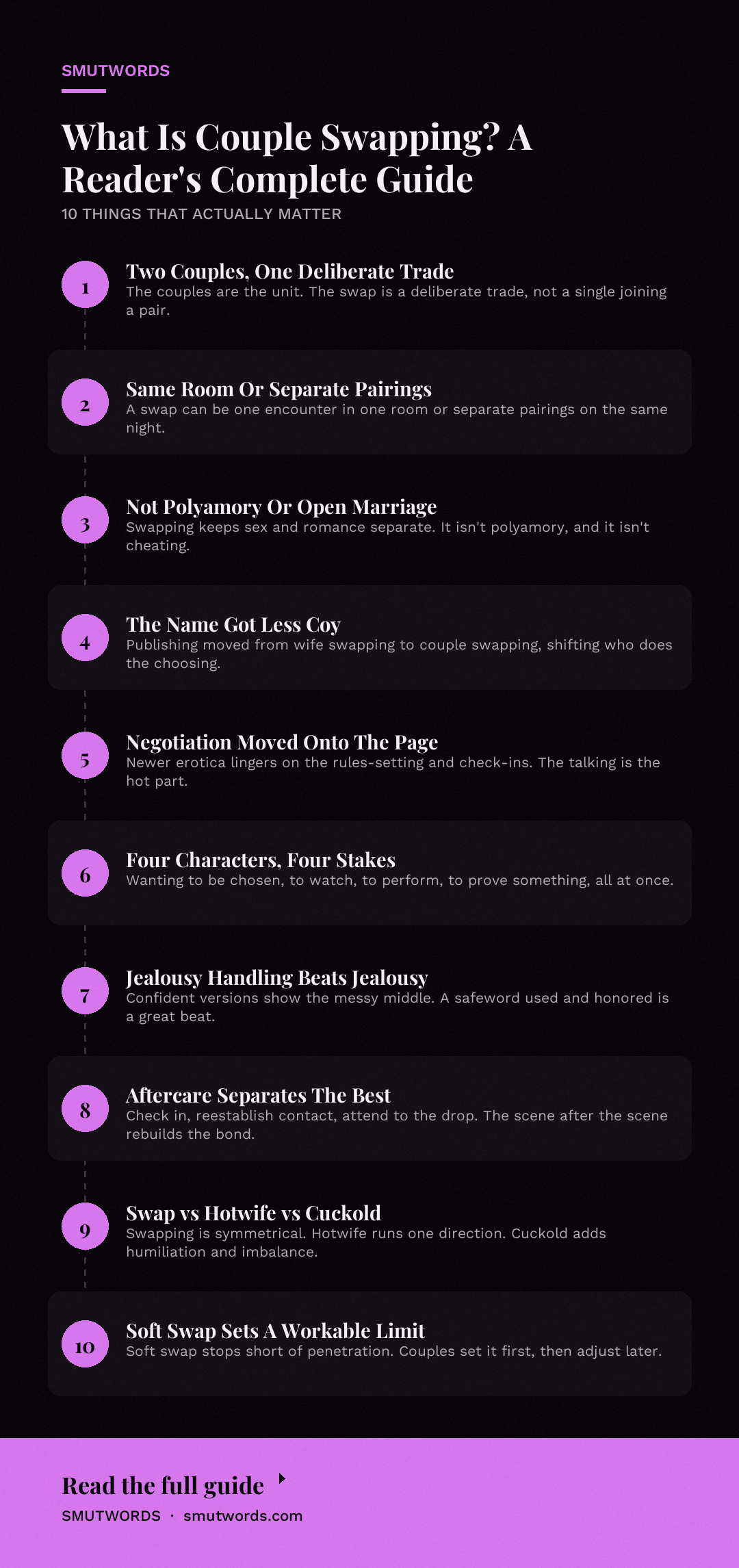
The term describes a specific structure: two couples, already partnered, exchanging sexual partners. The couples are the unit. Nobody enters alone. That distinction separates couple swapping from dating separately or from a single person joining an existing pair.
The swap can happen in one encounter (everyone in the same room, sometimes everyone touching everyone) or as separate pairings in different rooms on the same night. It can be a one-time event or a recurring arrangement. What makes it couple swapping rather than generic group sex is the pre-existing bond on both sides and the deliberate trade at the center.
What counts: two committed couples who negotiate terms, set limits, and follow through. What doesn't: one partner pushing the other into it, a surprise setup, or a scenario where only one half of a couple actually wants to be there. Erotica loves that last version as a conflict engine, but it's a betrayal plot wearing swapping clothes.
Common misconceptions worth clearing up. Couple swapping isn't the same as polyamory, which involves multiple romantic relationships rather than a sexual event between partners. It isn't an open marriage by default, since many swapping couples keep sex and romance strictly separated. And it isn't cheating, because the entire premise rests on disclosed, agreed-upon permission from every person involved.
The name itself is blunt and literal, which is part of why it stuck. Earlier publishing used "wife swapping" almost exclusively, a phrase that carried a wink and a stigma in equal measure. The shift to "couple swapping" and "partner swap" tracks a broader change in how the fiction frames who is doing the choosing.
Where Couple Swapping Comes From
Swapping as a recognizable practice has roots in mid-century American suburbia and the military-base social circuits of the 1950s and 60s, but the fiction history is what matters here. Pulp publishers figured out fast that partner exchange sold. The 1960s and 70s produced a flood of paperback originals with titles that made the premise explicit, often packaged as cautionary tales while delivering exactly what the cover promised.
The key-party trope entered the culture in that era and never fully left. A room, a bowl of keys, and a rule that you go home with whoever you draw. It's a convenient plot device because it removes the need for four people to negotiate on the page, which is also why modern writers often treat it as a period piece or a fantasy frame rather than a realistic setup.
Through the 1980s and 90s, swapping migrated into video and then early internet erotica, where it split into two strains. One was glossy and aspirational, all hot tubs and confident couples. The other was darker, leaning on humiliation and power exchange, which is where wife-sharing and cuckold dynamics branched off into their own genres with their own audiences.
The 2000s and 2010s brought a notable shift: the negotiation moved onto the page. Where older stories cut straight from the dinner party to the bedroom, newer erotica lingers on the conversation before, the rules-setting, the check-ins during, and the aftermath. That's partly a reflection of how real non-monogamous communities talk about consent, and partly an editorial realization that the talking is hot.
Indie publishing accelerated the trend. With no shelf to shock and a direct line to readers, authors could write the full arc: the nervous first conversation, the jealousy that flares and gets handled, the morning after. Couple swap stories now routinely run novel length, and the emotional negotiation is the spine rather than the preamble.
How It Shows Up in Erotica
On the page, a couple swap is a machine for generating tension from four directions at once. Each character has a stake: wanting to be chosen, wanting to watch, wanting to perform well for a stranger, wanting to prove something to a partner. A skilled writer keeps all four threads live.
The strongest versions follow a recognizable shape, though authors vary the order and the emphasis.
- The proposal. One partner raises the idea. The reaction tells you everything about the relationship's health and the book's real subject.
- The negotiation. Rules get set: soft swap or full swap, same room or separate, what's off the table, what happens if someone wants to stop. This scene is where the kink lives for a lot of readers.
- The build. Meeting the other couple, the charged small talk, the moment everyone understands it's actually happening.
- The swap itself. The physical scene, often intercut with the voyeuristic thread of watching your own partner with someone else.
- The aftermath. Jealousy, reassurance, or in darker versions, the fallout that was always coming.
Variations authors lean on: soft swap (everything but penetrative sex with the other partner), full swap, same-room swap where the couples stay together and watch, separate-room swaps that maximize the unknown, and the foursome where all four bodies end up in one tangle. Some stories frame it as a one-night experiment; others build a standing arrangement that recurs across a series.
What makes a strong version work is specificity of feeling. A flat couple swap scene reads like choreography: body A here, body B there, everyone enthusiastic, no interiority.
A strong one stays inside somebody's head during the swap and lets that head be complicated. The protagonist watching their partner's face change for a stranger is the real event. The sex is the setting.
The jealousy handling matters more than the jealousy itself. Amateur versions let the jealousy fester into a fight that ends the story or gets magically resolved by another orgasm. Confident versions show the messy middle: someone needs to stop, someone needs reassurance, and the group has to actually deal with it. A safeword that gets used, and honored, is one of the most satisfying beats the genre offers.
Aftercare is where the best authors separate themselves. Jealousy and emotional fallout are real, and the scene after the scene is where the relationship gets rebuilt or tested.
Think of how much a good impact play scene depends on what follows the paddle. Swapping runs the same way. The impact play aftercare model (check in, reestablish contact, attend to the drop) translates almost directly, and writers who borrow that structure get richer endings.
Scene craft matters too. A couple swap is a scene play event in the technical sense: agreed roles, agreed limits, a beginning and an end. Authors who treat it that way, with a clear negotiation and a clear close, produce cleaner, hotter stories than those who let it sprawl.
Enjoyed this? Get a free book.
Join the list and we will send a complete free story straight to your inbox, plus new releases every week after that. No credit card, no catch.
Voice and point of view do heavy lifting. First person from one half of a couple lets the reader live inside the jealousy and the arousal at once. Third person omniscient can track all four people, which suits sprawling foursome sequences. Multiple POV, alternating between the two partners, is a specialty move that lets the book show both sides of the same charged evening.
Kink crossover is common and often done badly. Swapping pairs naturally with mild power exchange, exhibitionism, and voyeurism. It pairs less naturally with heavy sadomasochism unless the negotiation addresses it, since a swap is an event among equals by default. If the story introduces a wooden restraint or a scene that needs recovery time, the group needs to have agreed to it in advance, and the writer has to show that agreement.
For readers tracking related dynamics, the possessiveness angle in swapping fiction is worth a separate look. Authors who want to write the jealous half of the couple well can study the possessiveness kink guide, which covers the same push-pull of wanting to own and wanting to share.
What to avoid, editorially: the swap as a magic fix for a dead bedroom with no work shown, the "oops we didn't discuss it" surprise that reads as a consent problem the author didn't intend, and the finale where jealousy vanishes because the sex was good. Readers who came for the emotional negotiation notice when it's skipped.
Couple Swapping vs Swinging, Hotwife, and Cuckold
These terms get tangled constantly, and the distinctions matter for readers searching for the right book.
Swinging is the broader practice: a couple enters a community or lifestyle where they swap, attend parties, or play with multiple other couples over time. Couple swapping is one specific act within that world. Every couple swap is a form of swinging; not every swinger swaps in the symmetrical, two-couples way. If you want the lifestyle, the parties, and the recurring social scene, look for swinging.
Hotwife is a different structure. In hotwife fiction, one partner (usually a wife) has sex with other men, and her husband or partner knows, approves, and typically finds it erotic, often without having a partner of his own that night. The attention runs one direction.
Couple swapping is symmetrical: both halves of the couple get a partner out of the deal. The confusion comes because both deliver the charged image of watching your partner with someone else, but the arrangement underneath is different.
Cuckold fiction, the related dark cousin, adds humiliation and power imbalance to the same watching dynamic. Couple swapping can tilt toward cuckold territory if the story introduces degradation or denial, but vanilla-leaning swaps keep the dynamic equal. If the appeal is the humiliation and the power shift, that's cuckold, not swapping.
Open marriage is the relationship-level umbrella: a committed couple who agree to outside sex. Couple swapping can happen inside an open marriage, but an open marriage doesn't require the swap structure at all. People in open marriages may date separately, play solo, or never actually take anyone up on it.
The practical distinction for readers: if the blurb promises four people and a trade, you're in couple swap territory. If it promises one partner watching while the other plays, it's hotwife or cuckold. If it promises a community and a lifestyle, it's swinging.
Frequently Asked Questions
What is a couple swap, exactly?
Two established couples trade sexual partners, either in the same room or as separate pairings, with everyone consenting in advance. The couples are the unit, and the trade is deliberate rather than a single person joining an existing pair. The arrangement can be a one-time experiment or a recurring setup.
What's the difference between soft swap and full swap?
Soft swap usually means everything short of penetrative sex with the other couple's partner: kissing, touching, oral, maybe mutual play. Full swap means penetrative sex with the other partner. The distinction exists so couples can set a limit that feels workable and adjust it later, and it's one of the most common negotiation beats in the fiction.
Is couple swapping the same as swinging?
Swinging is the broader lifestyle: parties, a community, recurring play with multiple couples. Couple swapping is one specific structural arrangement within it. All couple swaps are a form of swinging, but swinging covers a lot more ground, including solo play and group scenes that don't involve a clean two-couples trade.
Why do readers like jealousy in couple swap stories?
The jealousy is the proof the relationship matters. Watching a partner with someone else, then getting the reassurance that the bond survived, delivers the same charge as a possessiveness kink scene with a different mechanism. The taboo thrill of sharing something you're possessive about is the engine.
What are common couple swap rules in real life?
Explicit consent from all four people, limits negotiated in advance (often soft swap first), a safeword, and an agreement on what happens if someone wants to stop. Couples also agree on what counts as off-limits and how they'll check in afterward. Aftercare for jealousy and emotional fallout is part of the standard, not an afterthought.
Does couple swap fiction require a foursome?
No. Plenty of couple swap stories use separate-room pairings, and the voyeuristic charge often comes from what the protagonist can only partially see or hear. The same-room foursome is a common variation, not the definition. The definition is the trade between couples, however it's arranged.
Final Thoughts
Couple swapping works in fiction because it puts a relationship under a specific, agreed-upon pressure and lets the reader watch what holds and what bends. The negotiation, the watching, the jealousy, and the aftermath are the story.
If you want a book that handles the dynamic with real care, the possessive half of the equation is where to start reading, and the possessiveness kink guide makes an excellent warm-up before you find a full swap novel below. The list is right under this piece, ranked by the readers who actually finished them.




Loading comments…