
Possessiveness kink is the erotic charge that comes from a lover who will not share you, will not stop watching you, and cannot stand the idea of anyone else touching what belongs to them. In romance and erotica, the possessive love interest monitors, claims, and stakes public ownership over their partner. The partner being claimed finds all that intensity hot rather than suffocating.
The possessiveness kink turns jealousy and territorial behavior into foreplay, and the reader gets the fantasy of being wanted so badly that the other person has no interest in looking anywhere else.
The allure is specific: devotion cranked to its loudest possible setting, with a dark edge that makes the surrender feel earned. Being somebody's, in this fantasy, is being chosen above everything. The tension between ownership and giving in is the whole engine, and it runs on the page in looks, grip, growled sentences, and the slow tightening of a claim.
What Possessiveness Kink Actually Means
At its core, the term describes a dynamic in which one character's jealous, protective, or territorial behavior is framed as erotically desirable. The possessive partner wants exclusivity and announces it. The claimed partner feels that want as heat. The kink lives in the reciprocal charge between those two positions.
The label gets used loosely, so it helps to separate what belongs inside the tent from what does not. Several related terms get tossed around as near-synonyms: possessive hero, jealous love interest, claiming, mine kink, ownership kink, protective jealousy, obsessive devotion, possessive alpha. They overlap, but they point at slightly different flavors of the same appetite.
- Mine kink: the verbal core of it, the moment a character says "mine" and means it as a claim of belonging.
- Ownership kink: broader, often overlapping with formal D/s structures where ownership is a negotiated title rather than an emotional impulse.
- Protective jealousy: the softer version, where the possessiveness shows up as guarding rather than controlling.
- Obsessive devotion: the extreme end, where the possessive character's focus on their partner becomes total.
- Possessive alpha: mostly a marketing shorthand for shifter and dark romance heroes with territorial instincts baked into the premise.
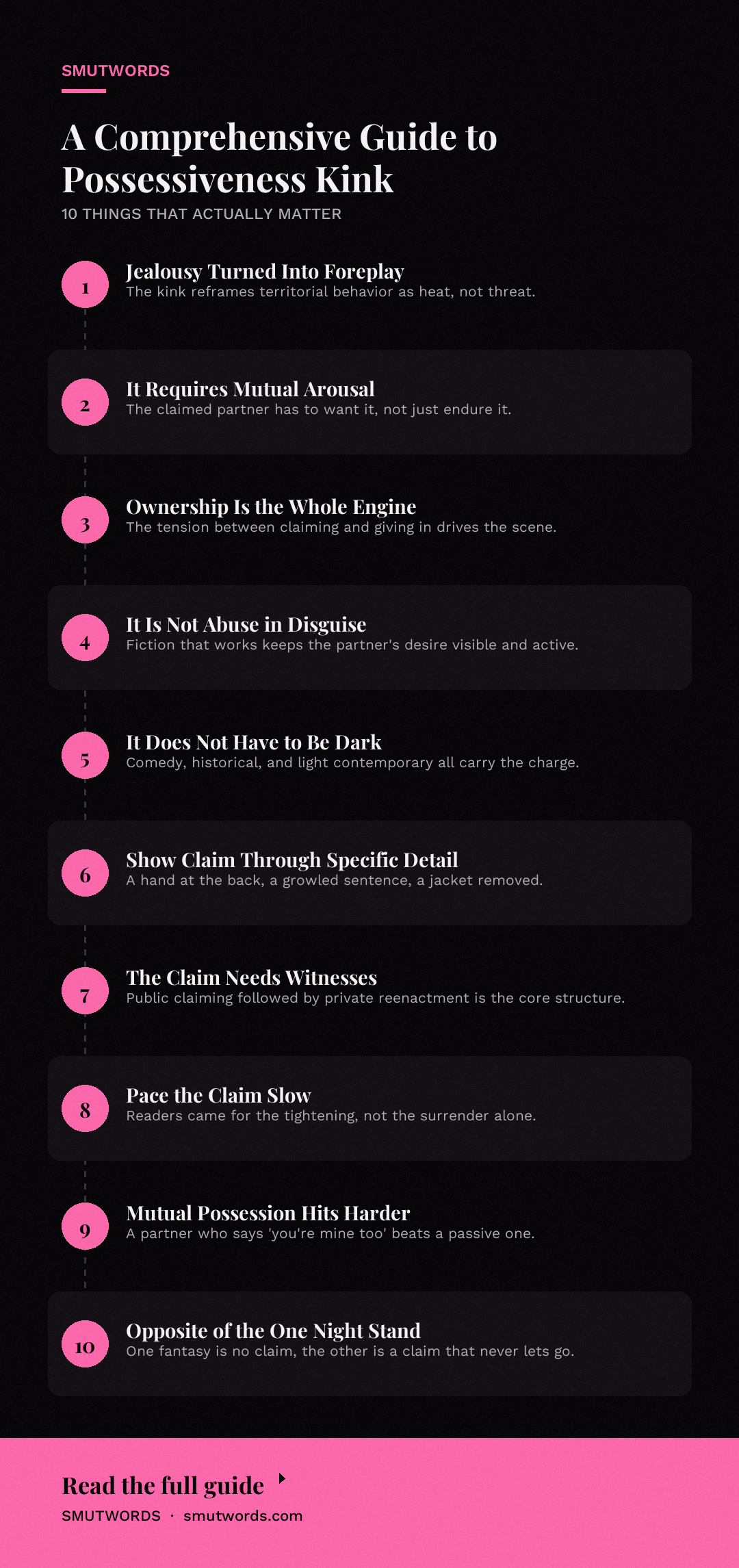
What does not count: a story where the jealousy is genuinely dangerous, where the partner being claimed is frightened rather than turned on, or where the narrative fails to distinguish between intensity the reader is meant to enjoy and behavior the story treats as abuse. The kink requires mutual arousal as part of the frame.
The most persistent misconception is that this is the same thing as a controlling relationship dressed up in sexy clothes. It is not, in the fiction that does it well. The strongest versions make the claimed partner's desire visible and active, so the possessiveness is something they are choosing to receive, not something being done to them without their participation.
Another misconception: that possessiveness kink has to be dark. Plenty of it lives in comedy, in historical romance, in light contemporary stories where the jealous love interest is more sulky than menacing. The charge remains. The temperature varies.
Where Possessiveness Kink Comes From
Possessive love interests are older than the modern romance genre. They run through the Gothic novel, the Brontës, the penny dreadful, the bodice ripper.
What changed is how the genre frames them. The brooding, jealous hero of the nineteenth century was often a warning. The brooding, jealous hero of the twentieth and twenty-first centuries became a promise.
The kink as a named, recognizable trope in erotica and romance is more recent. It rose alongside the broader acceptance of explicit desire on the page and the rise of internet reader communities that wanted shorthand labels for the exact flavor of intensity they were craving. "Possessive hero" as a category tag, a searchable phrase in book descriptions and recommendation threads, is largely a product of the last fifteen to twenty years.
Dark romance as a commercial force pushed the trope harder. In the 2010s, the publishing boom in dark romance, mafia romance, and paranormal shifter romance gave possessive love interests new homes. Shifter stories added a biological justification: the fated mate, the territorial instinct, the wolf who cannot bear another male near his female. Mafia stories added structural ownership: the wife as a claimed asset, the capo who marks what is his.
What changed most is the consent framing. Older romance often let the possessive hero's behavior go unexamined. Contemporary erotica and romance increasingly make the claimed partner's arousal explicit and mutual, sometimes with the partner actively asking for the possessiveness. The label "possessiveness kink" itself acknowledges that the reader is into this on purpose, and that the fantasy has terms.
How It Shows Up in Erotica
The craft of writing possessiveness is the craft of showing claim through specificity. Vague jealousy ("he seemed unhappy when other men looked at her") is flat. Strong versions operate at the level of a single detail: the hand at the small of the back in public, the sentence growled low enough that only the claimed partner hears it, the moment the possessive character removes someone else's jacket from their partner's shoulders without asking permission.
The scene usually needs some external pressure to ignite. A party full of people looking. A phone that rings at the wrong time. A former lover reappearing.
Erotica writers often stage the possessiveness against a crowded room, a bar, an event, an orgy, anywhere there are witnesses and the claim has to be performed publicly. The public claim followed by the private reenactment is one of the most reliable structures in the subgenre.
Look at how many variations exist. The trope has proven unusually flexible:
- The public claim: a hand on a hip, a kiss with too much tongue, a growled "she's with me" that lands like a verdict.
- The private mark: a bite, a bruise, a necklace chosen to signal ownership, a ring that everyone will see.
- The verbal claim: the growl, the "mine," the slow threat whispered into an ear about what happens to anyone who touches.
- The restraint version: cuffs, rope, ties, a controlled holding that makes the claim physical. Our guide to first restraints covers the practical side if the scene heads toward rope or cuffs.
- The watching: the possessive partner who cannot look away, whose attention is a physical pressure on the claimed partner's skin.
- The jealous reshuffling: the moment one lover is replaced by another in a partner's attention, and the possessive one watches their own stake slip and has to reclaim it.
- The formal version: D/s dynamics where ownership is negotiated, which is where keyholding and similar structural kinks overlap with possessive energy.
The strongest versions also do the work of showing the claimed partner's desire. A possessive hero who is not visibly desired by his partner reads as a problem, not a fantasy. The writer has to make the claimed partner's arousal legible on the page: the flushed skin, the hitched breath, the moment they press into the possessive grip instead of pulling away. The kink is a two-person engine.
Pacing the Claim
Possessiveness is a slow burn trope more often than a fast one. The escalation from a first sidelong look to a public claim to a private demand is the arc. A writer who jumps straight to "mine" without building the tension has given away the trick. The reader came for the tightening, not the surrender alone.
Enjoyed this? Get a free book.
Join the list and we will send a complete free story straight to your inbox, plus new releases every week after that. No credit card, no catch.
Some writers layer in related intensities. The primal play overlap is real when possessive scenes get animalistic, when the claiming is more growl and chase than sentence and grip.
The breathplay overlap appears when the possessive partner's hand at the throat becomes part of the claim. Writers who reach for the more physically extreme tools should read the safety material in our breathwork guide first. The fantasy is all the sharper when the craft is disciplined.
The best versions of this trope also let the claimed partner give as good as they get. A possessive hero whose partner waits until the moment is almost over and then says "you're mine too, you know" hits harder than one whose partner is purely passive. Mutual possession delivers a stronger charge than one-way ownership every time.
Possessiveness Kink vs One Night Stand
The most common confusion is between possessiveness kink and stories built around a one night stand. They sit on opposite ends of the exclusivity spectrum, and that is the point.
A one night stand is the fantasy of the indefinite: no claim, no follow-up, no obligation beyond the hours on the clock. Possessiveness kink is the fantasy of the permanent claim, the lover who does not want to let go and says so loudly.
Reading them together is useful because the two tropes define each other by contrast. The heat of a one night stand comes from the freedom; the heat of possessiveness comes from the choice to be held on purpose.
Writers who want both can stage them in sequence: a one night stand that turns into a possessive claim is a reliable two-act structure. The fantasy shifts from "nobody owns me" to "actually, one person does."
The comparison to gangbang stories is less about confusion and more about contrast. A gangbang is a scene of maximum non-exclusivity, and possessive kink is its mirror. Readers who like one often want the other for the whiplash. The genre has room for both.
Frequently Asked Questions
Is possessiveness kink the same as an abusive relationship?
No. The kink requires mutual desire as part of the frame: the claimed partner is turned on by the possessiveness, and their arousal is written into the scene. Possessive play that a partner asks for, negotiates, and can stop at any time is a scene. Controlling behavior that isolates, monitors, or frightens is abuse, and it has nothing to do with kink.
What do readers search for when they want possessiveness kink?
"Possessive hero," "jealous love interest," "mine kink," "claiming," and "possessive alpha" are the most common tags. Dark romance, mafia romance, and shifter romance are the categories where the trope is densest. Readers looking for the softer version search "protective jealous hero." Readers looking for the harder version search "obsessive devotion."
Can possessiveness kink be practiced in real life?
Yes, with clear negotiation about which behaviors count as hot and which count as controlling. Some couples enjoy public claiming, verbal possessiveness during scenes, marks that fade, or formal D/s ownership structures with safewords and check-ins. The line to hold is consent: anything that involves monitoring, isolating, or restricting a partner without an explicit and revocable yes crosses out of kink.
What makes a possessive love interest work on the page?
Specificity and mutual desire. The strongest versions build the claim through a single repeatable detail (a hand placement, a phrase) and show the claimed partner actively receiving it. The possessiveness needs an external audience to perform for and an internal logic that makes the claim feel earned rather than assumed.
Is possessiveness kink the same as primal play?
They overlap but are distinct. Primal play is the physical, animalistic version, all chase and growl and instinct. Possessiveness kink is broader and can be entirely verbal, entirely social, or entirely about public claim. A scene can be possessive without being primal, or primal without being possessive, and many scenes of both at once read as the strongest version.
Where does the possessive alpha trope come from?
Mostly from the commercial boom in shifter and paranormal romance, which handed possessive love interests a biological justification. The alpha wolf who cannot bear another male near his mate, the territorial instinct, the fated mate bond. The premise does a lot of work, letting writers push the possessiveness further than a realistic contemporary setting would easily support.
Final Thoughts
The fantasy at the center of the possessiveness kink is simple and durable: someone wants you so much that the whole room feels it.
What makes the trope worth reading again and again is the work required to sell it. A specific detail. Mutual desire. Pacing that builds the claim line by line before it snaps.
If you want the strongest version the catalog has, look for a dark romance or a shifter story where the possessive love interest is paired with a claimed partner who gives as good as they get.





Loading comments…