
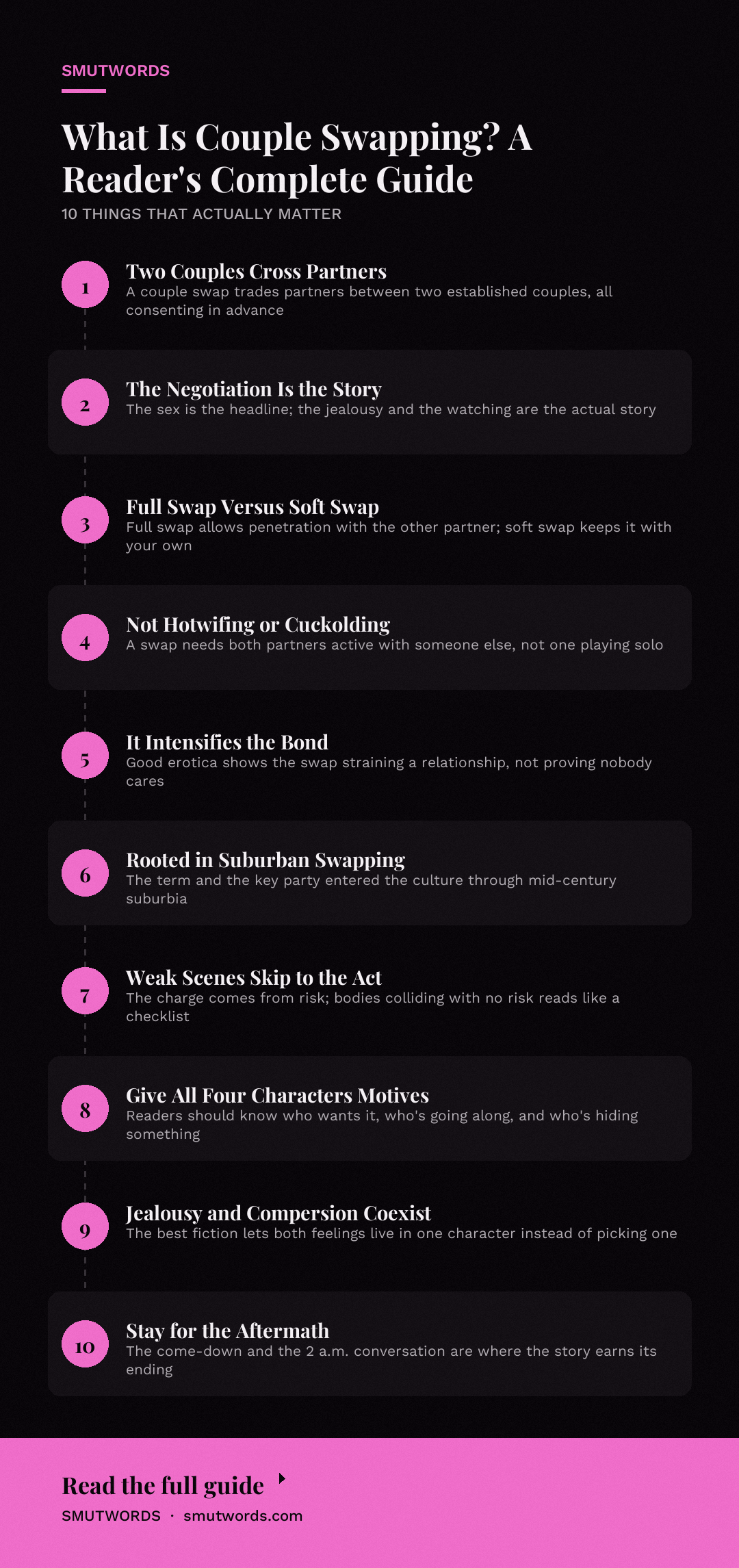
A couple swap is a partnered arrangement where two established couples trade partners for sex, either in the same room or in separate pairings, with everyone consenting and negotiating terms in advance. In erotica, the couple swap is a pressure cooker. It puts a relationship on the page and turns up the heat until everything the partners haven't said to each other comes boiling out.
The sex is the headline. The negotiation, the jealousy, and the moment one partner watches the other come undone for someone new is the actual story.
Readers searching for a couple swap story usually want more than bodies in a bed. They want the emotional math: what it costs, what it proves, what it changes. This guide covers what the term means, where it came from, how authors build a scene that works, and the real-world rules that keep the fantasy from turning into a cautionary tale.
What Couple Swapping Actually Means
The phrase describes two couples who agree to exchange partners sexually. The exchange can be a full swap, where each person has penetrative sex with the other couple's partner, or a soft swap, where play stays at oral, manual, or voyeuristic contact. It can happen in one shared room or in two separate ones. It can be a one-night arrangement or a recurring dynamic with the same two couples.
"Swapping" is a little misleading, because the couples don't trade partners like cars. Each person remains an autonomous adult who chooses what they want, with whom, and how far. The word survives because it's punchy and because it captures the central image: two partnerships crossed, each partner handed to someone else for the night.
What counts as a couple swap in fiction:
- Full swap: both couples have penetrative sex with the other couple's partner, usually in the same room.
- Soft swap: kissing, oral, and hands only; penetration stays with the original partner or doesn't happen.
- Same room swap: all four people stay in one space, which keeps the voyeuristic charge high and the accountability visible.
- Separate room swap: the couples split into pairs, which raises the stakes on trust and imagination.
- Half swap: only one pair crosses over, which often signals uneven desire or a partner who's more reluctant.
What doesn't count: a hotwife arrangement where one woman sleeps with other men while her partner stays home, or a cuckold dynamic built on humiliation and denial. Those are adjacent but distinct; the swap requires both partners to be active participants with someone else. An open marriage where each partner dates separately is also a different animal, because the sex doesn't happen as a shared event.
The most common misconception is that swapping means the couples don't care about each other. In good erotica, the opposite is true. The swap intensifies the bond by putting it under visible strain, and the couples who come out the other side usually do so because they talked first.
Where Couple Swapping Comes From
Swapping as a recognizable practice has roots in mid-century American suburbia, where the postwar boom, the car, and the cocktail party created conditions for private partner exchange among married couples. The term "wife swapping" entered the popular vocabulary in the 1960s and 1970s, and it carried a distinct tone: husbands trading wives like favors, women as currency, and a wink-wink suburban naughtiness that the era's magazines loved to scandalize.
The fiction of that period reflected the tone. Pulp paperbacks with titles like The Swap and Swap Club sold the idea as suburban transgression, and the covers almost always featured a woman's bare back and a wedding ring. The stories were thin on consent and heavy on shock. The women were often reluctant, the husbands often boorish, and the endings often punished everyone involved.
The key party, where couples drop their keys in a bowl and go home with whoever's keys they draw, became the era's shorthand for the whole scene. It shows up in novels, films, and later in retro-flavored erotica. The key party is a useful fictional device because it removes negotiation from the page and replaces it with chance, which is exactly what a writer building tension wants.
The 1990s and 2000s brought a shift toward ethical non-monogamy language. Swinging communities built their own etiquette: rules, limits, vetoes, and the concept of compersion, the warm feeling of watching your partner enjoy someone else. Erotica absorbed that vocabulary, and the couple swap story evolved from a cautionary tale into something more complicated. The negotiation scene became a set piece in its own right.
Contemporary erotica treats the swap as a relationship event with emotional consequences. The genre has diversified too: same-sex couple swaps, swaps between friends, swaps that go wrong, swaps that heal a marriage, swaps staged as a wedding anniversary gift. The trope has stayed popular because it does something no solo scene can: it forces two relationships onto the page at once.
How It Shows Up in Erotica
The strongest couple swap scenes are built like a scene play sequence: setup, negotiation, the act, the aftermath. The setup establishes what each character wants and what they're afraid of. The negotiation puts those wants on the table, often with a drink in hand and a knot in the stomach.
The act delivers the physical payoff. The aftermath is where the emotional story actually resolves.
A weak swap scene skips straight to the act. Bodies collide, everyone has a great time, and the story ends with a satisfied sigh. Those scenes read like a checklist. The reader gets the mechanics and none of the charge, because the charge comes from the risk that something might break.
Here's what a strong version does instead:
- Establishes a specific fault line in the primary relationship. Maybe one partner feels desired but not seen, or the couple hasn't had sex in months, or one of them has a fantasy they've never said out loud. The swap puts pressure on that fault line.
- Gives each of the four characters a distinct motive. The reader should be able to tell, before anyone undresses, who wants this, who's going along with it, and who's hiding something.
- Dramatizes the negotiation. The rules, the limits, the safe word, the "if either of us says stop" clause. These conversations are the foreplay of the ethical version and the suspense engine of the dubious version.
- Uses the voyeurism deliberately. Watching your partner with someone else is the emotional center of the trope. Whether the character feels jealousy, compersion, or some churned-up mix of both determines the scene's temperature.
- Stays with the aftermath. The come-down, the check-in, the conversation at 2 a.m. This is where the story either earns its ending or doesn't.
The variations authors lean on are numerous. The most common is the first-time swap, which trades on virginity-of-experience energy and lets the reader learn the rules alongside the characters. The established swap uses an experienced couple to introduce newcomers, which creates a power imbalance the author can play with.
The wedding or anniversary swap uses ritual occasion to heighten the stakes. The accidental swap, often at a party or a resort, uses miscommunication and alcohol to escalate into something nobody planned.
Enjoyed this? Get a free book.
Join the list and we will send a complete free story straight to your inbox, plus new releases every week after that. No credit card, no catch.
The wife-sharing variant deserves its own note. It overlaps with the broader category of partner sharing but keeps a specific charge: the husband watching, the wife enjoying, the marriage surviving or not surviving the test. It's one of the most searched variants and one of the most emotionally loaded, because it puts the wife's pleasure at the center and the husband's jealousy on the page.
Same-sex couple swaps have become more visible in recent erotica, where two gay couples trade partners or two lesbian couples cross over. These stories often skip the gender politics of the straight version and focus on other fault lines: competition, friendship, the specific mess of sleeping with your best friend's wife.
The jealousy-and-compersion mix is what makes the trope worth reading. A scene where nobody feels anything is just a sex scene. A scene where one character watches their partner come and feels their chest tighten, then loosen, then tighten again, is a story. The best authors orbit that tension for pages before they resolve it.
Realistic swap fiction also does the work of aftercare, though it usually happens in conversation rather than in a protocol scene. For a heavier treatment of the structural side, the SmutWords guide to impact play aftercare lays out the check-in sequence, which translates well to the post-swap talk. And if the characters are negotiating their first non-monogamous arrangement, the possessiveness kink guide covers the ownership-versus-freedom wire that swaps tend to touch.
The fluid-bonding conversation belongs in the swap scene more often than it shows up. In real life, condom use and testing status get negotiated before anyone's clothes come off. The fluid bonding discussion covers that language, and fiction that includes it reads more honest than the version where nobody mentions barriers.
Couple Swapping vs Swinging
Most readers use "couple swap" and "swinging" interchangeably, and in a lot of erotica they are the same thing. The distinction is one of scope. Swinging is the broad umbrella for partnered sex with other people, which can include swaps, threesomes, gangbangs, and solitary play with strangers while a partner watches. A couple swap is one specific configuration under that umbrella: two couples, four people, crossed pairings.
A couple swap always involves a reciprocal exchange. Swinging can be one-sided: a husband who watches while his wife plays alone is swinging, but he isn't swapping, because there's no second couple bringing their own partner into the arrangement. The gangbang guide covers the wider range of multi-partner scenes, which helps place the swap on the spectrum.
The other word that gets confused with swapping is the open marriage. An open marriage is a relationship framework, not a specific event. It's the policy; the swap is one thing that can happen under that policy.
If a story is built around a one-night exchange rather than a permanent arrangement, that's a swap. If it's about a married couple restructuring their whole relationship over months, that's an open marriage story with swap scenes in it.
Frequently Asked Questions
What is a couple swap in erotica?
A couple swap is a story premise in which two couples trade partners sexually, usually in a shared scene or a paired arrangement, with negotiation and jealousy as emotional drivers. The sex is one part of the page; the other part is the conversation before and after.
What's the difference between a full swap and a soft swap?
A full swap allows penetrative sex with the other couple's partner. A soft swap keeps penetration with the original partner and leaves oral, hands, and kissing on the table with the new one. Erotica uses soft swap for slow-burn tension and full swap for the payoff scene.
Is couple swapping the same as swinging?
Swapping is a specific configuration under the swinging umbrella. Swinging can be one-sided or solo; a swap always involves two couples and a reciprocal exchange. The terms overlap in common usage, but a story that features a hotwife's solo night out is swinging, not swapping.
What makes a couple swap story work emotionally?
Specific, unequal feelings. If both partners feel the same mix of jealousy and excitement, the scene flattens. Strong stories give each character a different relationship to the swap, so the reader gets tension, compersion, dread, or relief from four separate angles at once.
How do real couples negotiate a swap?
Explicit consent from all four people, written or spoken limits before the event, an agreed safe word, and a check-in plan for afterward. Real swaps hinge on the same rules the best fiction dramatizes: nobody surprises anybody, and anyone can stop anything at any time.
What is compersion and why does it matter in these stories?
Compersion is the experience of feeling pleasure at your partner's pleasure with someone else. It's the emotional counterweight to jealousy, and the best couple swap fiction lets both emotions coexist in the same character rather than resolving into one or the other.
Why does wife swapping keep showing up as a specific trope?
It puts the wife's pleasure at the center of the page and the husband's jealousy at the edge of it, which is a rare emotional structure in mainstream erotica. The trope persists because that tension is durable, and because it lets authors write a marriage under visible pressure.
Final Thoughts
The couple swap earns its popularity because it does something a solo scene can't: it makes a relationship visible on the page. The best version of the trope stays in the room after the sex is over, with two people learning something about each other that they couldn't have learned any other way.
If you want a place to start, the SmutWords library has plenty of swap and swinging stories worth your night, and the consent negotiation entry will sharpen your eye for which authors actually do the talk scene well. Read one. Read three. The good ones will put the tension in your chest before anyone takes their clothes off.



Loading comments…