
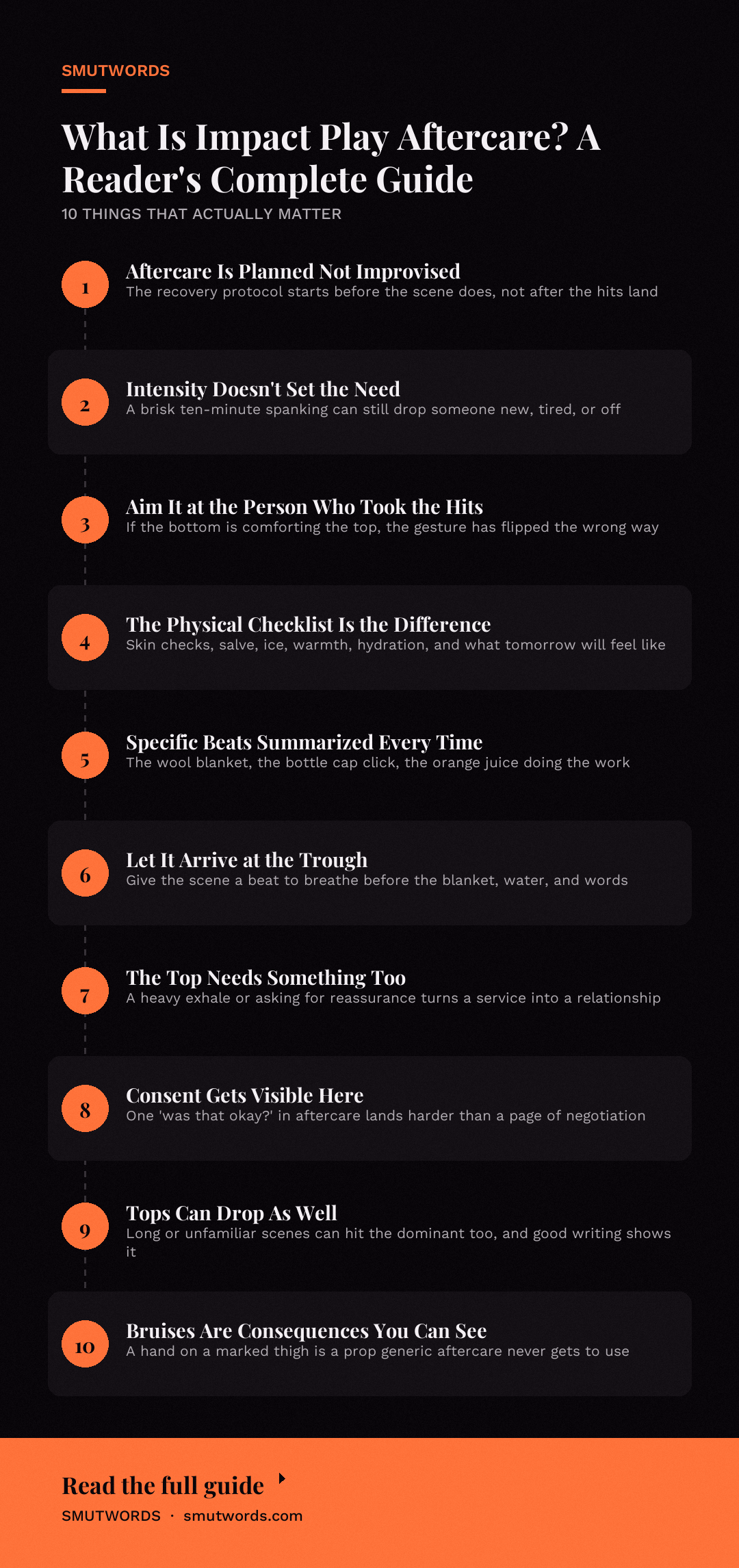
Impact play aftercare is the period after spanking, flogging, caning, or any other percussive scene where the person who took the hits gets put back together: physically soothed, hydrated, warmed up, and talked down from the endorphin cliff. It is planned, not improvised. It covers the sting on the skin, the shaking in the legs, and the strange hollow feeling that can arrive twenty minutes or two days later.
In erotica, impact play aftercare is where the power dynamic pays its debt. The scene takes something apart; the aftercare is the proof that someone was standing by to reassemble it. That is why the good versions land harder than the hits.
What Impact Play Aftercare Actually Means
The word "aftercare" is borrowed straight from medicine and cosmetic surgery, where it means the instructions you follow once the procedure is done so the result holds. Kink communities picked it up decades ago and never let go. "Impact play" specifies the kind of play: hands, paddles, floggers, crops, belts, canes, anything that lands a strike on a body.
So impact play aftercare is the recovery protocol for percussive play specifically. It is broader than a hug and narrower than the whole concept of aftercare, which also covers the aftermath of bondage, humiliation, sensory play, and psychological scenes. The impact version has its own physical checklist because impact play has its own physical consequences.
What counts as aftercare and what doesn't trips people up. A blanket is aftercare. So is a glass of water with electrolytes, a check for broken skin, a hand on the back while the bottom comes down, a text the next morning asking how the bruises feel. None of it has to be elaborate.
What doesn't count: anything the bottom has to administer to themselves because the top has already fallen asleep, or anything performed for the top's comfort while the bottom is still shaking. Aftercare is aimed at the person who absorbed the impact. The top needs care too, and gets it, but the direction of the gesture matters.
A common misconception is that aftercare is only for heavy scenes. A brisk ten-minute hand spanking can still produce a wobble in someone who is new to it, tired, or dropping for reasons that have nothing to do with how hard it was. Intensity is not the same as severity, and the aftercare scales to the person, not the implement.
Another misconception: that aftercare is inherently soft or vanilla. It can be as ritualized as anything else in the scene, with a fixed script, fixed props, and a fixed order of operations. Plenty of dominants get more satisfaction from a well-run aftercare protocol than from the flogging that preceded it.
Where Impact Play Aftercare Comes From
Genuine history here is thin in the way it is thin for most kink terminology: communities codified it in person, in workshops and leather bars and private homes, long before anyone wrote it down for a general audience. The word migrated from clinical settings into kink vocabulary sometime in the late twentieth century, and impact-focused communities made it specific.
The more documentable history is a publishing one. Aftercare barely appeared on the page in early erotic fiction. Spanking scenes in mid-century pulp ended on the punishment itself, or on the sexual act that followed it, and the book closed.
The aftermath was implied, dismissed, or simply not the point. The bottom's physical state after the scene was rarely described at all.
That shifted as BDSM romance grew into its own commercial category through the 2000s and 2010s. Authors writing longer books needed the crash after the peak, both for realism and for emotional structure. Aftercare scenes became the natural landing strip for a scene that had escalated hard, and readers responded to them.
The vocabulary expanded with the audience. Terms like "sub drop," "blanket burrito," and "drop prevention" moved from forum posts into fiction and back out again. Today, an author writing an impact scene almost has to decide what happens afterward, because readers expect the answer and will say so in reviews when they don't get it.
The internet pushed one specific shift: aftercare as a subgenre of comfort content in its own right. Entire books now market themselves on the tenderness after the punishment, and readers who would never seek out a caning scene will read forty pages of one if the following chapter is a bath and a blanket and someone murmuring into a scalp.
How It Shows Up in Erotica
Craft-wise, an impact play aftercare scene has one job: it converts the raw intensity of the scene into evidence of care. The hits demonstrate that one person will do this. The aftercare demonstrates that the other person was never actually in danger of being left there. The transition between those two states is where the emotional payoff lives.
The best versions are physical and specific. Not "he took care of her" but the sting of antiseptic on a split lip, the scratch of a wool blanket, the particular click of a bottle cap being opened. Sensory specificity is what separates a real aftercare scene from an author declaring that tenderness occurred.
Common variations that show up across the genre:
- Physical aftercare: checking skin for breaks, applying salve, ice packs, a bath, warm towels, dressing the bottom in soft clothing. This is the category most scenes open with.
- Emotional aftercare: verbal reassurance, naming what the top felt, confirming the bottom did well, reestablishing the relationship's ordinary register after the scene's heightened one.
- The blanket burrito: a genre staple. The bottom gets wrapped, sometimes to the point of immobilization, and the tightness itself is the comfort.
- Hydration and food: water, electrolytes, juice, something sweet, toast. The mundane domesticity of it is the point; a glass of orange juice can do more narrative work than a monologue.
- Wound care: rarer but potent, especially in books willing to acknowledge that a cane leaves marks that need attention. This version carries an extra charge because it makes the consequences literal.
- Ritualized aftercare: a fixed sequence the couple has built over time, and a scene that breaks or varies it signals trouble. If you're writing power-exchange dynamics, this is where the rituals you've established pay off, and it's the same instinct covered in Building Rituals in a Power-Exchange Relationship: Small Rules That Actually Stick.
Where scenes go flat is when aftercare is summarized rather than shown. "He cleaned her up and held her until she fell asleep" is a sentence that does the work of a paragraph and should have been the paragraph.
The other failure mode is aftercare used as an apology, meaning the top is wracked with guilt and the bottom has to comfort them. That inverts the scene's whole structure and readers notice.
Enjoyed this? Get a free book.
Join the list and we will send a complete free story straight to your inbox, plus new releases every week after that. No credit card, no catch.
The strongest versions also let the top need something. Not a collapse, not a spiral, but a moment where the dominant sits down heavily and exhales, or admits the scene was close to the edge, or asks for reassurance in return. That reciprocity is what turns aftercare from a service into a relationship. It is the same dynamic that makes a vanilla/kink mix relationship interesting on the page: the negotiation between two entirely different needs happening in the same bed.
Structure matters too. A good impact scene builds in waves, and the aftercare should arrive at the trough, not immediately after the climactic hit. Give the scene a beat to breathe. Let the bottom lie there for a moment.
Then the blanket, then the water, then the words. The sequence does the emotional work more reliably than any single element in it.
Small details that readers consistently respond to: the top checking in mid-scene before things go too far, the bottom being asked what they need rather than told, the reappearance of an ordinary object from before the scene (a phone, a dog, a cup of tea gone cold) that signals the world is still there. Aftercare scenes that gesture at anticipation play get an extra layer, since the comfort is also a promise about next time.
One more craft note. Impact play aftercare is where consent gets to be visible without being clumsy. In a scene, negotiations can read as interruptions; in aftercare, a check-in reads as care. A single "was that okay?" landing properly has more weight than a page of pre-scene discussion, because the reader has just watched what it refers to.
Impact Play Aftercare vs Aftercare
The two get used interchangeably, and that's mostly fine, but the distinction is worth holding onto when you're writing. Aftercare in the general sense applies to any scene play, including bondage, denial, psychological play, and roleplay that leaves no marks at all. Impact play aftercare is the specific protocol for the category that leaves marks.
The practical difference is the physical checklist. Impact play aftercare includes skin checks, bruise awareness, salve, ice, and an understanding of where the body will be sore tomorrow. General aftercare may include all of that but doesn't require it. Walking a partner through sub drop after an intense verbal scene and walking them through sub drop after a paddling have the same emotional shape and a different body count.
In fiction, impact play aftercare also carries more visual evidence. Bruises are consequences you can see on the page. That gives an author a physical prop to work with that generic aftercare doesn't offer, and it's why so many of the most memorable aftercare scenes involve a hand on a marked thigh.
The full-body version of this (the same partner who just did the damage, checking the damage) shows up in the best bondage and paddle-scene writing, where the implement leaves a print and the print has to be attended to.
If a book gives you a scene with any percussive element at all, the impact play aftercare is the required next beat. If the book gives you a scene where the physical consequences are minimal, general aftercare is enough. Knowing which one you're writing keeps the scene honest and keeps the reader's investment in the right place.
Frequently Asked Questions
What does impact play aftercare actually involve?
Skin checks for breaks or welts that need attention, warmth, hydration, food if the bottom can eat, and some form of emotional grounding. Physical touch and verbal reassurance do most of the work. The order and the props vary by couple, but the goal is the same: bringing the bottom back to a stable baseline.
How long does impact play aftercare need to last?
As long as the person needs, which is usually longer than people expect the first time. The immediate phase runs twenty to sixty minutes. Sub drop can arrive a day or two later, so the real standard is a check-in the following morning and a willingness to extend. Some couples plan the whole evening around it.
Can a top need aftercare after an impact scene?
Yes, and good writing shows it. Tops can experience their own drop, particularly after a scene that ran long or pushed into unfamiliar territory. The most satisfying scenes include a moment where the dominant receives comfort, even briefly, which strengthens the sense of partnership.
What is sub drop in impact play aftercare?
A crash in mood and energy that follows the endorphin peak of a scene, sometimes described as feeling hollow, tearful, irritable, or unreachable. It can arrive hours or days later. Good impact play aftercare doesn't prevent it, but it makes the drop shorter and less frightening, because the bottom isn't facing it alone.
Can aftercare scenes be written into power exchange without breaking the dynamic?
They can, and they're one of the best places to show the dynamic actually working. The dominant can stay fully in charge throughout aftercare, issuing instructions rather than asking. The submission is being received and honored. This is the same principle that makes ritual collaring ceremonies effective on the page: structure carries the tenderness.
Do couples in vanilla/kink mix relationships handle aftercare differently?
The negotiation is usually more explicit and more ongoing, because one partner is learning the protocol as they go. Aftercare scenes in these books often double as teaching scenes, where the experienced partner walks the other through what to check and what to say. If you want to write this dynamic convincingly, help your reader understand the whole picture with a guide like A Comprehensive Guide to Bondage, which covers the practical side of scene planning in detail.
Final Thoughts
Impact play aftercare is where a scene proves itself. Anyone can write the hits; the aftermath is where an author shows whether the relationship underneath is actually as strong as the scene suggested. Write it specific, keep it physical, and let the person who did the striking be visibly invested in what they did.
If you want a book that gets this exactly right, start with the ranked list below. The picks were chosen for the quality of their aftermath as much as their scenes, because the aftermath is the part you'll remember when the rest of the book has faded.





Loading comments…