
Most couples who try power exchange rituals fail at the same spot: they build a rulebook for a fantasy version of themselves, then discover the actual people living in that apartment have jobs, colds, and a dishwasher that needs unloading. The protocol that sounded scorching on a Saturday night turns into a nagging obligation by Wednesday, and within two weeks it's quietly abandoned. The fix isn't more discipline. It's designing rituals small enough to survive a bad week.
Good power exchange rituals run on a boring engine underneath the heat. Mutual buy-in, a review date, and a way to stop. Get those three right and the sexy part takes care of itself.
What Power Exchange Rituals Actually Are
A ritual is a repeated action that marks the dynamic as present and real. It can be verbal, physical, or situational. The Dominant says a specific phrase, the submissive responds, someone kneels for ninety seconds before coffee, a collar goes on at a set time. None of it requires rope, a dungeon, or a weekend free.
Protocols sit in the same family but run broader. Rituals are the small repeated beats. Protocols are the standing rules that shape how a couple operates: who asks permission for what, what titles get used, how a check-in happens after a hard conversation. A power exchange structure is the architecture holding both.
The appeal is not mysterious. A ritual converts an internal feeling into something visible. If you feel submissive on Tuesday morning but nothing in your day reflects it, the feeling stays hypothetical. A thirty-second ritual at the bedroom door makes it concrete.
Kink-fiction readers recognize the shape of this from the page. The structure of a held dynamic is often what makes the scenes land. If you want a sense of how it reads in fiction between practical experiments, there's plenty on the site worth poking at.
Why Small Rules Stick and Big Ones Collapse
The rules that survive share three qualities. They're brief, they're specific, and they don't depend on mood.
- Brief: under five minutes. If a ritual takes twenty minutes, it competes with every other morning obligation and loses eventually.
- Specific: "be more respectful" is not a rule. "You call me Sir before you leave the bedroom in the morning" is a rule, and both people know the score.
- Mood-independent: it happens whether the submissive feels sparkly or exhausted. A ritual that only fires when you're in the mood is a kink; a ritual you perform because it's Tuesday is a protocol.
Ambition is the usual killer. Couples draft eleven protocols, a full title hierarchy, a weekly schedule of tasks. Nine of them drop off within a month and the two survivors feel like failures because the rest of the system is gone.
Start with one. Live with it for two weeks. Then consider a second.
The 24-hour rule helps here. If you can't imagine executing a ritual for twenty-four consecutive hours without dread, it's too heavy for now. Shrink it until you can, or shelve it. "I could do this tomorrow even with a hangover and a sick kid" is the right test.
Designing Your First Ritual Together
Do the design outside the dynamic. The conversation belongs at the kitchen table with both people as equals, not mid-scene when one person is kneeling and the other is holding a flogger. A protocol built mid-scene tends to reflect the fantasy of the moment; a protocol built over a pot of coffee tends to survive Monday.
Structure the conversation around four questions. What exactly happens, in what order, at what time or trigger? What does each person do and say?
Then the harder two: what's the escape hatch if either party can't perform that day, and when do you both sit down to review it?
Write it down. A ritual that exists only in memory gets fuzzed by mood. A note in a shared document or a folded slip of paper in a bedside drawer creates a reference point. Reviewing a written rule is far easier than reviewing a half-remembered agreement.
A starter protocol that works for most couples
Pick one anchor. A morning greeting is a classic because it happens at the same time every day (wake-up), requires no props, and can be completed in fifteen seconds.
The Dominant says the submissive's chosen title as the first words exchanged after waking. The submissive responds with a specified phrase.
That's it. One sentence each, spoken before the phone gets pulled off the nightstand. It's low enough that a bad night's sleep or a hangover can't stop it.
Add a second ritual only after the first survives a full week without a single dropped day. The second one can be more involved: a collar placed at bedtime, a specific word used before the submissive leaves for work, a weekly check-in scheduled at a fixed hour so neither person has to ask for it.
Choosing Titles and Protocol Language
Titles are the emotional heat source of most power exchange structures, and also where couples most often overwrite. A title that sounds hard on paper can feel embarrassing in the kitchen on a Tuesday.
Try titles out during low-stakes moments before committing. "Sir" in a text message in the middle of the day reads very differently than "Sir" when one person is late for the school run. Use the trial period to find out which word makes each of you light up rather than cringe.
Specificity helps. "Mistress" is a category. "Ma'am, said with eye contact before you take your coffee" is a ritual. The title is the label; the phrase, posture, or gesture that goes with it is what makes it stick.
Off-limit words matter too. Some couples find that certain titles echo a childhood dynamic, a religious upbringing, or an ex. Say so upfront. Every list of approved titles should come with an equally explicit list of words that are off the table.
Language that lands in fiction sometimes doesn't land in real life. The ritual should be designed for how it feels in your actual apartment, not the version of your apartment that has a dungeon in the basement.
What to write down about titles
- Which titles are approved for each person.
- Which contexts they're used in (public, private, text message only).
- What the submissive does or says in response.
- Which words are off-limits and why.
- Whether titles apply on days off, or get suspended entirely.
Bringing It Up With Your Partner
Most people introduce this badly. They either drop a rule as a test in the middle of a scene or launch into a full negotiation at 11 p.m. on a work night, and the partner hears "I've redesigned our entire relationship without telling you."
Better move: name the shape, not the script. "I've been reading about couples who build small rituals into their dynamic, and I want to try one with you. Not a scene. A thirty-second daily thing we design together."
Offer a concrete example. Ask what they'd add, cut, or change. Then shut up and let them think.
If your partner is curious but skittish, point to a low-stakes entry node. A structured ritual is much easier to try than a full protocol hierarchy, and it gives both people hard evidence about whether the shape fits.
Enjoyed this? Get a free book.
Join the list and we will send a complete free story straight to your inbox, plus new releases every week after that. No credit card, no catch.
Read a story with a strong held dynamic together. Something like Absolute Surrender can function as a conversation starter about what each of you actually finds hot in the structure. It also surfaces preferences you might not have known were there. Fiction is often the safest place to test language out loud.
For readers new to power exchange who want their fantasy framework a little more grounded, our guide to the first time trope covers the arc of a dynamic starting out, which maps reasonably well onto the feelings you'll both be having.
Consent, Check-ins, and the Review Date
The load-bearing wall of any power exchange ritual is the review date. A protocol without a review is a bill you keep paying without looking at the charges. Two weeks is a good first interval. Then monthly for as long as the ritual runs.
The review meeting has its own shape. Both people sit as equals. Each answers three questions: what's working, what's drifting, and what needs to change.
The Dominant does not chair it. Whoever designed the ritual doesn't automatically run the review. Power gets suspended for the half-hour and reinstated at the end.
Think of consent less as a one-time contract and more as an ongoing conversation that gets a scheduled slot. The pack dynamics framework is useful here: the group holds the terms, not one person's mood. Real couples can borrow that. The rule belongs to both of you, not to the Dominant's whim or the submissive's enthusiasm.
Watch for the ordinary drift signals during review. Does one person keep forgetting their part? Does the ritual cause low-grade dread instead of pleasure? Is either party yielding on the review because they don't want the ritual to end?
Each of those is a signal to adjust or stop. Not a signal to push harder.
Signs the ritual has rotted
- One person skips their part so often the ritual functionally doesn't exist.
- Any part of it provokes resentment, dread, or guilt in either partner.
- The Dominant keeps escalating without renegotiating.
- The submissive keeps agreeing "yes" in the moment and feeling sour afterwards.
- The review meetings stop happening and nobody mentions it.
Any of these means the ritual needs to end or get rebuilt. Power exchange structures are forms both parties consent to, not contracts that override the person's changing mind.
The Real Risks, and How to Lower Them
Power exchange carries real risks. Most of them are ordinary ones with ordinary fixes.
The main one: ritual creep. A Dominant adds a new demand, a new title, a new rule without renegotiating, and the submissive goes along because refusing feels like breaking the game. Name the boundary explicitly during the review. No new protocol gets added without a sit-down first.
The second risk is dependency. A submissive who needs the ritual to function at all is in dangerous territory. The protocol is meant to hold the dynamic, not the person.
Design rituals so both partners have full access to their own finances, health, and outside relationships. Titles stay home. If a submissive cannot tolerate a day without the ritual, that's a clinical conversation with a therapist, not a kink conversation.
The third is performance drift. The Dominant starts performing dominance instead of holding the space, because they think the title is a job. A Dominant who's exhausted but still hitting every cue will eventually burn out.
Allow the Dominant to declare "off protocol" for a day with no penalty. This is the marriage in trouble dynamic playing out in miniature: the ritual that gets backfilled by willpower rather than desire starts cracking.
For physical rituals specifically, the limits matter. A kneeling posture held too long damages knees, so set a timer or use a cushion. Restraint for a protocol stays light and supervised, nothing that restricts breathing and nothing that leaves someone alone. If you're moving into restraint at all, our comprehensive guide to bondage covers the safety line at floor level before you try anything above it.
Sensory or physical props in a ritual carry similar rules. An ice cube or a feather across the submissive's skin reads as a firm ritual signal at the time; a hard object, a tight collar, or a held position doesn't. The sensory play for couples guide stays within safe range.
If you want to see a ritual written at full-volume fictional intensity, Alien Auction runs a protocol-driven dynamic you won't be replicating in your own living room, and Marked by the Bull treats rituals as emotionally high-stakes rather than routine. Read them for the shape of what you like. Design your own at a fifth of the intensity.
When to Stop
Stop when the ritual stops working. That's clear enough. The harder question is how to tell the difference between a ritual hitting a rough patch and one that has quietly become bad for someone.
Rough patch: one person had a hard week, two days got skipped, both partners want it back. Recalibrate and continue. Wrong-fit: the ritual keeps producing dread, guilt, or resentment in either partner even after adjustment. Stop it, name it as stopped, and take a month off before designing another.
Some couples don't return to it. That's a valid outcome. A power exchange structure that reflects the actual people in it can be one protocol, one title, one ritual. Anything beyond what both partners can sustain happily is decoration.
The one-hour rule is a useful bookend. If a ritual you designed in an hour no longer fits, you can retire it in an hour. Neither the Dominant nor the submissive signed a blood oath to a specific nightly phrase. That's the freedom that makes the whole system work.
Pick up a piece of fiction that treats the day-to-day beats of a held dynamic seriously. The Cum Couch Confessions is a good read for that, and it's a reminder that the fantasy version of a power exchange is a snapshot, not a schedule.
Final Thoughts
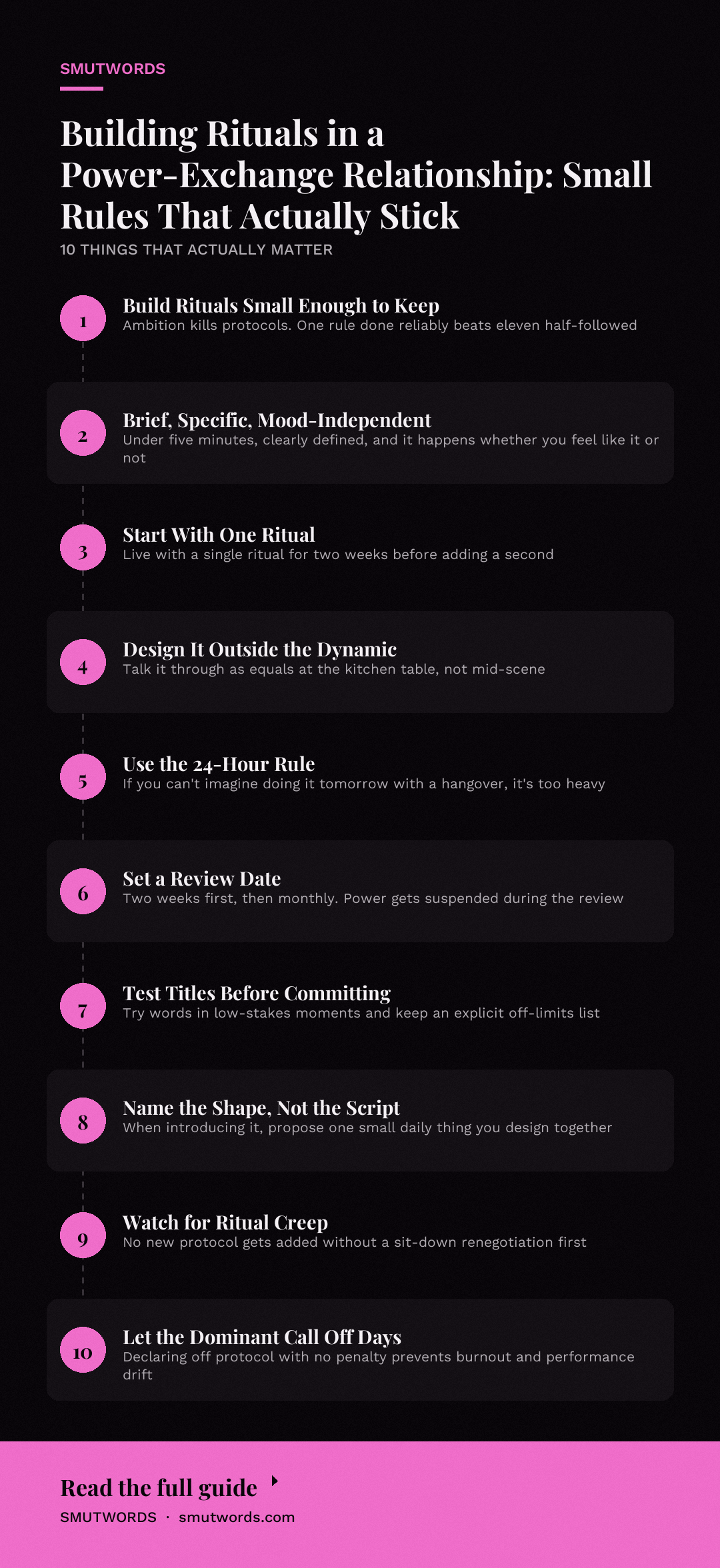
The ritual you want is probably smaller than the one you're drafting. One rule, executed reliably, beats eleven rules half-followed, and a two-week trial will tell you which one you actually have.
Start with the morning greeting. Schedule the review. Let it be boring for a week, then figure out what to keep.
If you want a book to read alongside that first month, Subroutine: Stretch Her is worth a slot on the nightstand.





Loading comments…