
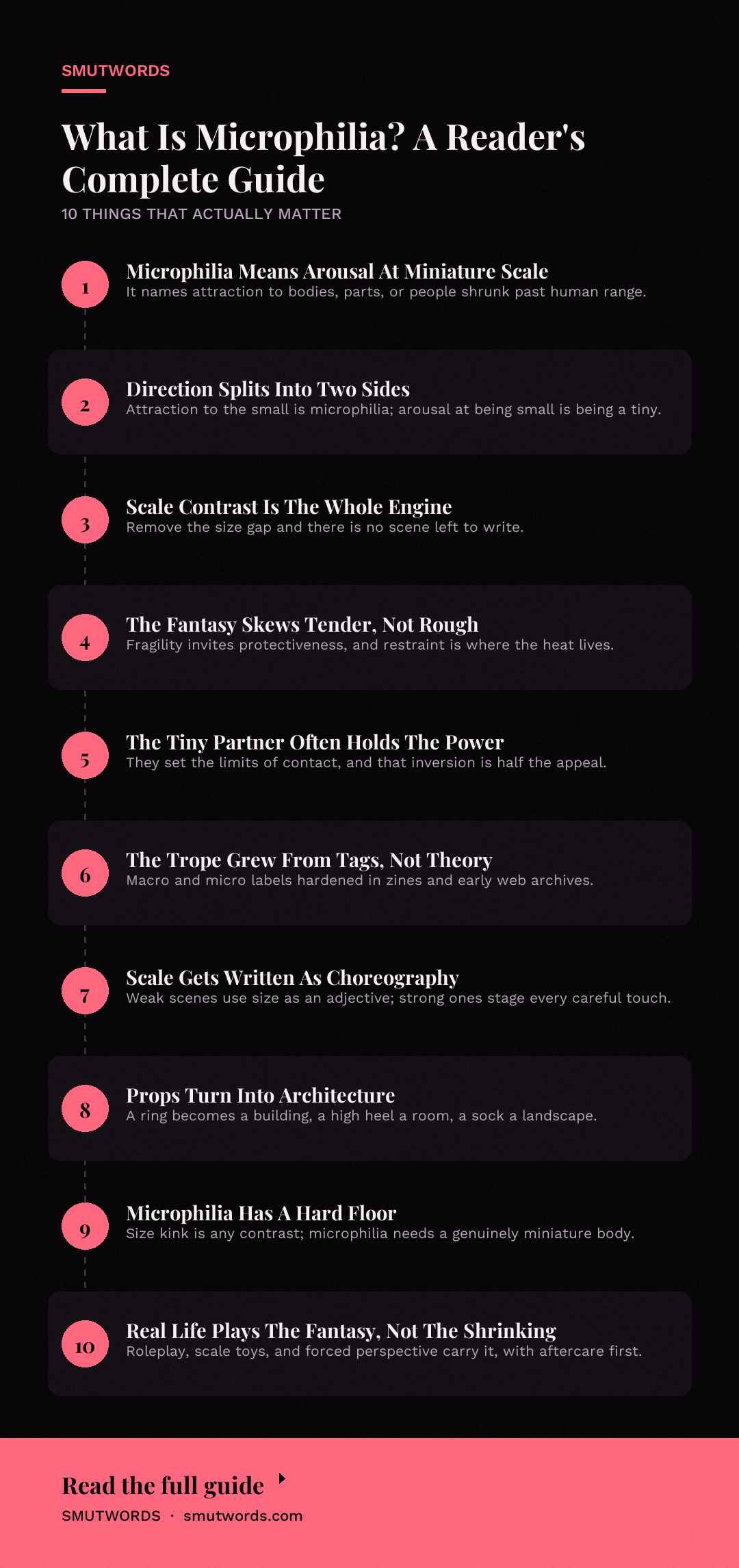
Microphilia is a fetish in which someone gets off on bodies, body parts, or whole people rendered at a miniature scale, or on the fantasy of being shrunk down to that scale themselves. In romance and erotica it lives almost entirely in fantasy and sci-fi settings, where a partner the size of a thumb becomes the entire source of tension, heat, and power exchange.
The appeal sits in extreme size contrast: a tiny lover held in a palm, sheltered under a shirt, or overwhelmed by a body that dwarfs them completely. A few inches of difference is the whole engine. Take it away and there's nothing left to write about.
If you have searched for microphilia and landed on three-line definitions that just say "small people, sexy," this is the long answer. It covers what the term means, where the trope came from in publishing, how authors actually build a scene around it, and where the line sits between microphilia and the broader size-difference shelf it gets shelved beside.
What Microphilia Actually Means
The word breaks cleanly: micro, small, and -philia, the Greek-rooted suffix used across sexology for a strong erotic attachment. Microphilia names arousal tied to miniaturization. That can mean a partner who is inches tall, a hand or mouth scaled down, or the reader's own imagined self shrinking into someone else's grip.
The distinction that matters most is direction. Microphilia describes attraction to the small. The mirror experience, arousal at being the small one, is often called being a tiny, or in community shorthand, a micro. Plenty of readers enjoy both sides.
Novels almost always pick one and build the point of view around it. The fantasy reads very differently depending on whose body is the size of a doll.
What counts as microphilia
Four elements show up in nearly every genuine example:
- Scale contrast as the erotic engine. The size gap is doing the work. Remove it and the scene collapses.
- Vulnerability held inside safety. The tiny partner is fragile, and the giant partner is careful. The tension comes from how much care the larger body has to exercise.
- Sensory asymmetry. One partner experiences the other as landscape, texture, warmth, weight. The prose leans hard on that mismatch.
- Negotiated fantasy framing. Even inside fiction, the best microphilia makes the rules of the shrinking explicit, because the reader needs to know what the tiny body can survive.
What doesn't count
A couple with a twelve-inch height difference is not microphilia. Neither is a tall heroine and a shorter hero, however much the cover copy leans on the contrast. Microphilia requires that at least one body be genuinely miniature, scaled down past the range human bodies come in.
It also is not the same as arousal from being dominated, though the two overlap constantly on the page. A six-foot partner pinning someone to a mattress is power exchange. A six-inch partner doing it is microphilia, because the physics of the scene have changed entirely.
Common misconceptions
The biggest one is that microphilia is always rough or violent. In erotica it skews tender far more often than readers expect. Fragility invites protectiveness, and a lot of microphilia romance is essentially about a giant partner trying very hard not to hurt someone they desperately want to touch.
Another misconception is that microphilia means the tiny partner has no agency. The best-written micro stories give the tiny character all the negotiating power, because they are the one deciding what the giant body is allowed to do. That inversion is half the appeal.
Where Microphilia Comes From
Microphilia as a named fetish is recent. The term circulates in size-fetish communities and on tagging sites rather than in academic sexology, and it shows up in erotica metadata and reader forums long before it shows up anywhere else. The fantasy itself is much older than the word.
Miniaturization as a story device runs through nineteenth- and twentieth-century speculative fiction: shrunken explorers, tiny civilizations, people reduced and set adrift in an ordinary room. Those stories were not erotic. They were adventure and satire, and they established the visual language that erotica later borrowed wholesale: the carpet as a forest, a teacup as a lake, a human hand as a wall.
Erotic publishing picked that language up in the zine era and then on early web archives, where a handful of tagging conventions hardened into a genre. Writers started distinguishing macro, giant characters, from micro, tiny ones, and the slash pairing macro/micro became a shelf label. That is where microphilia as a search term really comes from. It grew as a publishing and tagging phenomenon before anyone wrote a clean definition of it.
The shift over the last decade is tonal. Early micro fiction was frequently comic or body-horror-adjacent, obsessed with the logistics of being small. Contemporary romance and erotic romance use the same scale gap to write intimacy.
The shrinking is a device for forcing proximity, and the heat comes from how carefully two mismatched bodies have to negotiate each other. Size-fetish readers now expect emotional stakes and aftercare beats, and authors who skip them get reviewed accordingly.
How It Shows Up in Erotica
Read enough of these books and the mechanics stop being mysterious. Microphilia lives or dies on sensory specificity. A scene where the tiny partner is "so small and delicate" is dead on the page. A scene where the tiny partner is standing on a collar bone the width of a road, feeling the pulse under it through bare feet, is alive.
That's the standard, and it's strict. The writers who make this trope work commit to the physical mismatch and describe it from inside one body. Nothing about the scene gets to stay abstract.
The anatomy of a strong microphilia scene
First comes the scale-establishing beat. Good authors spend a paragraph on something mundane that has suddenly become enormous: a pillow seam, a ring, a page of a book. This calibrates the reader before any sex happens, and it lets the heat land on solid physical ground.
Enjoyed this? Get a free book.
Join the list and we will send a complete free story straight to your inbox, plus new releases every week after that. No credit card, no catch.
Next comes the touch problem. A giant hand cannot simply grab. It has to decide where to put fingers, how much pressure a thumb can apply, whether a partner can even be held without risk. That deliberation is where the erotic charge concentrates, because every careful touch reads as restrained desire.
Then the sensation sentence. What does the tiny partner feel, temperature and texture and weight, and what does the giant partner feel in return? The best microphilia writing keeps cutting back and forth between the two points of view at the moment of contact. The gap between what the big body feels and what the small body experiences is the scene.
Common variations authors use
- Shrinking in progress. A character reduces gradually, which lets the author write the transition as its own erotic beat. This overlaps heavily with the transformation fetish, since the shrinking body is a body changing.
- Fixed tiny partner. A fae, a homunculus, a miniature alien. The size is stable and the plot turns on living at that scale.
- Temporary reduction. Shrunk for an hour, for a night, for the length of a spell. The clock does a lot of work, because both partners know the size gap will end.
- Pet-scale domesticity. The heat comes from a tiny partner living inside a giant one's space: sleeping in a drawer, riding in a pocket. There is overlap with soft pet-play dynamics here, and readers who like that register often read kitten play alongside it.
- Body-part focus. The tiny character is positioned on a specific region of the larger body, and the scene becomes about that region. Once you are writing about a partner standing on a foot, the foot fetish shelf is one aisle over.
What separates a flat scene from a hot one
Weak microphilia writes scale as an adjective. Strong microphilia writes scale as choreography. If the tiny partner could be swapped for a regular-sized partner without rewriting a sentence, the scene was never actually about size.
The other failure is ignoring the practical realities the fantasy creates. A micro scene that never mentions a barrier, a risk, or a negotiation reads as lazy, because the fragility is the entire point. Readers who love this trope are there for the tension between wanting to hold someone and knowing they could break. Skip that and the heat drains out.
One craft note specific to this trope: erotica loves props, and microphilia gives them unusually heavy lift. A ring becomes architecture. A high heel becomes a room.
Fabric does enormous work too, since a sock or a stocking is a landscape at this scale, and writers with a textile fixation get to lean fully into it, the same instinct that drives the nylon fetish shelf. Even fluids read differently, which connects microphilia scenes to the wet and messy fetish register more often than readers expect.
Microphilia vs Size Kink
These two get confused constantly, and the confusion is fair because the reader overlap is large. Size difference, or size kink, is the broader category: arousal from any meaningful scale contrast between partners. That includes tall and short, muscular and slight, and it covers muscle worship dynamics where one body is simply huge next to another.
Microphilia is a subset with a hard floor. The smaller partner has to actually be miniature, not just smaller.
A seven-foot hero and a five-foot heroine is size kink. A hero holding his lover in one hand is microphilia. Giantess content is the mirror subset on the other end, where the pleasure is in encountering someone enormous.
Worth knowing if you are sorting titles: female-led microphilia is often tagged giantess, while male smallness is usually tagged micro or shrinking. The tag tells you where the power sits, not just who is tall.
Frequently Asked Questions
Is microphilia a real fetish or just a fantasy?
Both, depending on who you ask. Readers of microphilia erotica are fantasizing, and that fantasy is genuine. Some people also practice size fantasy in roleplay or through sensory props, and for them the fetish is part of their real erotic life, entirely separate from the shrinking itself, which is impossible.
What is the difference between microphilia and macrophilia?
Macrophilia is arousal toward enormous bodies and giants; microphilia is arousal toward miniature bodies and tinies. They are mirror images, and the community tag macro/micro covers both ends. Many readers enjoy both directions and do not think of them as separate kinks.
Is microphilia always about domination?
No. A lot of microphilia romance is tender rather than dominant, built around a giant partner's restraint and protectiveness. Power exchange does show up often, but the tiny partner frequently holds the negotiating power in well-written scenes, since they set the limits of contact.
Can microphilia be practiced safely in real life?
The shrinking cannot, but the fantasy can. Couples commonly play with scale through roleplay, scale toys, forced-perspective photography, and sensory deprivation that mimics being small. Plain conversation about what is fantasy and what is off limits comes first, and aftercare matters when a scene touches on vulnerability or power imbalance.
Where can I find microphilia books?
Search the size-fetish tags on erotic retailers, or filter romance catalogs by "size difference" and then check whether the blurb specifies miniature scale. Giantess and shrinking anthologies are the most reliable entry points, and our ranked list below covers the strongest titles available.
Why do readers like microphilia so much?
It combines extreme size contrast with intimacy: a tiny partner becomes intensely held, sheltered, and overwhelmed at once. That combination scratches the same itch as giantess and size-difference reading, but at a smaller, closer register, where every point of contact matters.
Final Thoughts
Microphilia rewards readers who want scale to mean something. The trope is at its best when the size gap forces both partners to negotiate every touch, and the strongest books on the shelf take the fragility seriously and then go somewhere tender with it.
Start with a title where the shrinking is explicit in the blurb and the reviews mention care and restraint. That combination is the reliable signal. The ranked list below the article has the recommendations, sorted for exactly this.




Loading comments…