
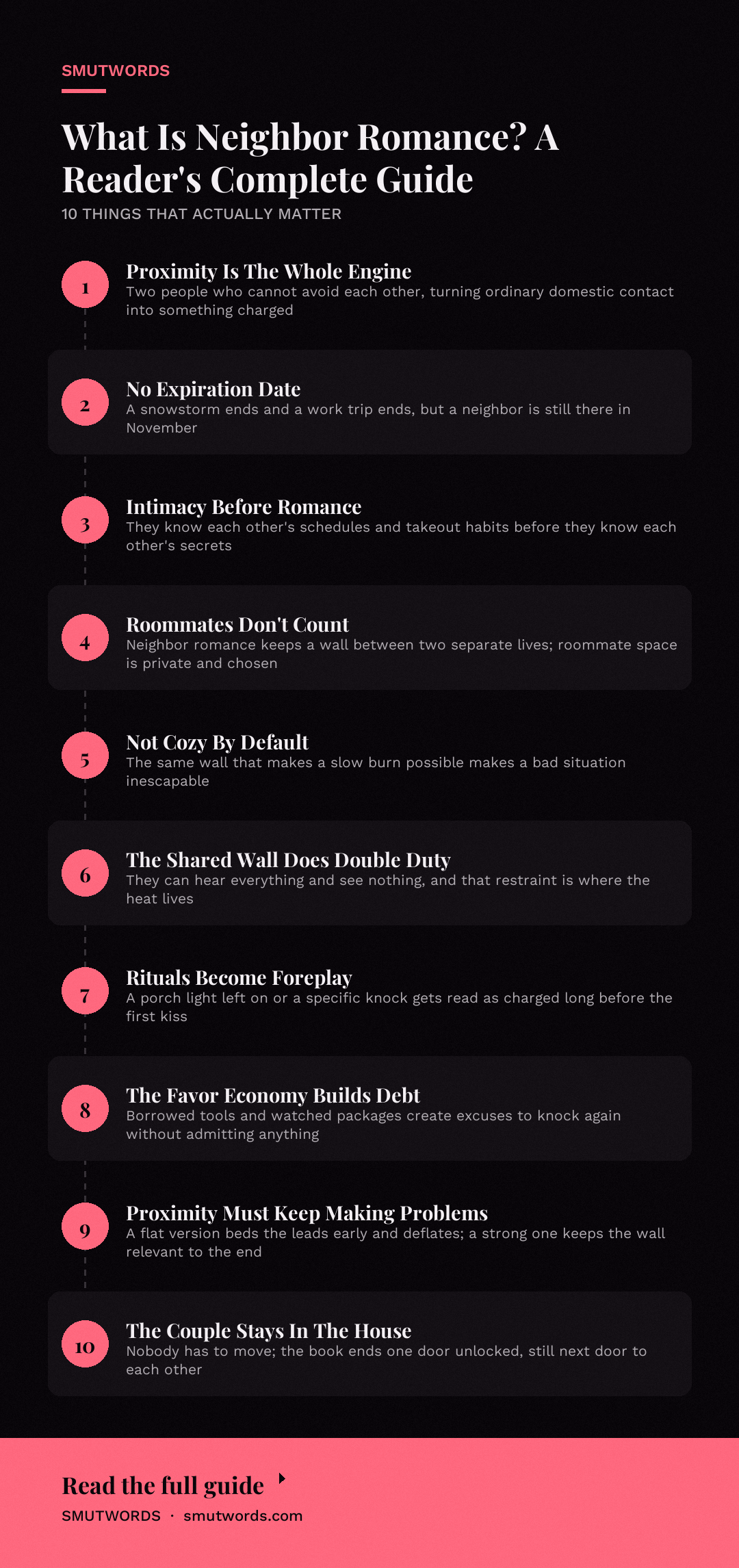
Neighbor romance is the subgenre where the love interest lives close enough to hear through the wall, borrow a ladder, or catch you hauling groceries up the steps in your worst sweatpants. The whole engine of it is proximity: two people who cannot avoid each other, whose bathrooms share plumbing and whose mail gets swapped by mistake, slowly turning ordinary domestic contact into something charged.
It is the romance of the driveway wave that starts meaning more than a driveway wave. If you have ever read a book where the hero is the guy in 4B and the tension comes from how many times the heroine has to see him before she cracks, you already know the shape of it.
What makes neighbor romance distinct from every other forced-proximity setup is that there is no expiration date. A snowstorm traps people for a weekend. A work trip ends. A neighbor is there in March and still there in November, mowing the same lawn, and that permanence is the entire point.
The genre runs on the slow accretion of small moments until the accumulated weight becomes impossible to ignore.
What Neighbor Romance Actually Means
The term describes a romance where the central relationship grows out of residential proximity. The characters live next door, across the hall, in the same duplex, or on the same cul-de-sac, and the plot is built on the friction and intimacy of that arrangement. The name is literal. It is not a metaphor for anything.
The expanded definition matters because readers and writers both blur the edges. Neighbor romance requires that the physical closeness be ongoing and domestic. A one-time meet-cute at a building's mailroom that launches a relationship across town is not neighbor romance, it is a meet-cute. The neighbor has to stay a neighbor long enough for the proximity to do narrative work.
What counts:
- Characters whose homes share a wall, a yard line, a hallway, or a street, and who interact repeatedly because of it.
- A relationship that develops through small, ordinary encounters: borrowed tools, package mix-ups, shared fences, noise complaints, dog walks at the same hour.
- Domestic intimacy that arrives before romantic intimacy. They know each other's schedules, cars, and takeout habits before they know each other's secrets.
What does not count:
- Coworkers or roommates. Roommate romance is a close cousin but the shared space is private and chosen; neighbor romance keeps a wall between two separate lives.
- Small-town romance where everyone is technically a neighbor. If proximity is not the specific engine driving the two leads together, the label does not fit.
- Enemies-to-lovers where the leads happen to live near each other but the conflict is professional. The neighbor element has to carry weight.
The most common misconception is that neighbor romance is low-stakes or cozy by default. Plenty of it is warm and funny. But the same setup supports obsession, grudges, and long-simmering resentment, because a neighbor you cannot stand is a neighbor you cannot escape. The wall that makes the slow burn possible also makes a bad situation inescapable, and skilled authors use both sides of that.
Where Neighbor Romance Comes From
The trope has deep roots in the romance publishing tradition, though it rarely gets its own shelf label the way soldier romance or gothic romance does. Instead it operates as a structural device that shows up across categories.
The Victorian novel loved a neighboring estate as a way to put eligible people in each other's orbit without impropriety. The marriage-plot comedies of manners ran on the fact that the only acceptable people to fall for were the ones close enough to visit.
In twentieth-century category romance, the neighbor became a staple of the contemporary line. The 1980s and 1990s paperbacks leaned hard on the divorced-and-starting-over heroine whose new apartment came with a suspiciously attractive man next door. The setup let authors deliver instant proximity without the complication of a workplace hierarchy, which publishers found easy to sell and readers found easy to believe.
The bigger shift came with the indie ebook boom. Self-published contemporary romance turned neighbor setups into a full subgenre with its own cover conventions (a house, a fence, a shirtless man leaning on a porch rail) and its own reader expectations. The single-dad-next-door and the grumpy-recluse-next-door became recognizable types, almost like archetypes in a shared universe.
The most recent evolution is the emergence of "forced proximity by shared wall" as a selling point in its own right. Authors now advertise thin walls, overheard phone calls, and midnight noise complaints in the blurb. What used to be a quiet convenience has become the headline hook. The trope stopped being background and became the product.
How It Shows Up in Erotica
On the page, neighbor romance is a machine for generating charged small moments. The craft question is always the same: how does an ordinary domestic interaction get loaded with meaning? A good neighbor romance makes a borrowed egg feel like a proposition and a wave across the fence feel like a confession.
The strongest versions build a private language between the two characters before anything physical happens. They develop rituals.
The trash goes out at the same time. One leaves the porch light on. There is a specific knock.
By the time the first kiss lands, the reader has been conditioned to read every one of those rituals as foreplay, and the author can cash in on that conditioning.
Common variations and how each one does its work:
- The shared wall. Sound becomes the erotic engine. Overheard showers, muffled arguments, a bed frame against the same studs. The wall is a barrier and a conduit at once, and the restraint it enforces (they can hear everything and see nothing) is the whole appeal.
- The favor economy. Borrowed tools, fed cats, watched packages. Each favor creates an obligation and an excuse to knock again. Authors use the exchange of small debts to build a relationship that neither character has to admit they are building.
- The FWB next door. An arrangement with built-in convenience and a built-in disaster: the person you are sleeping with lives six feet away. No contact can survive the friction that follows, and the author's job is making the collapse feel inevitable and hot rather than stupid.
- Childhood neighbors reuniting. The history does the work of ten slow-burn chapters in one scene. A shared childhood creates instant intimacy that the adult characters have to renegotiate, and the tension sits in the gap between who they were and who they are now.
- The single-parent neighbor. Domesticity goes from subtext to text. The love interest folds into an existing family life before anyone calls it romance, and the heat comes from how natural it all feels and how much that frightens the person who has been burned before.
What separates a strong neighbor romance from a flat one is whether the proximity keeps generating new problems. A flat version uses the neighbor setup to get the leads into bed early and then puts them in a normal relationship, which deflates the premise. A strong version keeps the wall relevant to the very last page.
That might mean a fight about a parking spot that is really a fight about commitment. It might mean a character whose obsessive ex lives close enough to make the neighbor's proximity a liability. It might mean a stalker's willingness to watch a window turn the shared yard into a source of dread rather than desire, a move that borrows the menace of stalker romance while keeping the two leads essentially decent.
Enjoyed this? Get a free book.
Join the list and we will send a complete free story straight to your inbox, plus new releases every week after that. No credit card, no catch.
Craft-wise, the single most important tool in neighbor romance is the pacing of small revelations. The reader should learn the neighbor the way the protagonist does, one detail at a time, through observation rather than conversation.
The way he handles a bad day. The music that comes through the floor at odd hours. The fact that she locks the door twice before bed. These details build the erotic charge because they are intimate without being romantic, and intimacy before romance is the trope's signature.
Authors also lean on sensory texture more than they would in a broader-set romance. The smell of a neighbor's cooking. The specific sound of footsteps on stairs. The sight of a bare shoulder through a window at night.
When you can only see a slice of a person, every visible slice gets charged. The character cannot touch, so she notices, and the reader notices with her.
This narrowed attention is why neighbor romance pairs well with fetish-forward detail, the way a single visual obsession can carry a whole book. A neighbor who only ever sees one specific thing about the person next door can build an entire private fixation on it.
Another reliable move is the misunderstanding that the proximity makes unavoidable. Characters who can usually walk away from a misstep cannot walk away from the person they will see at the mailbox tomorrow. The forced follow-up, the awkward morning after, the apology that has to be delivered in person because there is nowhere else to deliver it: all of these exist because of the wall. Good authors treat the inability to avoid someone as a gift and a threat.
Finally, the trope rewards a certain kind of ending that other romances find harder to earn. The couple stays in the house. Nobody has to move. The neighbor romance can end with two people still next door to each other, just with one more door unlocked.
That domestic resolution lands because the book has spent hundreds of pages convincing the reader that this particular porch, this particular fence, this particular view out the kitchen window is where the love story lives.
Neighbor Romance vs Rockstar Romance
These two get confused more than you would think, mostly because both rely on the tension between public and private lives. Rockstar romance puts its leads in proximity through touring, backstage access, or the shared orbit of celebrity, and the appeal is that the person everyone sees is only really visible to the heroine.
Neighbor romance inverts that. The neighbor is not famous, everything about him is visible, and the challenge is that visibility is not the same as knowledge.
The practical difference is what the proximity does to the plot. A rockstar's absence is a plot engine, and the reunion after the tour is a big beat. A neighbor's absence is a crisis, because the whole premise is that he is not supposed to go anywhere.
If you like the idea of a famous person who only the heroine truly knows, you want rockstar romance. If you want the slow saturation of routine intimacy with someone whose car you can recognize from the kitchen, you want this. For the other half of that equation, the starting-over-after-divorce flavor the trope grew up on, the divorced-and-dating guide covers the ground.
Frequently Asked Questions
What makes neighbor romance different from forced proximity?
Forced proximity is a broader device that can trap characters anywhere, from an elevator to a snowbound cabin. Neighbor romance is a specific, ongoing version: the proximity has no timer on it, and it is tied to home. The characters are not trapped together by an event. They simply live next to each other, indefinitely, and the romance has to grow out of that permanence.
Is neighbor romance always a slow burn?
Most are, because the setup rewards gradual escalation through small moments, but it is not required. A neighbor romance can move fast if the characters already have history or if the conflict is what keeps them apart rather than timing. The slower versions dominate because the trope's appeal is the accumulation of ordinary contact into desire.
Why do readers like the shared-wall setup so much?
Because the wall creates a constant low-grade erotic friction. The characters hear each other and cannot see each other, which means imagination does the work. There is also the restraint of it: they have to live with the sounds and the fantasies and the knowing without necessarily doing anything about it. That restraint is where the heat lives.
Can neighbor romance work in a small town or does it need a city apartment?
Both work, but they produce different books. An apartment building gives you density, thin walls, and neighborly anonymity, which suits overheard-sound plots. A small town or a suburb gives you yards, driveways, and community gossip, which suits single-parent and long-history plots. Choose the setting based on which source of tension you want to run.
What is FWB next door as a variant?
It is a neighbor romance where the two leads start a no-strings sexual arrangement while remaining neighbors. The variant is popular because it doubles the danger: the arrangement is reckless anyway, and the neighbor proximity means the fallout cannot be avoided. Authors typically use it to drive a messy midpoint crisis that forces both characters to admit the arrangement stopped being casual.
Do neighbor romances usually include an age gap or is that a separate trope?
Age gap is a separate trope that authors often layer on, especially in single-parent and older-neighbor variants. The proximity intensifies an age gap because the characters can observe each other's lives in detail and the mismatch shows up in everyday routines, not just declarations. If the book is marketed as neighbor romance, expect the age gap to be a subplot rather than the headline.
Final Thoughts
Neighbor romance is the trope for readers who think the most erotic thing in the world is a person you cannot stop seeing. The genre works because it turns the smallest domestic details into a slow-burning argument for why two people belong together, and the best versions keep the wall doing its work all the way to the last chapter.
If you want to see the trope pushed into trickier territory, look for the books that let a neighbor's closeness slip from comfort into obsession. The wall does not go anywhere. That is the point.





Loading comments…