
Divorced and dating romance is exactly what it sounds like: one or both leads have a marriage behind them that ended, and the story follows them back into the dating pool with all the scar tissue, custody schedules, and hard-won self-knowledge that entails. It is a trope about adults who already know how love can go wrong, meeting someone new anyway.
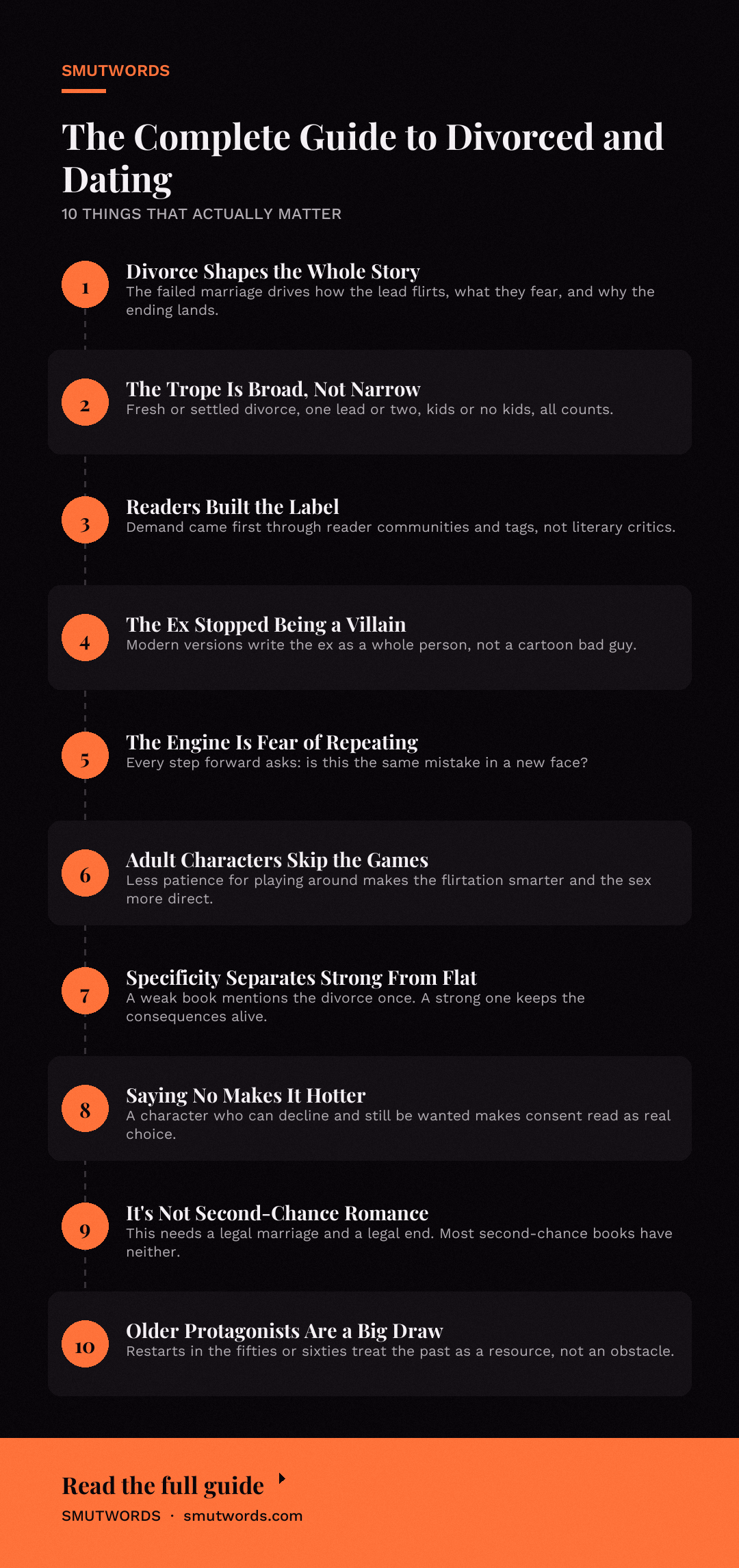
The divorce is never just backstory filler. It shapes how the character flirts, what they fear, and why the eventual happiness lands with real weight.
This is one of the fastest-growing corners of contemporary romance, and for good reason. Readers who have been through it themselves find a version of their own life on the page. Readers who haven't get the emotional payoff without the paperwork. Either way, divorced and dating stories deliver something rarer than insta-love: proof that a person can be wrecked and still be worth choosing.
What Divorced and Dating Actually Means
The label describes a character situation, not a plot engine. The protagonists are typically in their thirties, forties, or older, though a young divorce happens too. At least one of them carries the specific residue of a failed marriage: a legal decree, a shared mortgage being untangled, kids who split their week between two homes, or a set of habits built around a partner who is no longer there.
What counts as divorced and dating is broader than people assume. The divorce can be fresh (weeks old) or settled (years past). The story can focus on one divorced lead or two, and the pairing matters. A divorced heroine with a never-married hero hits differently than two people comparing custody calendars over dinner.
What does not count: a widowed character, a character who simply had a long-term breakup, or a marriage-of-convenience plot where the divorce is the goal rather than the starting wound. Those are adjacent, and the widowed version especially shares DNA, but the specific texture of divorced and dating comes from a relationship that was chosen, legally formalized, and then failed.
The name itself is plain because the trope is plain. It entered romance vocabulary through reader communities and publisher category tags, not through literary criticism. It describes a recognizable scenario rather than a formal genre, which is why you'll see books shelved as "divorced and dating" alongside "second chance" and "single parent" without any strict line between them.
One common misconception: readers assume these books are downbeat or full of ex-spouse drama. Most aren't. The divorce is the setup. The subject is the new relationship and what the protagonist has learned to do differently.
Where Divorced and Dating Comes From
The trope as a recognized publishing category is recent, but its ingredients are old. Mid-century category romance rarely featured divorced heroines; the genre's market conventions of the 1970s and 1980s treated divorce as tragedy or scandal. By the 1990s, with rising divorce rates and a generation of readers who had lived through it, contemporary romance began to make room for heroines who were already married once.
The real shift happened in the 2000s and 2010s. Indie publishing and digital-first imprints let authors write older protagonists without a traditional publisher worrying about whether the reader would "relate." Reader communities on Goodreads and BookTok then made the trope visible by name, tagging books explicitly as divorced and dating and trading recommendations around it.
That publishing-side history matters more than real-world sociology here. Divorced and dating became a searchable label because readers wanted to find more of it, not because critics defined it. The demand came first; the taxonomy followed.
The evolution shows in how the ex-spouse is written. Early versions often made the ex a villain, a cartoon bad guy to be defeated. Modern versions treat the ex as a whole person, sometimes a co-parent, sometimes a friend, sometimes simply someone who didn't work out.
The protagonist's growth is the point now. The ex's comeuppance isn't.
Another shift: the trope has moved upmarket. What used to be category-length fluff now appears in full-length novels with serious emotional stakes, and male divorced leads have gone from rare to common. The divorced dad is now as much a fixture as the starting-over heroine.
How It Shows Up in Erotica
On the page, divorced and dating scenes run on competence and honesty. These characters have less patience for games, which makes the flirtation smarter and the sex more direct. A divorced heroine knows what she likes and isn't shy about saying so. A divorced hero has learned where his previous relationship broke and is careful about the same fault lines.
The emotional engine is fear of repetition. Every significant step forward carries a silent question: is this the same mistake in a new face? Writers use that tension to give the sex extra charge. The first time becomes a risk, not a formality, and the reader feels the character choosing to trust again in real time.
Here are the variations that show up most often:
- The co-parenting pairing. Two single parents, often with kids who clash, whose relationship is squeezed into school plays, custody handoffs, and stolen weekends. The obstacles are logistics and guilt as much as feeling.
- The rebound that isn't. The story opens with a character insisting this is casual and temporary, and the arc is the slow collapse of that insistence. This is the most common shape of the trope.
- The late-in-life restart. Protagonists in their fifties or later, sometimes after a decades-long marriage. The erotic focus shifts to rediscovery and the still-authorized version of oneself.
- The ex-returns complication. The former spouse reappears with a claim, a question, or a craving, forcing the lead to articulate what they actually want now.
- The two divorcés colliding. Both leads carry damage, and the story is two people teaching each other by comparison, often with a spectacular, mutual, hard-won tenderness at the end.
What separates a strong version from a flat one is specificity. A weak divorced and dating book mentions the divorce in chapter one and never again. A strong one keeps the consequences alive: the character flinches at a certain tone, panics at a particular piece of paperwork, or has a custody weekend that ruins a date and reveals the relationship's real priorities.
The flat version also makes the ex a pure obstacle. The strong version gives the ex a history and a reason, and lets the protagonist hold mixed feelings about them. Friction you can argue with is sexier than a villain you can hate.
Enjoyed this? Get a free book.
Join the list and we will send a complete free story straight to your inbox, plus new releases every week after that. No credit card, no catch.
There is a craft move that the best books in this trope use constantly: the protagonist says no. A divorced character who can decline sex or intimacy and still be wanted by the narrative is far more believable than one who is dragged along by attraction. When a character has already left one bad relationship, their consent to a new one reads as an active choice.
Authors who write this trope well also let the new partner be interested in the whole person, ex-spouse history included. The scene where a love interest asks, without judgment, how the marriage ended and actually listens is often the most seductive scene in the book. It's a version of emotional foreplay that only this trope can pull off.
Readers drawn to the adult, negotiated quality of these books often find the same appeal in other corners of the catalog. A guide to finding your D/s role explores the same currency of self-knowledge and honest conversation, and massage roleplay shares the trope's focus on consent and deliberate touch.
The starting-over stakes also show up in childhood friends to lovers, where a familiar face gives a divorced protagonist a safe place to land, and in lumberjack romance, which frequently pairs a big-city divorce with a rugged, small-town reset. Setting itself can carry this weight; our piece on cabin versus big-city settings gets into why a woman who has just rebuilt her life often needs a literal change of scenery on the page.
Divorced and Dating vs Second-Chance Romance
These two labels get used almost interchangeably, and the confusion is real. Second-chance romance is a broader category: any two people who had a relationship before and are getting another shot, whether as exes, former friends, or high school sweethearts who reunite. Divorced and dating is narrower. It requires a legal marriage and a legal end.
A practical way to split them: all divorced-and-dating stories are structurally second-chance, but most second-chance stories are not divorced-and-dating. A pair of exes who split after college and meet again at a wedding belongs in the second-chance bucket. A pair of exes who signed divorce papers, divided the furniture, and are now reconnecting over shared custody sits in both. Readers searching for the specific divorced texture need the stricter tag.
Related but distinct: single parent romance. The protagonist is a parent, and the other lead must accept a life that includes kids. Divorced and dating overlaps heavily with it, but a never-married single parent doesn't carry the same failed-marriage backstory.
Redemption arc romance is different again: that trope is about a character who did wrong and is earning forgiveness, which can apply to a divorced character but isn't required. When a divorced protagonist has done something genuinely bad, the story usually blends into redemption; when the divorce was mutual, it stays pure divorced and dating.
Frequently Asked Questions
What does "divorced and dating" mean in romance?
It's a trope label for books where one or both main characters are recently divorced and re-entering the dating scene. The story follows them as they navigate the emotional baggage of a failed marriage while pursuing a new relationship, often dealing with co-parenting, trust issues, and the fear of repeating past mistakes.
Is divorced and dating the same as second-chance romance?
No. Second-chance romance covers any reunion between people who were previously involved. Divorced and dating is more specific and requires that a legal marriage took place and ended. Every divorced and dating story is a second chance of sorts, but plenty of second-chance books have no divorce at all.
What's the appeal of divorced and dating books?
Readers come for the emotional depth. The characters have already lived through the worst of a failed marriage and grown from it, which makes the new love story feel earned. There's also a realism to the obstacles: custody schedules, money, and the psychological residue of having been left before.
Do divorced and dating books always involve kids?
No. Many of the strongest books in the trope feature two divorced leads with no children between them, and the drama comes from the ex-spouse, the shared history, or the characters' own internal fears. Co-parenting is a very common variation, not a requirement.
Can divorced and dating stories feature older protagonists?
Frequently, yes, and that's one of the trope's biggest draws. Late-in-life restarts, romances beginning in the fifties or sixties, and stories about rediscovering desire after a decades-long marriage all fall under the divorced and dating umbrella. The older the lead, the more the story leans on the past as a resource rather than an obstacle.
Are the ex-spouses usually villains?
The better written ones are not. Modern divorced and dating fiction tends to treat the ex as a full person: sometimes a co-parent, sometimes a friend, occasionally someone the protagonist still has complicated affection for. The protagonist's growth is the focus, and a cartoonish ex usually reads as lazy writing.
How explicit is the sex in divorced and dating books?
It varies widely. Category romance versions can be closed-door, while contemporary full-length novels frequently have explicit on-the-page sex. The trope itself doesn't dictate heat level. What it does tend to favor is directness: these characters have less patience for games, which usually makes the intimate scenes candid and specific.
Final Thoughts
The best divorced and dating books earn their emotional weight by treating the failed marriage as a teacher rather than a shame. Readers who want the full version of that arc, where a character has to name what went wrong and choose someone new anyway, will find plenty of candidates in the ranked list below.
Start there, and pay attention to the first scene where the protagonist declares they are done with love. It never sticks, and the way it doesn't stick is the whole reason to read these books.





Loading comments…