
Rough sex is sex with the dial turned up: forceful, physically intense, aggressive on purpose, and negotiated. It covers a wide range of acts, from hair pulling and spanking to hard thrusting, pinning, biting, and dirty talk that runs sharp.
In erotica it's one of the most reliable engines a scene can run on, because it converts passion into something a reader can feel in their hands. It's also the kink readers most often misread as simple violence, which is why it earns its own full guide here.
What Rough Sex Actually Means
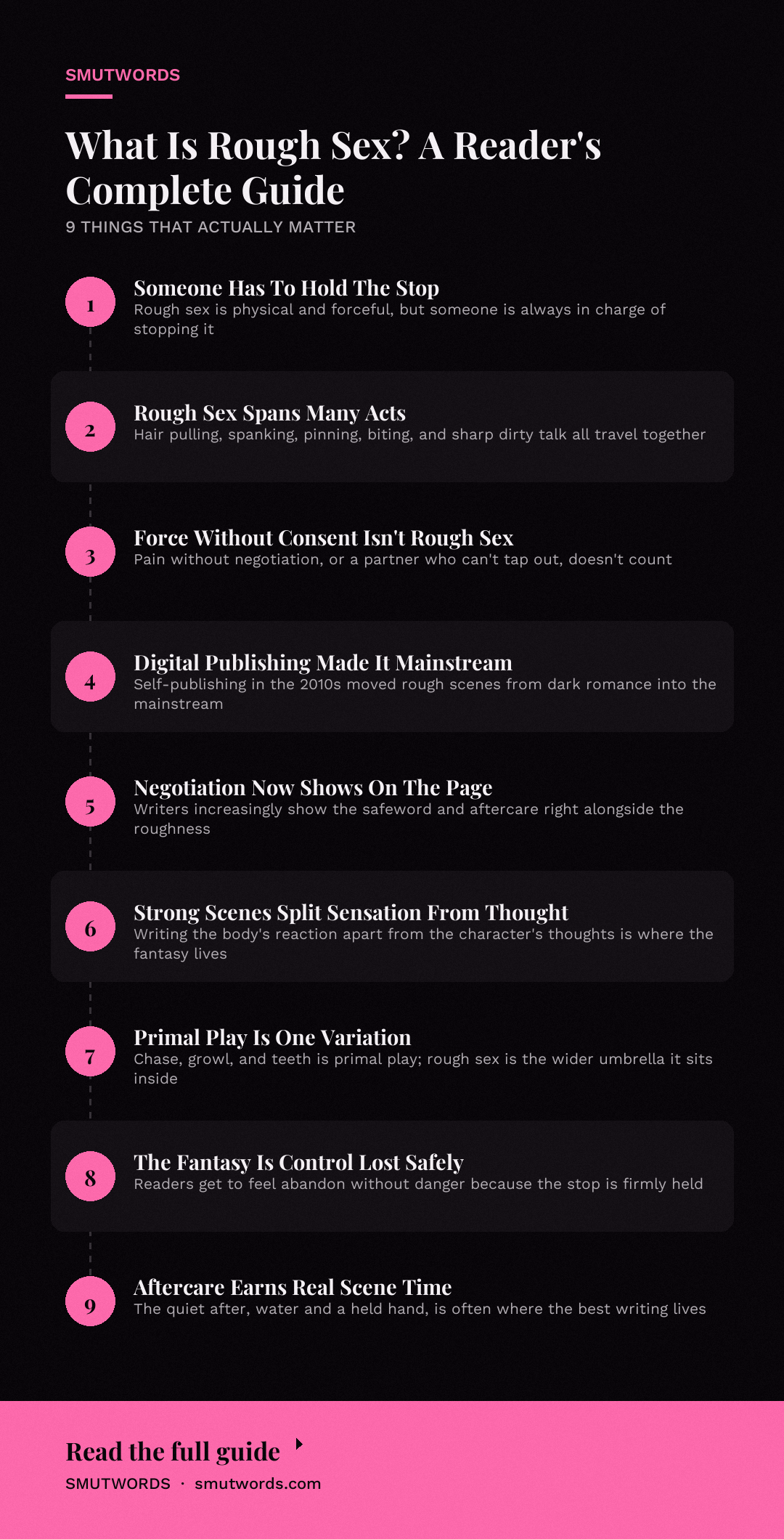
The term itself is blunt and modern. "Rough sex" is a term that writers use to signal a scene will be physical and forceful, with the understanding that it's consensual and that someone is in charge of stopping it. That last part is not a footnote. It's the definition.
In a romance novel, the term sits on the page as an informal umbrella. It can mean hair pulling during oral, a hand at the throat (gently or not), a partner pinned against a wall, spanking that leaves marks, or thrusting hard enough the bed knocks the wall. It can also mean the dirty talk, the order to stay still, the growl near the ear. The physical acts and the verbal ones travel together.
What counts:
- Forceful penetration, hard thrusting, a pace that doesn't let up
- Hair pulling, spanking, biting, scratching, gripping hard enough to bruise
- Pinning, holding a partner down, controlling their movement
- Aggressive dirty talk, orders given in the imperative, threats that are plainly a game
- Restraint in the moment (a belt, hands, a tie) even without formal bondage gear
What doesn't count, in the fiction or out of it:
- Anything a partner didn't agree to beforehand or can't stop
- Pain without negotiated consent, or someone who can't tap out
- A scene where the roughness is framed as punishment the partner didn't ask for
- Roughness used to cover a scene that has no trust behind it
The common misconception is that rough sex means one partner is out of control. In the strongest version, someone is very much in control of the roughness, usually the person on the receiving end as much as the one delivering it. That person holds the stop.
Where Rough Sex Comes From
The phrase as readers know it is a publishing phenomenon before it's a bedroom one. For most of the twentieth century, explicit roughness in print had to be smuggled in. Writers developed a set of codes: a scene that was "animal," a partner who "took" what they wanted, a bedroom that was "savage" rather than tender.
Readers learned to recognize the code. Rough sex as a named kink, with a fan following and its own tropes, is newer.
The big shift came with digital publishing and self-publishing in the 2010s. Romance had a large, self-selecting audience, and rough sex scenes were a reliable signal that a book was for grown readers who wanted heat. Books began marketing themselves on this explicit promise, with covers and blurbs that promised force, dominance, and a partner who didn't ask permission in the story.
That decade is also where the flip happened. Rough scenes moved from the shadows of "dark romance" into mainstream contemporary romance, women's fiction, and even some rom-com territory. A scene that would have been scandalous in 1995 became a selling point in 2015. The readership largely did the demanding, and the industry caught up.
The last five years have hardened the kink's conventions rather than loosened them. Writers are much more likely now to show the negotiation, the safeword, and the aftercare on the page alongside the roughness. That's a real style shift, not a warning label, and it's made the scenes hotter for readers who want both.
How It Shows Up in Erotica
This is the section that earns the guide. If you've read several hundred of these books, you can see the same mechanics at work under the surface, and you can see when a writer skips them and the scene goes flat.
The strong version of a rough sex scene usually does four things on the page: it establishes who is in charge of the stop, it draws a visible line between force and consent, it writes the body's response in detail, and it leaves room for the aftermath.
The flat version skips straight to the impact. A scene that opens with a hand at the throat and never says whose decision that was reads as a threat report. A scene that shows the exchange of power reads as a fantasy.
Most published rough sex scenes run within a small number of recognizable variations.
Enjoyed this? Get a free book.
Join the list and we will send a complete free story straight to your inbox, plus new releases every week after that. No credit card, no catch.
- Primal play. A partner chases, catches, and pins. The roughness is animal, wordless, and fixed on the body. It overlaps with primal play and is the version most likely to appear in a cabin-in-the-woods setting where the characters are alone.
- Impact play. Spanking, paddles, belts, biting that bruises. The sting is the point and the scene pauses between strikes to check in.
- Hard-thrusting wall sex. The mainstay. The character is lifted, pinned, and thrust into with a full display of strength. The partner's arousal is written as involuntary and immediate.
- Hair-pulling and restraint. A hand in the hair, a wrist held behind the back, a partner's body bent over the nearest surface. It shades toward the shibari end of the genre when the restraint gets elaborate.
- Forced seduction. A fictional variation where a character is meant to be convinced. It only works on the page when the consent is unambiguous in the reader's mind: a partner who is plainly willing and has a way out.
- Aggressive dirty talk. A partner ordered to stay still, take it, beg. Sharp language that's negotiated is often the actual hook of the book. Where it drifts into humiliation, it crosses into degradation kink, and the two overlap but don't have to.
- Group roughness. The same force applied by more than one partner. It belongs to the orgy scene in some books and to the why choose romance arrangement in others, and the best writers are careful about who holds the stop.
The craft move that separates a strong scene from a flat one is the split between sensation and narration. Strong writers write the body's reaction (breath, slickness, an involuntary sound) separately from what the character thinks. That gap is where the fantasy lives. The reader knows the force is controlled. The character on the page is allowed to feel it as if it isn't.
Length matters too. A scene that's all impact, no buildup, and no aftermath tends to read as a list of acts. The best versions slow down. A single line in the negotiation ("tell me when") can make a page of intense roughness land.
A practical warning for writers reading this for craft: the rhythm of the prose should follow the scene's intensity. Short sentences for a fast, hard sequence. Longer sentences as it eases. When a scene runs long at full force, the reader's body stops registering it as intense and starts registering it as loud.
Rough Sex vs Primal Play
The two are close enough that readers confuse them, and the overlap is real. The distinction is worth knowing because it changes how a scene gets written.
Primal play is the animal-chase version of roughness: crouching, growling, biting, being hunted and caught. It's often wordless and instinct-driven. Rough sex is the wider umbrella. Primal play is one of its variations, though not all rough sex is primal.
If a scene is all growling, chase, and teeth, it's primal. If a character is held down and ordered to stay while a partner works them over, it's rough sex with a verbal layer. Both are in the same family. Most published rough scenes borrow from both.
Frequently Asked Questions
Is rough sex a kink or just intense sex?
It's a kink when the roughness is the point and the scene is negotiated around it: force, aggression, and power exchange that partners have agreed to in advance. Intense sex can be rough incidentally. The kink version is intentional and organized around a stop word, a top, and aftercare.
What's the difference between rough sex and abuse in fiction?
The difference is consent that exists in the story, not just in the author's head. A rough scene in a good book shows who is in charge of stopping it, gives the receiving partner a visible way out, and gives them pleasure that they want. A scene that hides all of that reads as violence, and readers notice.
Does rough sex in romance require a safeword on the page?
Not always, but the strongest scenes find a way to show an equivalent: a hand signal, a spoken "stop" that means something, a partner checking in with a squeezed hand. The safeword can be implied. The mutual understanding can't be. Scenes that skip it entirely sometimes get away with it, but only when the trust is on the page elsewhere.
Why is rough sex so popular in romance right now?
It delivers the fantasy of losing control without the actual risk. The reader is safe on the couch. A partner who's forceful and aggressive and utterly in charge of the stop gives the reader a way to feel abandon without danger, and that's a very marketable combination.
Can rough sex scenes be written without domination or submission?
Yes. Two switches or two kink-averse characters can push each other around and have an intense, rough scene with no assigned D/s roles. The force is mutual and the control is shared.
It's a less common arrangement in published romance, where the dominant lead is a reliable selling point, but it exists. If you're not sure which role you belong in, the beginner's guide to figuring out if you're dominant, submissive, or switch is a good starting point.
What does aftercare look like in a rough sex scene?
On the page, it's the quiet after: water, a blanket, a hand held, a partner carefully checking the injured shoulder or the spot where a bite broke skin. The best writers give aftercare as much scene time as the intercourse, and it's often where a book's best character writing lives.
Final Thoughts
The reason rough sex keeps outselling gentler kinks is that it's the most legible version of a fantasy readers already have: that being wanted with force is a form of being wanted completely. The strongest books don't shy away from the force. They make it safe by showing who holds the stop, and then they make it terrible in the good way.
If you want to see the whole machine working (the chase, the negotiation, the aftermath), start with the rough sex scenes in the cabin-romance tradition, where the isolation sets up the primal version with less fuss. The cabin-in-the-woods vs big-city-romance guide will tell you which setting suits which flavor of force. Then try a rough sex book from the ranking on this page and see how the author handles the stop. That's the mark of a writer who knows what they're doing.





Loading comments…