
Small town sheriff romance is a love story built around the lawman who runs a community small enough that he knows every truck in every driveway, and the woman who makes him want to break his own rules.
The badge gives him authority, a gun, and a sworn duty; the town gives him a fishbowl. Every look he gives her is witnessed, every night he spends at her place is public knowledge by sunrise, and that pressure cooker of visibility is exactly what the subgenre runs on. If you want the full answer to what this trope is, why it works, and how to tell a great one from a lazy one, this is the page.
What Small Town Sheriff Romance Actually Means
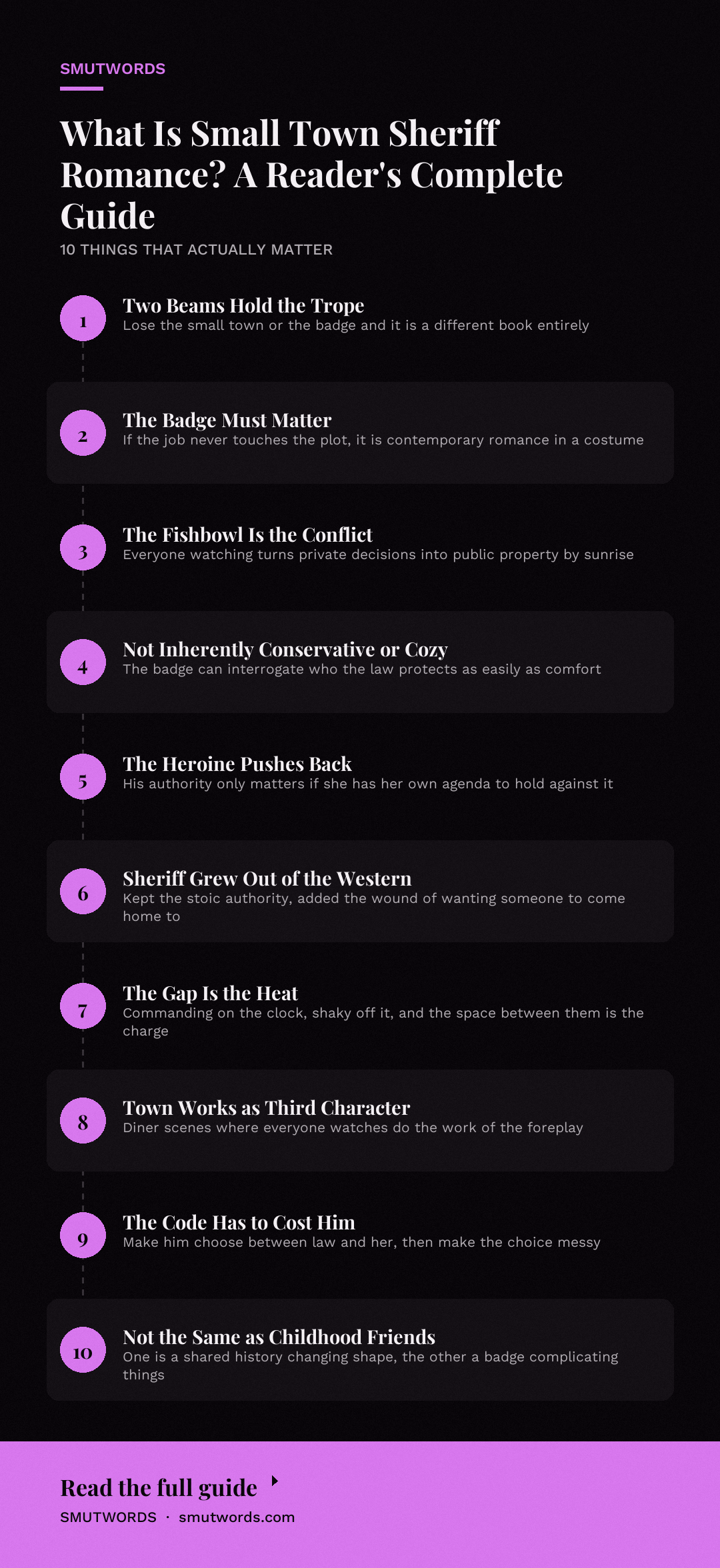
The name tells you the two load-bearing beams: the small town and the sheriff. Remove either and you have a different book. A big-city cop romance has the authority figure but loses the claustrophobia of everyone knowing your business. A small-town romance with a carpenter hero has the community but loses the specific charge of a man whose job is literally to keep order among the people he loves.
So the trope requires a hero whose profession gives him public power and private stakes. He is the person the town calls at 2 a.m. He is also the person who has to arrest the heroine's brother, or look the other way, or choose. The law is not abstract in a town of nine hundred people; it has a first name.
What doesn't count: a hero who happens to be a sheriff but whose job never touches the plot. If the badge is decoration, it's just a contemporary romance with a costume. The strong version makes the job inseparable from the conflict.
The Name and Its Origins
Unlike kink and romance subgenre labels with specific coinages, "small town sheriff romance" is a descriptive reader category, coined by readers and publishing marketers rather than a single author. It sits inside the broader small-town romance boom and pulls the lawman archetype from Westerns, where the sheriff was the lone moral center holding back chaos.
Romance inherited that figure and softened him. The Western sheriff was stoic and alone; the romance sheriff is stoic and secretly starving for someone to come home to. The genre kept the authority and added the wound.
Common Misconceptions
The biggest one is that this trope is inherently conservative or nostalgic. Plenty of small town sheriff romances are quietly subversive, using the sheriff's conflicted position to interrogate who the law actually protects. The badge can be a critique as easily as a comfort.
The second misconception is that the hero is the main event. The strongest books in this category give the heroine her own agency and agenda; the sheriff's authority only matters if she pushes against it. A sheriff with nothing to push against is a paper doll in a hat.
Third: readers assume "small town" means cozy and low-conflict. The fishbowl is the conflict. Everyone watching means every private decision becomes public property, and that friction is the engine.
Where Small Town Sheriff Romance Comes From
The lawman hero has lived in American popular fiction since the dime novels, where the marshal was the man who stood between the town and the outlaws. That figure carried into Western romance and then migrated into contemporary settings as the frontier closed and the small town replaced the open range.
As a publishing category, small town sheriff romance crystallized alongside the broader small-town romance surge of the 2000s and 2010s, when series like the rancher-and-bartender books proved readers wanted a whole community to revisit across multiple titles. Publishers noticed the sheriff was the most requested supporting character to promote to hero, because he already appeared in every book as the guy who showed up after the trouble.
What changed over time is the sheriff himself. Early versions were stoic authority figures whose main function was to protect the heroine. Contemporary versions are more emotionally exposed: the single dad sheriff, the grumpy sheriff with a dead marriage behind him, the returning veteran who took the job because he needed roots.
The 2010s also brought a wave of heroines who were not damsels. The sheriff's love interest is now frequently the town doctor, the returning prodigal daughter, the new deputy who outranks him in competence. Publishers tracked the shift because readers kept asking for lawmen who could be challenged, not just obeyed. There is a real appetite for heroines who make the badge earn its keep.
The Slow-Burn Influence
The subgenre's emotional pacing owes a debt to slow-burn romance, where the tension lives in restraint. A sheriff who is publicly careful and privately undone is a slow-burn machine. The town watches, so he can't touch her the way he wants, and that withholding is the heat.
How It Shows Up in Erotica
On the page, the craft challenge of a small town sheriff romance is making the badge mean something in the bedroom and the interrogation room at once. The sheriff is an expert at control in his professional life and often a disaster at it personally, and the erotic charge comes from that gap.
Authors use the job to stage power. He can be commanding on the clock and shaky off it. He can use his voice, his stillness, his habit of asking questions rather than answering them. A scene where he tells her what to do in a way that mirrors how he runs a traffic stop is far more charged than a generic dominant moment, because it is specific to him.
Common variations authors reach for:
Enjoyed this? Get a free book.
Join the list and we will send a complete free story straight to your inbox, plus new releases every week after that. No credit card, no catch.
- Grumpy sheriff: the man who hates the town gossip mill and is therefore miserable about wanting her in public.
- Single dad sheriff: the badge plus bedtime stories, which doubles the stakes and the vulnerability.
- Outsider turned sheriff: a man who came from somewhere else and has to earn the town's trust while falling for the one woman who won't hand it over.
- Enemies to lovers with a deputy: the rival who outranks or challenges him, and whose authority conflicts with his own.
- Childhood sweethearts return: the girl who got out and came back, and the boy who stayed and now wears the star.
- Forced proximity in a snowed-in town: a storm, a blackout, a single working furnace, and a town that assumes they are already together.
The strongest versions make the town a third character. The gossip is a plot device. The diner scene where everyone watches them is a scene of real erotic tension, because the fact of being seen is doing the work of the foreplay. A flat version keeps the town as wallpaper and lets the sex scenes happen in a vacuum where nobody would ever find out.
Another craft marker: the sheriff's moral code gets tested in a way that costs him something. A good small town sheriff romance makes him choose between the law and the woman, or between the town's expectations and her needs, and then makes the choice messy. Readers remember the book that made a lawman break a rule for love.
Authors who want to escalate the pressure often borrow from power exchange, using the sheriff's day job as the vocabulary for bedroom dynamics. The trust required to surrender to a man whose literal profession is enforcing rules becomes the emotional core.
For the grumpy hero specifically, the antagonism has to have a reason. The writers who get it right make the hostility a defense, and the thaw earned. There is a useful distinction here between grumpy and outright hostile that the SmutWords breakdown of grumpy/sunshine vs enemies to lovers lays out clearly; the small town sheriff with a chip on his shoulder needs a real cause for it, not just a personality.
The return-home version leans hard on nostalgia, and the subgenre does its best work when it honors that pull while still lighting a fire under the present. The romance is partly about the town and partly about the two people deciding whether the place they grew up is the place they can become someone new.
And because the town is full of people, the category rewards an author who can sketch a memorable supporting cast with two lines each. The sheriff's deputy, the diner owner, the busybody who knows everything, the ex who still lives two streets over: those are the pressure valves. When a reader finishes and immediately wants the deputy's book, the author has done the job.
Small Town Sheriff Romance vs Childhood Friends to Lovers
The most common confusion is between this trope and childhood friends to lovers, because so many small town sheriff romances are also that. The two overlap heavily but are not the same category.
Childhood friends to lovers is about a pre-existing relationship that changes shape. Small town sheriff romance is about a professional identity that complicates a relationship. You can write a sheriff romance between two total strangers, and you can write a childhood friends romance with no badge anywhere.
When the two combine, they amplify: the shared history makes the sheriff's authority feel unfairly familiar, and the badge makes the history feel newly charged. The returning heroine who knew him before he was the law is a potent combination because she remembers the boy who cried at his dad's funeral, and she now has to reckon with the man who can cite her for a broken taillight.
Frequently Asked Questions
What is a small town sheriff romance?
It is a contemporary romance where the hero is the sheriff or deputy of a close-knit town, and his public role creates the central tension. The small setting makes the relationship visible to everyone, and the lawman's duty to keep order keeps colliding with his private desire. The town functions as a pressure cooker for the love story.
Why do readers love a small town sheriff romance?
The sheriff represents stability, competence, and moral clarity in a way that feels like relief from a chaotic world. Readers also love the public-versus-private tension: a man who must be careful in front of the whole town is a man whose private surrender to the heroine hits harder. The close community turns every look into a confession.
Is small town sheriff romance always slow burn?
Often, but not always. The fishbowl setting naturally slows the pace because the hero has a reputation to protect, and the town's eyes create friction that delays the affair. Plenty of books in the category are quicker and hotter, using a single forced-proximity setup like a storm or a shared house to accelerate the timeline.
What is the difference between a grumpy sheriff and an enemies-to-lovers sheriff?
Grumpy is a temperament; enemies to lovers is a plot engine. A grumpy sheriff is short and closed off but there is no structural conflict between him and the heroine. An enemies-to-lovers dynamic requires a genuine reason for hostility, a competing interest or a history, that has to be resolved before the romance can work.
Do small town sheriff romances work with a female sheriff or deputy?
Yes, and they are increasingly common. A female sheriff swaps the expected gendered dynamic and often brings out the town's assumptions about who gets to hold power. The tension between professional duty and private desire works the same, and the community's scrutiny is often sharper.
Does the heroine always need to be new in town?
No. The returning-prodigal heroine is just one variation. Some of the strongest books pair the sheriff with the town doctor, the bartender, or a woman who has lived there her whole life and knows every secret he is trying to keep. What matters is that she has her own stake in the community.
Final Thoughts
The best small town sheriff romance is about a man whose job is to hold a whole town together and who is quietly afraid he has nobody holding him. Find the book that makes the badge cost him something and gives him a woman with enough spine to make him choose. If you like the lawman with a complicated moral code, our redemption arc romance guide is a natural next read.







Loading comments…