Fake dating and forced proximity books are the two most reliable engines of sexual tension in the genre, and writers keep bolting them together because the math looks obvious: lock two people into a lie, then lock them into a room.
The problem is that most of these books never bother to justify both constraints. They get the booking at the one hotel for the wedding and forget to explain why the ex has to believe the relationship is real in the first place.
When the stacking works, it works brutally well. You get a plot where every public performance of affection has a private cost, and every private moment has a legal or social reason to exist. When it doesn't, you're reading a book that spent its tension budget in chapter three and now has 200 pages of people sharing a cabin and being weird about a toothbrush.
Why Fake Dating and Forced Proximity Books Stack So Well
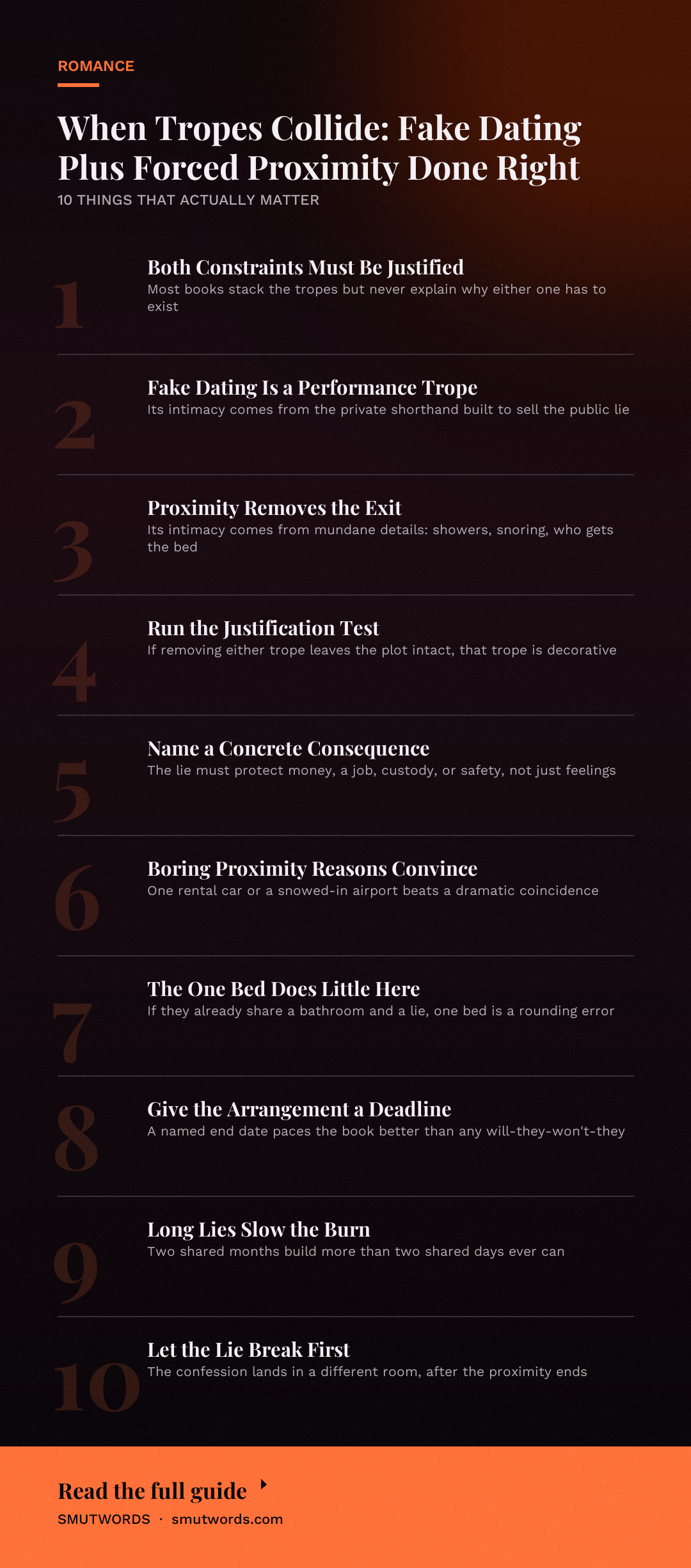
The two tropes pull on different muscles. Fake dating is a performance trope: it makes the characters lie to everyone except each other, and the intimacy comes from the private shorthand they build to sell the lie.
Forced proximity is a logistics trope. It removes the exit, and the intimacy comes from the mundane.
Sleeping arrangements. Who gets the shower first. Whether the other person snores.
Put them together and you get a rare thing in romance: a plot where the characters can't retreat to their own apartments to process their feelings. The lie keeps them performing in public and the shared space keeps them performing in private, and both performances start to erode.
A character who can fake a kiss for a room full of cousins but can't fake sleeping on the far side of the mattress is a character who's about to have a bad time.
The scene this combination does better than any other is the moment the performance slips when no one is watching. She fixes his collar out of habit after the wedding ends. He saves her the last of the coffee because he noticed how she drinks it.
Nobody asked them to do that. The fake has started leaking into the real, and neither of them mentions it.
What a Well-Justified Stack Actually Looks Like
Take the classic setup: a publicist books a celebrity romance pairing to cover a scandal, then a blizzard or a broken engagement or a booked-up hotel traps them in the same room. That works because the fake relationship has a hard economic reason to exist (the contract) and the proximity has a hard physical reason (there's nowhere else). Neither constraint is decorative.
The best versions add a third pressure: a deadline. The fake relationship has to end on a specific date, and the proximity has to hold until then. That timer does more for pacing than any amount of will-they-won't-they, because every scene is visibly subtracting from the clock.
The Justification Test
Before you trust a book with this combination, check whether it would fall apart if you removed either trope. If the couple could just tell the family the truth and everything would be fine, the fake dating is decorative. If they could go home and text each other, the proximity is decorative.
- Fake dating holds up if the lie protects money, a job, custody, a career, or a person's safety. "My grandmother is fragile" is weak. "My grandmother is signing over the vineyard and my cousin will contest it" is strong.
- Forced proximity holds up if the reason is logistical and boring: one rental car, a snowed-in airport, a contract that requires them on the same tour bus for six weeks. Boring reasons are the most convincing.
- Both hold up if the two constraints feed each other. The lie is what put them in the room, and the room is where the lie gets tested.
The One-Bed Problem
Stack these tropes and reach for the single-mattress setup too, and you're running three engines at once. The third one is the weakest link. The only-one-bed trope works best when it's the sole device carrying the chapter, because it's an external excuse for intimacy the characters haven't earned.
If they're already sharing a bathroom and lying to his mother, one bed is a rounding error.
Better books know this. They put the couple in the same suite with two beds and make the tension about the wall between them and how thin it is. Or they give them a king size and let the real problem be that they wake up tangled and neither one moves right away.
Enjoyed this? Get a free book.
Join the list and we will send a complete free story straight to your inbox, plus new releases every week after that. No credit card, no catch.
Signs You've Loaded the Premise Until It Breaks
The warning signs are usually in the blurb. If the setup requires you to hold more than three facts in your head before you've met either character, the book has over-committed. A fake engagement to a grumpy billionaire who's also her brother's best friend and also the man who fired her and also the only person who can fly the plane out of the storm is a premise doing four jobs badly.
The other tell: the fake dating runs out of fuel at the 60% mark and gets quietly abandoned. You'll know it's happening because suddenly the couple is alone at his place with no family, no deadline, and no reason for the lie, and the plot switches to standard contemporary romance. That's a book that had a good engine and then idled.
Three Questions to Ask Before You Buy
- Does the fake relationship have a named consequence if the lie is exposed? Not just embarrassment. A specific loss.
- Is the proximity reason explained in the blurb or chapter one, or is it a coincidence that appears in chapter eight when the author got stuck?
- Does the deadline get named, or does the arrangement have an open end? Open-ended fake dating has no urgency.
When the Stack Works in Other Subgenres
Half the reason this combination feels so versatile is that it survives a genre transplant. Drop it into a rockstar romance and the fake dating becomes a PR contract, the proximity becomes the tour bus, and the whole engine runs on six weeks of shared bunk beds and no physical privacy whatsoever. That version is fun because rockstars are already performing, and the book can play with the way the fake relationship looks a lot like their real job.
It's just as comfortable in cyberpunk romance, where the fake identity is literal and the proximity is a shared safehouse, or in a prince/princess romance, where the fake courtship is a matter of statecraft and the proximity is a palace with exactly one guest suite. The genre changes the stakes but the mechanism is identical, which is why these tropes pair so reliably.
Using the Fake Relationship to Slow-Burn the Proximity
Here's the move most of these books miss: the longer the couple has to keep lying, the slower the proximity gets to burn. A forced-proximity book that runs on two shared days runs hot and fast and then runs out.
A book that runs on two shared months gets to build the mundane details that make the payoff land. Readers who are allergic to insta-love already know this, and it's the same instinct that drives best friends to lovers books slow burn fans to lose their minds over a couple who spends 80,000 words not admitting anything.
Put a fake relationship in front of that and you get slightly more than a year's worth of tension: the lie gives them permission to touch early and the proximity removes their reasons to stop. The trick is making them touch a little less than they need to, every single time.
Why the Best Versions Get the Grumpy One Right
Almost every strong fake dating plus forced proximity book has one character who is visibly inconvenient to lie about. He's rude to the extended family at dinner. She competes with his ex at the charity gala. The lie turns the inconvenience into a character flaw the other person has to defend in public.
Readers who want the softer version of that character can find it in the best grumpy hero soft for her titles, where the hostility is entirely directed at the rest of the world and the fake partner gets the exception. The reason the combination snaps together there is that the fake relationship gives the grump a legitimate reason to be soft in public, and the proximity means the softness isn't a public performance anymore.
What the Ending Needs
The final act of a fake dating book has to justify the reveal. That means the lie has to cost something concrete before it gets confessed. If the reveal is a single scene where the couple says "actually we're together now" and everyone claps, the whole book was just waiting for the plot to stop.
The books that nail it let the lie break first. Someone outside the arrangement finds out and uses it against them, or the deadline arrives and one of them actually leaves the shared space before the other can say the real thing. Then the confession happens in a room that isn't the one they shared, because the proximity has to end before you can tell whether the feelings were real.
Where I'd Start Reading
If you want the combination at its most disciplined, look for books where the fake dating has a contract and the proximity has a deadline, in that order. Trust the blurbs that name the loss. Skip the ones that list five complications and no consequences. And don't let the one bed talk you into believing it's doing the heavy lifting, because most of the time it isn't.
Final Thoughts
The stack works when both constraints are load-bearing: the lie keeps the couple in the room, and the shared space keeps the lie under pressure. Start with a title where the fake partnership has a named penalty and the shared space has an end date, and you'll have a much better time than you would with the books that just put two attractive people in a suite and hope.
Pick one with a real deadline and read the first three chapters before you buy. The clock is the whole point.





Loading comments…