Most insta-love fails for the same reason a cold open fails: nobody has earned the kiss yet. Two paragraphs in, the leads are already undone by each other's forearms, and you're supposed to swoon on cue. The best friends to lovers books slow burn does the opposite.
It makes you wait through years of shared history, bad timing, and one disastrous almost-kiss. By the time they finally touch, you feel like you've been holding your breath for two hundred pages. That held breath is the whole appeal.
If you've been burned by love-at-first-sight plots that read like a bulleted list of chemistry beats, this roundup is for you. Every title below runs on built-up intimacy, not lightning. Stick around for the section on childhood friends, the anatomy of a good almost-kiss, and the specific ways these books deliver versus fumble.
Why the Slow Burn Beats Insta-Love
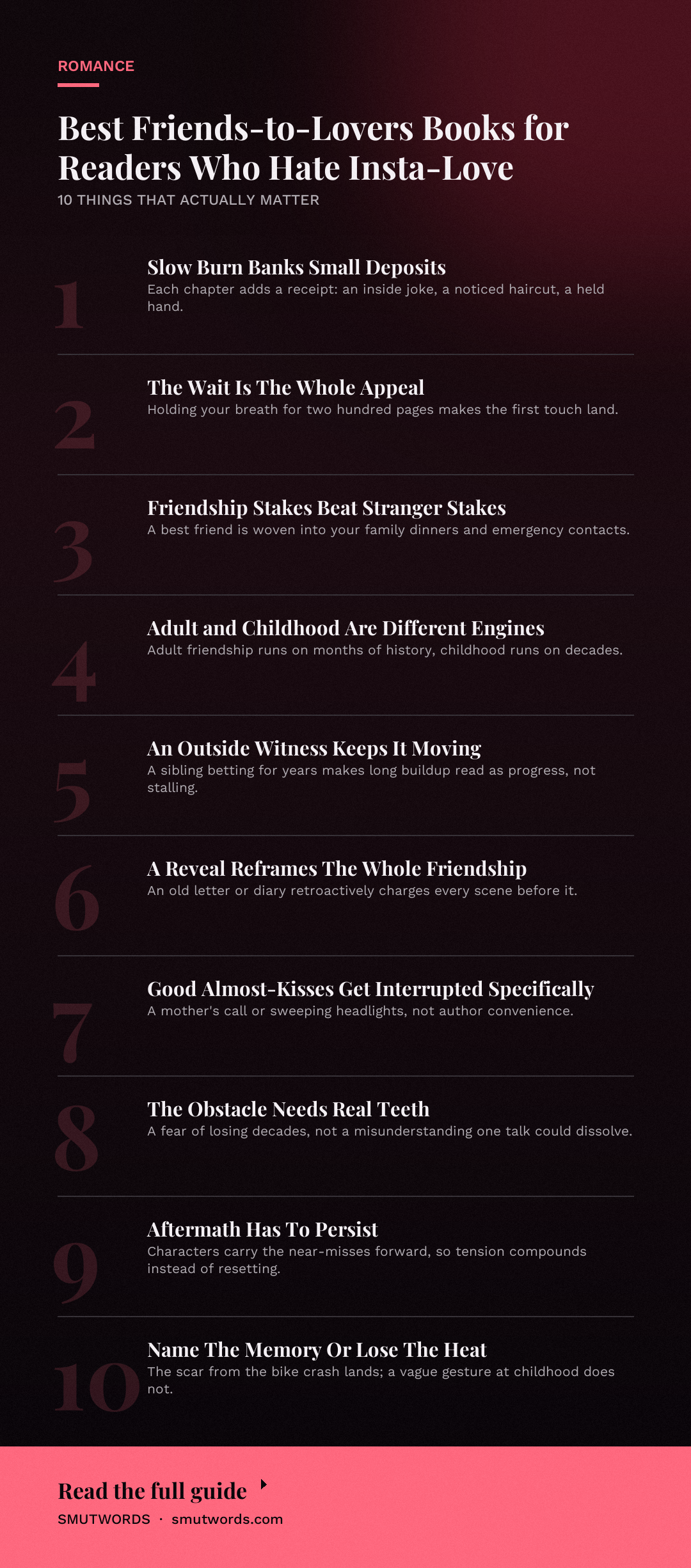
Here's the mechanical difference. Insta-love asks you to believe a stranger is irresistible before either character has done anything to deserve it. Slow burn spends chapters giving you receipts: the inside joke nobody else gets, the time she held his hand at a funeral, the way he notices her new haircut before anyone else does.
By the time tension finally snaps, the author has banked dozens of small deposits. You aren't told the attraction is real. You watched it accrue. The payoff feels earned instead of announced.
There's also the discomfort slow burn does better than any other trope: the terror of ruining a friendship. A stranger can be walked away from. A best friend who's known you since fourth grade is embedded in your whole life.
One more thing slow burn gets right. It makes the first kiss an event because the book has to earn it. In insta-love, the kiss is a checkpoint. Here it's the release valve.
The Difference Between Friends to Lovers and Childhood Friends to Lovers
These get lumped together, but they run on different engines, and knowing which one you're picking up changes what you'll get. If you're new to chasing this specific flavor, the childhood friends to lovers glossary entry is a good place to start sorting them out.
- Friends to lovers usually starts in adulthood. They met at a job, the gym, a shared friend group. The history is measured in months or a few years, and the tension is about crossing a line both people can still see clearly.
- Childhood friends to lovers starts before either character had any idea what attraction was. The history is measured in decades. The tension is heavier, because renegotiating a relationship that predates your first crush is harder than shifting a friendship into something new.
- Second-chance friends folds in a separation: they were friends, drifted or fell out, and one of them comes back changed. The reunion does the emotional labor a cold open skips.
Each variant changes the pacing math. The childhood version can afford an absurdly long slow burn because the shared history is already understood. The adult-friendship version has to build intimacy across fewer chapters, so it leans harder on proximity and forced time together.
Best Friends to Lovers Books Slow Burn: The Roundup
When Everyone Knew It First
The friends-to-lovers engine runs hardest when the two people are the last to know. The book that does this well gives you a third party who clocks the tension long before either lead does. That outside witness keeps the slow burn from feeling like the author spinning wheels, because every scene where the friends say "you two are obvious" is a beat of progress even when nobody has confessed.
Look for the version where the witness is specific: a younger sibling who's been placing bets for years, a bartender who keeps their drinks coming because he's watched the same dance for a decade. Those small observational anchors keep a long buildup from reading as stalling.
The Reread That Reframes Everything
Some of the strongest entries hinge on a single reveal, a document, a diary, an old letter, that forces the heroine to reread a friendship in a new light. Suddenly the years she read as one thing were something else entirely. That reframing is a slow-burn power move because it retroactively charges every prior scene.
The trick, and the difference between a book that executes this and one that bungles it, is whether the reveal gets seeded early enough to feel inevitable. A clue dropped on page twelve and paid off on page two hundred lands. A reveal that shows up cold reads as a plot twist out of nowhere.
The Overheard Confession
There's a beat that reliably works in friends-to-lovers: one of them overhears the other confiding to a mutual friend, or catches a half-finished text, and has to decide whether to pretend they didn't hear it. That scene puts the slow burn at a fork. Either the overhearer retreats and the tension balloons, or they make a move.
The good version makes the choice cost something. The overhearer knows too much now, and they have to live inside that knowledge for chapters. The bad version resolves it within a page and wastes the standoff.
The One That Broke Her Heart a Decade Ago
Second-chance friends to lovers is the emotional heavyweight of the subgenre. These leads have history that includes rupture, and the slow burn is really a slow repair. What makes it work is specificity about the breakup. Not "we lost touch." Exactly which conversation ended it, what each of them got wrong, and what they've been telling themselves ever since.
Enjoyed this? Get a free book.
Join the list and we will send a complete free story straight to your inbox, plus new releases every week after that. No credit card, no catch.
If the "trapped together" flavor of forced proximity is your thing, our breakdown of the trapped together trope covers why a snowed-in cabin or a broken-down car works so well here: it locks two people with history into the conversation they've been avoiding.
The Almost-Kiss, and How to Tell a Good One From a Bad One
The almost-kiss is the load-bearing scene of any slow burn friends-to-lovers book. Get it wrong and the whole buildup deflates. Get it right and it's the scene readers text their group chat about.
A good almost-kiss gets interrupted by something specific: a phone call from their mother, headlights sweeping the driveway, the dog barking. It happens mid-sentence, mid-reach. It leaves one character standing there with their hand still out.
A bad almost-kiss gets interrupted by author convenience. Someone pulls away for no reason other than the plot needed more pages. Readers can feel the puppet strings, and the tension leaks out of the next fifty pages.
The other tell is aftermath. In a good version, both characters spend the following chapters mentally bookmarking the moment. In a bad one, neither mentions it again until the author needs a reason to restart the tension.
Childhood Friends to Lovers: When the History Is the Heat
The childhood variant is its own animal, and it doesn't run on the same pacing as adult friendship. You can't rush a decade of shared summers. If the author jumps from "we grew up together" to third-act confession in thirty pages, the intimacy reads as thin.
The books that get it right give you specific, residual details: the scar on his knuckle from the summer he crashed his bike trying to impress her, the way she still drinks her coffee like she did at sixteen. That specificity is what separates a childhood friends slow burn that singes from one that reads like a plot summary. If the author can name the memory, you'll feel the history. If they can only gesture at it, you won't.
This variant also tends to land harder when the author uses the room between them: the years the friendship went quiet, the partners each of them had in between, the photograph in a drawer neither of them talks about. A slow burn with real gaps in it hits harder than one running on constant contact.
Five Things That Make a Slow Burn Succeed or Fail
After enough of these books, the patterns separate cleanly. Here's the checklist that decides whether a friends-to-lovers slow burn lands or leaks tension:
- Seeded history. The author names at least one specific memory early that pays off later. If the past is vague, the whole burn is vague.
- An observant third party. Someone clocks the tension before the leads do. It gives the reader a witness and keeps long stretches from feeling like stalling.
- A real obstacle. The reason they can't confess yet needs to be a genuine risk, not a misunderstanding one conversation could dissolve. A friend afraid of losing the other friend after decades, a dying father they both care for, a promotion that moves them across the country. Something with teeth.
- Earned interruption. Almost-kisses and near-misses need a specific cause in the scene, not the author's schedule.
- Aftermath that persists. The characters carry the near-misses with them. If the tension resets instead of compounds, the burn cools down instead of building heat.
Run any slow burn you're considering against that list and you'll know within the sample pages whether it'll hold you. Half these books fail item three, and item three is the one that matters most. The reason two friends can't cross the line has to be something the reader believes in.
Two more structural notes. If you love the way forced proximity traps two characters into close quarters, our roundup of books with the only one bed trope is the natural companion read, since a shared bed is the ultimate slow burn pressure cooker. And our piece on the grumpy hero soft for her trope covers the friendliest version of the gruff-until-the-right-person-cracks-them-open thing, if that's your taste.
The Discomfort That Makes It Work
What separates the best friends to lovers books slow burn from every other subgenre is that the central tension is genuinely uncomfortable. The characters have something real to lose. A stranger can be walked away from with a shrug and a glass of wine. A best friend who's known you since you were nine is woven into your family dinners, your group chat, your emergency contact list.
That stakes level is why the confession lands like a gut punch when it finally comes. The author has spent chapters making you understand that if this goes wrong, one of them loses the other person entirely. So when they finally close the gap, you feel the risk they took.
If that intimacy payoff is what you're chasing, it's worth chasing through a subgenre built on quiet history rather than a spark on page one. And if you want the same earned intimacy with a different engine, spy romance runs its slow burn across a different set of risks: dual identities, cover stories, and a love that can't be named until the danger clears.
Final Thoughts
Start with the childhood friends to lovers entry that seeds its history in the first fifty pages and refuses to spend it cheap. You'll know the good ones because you'll reread a single scene at the funeral, or the driveway, or the text they didn't send, and realize the author planted the whole ending there and dared you to miss it. When you find the one that does it, the wait stops feeling like a wait.






Loading comments…