
Most people arrive at their first real kink negotiation with a vague sense that they should have "limits" and no working definition of what one is. So they say something like "I'm pretty open, but nothing too extreme," and their partner nods, and both of them walk away thinking they've covered it. They haven't.
The hard limits vs soft limits question is the one that decides whether a scene lands or goes sideways at 1 a.m. with somebody crying in a bathroom. Fifteen minutes of actual thought before you're naked is worth it.
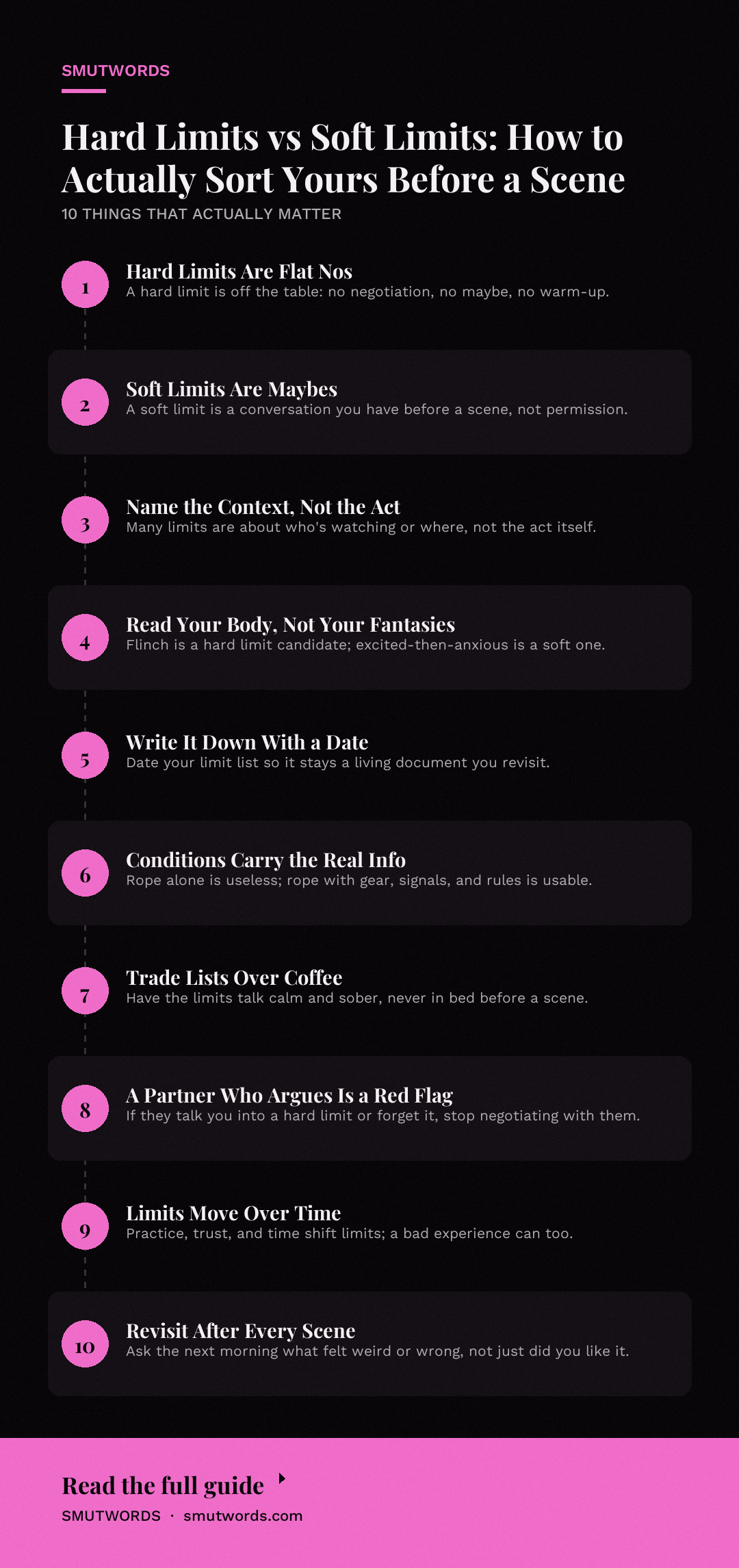
Here's the working version. A hard limit is a thing you don't do. No negotiation, no warm-up, no "maybe if I'm in the right headspace." Current, non-negotiable, off the table.
A soft limit is a thing you'll consider under specific conditions and want to talk through first. The two words sound similar and behave nothing alike, and the gap between them is where most scene disasters live.
What a Hard Limit Actually Is
A hard limit is a flat no. It's not a preference, not a thing you'd try after three glasses of wine, not something you'll grow into. It's the door you don't open, and the whole point of naming it out loud is that your partner never has to guess where it is.
Common hard limits look like this: no blood, no breath play, no permanent marks, no degradation about a specific family member or a specific body part, nothing involving kids or animals (those are hard limits for everyone, legally and morally, full stop), no recording, no third parties, no being tied in a way you can't get out of.
Some hard limits are absolute and forever. Some are absolute for now. The distinction matters and we'll get to it. What makes a limit hard is that you've decided, in a calm moment, that this is the line, and your partner can plan around it without anxiety.
The hard limits that aren't really about the act
A lot of hard limits are about context, not the thing itself. Someone might be fine with spanking but not with being spanked while a third person watches. Fine with restraint but not with restraint in a room where the door doesn't lock. Fine with "slut" as a word and not fine with it from a specific person.
Name the context, not just the act. "No humiliation in front of other people" is a clearer limit than "no humiliation," and clearer limits are the ones that actually hold up under pressure.
What a Soft Limit Actually Is
A soft limit is a maybe. It's the thing you're curious about, nervous about, or willing to try once with the right person under the right conditions, and you want it discussed in detail before anyone does anything. "I think I'd try rope, but I need to learn about it first and I need a safeword I trust." That's a soft limit. "Maybe wax, if we start with a small amount and I can stop whenever." Also a soft limit.
The thing people get wrong about soft limits is treating them as a green light with a shrug attached. A soft limit is not permission. It's an invitation to a conversation that has to happen before the scene, not during it, and the outcome of that conversation might be "yes, let's try," or "not tonight," or "actually, having talked it through, that's a hard no."
- Hard limit: "No breath play, ever. I don't want anyone's hands near my throat."
- Soft limit: "I'm curious about being restrained, but I've never done it and I need to know I can get out."
- Hard limit: "No marks anywhere a shirt doesn't cover. I have a job."
- Soft limit: "Bruises on my thighs are probably fine, but ask me that day, because sometimes I have a swim in the morning."
- Hard limit: "No degradation about my body. That's a childhood thing, not a kink thing."
- Soft limit: "I like being called names, but I need to know you'll stop the second I go quiet instead of laughing."
Read that list twice, because the shape of it is the whole lesson. Hard limits are stated as facts. Soft limits are stated as conditions and open questions. If your partner hears both and can't tell which is which, you haven't communicated the limit yet.
How to Figure Out Your Own Limits
The hardest part of limit-setting isn't telling someone. It's knowing what's true before you open your mouth. Most people's first list is a copy of something they read online, and it's about as useful as a borrowed password.
Start with your body's reactions, not your fantasies. Fantasies lie all the time; they're allowed to. Your nervous system is more honest.
Notice what makes you flinch when you read about it, what makes you excited and then immediately anxious, and what you keep coming back to when nobody's watching. Flinch is a hard limit candidate. Excited-then-anxious is a soft limit candidate, and it's also where the good stuff usually lives.
Then write the list in three columns: yes, maybe, never. Be honest about how many "maybe" entries are really "no" entries you're embarrassed to admit. A lot of people put things in "maybe" because "never" sounds judgmental, and then they get talked into the "maybe" by a persuasive partner, and that's how a limit gets violated without anyone technically breaking a rule.
Notice where the fear lives
If your heart rate spikes at the idea of being restrained, that could be fear of the ropes or fear of being out of control. Those are different problems. Fear of rope is solved by learning about rope. Fear of losing control is solved by practicing with someone safe, going slowly, and building in a way to stop.
A soft limit that's actually about trust gets mislabeled all the time, and it gets mislabeled in the direction of the partner's preferences, which is why it's worth doing this part alone.
For readers who come to this through fiction: the dynamics you're drawn to in a story are information. Notice whether the appeal of a hotwife scene in Understanding Hotwife Date Night is the watching, the being watched, or the shame, because those are three different soft limits.
A breeding fantasy might be about the breeding or about the being claimed, and the kink under the kink is what you actually need to name on your list. The knot/knotting dynamic guide makes this point well: the appeal is rarely the physical act, it's the helplessness, and helplessness has to be negotiated with the same care as anything else.
How to Write Your Limits Down
Write them down. This is not optional, and it's not because you're forgetful. Written limits are how you find out that you and your partner have been using the same word to mean different things.
A written limit list has four parts: the act, the hard/soft label, the conditions, and the date. The date is what turns a limit list into a living document you revisit instead of a one-time contract you signed at 24 and can never change.
If you and your partner are using a shared note, put it in writing and put a date on it. If you're doing this solo, keep it in your phone and actually look at it before dates and before scenes.
Some people keep a version with three lists: hard limits, soft limits, and things they want to try. The third list saves you from the trap of only ever cataloguing what you won't do, which makes the whole document feel like a legal waiver rather than a menu of things two people want.
Enjoyed this? Get a free book.
Join the list and we will send a complete free story straight to your inbox, plus new releases every week after that. No credit card, no catch.
What to put in the conditions column
This is where the real information lives. "Rope" is useless. "Rope, soft limit, only with someone who knows how to do it, only a chest harness, scissors in the room, no suspension, safeword and a non-verbal signal I actually remember when I'm panicking" is a limit you can hand to a partner.
Add the things that are specific to you: whether alcohol is involved (it shouldn't be, for either of you, in a scene with anything risky), whether you've eaten, what time of day, whether you're in a good headspace, whether your partner has been reliable in the past. The conditions are the padding that keeps the limit from cracking under pressure.
Physical, non-verbal, and unexpected limits
Most limit lists cover acts and skip the physical realities. Note them: past injuries, sensitive areas, joints that don't bend that way, skin that scars easily, a place a too-tight grip has hurt you. Also note the limits you only discovered after something went wrong, and write down what went wrong, because the next partner deserves the warning.
The mummification glossary entry is a decent case study in why conditions matter. The act itself is not complicated; the risk is in confinement, temperature, panic, and the inability to get out fast. Someone can have it as a soft limit and only engage a practitioner who plans for all of that, and they can have it as a hard limit for the very same reason, and both of those are correct.
How to Bring It Up With a Partner
Pick a time when nobody is turned on and nobody is running late. This conversation does not happen in bed, and it does not happen in the ten minutes before the party. It happens over coffee or on a car ride with the radio off, and it can be its own kind of intimate once you're used to it.
Lead with a limit of your own. It models the shape of the answer and it takes the sting out of the question. "Here's what I've figured out about what I want and don't want. Do you want to look at mine and tell me yours?"
Then actually trade lists. If your partner says "I'm open to anything," push back, gently but firmly. "Anything" is what people say before something goes wrong.
Ask them specifics from the list, one at a time, and watch their face. The face will tell you which "fine" is not fine.
On hard limits being respected the first time
A partner who respects a hard limit when it's easy to respect and violates it when they're turned on has shown you who they are. That's not a communication problem. People who do this remember hitting the limit about a week after the first time, when things are quiet, and they're more likely to resent you for it than to stop doing it.
If a partner argues with your hard limit, tries to talk you into it, "forgets" it, or says something like "you'd like it if you relaxed a little," stop negotiating with them. Limits only work with someone who treats them as facts. A person who respects protocols and safewords is the bare minimum. The munch guide is worth reading if you're meeting people in the wider kink community and want to know where you might run into them.
Limits Change Over Time
The most under-discussed fact about hard limits vs soft limits is that they move. Someone who swore they'd never do needle play at 22 might do it at 35, and someone who thought they'd love being tied up might find that the reality is a panic attack and a long conversation afterwards. Both are legitimate, and both mean your list has an expiration date.
Three things reliably move a limit: practice, trust, and time. Being restrained in a safe room with a partner who checks in three times is a different experience than being restrained with someone who doesn't, and a soft limit often becomes a yes after enough of the former.
The reverse is more common and less talked about: things that used to be fine stop being fine after a bad experience, a change in health, or a new partner who doesn't inspire the same confidence.
Why you revisit the list on a schedule
Schedule it. Once a month or whenever you're about to do a scene with something new in it, pull up the document and read it out loud. "Still a hard no on breath play?" "Still a soft yes on the ropes?" "Anything changed about your body or your life that affects this?" That's a five-minute conversation that prevents a specific kind of harm, and it's also a chance to tell your partner what worked and what didn't.
Revisit after scenes too. The best check-in happens the next morning, in bed, with coffee, and the question is: "Anything I should know?" Not "did you like it," which invites a polite answer. "Anything that felt weird, anything that felt wrong, anything you'd want different next time." The answers to that question are how a soft limit becomes a hard limit that actually gets respected.
Common Mistakes to Avoid
- Treating "I'm open" as a limit list. It's a mood, not information. Anyone who won't get specific about what they're not into is a bad scene partner for anything with real risk.
- Confusing a soft limit with a yes. A soft limit is a maybe that has to be negotiated first. If your partner treats your soft limits as available by default, they've stopped reading the labels.
- Moving the goalposts to be polite. Agreeing to something you don't actually want, in the moment, because saying no feels like rejection. Practice saying it in the mirror if you have to.
- Skipping the safeword conversation because "we know each other." Knowing each other is not a safeword. Pick a word, pick a non-verbal signal for when your mouth is otherwise occupied, and confirm both of you remember them before the scene.
- Doing anything that can suffocate you, restrict your breathing, or leave you unable to communicate, without a plan and a sober partner who has done it before. Breath restriction and unsupervised heavy restraint carry real injury risk. A mummification scene with no way to signal and no way out is the extreme version. A rope harness too tight on the chest for too long is the everyday version. Neither is a place to start.
Being able to say "I don't want that" out loud and mean it is what makes the rest of it possible. A scene where both people have stated their limits and know what happens if one is crossed is a scene where the good stuff can actually happen, because nobody's tracking the danger the whole time.
The fictional version of all this is why the kink scenes in books land when they do. Read Free Use Strip Club VIP Room and notice how much of the tension is built on a setup where the character can stop.
Read The Crimson Breeding Chambers: A Dark Alien Breeding Captivity Romance and notice what makes the captivity scary and also what makes it work: the safeword, the way out, the thing that tells you the character is safe underneath it.
Read Inserted by the Mainframe: A Cyberpunk AI Possession and Domination Erotica for the same reason. And if you want the caregiver version, The Caregiver's Covenant is a decent study in a character whose soft limits get treated as soft limits.
The soulmate trope exists to make you feel like consent is inevitable. Real scenes need the checklist.
Final Thoughts
Start smaller than you think you need to. Pull out your phone, write three lines labeled hard, soft, and want, and take it to your partner over coffee.
If you want to see what limits look like when the writer's done the homework, Plugged For Transport is a short, controlled example of a character who knows exactly where their lines are. Get yours down in the same kind of detail, and revisit them in a month. The conversation gets shorter every time, and the scenes get better once everybody's sure where the floor is.






Loading comments…