
There's a reason the one bed scene survives every trope cycle. It works because it strips away every excuse. Two people who have spent chapters avoiding each other, ignoring a crush, or gritting their teeth through proximity suddenly have nowhere to go and only one place to sleep.
The forced-proximity version of romance takes that premise and stretches it across a whole book. When it's done well, the payoff is a slow, unbearable pull toward the moment somebody finally crosses the mattress line. If you're hunting for books with the only one bed trope that actually deliver on that tension instead of fumbling it, this list breaks them down by heat level so you can pick the register you're in the mood for.
Why the Only One Bed Trope Works So Well
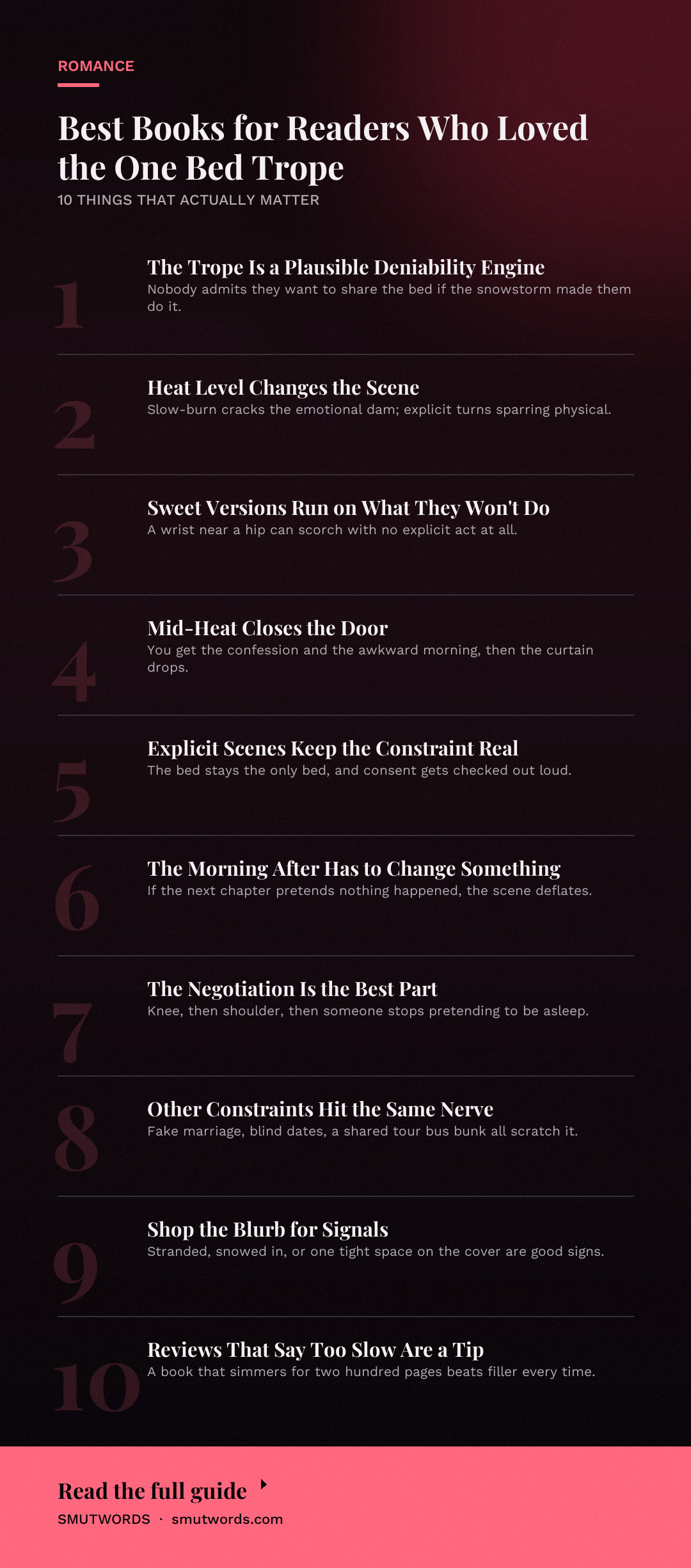
The trope is a machine for manufacturing plausible deniability. Nobody has to admit they want to share a bed if the hotel, the snowstorm, the tour bus, or the wedding party made them do it. That's the engine humming underneath every good version of this scene.
Strip it back and the mechanics are almost embarrassingly simple. You put two people in an enclosed space overnight. You add a physical constraint (one mattress, one blanket, one pillow). You let them negotiate the gap between them in inches and excuses.
Each negotiation raises the stakes. Someone's self-control gets thinner every time they agree to scoot another degree closer.
Forced proximity in general is a workhorse of the genre. Competition romance leans on the same engine when rivals get stuck sharing a cabin or a training schedule. The one bed beat is the most concentrated version of that pressure: the whole book's unresolved heat has to survive one night in the same sheets.
Books With the Only One Bed Trope Across Heat Levels
Heat level changes what the scene is doing. In a slow-burn, the one bed is where the emotional dam cracks. In an explicit read, it's where the verbal sparring finally turns physical and the author stops cutting away.
Both versions work. They just aim at different parts of your brain, and it's worth knowing which one you're picking up before you start.
Sweet and Slow-Burn: Warmth Without On-Page Sex
Sweet romances use the shared bed for emotional proximity rather than heat. Two coworkers stranded at a conference. A bodyguard and the client he can't stop watching. A childhood friends to lovers pairing who've slept in the same room a hundred times and suddenly can't.
The tension lives in a wrist near a hip, a shared blanket that keeps getting stolen in the night, an early-morning moment where one character wakes with their face against the other's shoulder and freezes.
If you like your longing untangled slowly, the payoff is a held breath at the end rather than a door slammed shut on the bedroom. The best sweet versions understand that a scene can be scorching without a single explicit act. It turns on what the characters won't do and can't stop thinking about.
Mid-Heat: The Scene That Fades to Black
Mid-heat titles give you the full emotional arc of the shared bed and then close the door at the crucial moment. You get the negotiations, the awkward morning, the confession that slips out before either of them is ready. Then the curtain drops. Some readers find that frustrating.
Others find it perfect. The fade is its own skill. A fade-out works when the author has built enough tension that the reader's imagination does the work. It fails when the scene has been telegraphing the payoff for two hundred pages and then gets coy exactly when you want the specifics.
If you're a reader who needs the explicit follow-through, go up a heat level. If you want the ache without the anatomy, mid-heat is the sweet spot.
Explicit: When the Negotiation Turns Graphic
The explicit end of this trope is where the shared bed scene becomes the pivot the whole book was pointing at. The negotiations have names and bodies and consequences. A few things a well-written explicit one bed scene does right:
- The constraint stays real. The bed is still the only bed. The characters don't magically get a second room halfway through the night.
- Consent gets checked out loud at least once. The negotiation is part of the heat.
- The morning after gets the same attention as the night before. The emotional fallout matters as much as the physical one.
- Character-specific details carry the scene. A bodyguard's vigilance, a rockstar's ego, a rival's need to win even here. The specifics are what make it land.
A rockstar romance can use the shared bed as ego warfare: two voices on the same tour bus, one bunk, and a pride that won't let either of them take the floor. A cyberpunk romance can make the bed a shared pod or a safe house cot, with the same negotiation playing out under neon and grime. The trope stretches across subgenres without losing what makes it work.
Forced Proximity Beyond the Mattress: Other Setups That Hit the Same Nerve
The one bed beat is the purest form of a broader category: the constraint that traps two people together. Plenty of books get the same result through a fake marriage, a shared work assignment, or a road trip with one motel room at the end of the day. If the one bed scene is what you're here for, these adjacent setups will scratch the same itch.
Enjoyed this? Get a free book.
Join the list and we will send a complete free story straight to your inbox, plus new releases every week after that. No credit card, no catch.
Undercover marriage stories use the same obvious lie and the same forced closeness, only the bed is legally shared and the tension runs across every room in the house. You can read a fuller breakdown of that setup in Undercover Marriage: Everything You Need to Know. The constraint is different but the negotiation is the same.
Blind date romance gets there by way of a setup rather than a snowstorm: two strangers who agree to one evening and end up snowed in, or locked out, or sharing a couch after the restaurant closes early. The one bed beat works there too, because the entire premise has already forced them into the same room.
How to Tell a Good One Bed Scene From a Bad One
The trope is sturdy enough to survive mediocre execution, which is why it keeps getting written. But there's a real difference between a scene that earns its heat and one that simply checks the box. Here's what separates them.
- Good: The constraint is established before the scene starts, so you're not caught off guard when the second bed vanishes. Bad: A bed disappears mid-book with no explanation beyond "the plot needed it."
- Good: Both characters want it and both have a reason not to admit it. Bad: One character is oblivious and the other does all the wanting, which kills the negotiation.
- Good: The author lets the physical gap shrink in stages. Knee, then shoulder, then the moment where someone stops pretending to be asleep. Bad: The scene jumps from separate sides of the mattress straight into the act with no space between.
- Good: The morning after changes something in the relationship. Bad: The next chapter opens with both characters acting like nothing happened, which retroactively deflates the whole scene.
- Good: The specific detail of who sleeps where and why says something about their dynamic. Bad: The author skips the negotiations and gives you the outcome without the back-and-forth.
The conversation before the sleep is often the best part. If the author skips it, you can feel the book lose a beat it can't get back.
Pairing the Trope With Other Constraints
Some of the most effective one bed scenes stack a second constraint on top of the first. A snowstorm, an undercover assignment, a tour bus with no spare bunk, a competition where the winner gets the bed. The competition romance angle is especially useful, because the shared bed becomes a prize one of them technically won and the other refuses to concede. You can read more about that dynamic in A Comprehensive Guide to Competition Romance.
A stalker romance can use a safe house with one bed and one watched door, which turns the mattress into the last line of defense and the only place either of them can sleep. Same negotiation of inches, higher stakes, a locked door that stays locked for reasons neither of them will say out loud.
Childhood friends to lovers uses a gentler version. Two people who've known each other their whole lives end up sharing a bed and discover the familiarity makes the negotiation harder, not easier. There's no pretense of strangers. The history makes every inch feel like it might cost a friendship.
What to Look For When You're Buying the Book
If you're scanning blurbs and reviews for a satisfying one bed scene, a few signs will tell you whether the book is really going to deliver or just mention the trope once and move on. Look for the word "stranded" or "snowed in" in the blurb. Look for a cover that puts both characters in the same tight space.
Reviews that mention the morning after scene are a good indicator the author didn't just cut away as the clothes came off. Reviews that complain about the book being "too slow" or "not enough plot" around the middle are sometimes the best sign you've found a real slow-burn version of this trope.
A book with no middle, where the bed scene comes at page eighty and the rest is filler, tends to be worse than a book that keeps the tension simmering for two hundred pages before the payoff. Slow-burn readers know this and seek it out.
If you want the explicit counterpart to the shared bed beat and don't mind a detour, the Complete Guide to Shibari covers the rope side of high-heat scenes and how the physical negotiation gets written in that register. The bed scenes in kink-forward books often use a similar vocabulary: consent checks, negotiated limits, and a scene plotted as carefully as a conversation.
The Books That Get the Trope Right
The trope has been done to death because it works, and it keeps getting picked back up because readers want that exact feeling: two people trapped by circumstance, one mattress, and every excuse running out at exactly the wrong moment. The best books with the only one bed trope understand that the scene is a pressure cooker. They let it cook. The worst ones rush the first chapter and skip the negotiations entirely.
Start wherever your mood sits and don't force yourself to like the sweet version if you came for the explicit one, or the other way around. Both are legitimate, and the trope is robust enough to hold up under either register.
Final Thoughts
If you only pick up one book from this list, make it whichever one is closest to the heat level you actually read for. The mechanics are the same across all of them: constraint, negotiation, collision. The difference is how much of the collision you're allowed to see.
A good version of this scene leaves you holding your breath through what should be a completely mundane moment of someone claiming the left side of the mattress. If you want a book that turns that mundane moment into the whole point, the forced-proximity shelf is where to look next.






Loading comments…