
Verbal degradation is the kink of using words (humiliating, demeaning, contemptuous language) to build arousal and reinforce a power exchange. It happens during sex or BDSM play, and it runs on a strange contradiction: the person being called worthless is often the person holding the most control in the room. It's one of the fastest ways to change the emotional temperature of a scene, and one of the easiest to get wrong.
That's why it earns its own entry here instead of getting folded into generic dirty talk.
What Verbal Degradation Actually Means
The short glossary version gets you the basics: one partner uses humiliating language, the other receives it, and the dynamic of dominance and submission gets reinforced. That covers maybe a third of what the kink actually involves.
Start with what counts. Verbal degradation is language used as a tool of power. The words can be insults ("you're pathetic"), objectifying statements ("you're just a hole for me"), possessive claims ("you belong to me and everyone knows it"), or mockery of the submissive's desires, body, or reactions. The through-line is that the words lower the submissive's status inside the scene, and both people find that lowering arousing.
What doesn't count matters too. Ordinary praise ("you're so good for me") isn't degradation, no matter how dominant the tone. Rough sex without demeaning language is rough sex, a separate kink with its own mechanics. And cruelty delivered without consent isn't this kink at all; it's just cruelty wearing the kink's clothes.
The term itself is genre shorthand. "Verbal degradation" shows up in BDSM glossaries and kink education more than in everyday speech, where people say "humiliation play," "degradation kink," or just "he talks to her like that." Erotica publishing picked up the phrase because it distinguishes the kink from physical roughness on a content label, which matters when readers are scanning for what they actually want.
Common Misconceptions
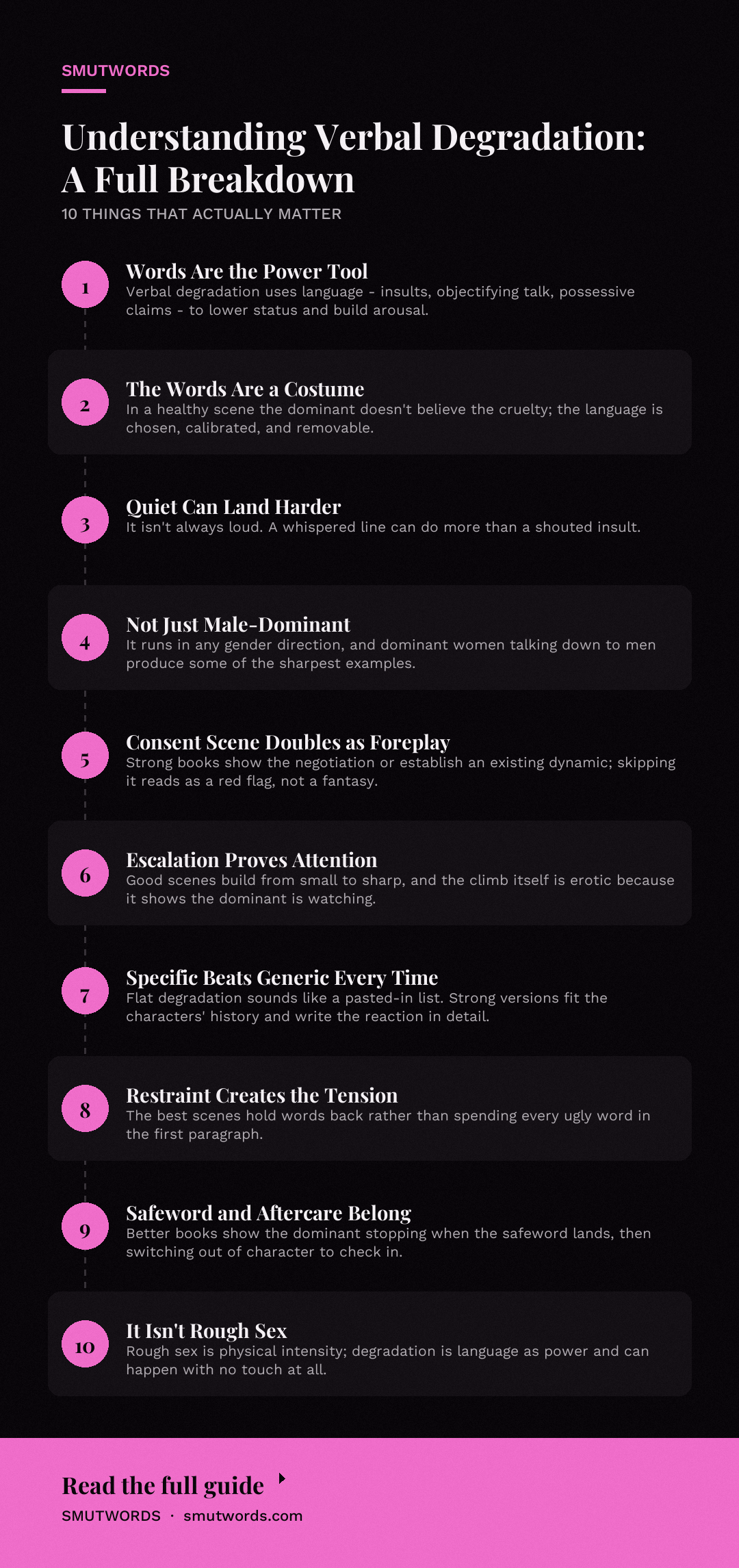
The biggest one: that degradation means the dominant actually believes the awful things they're saying. In a healthy scene, the words are a costume. They're chosen, calibrated, and can be taken off, and the submissive knows it.
The second: that it's always loud and vicious. Some of the most effective verbal degradation in fiction is quiet, almost tender in delivery, and lands harder for it. A whispered "look at you" can do more damage than a shouted insult.
The third: that it's a male-dominant, female-submissive act. Plenty of verbal degradation runs the other direction, or between partners of any gender combination, and some of the sharpest examples in the genre come from dominant women talking down to men.
Where Verbal Degradation Comes From
Humiliation as an erotic device is old. Verbal degradation as a named, labeled kink in English-language erotica is a late-twentieth-century publishing phenomenon. It grew out of the BDSM community's vocabulary, where "humiliation play" had been a recognized practice for decades, and out of the broader mainstreaming of explicit dirty talk that started in the 1970s and 1980s.
The internet changed the scale of it. Kink forums and early erotic fiction archives gave writers a place to label and share work, and "verbal humiliation" became a searchable tag. That's the real history here: the term's rise as a genre category tracks the rise of tagging, not any single author or book.
What's shifted over time is the framing. Older erotica often treated degradation as something the submissive endured and the dominant inflicted, with the emotional aftermath left off the page. Contemporary romance and erotica put much more weight on the negotiation beforehand and the aftercare afterward. The words got filthier and the care around them got more explicit.
The other shift is voice. Modern verbal degradation in romance tends to be specific to the character. A dominant who's a corporate rival insults differently than a dominant who's a soldier, and readers have gotten sharper at noticing when the dialogue sounds generic. The genre has moved from "he called her dirty names" toward "he said the exact thing that would get to her."
How It Shows Up in Erotica
This is where the craft lives. Verbal degradation on the page is a dialogue problem before it's a kink problem, and the books that do it well understand that the words have to sound like they're coming from a specific mouth.
The Negotiation Scene (or the Lack of One)
Strong books either show the conversation or establish an existing dynamic that makes the conversation unnecessary. When the negotiation scene is included, it's often its own piece of foreplay: the dominant asking what the submissive wants to hear, the submissive getting flustered trying to say it out loud, the charge of that confession.
Weaker books skip it entirely and hope the reader won't notice. Readers notice. If a dominant character starts spitting contempt with no prior signal that it's welcome, the scene reads as a red flag rather than a fantasy.
Calibration and Escalation
A good degradation scene builds. It starts with something small (a possessive phrase, a teasing jab) and escalates as the submissive's reactions confirm they're still in it. The escalation itself is erotic because it's proof the dominant is paying attention.
Common variations authors use:
- Praise-to-contempt whiplash. The dominant alternates warm praise and cold contempt, and the submissive can't predict which is coming. Probably the most popular variation in contemporary romance.
- Objectification. The submissive is described as a thing, a toy, a set of holes. Often paired with pegging scenes, where the objectification language follows the role reversal.
- Possessive degradation. "Mine," "everyone knows who you belong to," ownership language delivered as a threat. Overlaps heavily with keyholding dynamics, where the possession is literal.
- Mockery of arousal. The submissive is laughed at for how wet, how hard, how desperate they are. Cheap to write, devastating when it's targeted.
- Confession forced. The submissive is made to say humiliating things about themselves out loud. This variation leans hardest on vulnerability, because the submissive's own voice becomes the instrument.
- Contemptuous nickname. A single degrading pet name, used consistently across the book until the submissive's reaction to it does the emotional work.
What Makes It Strong vs. Flat
The flat version has a dominant character reciting insults that could be pasted into any scene. It sounds like a list. The reader skims.
Enjoyed this? Get a free book.
Join the list and we will send a complete free story straight to your inbox, plus new releases every week after that. No credit card, no catch.
The strong version has three things. First, the words are specific to the characters and their history. Second, the submissive's reaction is written with detail, because the kink lives in the reaction as much as the words. Third, there's an aftermath, even a brief one, where the emotional weight lands and the characters process it.
One more marker of quality: restraint. The best degradation scenes don't use every ugly word the author knows in the first paragraph. They hold something back, and the holding back is what creates tension.
Where It Overlaps Other Tropes
Verbal degradation shows up across a lot of subgenres. In why choose romance, multiple love interests frequently degrade the shared protagonist in different registers, and the contrast between voices is part of the appeal. In harem romance, the same mechanic runs in reverse, with a central dominant figure and a group of submissives receiving different flavors of the same treatment.
It also pairs naturally with primal play, where the degradation language draws on animal imagery ("filthy little thing," "in heat") and feral play, where the dominant's words come out less controlled. In friends with benefits setups, degradation can be the thing that breaks the casual arrangement open, because you can't hear someone say that and keep pretending it's nothing.
The Safety Layer Authors Often Forget
Verbal degradation is the kink most likely to land wrong, because words carry weight that physical actions don't. A reader can skip a rough scene; a reader can't un-read a phrase that hits something raw.
That's why the genre's better books include explicit consent negotiation and a safeword, and why they show the dominant stopping when it's used. The safeword isn't a mood-killer in good hands; it's part of what makes the scene safe enough to enjoy. Writers who leave it out are writing a fantasy of degradation without the safety that makes the fantasy functional.
Many books also fold aftercare into the aftermath, with the dominant switching fully out of character to check in, hold the submissive, and reassure. That switch is now one of the most beloved beats in degradation-heavy romance, and some readers read for it more than for the scene itself.
Verbal Degradation vs. Rough Sex
These two get confused because they so often appear together, and because both sit under the general "he treats her bad" umbrella that surfaces in marketing copy. The distinction matters for readers searching for one and not the other.
Rough sex is about physical intensity: force, speed, impact, restraint. It can happen with total silence. Verbal degradation is about language as the instrument of power, and it can happen in a scene with no physical roughness at all, delivered across a dinner table with nothing but eye contact and a lowered voice.
Plenty of books stack them, but the kinks are separable, and a reader who loves one may not want the other. If you're scanning for a book, check whether the reviews mention "he talks to her like that" (degradation) versus "he pins her down" (rough sex), because publishers don't always label the difference.
Frequently Asked Questions
Is verbal degradation the same as dirty talk?
No. Dirty talk is a broad category that includes praise, teasing, narration of what's happening, and explicit instructions. Verbal degradation is a narrower kink where the specific intent is to humiliate or demean within a power exchange. All degradation is dirty talk, but almost none of the dirty talk you'll read is degradation.
Do I need a safeword for verbal degradation?
Yes, in real life, and any decent guide will tell you to negotiate the specific words and topics beforehand, since certain phrases can trigger old wounds unexpectedly. The safeword should be something you can say in any state, and the dominant should stop cleanly when it's used. A book that shows this is doing it right.
Can verbal degradation go too far?
Easily. Slurs, insults about bodies or identities, and anything that touches a real insecurity without explicit prior consent are the usual failure points. The kink works when the words are chosen, not when they're aimed at something the submissive actually feels bad about.
Why do people find being called names arousing?
For a lot of readers and practitioners, the appeal is the surrender. Hearing someone you've given power to use that power to say something cruel to you is an intense form of vulnerability, and vulnerability plus safety equals arousal for many people. The service submission guide gets at a related idea: the pleasure comes from the surrender, not the pain.
Is verbal degradation always physically rough?
No. It can be delivered in a completely vanilla physical scene, or with no touch at all. Some books build an entire degradation arc around a single whispered conversation. The physical intensity is optional; the language isn't.
Where can I find books with good verbal degradation?
The catalog below picks a range, from dark romance to enemies-to-lovers, and several of the titles are heavy on the negotiation and aftercare beats that make the kink work on the page. If you like degradation mixed with other kinks, the blood play guide covers a related kink with the same emphasis on consent framing.
Final Thoughts
Verbal degradation is the kink that asks the most of the writer's ear. Anyone can string together insults; the books that work make the words sound like they belong to the people saying them, and then show what those words cost. Read one with a negotiation scene, a safeword that gets used, and an aftermath that lands, and you'll understand why readers search for this kink specifically.
Start with the ranked list below. If enemies-to-lovers dialogue is your thing, the competition romance guide covers the trope that gets the sharpest insults, and the one bed trope list has plenty of tension-heavy picks if you want slow burn before the degradation lands.








Loading comments…