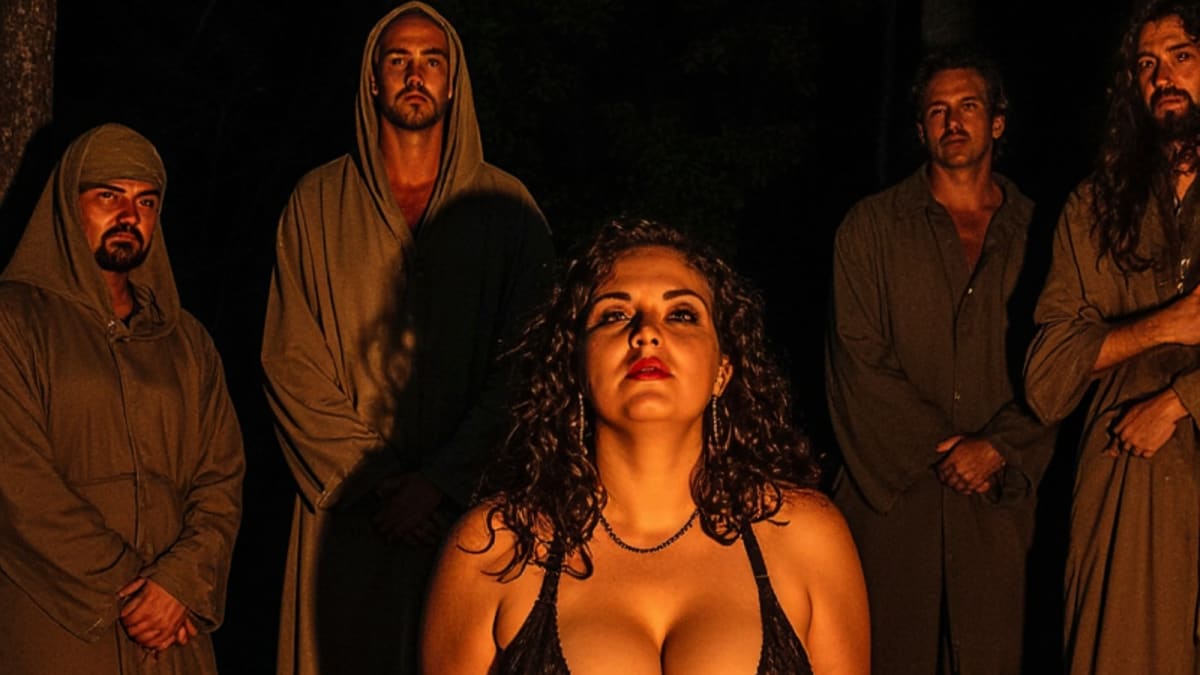
Body worship is a kink built on focused, reverent attention to a partner's body, delivered through touch, mouth, eyes, and voice until every part of them reads as sacred. A worshipper kisses, licks, strokes, and praises. The person being worshipped receives without having to perform, reciprocate, or earn it.
The practice can center on a single feature (feet, hands, breasts, a cock, a pussy, an armpit) or sweep the whole body in a slow, deliberate progression. What separates body worship from ordinary good sex is intent: the devotion is the point, and the giving is its own reward.
That dynamic is why the kink has become one of the most requested and most written-about in modern erotic romance. It sells a specific fantasy of total acceptance, where a lover's attention is unapologetically singular and nothing about the receiver's body needs to be fixed, hidden, or explained. The appeal lives in being seen that completely, and being seen does not come cheap.
What Body Worship Actually Means
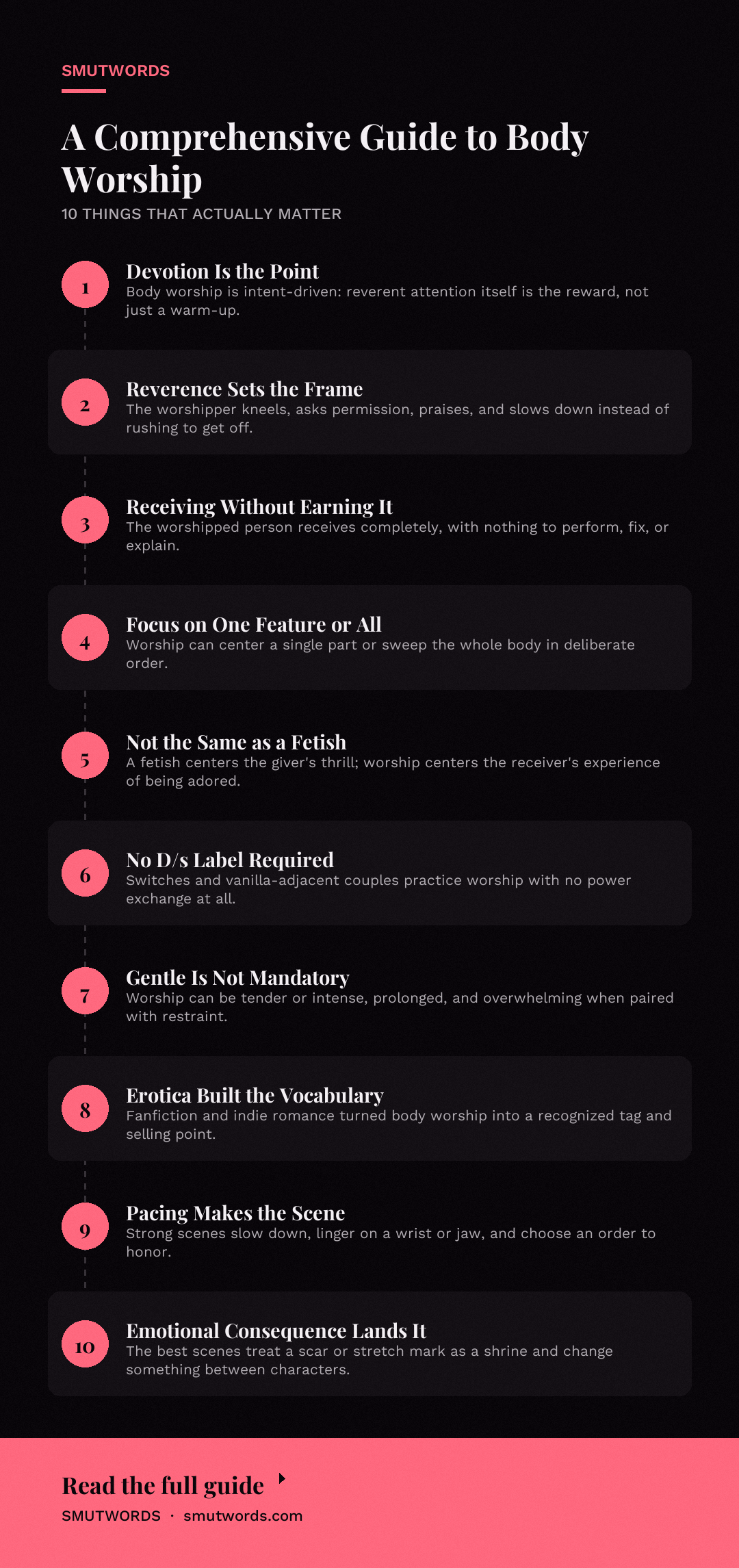
The word "worship" is doing real work here. It signals reverence, ritual, and a deliberate lowering of the worshipper before the worshipped. In practice that means the person giving attention often kneels, speaks in praise or prayer-like language, asks permission, and moves at a pace that has nothing to do with getting off fast.
The receiver may lie still, be bound, be blindfolded, or simply be told not to move. The frame is adoration, and the frame holds even when things get filthy.
Body worship overlaps with service submission, where one partner's pleasure comes from giving devoted care. Many worshippers describe the act as deeply satisfying on its own, sometimes more than their own orgasm. Others treat it as foreplay that builds toward something else. Both are legitimate; the kink is a mode of attention, and it can be a whole scene or an opening act inside a larger one.
What does not count is worth naming, because the term gets stretched. A partner who compliments your body during vanilla sex is not worshipping it. A foot fetishist who wants feet in their mouth for their own gratification is enjoying a fetish, which may or may not include the reverent, receiver-centered quality that defines worship. The distinction is where the focus lives: on the worshipper's thrill, or on the worshipped's experience of being adored.
Two misconceptions come up again and again. The first is that worship requires a formal Dominant/submissive label. It doesn't; plenty of switches and vanilla-adjacent couples practice it without any power exchange at all.
The second is that it's always gentle. Body worship can be tender, but it can also be intense, prolonged, and deliberately overwhelming, especially when combined with restraint or sensory play.
Where Body Worship Comes From
The kink has deep roots in the language of religious devotion, and erotica has leaned on that language for centuries. Mystics wrote about the body as a site of ecstatic surrender long before anyone used the word "kink," and Victorian and Decadent writers borrowed the vocabulary of altars, offerings, and prayer for explicitly sensual ends. The trope of the lover as devotee, kneeling and murmuring praise, is old.
As a named practice in modern kink communities, body worship solidified through the twentieth century alongside the broader articulation of power exchange, service, and fetish. Foot worship and hand worship have their own long fetish histories. What changed in the last few decades was the framing. Worship moved from a niche interest into a recognized, named dynamic that couples could negotiate and communities could discuss openly.
Erotic romance and fanfiction accelerated that shift dramatically. The rise of the internet gave writers a shared vocabulary and an audience hungry for it, and "body worship" became a tag, a warning, a selling point. Wattpad, Archive of Our Own, and the indie romance boom all pushed the term into mainstream reader consciousness. Self-publishing made room for full-length books built entirely around adoration as the central erotic engine.
The publishing history matters because it shaped the trope's conventions. Certain beats became near-mandatory: the kneeling, the praise, the slow inventory of the body, the moment the receiver realizes they are not being judged. Readers learned to expect them, and writers learned to deliver them with variation. The genre's growth also widened who gets worshipped on the page, moving the trope well past its early focus on slim, conventional bodies.
How It Shows Up in Erotica
On the page, body worship is a pacing decision as much as a kink. A strong scene slows down. It lingers on a wrist, a knee, the underside of a jaw, and it treats each stop as its own small event. The craft problem is focus: a writer who tries to worship everything at once produces a blur, while a writer who chooses an order and honors it produces the sensation of being undivided.
Authors use several recognizable variations. These are the ones that show up most:
Enjoyed this? Get a free book.
Join the list and we will send a complete free story straight to your inbox, plus new releases every week after that. No credit card, no catch.
- Full-body progression. A slow, ritualized head-to-toe sequence where each region gets its own paragraph. The order itself becomes erotic structure.
- Feature-specific worship. Feet, hands, breasts, a cock, a pussy, armpits, the back of the neck. The narrower the focus, the more obsessive the tone reads.
- Praise-heavy worship. Language does the heavy lifting, with the worshipper narrating what they see and how much it undoes them, often in second or close third person.
- Restrained worship. The receiver is tied or held, so the attention becomes something they cannot escape and did not have to ask for. This pairs naturally with shibari rope work in both practice and fiction.
- Service-driven worship. The receiver is Dominant and receives as part of a service dynamic, or the worshipper frames devotion as obedience.
- Worship as aftercare and repair. A character who has been treated as unlovable gets their body adored as emotional reckoning, a frequent move in darker romance.
What makes a scene strong is specificity. Good worship writing names textures, temperatures, and small asymmetries. A strong version also keeps the receiver active inside their stillness: they flinch, they blush, they give permission, they change their mind. A flat version turns the receiver into a passive object with no interior life, and the scene loses the very intimacy the kink is built on.
The other craft marker is emotional consequence. The best body worship scenes change something between the characters. A character who has spent the book ashamed of a scar, a stretch mark, a body that doesn't match the shape they wanted gets a scene where a lover treats that exact part as a shrine. The erotic charge compounds the emotional one, and readers remember it long after the plot moves on.
Body Worship and the Wider Kink Scene
Worship rarely appears alone in erotica. It blends with other dynamics easily, which is part of why it's so versatile. In a why choose romance or harem romance, multiple lovers can worship a single character, each with a different style and focus, and the accumulation becomes its own kind of ecstasy. The trope also plays well against rough sex, where the contrast between a bruising earlier scene and a slow devotional one afterwards hits hard.
Some writers fold worship into use kink by making the receiver's body a thing to be handled with reverence rather than roughness. Others pair it with primal play for deliberate tension, since worship and animalistic hunger pull in opposite directions and collide well on the page. The feral hero trope loves this collision: a character who is all instinct forced to slow down and give devoted attention.
Readers who come to worship from other dynamics often notice the same thing: it's one of the cleanest ways to write tenderness without writing fluff. The kink gives permission to slow down and be explicit about it, and that's a rare thing in erotic fiction.
Body Worship vs Feral Play
These two get compared because they sit at opposite ends of the same dial, but they aren't easily confused on the page. Body worship is deliberate, controlled, and language-heavy, built on stillness and reverence. Feral play leans into instinct, growling, chasing, and a loss of decorum. If you want the animalistic version, feral play is the better term, and the feral hero trope breakdown covers how it shows up in romance.
The useful overlap is contrast. A partner who can shift from feral ferocity into kneeling worship, or the reverse, creates a scene with real emotional range. Writers lean on that whiplash on purpose, and readers can feel exactly when the switch happens.
Frequently Asked Questions
Is body worship a sex act or a power dynamic?
It's both, depending on how you set it up. The act is the focused, reverent attention itself; the dynamic is the frame around it, where one person gives and one receives. Some couples practice it with no power exchange at all, and others build an entire Dominant/submissive relationship around the giving.
What is foot worship, and how is it different from a foot fetish?
Foot worship is body worship focused on the feet, delivered with the same reverent, receiver-centered intent as the full-body version. A foot fetish is arousal from feet that centers the fetishist's pleasure. They overlap constantly, and many people use the terms interchangeably, but who the attention is for remains the clearest distinction.
Can body worship be a full scene on its own?
Yes, and many practitioners prefer it that way. Without orgasm as the goal, the scene runs on pacing and attention, so it can last an hour or more. As in any kink scene, agree on limits, name sensitive or off-limits body parts, and set a safeword first; the scene negotiation guide walks through that conversation.
Why does body worship trigger strong emotional reactions?
Being looked at without judgment is rare, and prolonged adoration can bring up shame, grief, or old wounds unexpectedly. Writers use that response as a plot turn, and practitioners should expect it and leave space for it. A safeword exists precisely because worship can land harder than either person anticipated.
Does the person being worshipped always have to be submissive?
No. Worship and submission get tangled in romance, but they're separate. A Dominant can receive worship as part of a service dynamic, and a submissive can worship while holding no formal power. The only rule is that both people agree on who gives the attention and who receives it.
Is body worship always slow and gentle?
Usually, but not always. The defining feature is reverent attention, not a specific pace or intensity. It can be drawn out and intense, combined with restraint or denial, or used as a deliberate contrast to a rougher scene earlier in the same encounter.
Final Thoughts
Body worship works on the page because it answers a hunger most readers carry quietly: to be looked at completely and found worth keeping. That's a durable fantasy, and the kink gives it a shape, a rhythm, and a language. If you want to see the pacing done right, read a romance where the devoted character is given whole chapters to take their time.








Loading comments…