
Bondage safety is the set of practical precautions, spoken agreements, and physical limits that keep a restraint scene from turning into an injury scene. In erotica it doubles as the clearest way an author can prove a dominant character actually deserves the power they're holding.
You'll find it in rope scenes, cuff scenes, spreader bars, cage play, and anything else where one body stops being able to move freely. On the page it looks like a folded pair of blunt-tipped shears on the nightstand, two fingers slid under a wrist wrap, a safeword agreed on before the first knot is tied. Off the page it's the same list, minus the narrative tension.
Readers keep coming back to bondage safety because it solves a problem that pure dominance can't: it makes surrender believable. A submissive who hands over control to someone reckless is a horror story. A submissive who hands over control to someone who checks their fingers for warmth every ten minutes is a romance. The care is the heat.
What Bondage Safety Actually Means
The phrase covers three separate jobs that get lumped together because they all happen in the same scene. First, physical precautions: things done to a body to keep it intact while it's restrained. Second, communication practices: things said out loud, before and during, so both people know what's happening and what stops it. Third, agreed limits: the specific acts, positions, and body parts that are in play tonight and the ones that aren't.
Where the name comes from is straightforward. "Bondage" is the practice of restraining someone, from the old sense of a bond as a binding. "Safety" got attached to it as the kink community built out its own vocabulary in the late twentieth century, largely through leather culture, rope communities, and the early internet forums where practitioners traded injury reports the same way climbers trade route notes. The compound term exists because the risk is real and specific, not vague.
What counts as bondage safety in fiction is broad. A hand on a throat during sex, with pressure discussed beforehand, counts. A character asking "color?" and getting "green" counts. So does a top who unties a submissive's wrists the second they say their fingers are tingling.
What doesn't count is a scene where the care is implied but never shown, or shown only as a throwaway line after the fact.
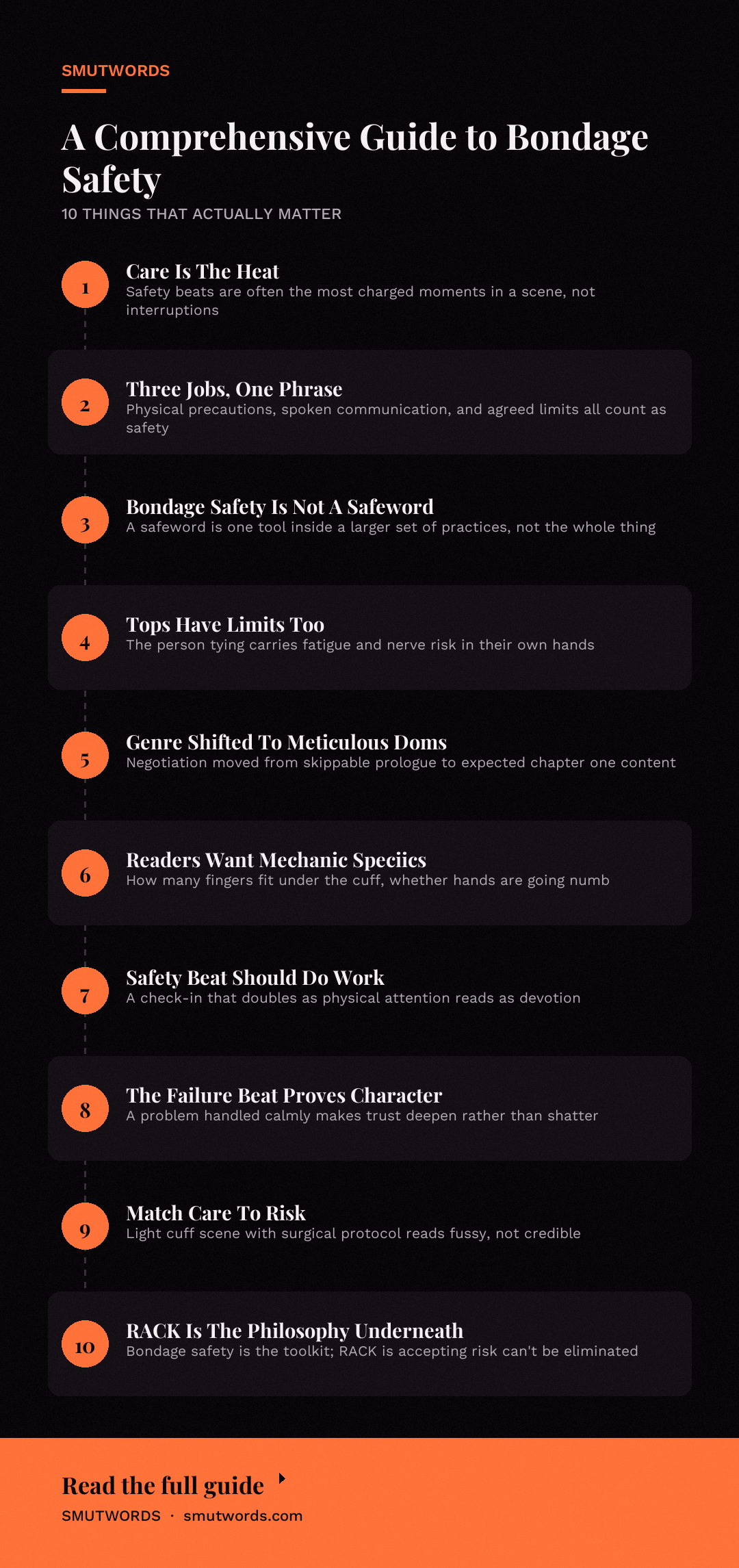
Common misconceptions are worth naming directly. Bondage safety is not the same thing as a safeword. A safeword is one tool inside it. It's also not exclusively a submissive's concern; the person tying has limits, fatigue, and nerve damage risk in their own hands too.
And it isn't a mood killer. In well-written erotica the safety beats are frequently the most charged moments in the scene, because they're the moments where one character's attention is fully, visibly on the other.
If you want the full framework for how risk gets discussed rather than eliminated, RACK is the term to know: Risk-Aware Consensual Kink, which accepts that nothing is zero-risk and asks instead that everyone involved understands the risks they're taking.
Where Bondage Safety Comes From
The honest history here is a publishing history, because that's where the term's shape in romance and erotica actually comes from. Rope and restraint have appeared in erotic writing for as long as erotic writing has existed, but for most of that time the restraint was a metaphor for captivity, punishment, or possession.
Nobody checked anyone's circulation. Nobody had shears. The scene ended when the plot said so.
That started shifting in the 1970s and 1980s alongside the emergence of a more organized kink subculture, which developed its own safety literature for practical reasons. Rope communities in particular produced detailed material on nerve compression and circulation, because rope injuries are cumulative and easy to miss until they aren't. That material slowly bled into fiction as authors who actually practiced started writing what they practiced.
The bigger shift came with the mainstreaming of kink romance in the 2010s. Once BDSM romance became a category with its own bestseller lists rather than a niche curiosity, the genre had to decide what a competent dominant looks like. The answer that won out, commercially and critically, was the one who is meticulous. Negotiation scenes moved from skippable prologue to expected chapter one content.
What changed most recently is the level of detail. Early kink romance tended to gesture at safety: a safeword mentioned once, a check-in that existed so the author could get back to the sex.
Contemporary readers want the mechanics. How many fingers fit under the cuff. Whether the rope is jute or nylon.
Whether the submissive's hands are going numb. That specificity is now a marker of an author who knows the territory.
If you're tracking how consent frameworks evolved in the genre more broadly, the guide to dubious consent in romance covers the adjacent territory, including why so much older work skipped the negotiation entirely and how modern authors handle that legacy.
How It Shows Up in Erotica
On the page, bondage safety is mostly a series of small physical beats that carry enormous emotional weight. The knot tightened slowly enough to ask a question. The hand that pauses on a buckle to wait for a nod. The character who keeps talking, low and steady, not because the submissive needs reassurance but because the sound of the top's voice is part of what's holding them.
Strong versions of this share a structural habit: the safety beat does work for the scene instead of interrupting it. A check-in that doubles as dirty talk. A top whose attention to the submissive's body is so complete that the physical inspection reads as devotion. The best scenes make readers feel that being watched that closely is its own kind of pleasure.
Weak versions fall into two patterns. The checklist scene, where safety exists as a bulleted list recited at the door before anything interesting happens. And the magic dom, where the top simply knows what's wrong without checking, which is fantasy in a way that undermines the point.
Enjoyed this? Get a free book.
Join the list and we will send a complete free story straight to your inbox, plus new releases every week after that. No credit card, no catch.
Competence in this trope is procedural. It's the procedure that's hot. For a sense of how much a genre can shift once readers start expecting that competence on the page, the breakdown of exhibitionism in erotica runs a similar arc.
Here are the variants that show up most often, roughly in order of frequency:
- Pre-scene negotiation. A conversation before anything physical, covering limits, safewords, and what happens if something goes wrong. Common in longer novels where the relationship has room to build.
- Mid-scene check-ins. The "color?" system, a squeeze of the hand to confirm presence, or a verbal check when the submissive's face is hidden. This is the variant that carries the most tension, because it interrupts momentum at exactly the moment momentum is highest.
- Body checks. Fingers under cuffs, a look at the skin above a rope line, a hand pressed to the submissive's chest to feel breathing. Pure physical detail, almost no dialogue.
- Tool discipline. Shears within reach, a specific rope chosen for a specific tie, quick-release hardware. Often used by authors to signal that the top has done this before.
- Safeword protocols. Standard colors, or a custom word, or a gesture for when speech isn't possible. The last one is the most useful for scenes where a mouth is occupied.
- Aftercare planning. Arrangements made before the scene for what happens after. Water, blankets, a bath, food, quiet. Frequently where the emotional payoff of the whole scene lands.
- The failure beat. Something goes wrong, a rope slips, a limb goes numb, and the top responds immediately and without blame. This variant exists almost entirely to demonstrate character.
The failure beat deserves its own note, because it's the one authors get wrong most often. When it's done well, the top does not panic and does not apologize into a spiral. They get the submissive out of the restraint, check the affected area, and stay calm, and the submissive's trust increases rather than shatters. That's the emotional math of the trope: a problem handled well is more intimate than no problem at all.
Rope scenes carry the most specific physical vocabulary, which is why rope safety gets its own entry. Nerve compression in the wrists and forearms is the main hazard, and it can develop faster than blood flow problems. Authors who know this write tops who check the fingers for sensation and color rather than just asking how the submissive feels.
Negotiation itself is a craft tool worth understanding separately, especially because it can be written as a scene in its own right. Kink negotiation covers the full range, from a two-page contract to a five-minute conversation in a doorway, and the choice of format tells the reader a lot about both characters.
Aftercare is where a lot of bondage scenes actually resolve emotionally, and readers who finish a scene and feel unsatisfied usually mean the aftercare was missing or rushed. Aftercare in fiction does the work of returning both characters to themselves, and it's where a submissive's need for care finally gets stated plainly rather than encoded in the restraints.
For scenes involving striking rather than binding, the physical recovery profile is different and so is the planning. Impact play aftercare covers bruising, skin care, and the longer emotional tail, and it's a good contrast case if you're trying to write a scene where two kinds of play happen back to back.
One more craft note that experienced authors lean on: the level of safety detail in a scene should scale with the intensity of what's happening, and readers notice when it doesn't. A light wrist cuff scene that reads like a surgical protocol feels fussy. A full suspension scene that reads like a light wrist cuff scene feels dangerous in the wrong way. Match the care to the risk and the whole book reads as more credible.
Bondage Safety vs RACK
These two get conflated constantly, and they sit at different levels. Bondage safety is the practical toolkit: the physical precautions, the checks, the shears, the agreed words. RACK is the philosophy underneath it, the position that risk can be understood and accepted but never eliminated, and that informed adults get to choose what they take on.
In fiction, the distinction matters because they produce different kinds of characters. A top who practices bondage safety well is competent. A top who thinks in RACK terms is also honest, because they'll tell a submissive what could go wrong instead of promising it won't. That honesty is a specific flavor of dominance that a lot of readers find more attractive than pure confidence.
It's also worth separating bondage safety from a total power exchange, which describes an ongoing relationship structure rather than a scene. A TPE couple still stops for a numb hand. The power exchange changes who decides things, not whether a body gets injured.
Frequently Asked Questions
What does bondage safety actually require?
In real practice: blunt-tipped safety shears within arm's reach, a check for nerve and blood flow every ten to fifteen minutes during any restraint, and a stop signal agreed on before the first knot goes on. Those three items cover most emergencies. Everything else is refinement.
Why do romance authors include so much safety detail in BDSM scenes?
Because it's the fastest way to show that a dominant character is trustworthy, and trust is what makes the surrender in the scene feel earned rather than reckless. A top who checks circulation is a top who is paying full attention, and full attention reads as desire in this genre.
What's the difference between a safeword and bondage safety?
A safeword is one component of a larger set. Bondage safety also includes the physical precautions, the pre-scene negotiation, the mid-scene checks, and the aftercare plan. A scene can have a safeword and still be unsafe if nobody's watching for numbness.
Can a scene be safe if the submissive can't speak?
Yes, and this is where gesture protocols come in. Common options include holding a set of keys to drop, squeezing the top's hand twice, or snapping fingers. Any of these work as long as both people have agreed on it beforehand and the top is actually watching for it.
Does including safety checks make a scene less hot?
Only when they're written as interruptions. When a check-in doubles as physical attention, or when the top's inspection of the submissive's body reads as hunger rather than caution, the safety beat becomes part of the heat. The flat version is a checklist. The strong version is devotion.
What are the most common mistakes authors make with bondage scenes?
Leaving the submissive bound longer than any check-in occurs, using gags without establishing a signal, and skipping aftercare once the sex is over. There's also the magic dom problem, where a top simply senses something is wrong without ever looking. That one undercuts the competence the scene was built to showcase.
Final Thoughts
Bondage safety is the machinery that makes surrender legible, and in erotica it's the single most reliable way to show that a dominant character's control is worth giving up control to. Write the check-ins, write the shears on the nightstand, and let the submissive's trust be something the reader can see being earned in increments.
If you want to see the full pattern executed well, read a book where the negotiation is as charged as the scene that follows it. That pairing is the whole trick, and once you've read one done properly, the flat versions become obvious on the first page.






Loading comments…