
Caning is impact play with a rigid rod, traditionally rattan, used to deliver precise, stinging strikes that leave raised welts and a lasting sting. In the smut you read, the caning tube is the object that makes the scene legible: a thin, whippy length of cane that turns a single stroke into an event. The sound arrives before the pain does. So does the mark, and it stays for days.
And the person holding it has to know exactly what they are doing. Caning is one of the oldest disciplinary implements in erotic writing, and one of the few where the physical evidence of the act is part of the story.
If a book threw the word at you and you want the full picture, this guide covers the definition, the history, how authors actually write it, the variants you will run into, and the safety realities that fiction tends to gloss over.
What Caning Actually Means
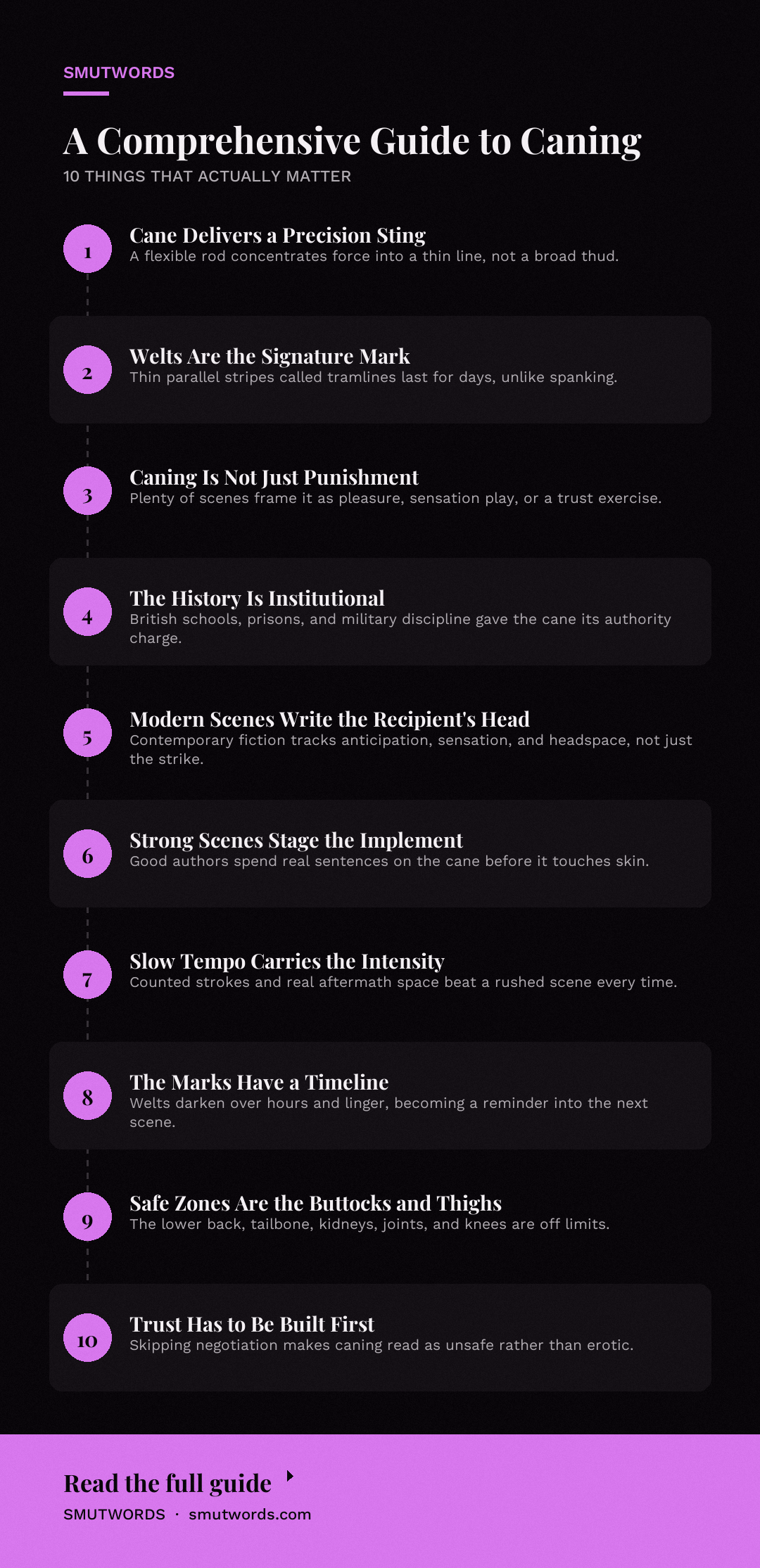
Caning is the practice of striking the body with a cane: a long, thin, flexible rod, usually between 60 and 100 centimeters, made from rattan, bamboo, or synthetic materials. The term covers both the act and the implement. In kink contexts, the cane is a precision tool. It concentrates force into a narrow line, producing a sharp, surface-level sting rather than the duller thud of a paddle or flogger.
The word itself comes from the plant. Canes are the hollow, jointed stems of plants like rattan and bamboo, and the same material has been used for walking sticks, furniture, and, historically, schoolroom discipline.
That last association matters for how caning reads on the page. It carries a built-in whiff of authority, correction, and institutional power.
What counts as caning and what doesn't is mostly about the implement and the intent:
- Counts as caning: a rattan or bamboo rod delivered in controlled strokes, whether the framing is disciplinary, erotic, or ritual; over-the-knee positioning; targeted strikes to buttocks, thighs, or upper back with negotiation; the deliberate production of welts as part of the experience.
- Doesn't count as caning: a leather belt or strap (that's strapping), a flogger (that's flogging), a paddle (that's paddling), or a switch cut from a tree in the moment (that's switching). The rigid rod and its specific sensation are what make caning its own thing.
The most common misconception is that caning is simply "hard spanking with a stick." It isn't. The cane produces a different quality of pain entirely: a thin, biting line that fades into a warm bloom. The marks it leaves, thin parallel stripes sometimes called tramlines, are a signature that spanking doesn't produce. Readers who love caning scenes often love them for exactly that visible evidence.
Another misconception: caning is always punishment. Plenty of caning is framed as pleasure, sensation play, or an intense trust exercise with no discipline narrative attached. The rough sex umbrella sometimes covers it, but caning has its own mechanics and its own fanbase.
Where Caning Comes From
Caning's real-world history is institutional before it is erotic. The British school system used the cane for corporal punishment well into the twentieth century, and the practice spread through colonial administrations, prisons, and military discipline across several continents. That history is why the cane carries such a specific charge in fiction: it is the tool of the headmaster, the officer, the authority figure.
Erotic literature picked that up early. Victorian flagellation writing, which circulated privately in the nineteenth century, already treated the cane as a disciplinary prop with obvious erotic charge. The schoolroom setting, the strict governess, the punished student: those tropes were in circulation long before modern BDSM publishing existed.
Caning moved into mainstream erotic fiction through the same channels as other impact play, and it gained a specific foothold in romance when the discipline-heavy historical and contemporary subgenres took off. The publishing shift is worth noting. Caning scenes used to appear almost exclusively in books that framed themselves as discipline narratives. These days it shows up in everything from dark romance to contemporary BDSM romance to erotic fantasy.
The terminology around it matured alongside the practice. "Caning tube" is the term readers search for when they want to find the implement itself, a tube of rattan or a caning rod, and it's also the phrase that turns up in product listings and in scenes where the cane is stored, presented, or discussed as an object. The word has a dual life in fiction: as the act and as the physical thing in the room.
What's changed in recent portrayals is the interiority. Older caning fiction focused on the event and the authority delivering it. Contemporary writing spends far more time on the recipient's experience: the anticipation, the sensation, the trust, the headspace.
That shift mirrors the broader move in BDSM fiction toward showing negotiation and consent on the page. For a fuller look at those headspaces, the SmutWords piece on subspace and domspace is worth reading alongside this one.
How It Shows Up in Erotica
Caning scenes are among the most technically demanding to write well, because the cane is a precision instrument and precision is hard to fake. An editor who has read hundreds of these books can tell within a paragraph whether the author knows what a cane actually does. When they don't, the scene collapses into vague throbbing and purple prose.
Here's what a strong caning scene actually does on the page:
It stages the implement. Good caning fiction treats the cane as a character. It gets selected, presented, flexed, tapped against a palm. The sound of it cutting air is part of the buildup.
The best authors spend real sentences on the cane before it ever touches skin, because that's where the tension lives.
It slows the tempo. A caning scene is usually written in slow motion compared to other impact scenes. The buildup is deliberate, the strikes are counted, and the aftermath gets real space. Authors who rush it lose the specific intensity that makes caning worth writing about.
Enjoyed this? Get a free book.
Join the list and we will send a complete free story straight to your inbox, plus new releases every week after that. No credit card, no catch.
It writes the recipient's reaction, not just the strike. The reader wants the breath, the flinch, the involuntary sound, the moment of processing. Caning fiction at its best lives inside the recipient's head. The subspace and domspace material applies directly here: a well-written caning scene tracks the shift in the recipient's awareness, not just the marks on their body.
It makes the marks part of the story. The welts have a timeline. Raised and red at first, they darken over hours and linger for days. Good authors use that.
The marks become a reminder the recipient carries into the next scene, or a tension point when someone else might notice them.
Common variations authors reach for:
- Over-the-knee caning, which borrows the positioning of a domestic discipline scene and often reads more intimate and less formal.
- Caning for discipline, where the framing is correction or punishment and the scene is built around rules and consequences.
- Caning for pleasure, where the sensation itself is the point and the discipline framing drops away.
- Formal or ceremonial caning, with strict positioning, counted strokes, and ritual pacing. It suits dark romance and fantasy settings.
- Bamboo cane or dragon cane variants, where the implement's stiffness or thickness is part of the scene's texture. A dragon cane is thicker and stiffer than standard rattan, and authors who know the difference use it to signal intensity.
The flat version of a caning scene tends to look the same regardless of the book: a few generalized strikes, a vague sting, then immediate sex. The strong version has specificity. It knows where the cane landed, what it looked like, how the recipient's body reacted, and what the cane did to the dynamic between the two people.
Caning plays especially well with dynamics built on authority and surrender. It sits comfortably inside service submission frameworks, where the cane can act as a ritual of structure, and inside primal play scenes, where the blunt physicality of it fits the animalistic register.
It also pairs naturally with shibari in scenes that combine restraint with impact, though authors who write both should remember that a bound body has less ability to move away from a strike, which changes the risk profile.
Where caning shows up less comfortably is inside the casual, low-stakes register of a one night stand or a light friends with benefits arrangement. The trust requirements are high enough that authors usually either establish the relationship first or work the negotiation into the scene itself. When they skip the trust setup entirely, the caning reads as unsafe rather than erotic.
A note on the real-world version, since fiction often treats it casually: caning carries genuine risk. The cane concentrates force on a narrow band of tissue, and strikes can cause deep bruising, tissue damage, and nerve injury if the force is wrong or the target area is wrong. The safe areas are the fleshy parts of the buttocks and thighs. The lower back, the tailbone, the kidneys, the joints, and the back of the knees are off limits.
Caning also requires warm-up, controlled force, an agreed safeword, and immediate aftercare. Fiction can dramatize intensity without the safeguards, but a scene that shows no negotiation at all is writing a fantasy that real practitioners would flag as dangerous. The best authors thread the safety in without slowing the scene down.
Readers who like their impact play with a side of humiliation and structure should also look at use kink, which shares caning's interest in objectification and framing. Readers who want the messy, high-emotion version of physical intensity might enjoy makeup sex scenes, which run on a different kind of heat but hit some of the same vulnerability notes.
Frequently Asked Questions
Is caning the same as spanking?
No. Spanking uses an open hand and produces a broad, dull impact. Caning uses a flexible rod and produces a sharp, localized sting with characteristic welts. The sensation, the risk profile, and the marks are all different, and most practitioners treat them as separate skills.
What is a caning tube?
A caning tube is the rigid rattan or bamboo rod used to deliver the strikes, and the phrase also shows up in product listings and in fiction to describe the implement itself. It describes the object, usually a flexible tube of rattan with natural joints along its length. Readers searching for caning tube scenes are looking for the physical cane as it appears on the page: selected, presented, and used.
What does caning feel like?
It's a sharp, thin, stinging sensation that hits the surface of the skin, followed by a warm bloom that spreads outward. The sting fades faster than the warmth. Marks appear almost immediately as thin raised lines and darken over the following hours. People who like caning often describe the sensation as focused rather than overwhelming.
Is caning dangerous?
It can be. The cane delivers concentrated force, and misplaced strikes can cause deep tissue damage and nerve injury. The safe zones are the fleshy parts of the buttocks and thighs. Negotiation, warm-up, controlled force, agreed safewords, and immediate aftercare are not optional when caning happens in real life.
Why do romance readers like caning scenes so much?
Because the cane is visible in every sense. The setup is a ritual, the strokes are counted, and the marks last. That gives readers a scene with structure, high stakes, and physical evidence of everything that passed between two people. The vulnerability and trust in a caning scene are unusually legible.
What's the difference between a rattan cane and a dragon cane?
Dragon canes are thicker and stiffer than standard rattan canes, which makes them deliver a heavier, more intense strike. Rattan is the more common and more flexible option. In fiction, authors usually signal the difference through how the scene describes force and reaction, but both produce the same stinging line characteristic of caning.
Final Thoughts
Caning is the rare kink where the implement tells the story as much as the people do. A cane has to be chosen, held, and used with intent, and every good caning scene on the page knows that. If you want a next read that gets the mechanics and the heat right, start with the ranked picks below and let the cane do what it does.






Loading comments…