
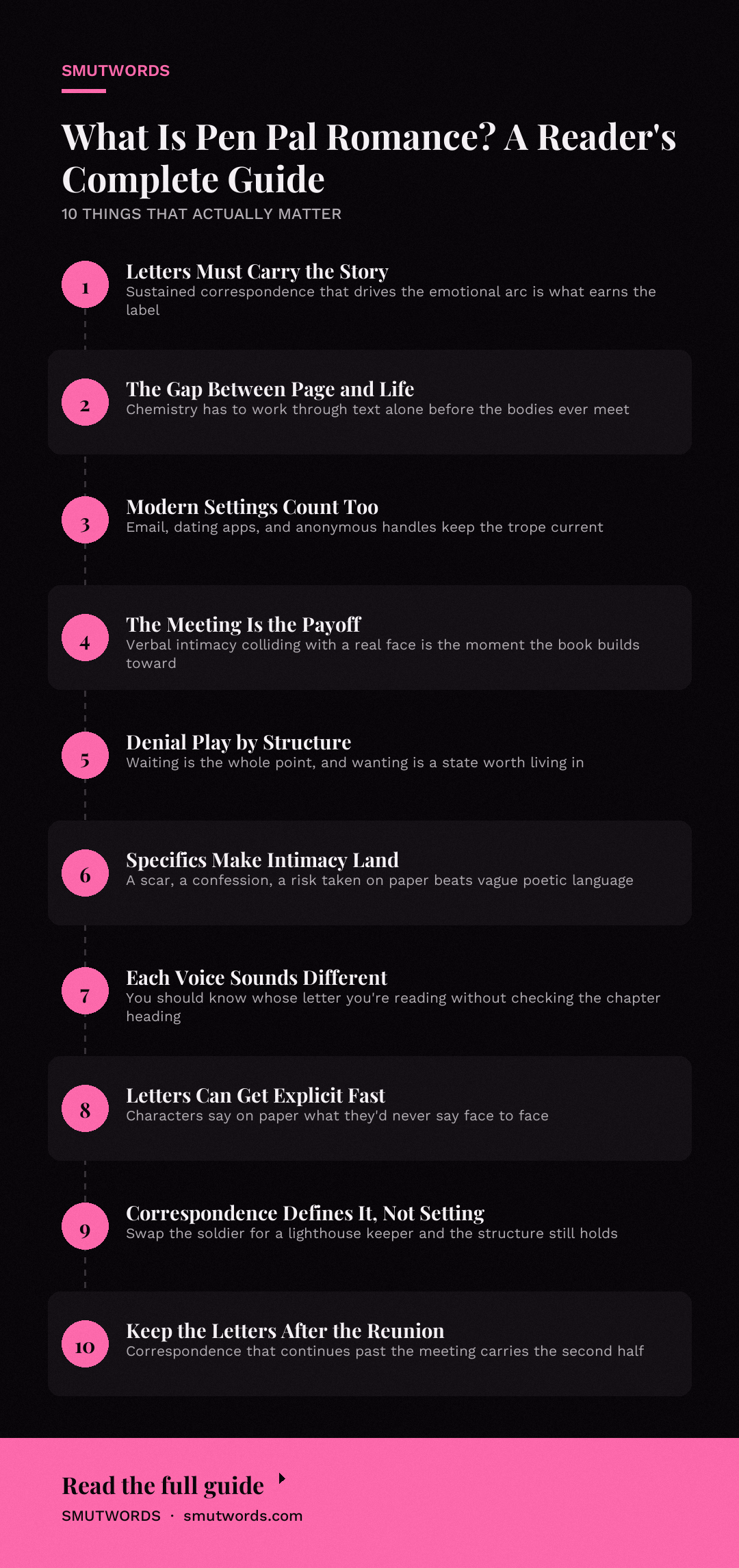
A pen pal romance is a love story built on written words before bodies. Two people exchange letters, emails, or messages across distance, and the relationship deepens through language, confession, and anticipation long before they stand in the same room. The distance here is structural. It forces the couple to fall for a voice, a vocabulary, a way of thinking, and it makes every reply carry weight.
The category spans historical letters, prison correspondence, anonymous online matches, and wartime mail, but the engine in every version is the same. Intimacy arrives on paper first, and the physical meeting becomes the payoff the whole book has been holding back.
What Pen Pal Romance Actually Means
The name describes the medium as much as the relationship. A pen pal romance is a romance novel or novella where the central romantic connection grows through written correspondence, and the correspondence drives the plot. The letters are not decoration or a framing device. They are the relationship.
Plenty of books contain letters without being pen pal romances. A single epistolary chapter, a recovered diary, a text thread that sets up a meet-cute, a love letter found in an attic: these can add texture to a blind date romance or a second-chance story without making the book a pen pal romance. What earns the label is sustained correspondence that carries the emotional development.
The reader spends real page time inside the written exchange, not just reading about it afterward.
The distinction matters because readers search for this trope by feel. They want the specific pleasure of watching two people say things on the page they could not say out loud, waiting for the next letter the way the characters wait for the mail, and then watching all that verbal intimacy collide with a real face. If the letters are a gimmick for two chapters, that pleasure never arrives.
A few misconceptions are worth clearing up directly.
- It does not require historical setting. Contemporary pen pal romances use email, dating app messages, anonymous chat handles, and good old-fashioned handwritten letters. The trope is alive in modern settings.
- It does not require physical separation for the entire book. Most pen pal romances hinge on the meeting, and some spend a whole second act in person. The correspondence can continue past the first meeting, too.
- It does not require strangers. Some of the strongest versions pair people who already know each other, like a small-town childhood friends to lovers setup where anonymity lets them say what years of proximity never did.
- It does not require a hidden identity. Secret identity and anonymity are common variants, but plenty of pen pal romances have two people who know exactly who they are writing to.
- It is not slow burn by definition. Many pen pal romances are slow burns because the structure rewards delay, but the letters themselves can get filthy fast. Verbal intimacy can escalate to explicit sex on the page well before the physical meeting.
One more clarification. A pen pal romance is defined by the correspondence between the two leads. A book about a character exchanging letters with a dead grandmother, a therapist, or an advice columnist is not automatically a pen pal romance, even if those letters are beautiful. The romantic pair has to be doing the writing.
Where Pen Pal Romance Comes From
The honest history here is the history of the epistolary novel, filtered through the romance genre. Letters as fictional scaffolding go back centuries, and the nineteenth-century novel leaned on correspondence to let characters speak with a confessional intensity that social convention otherwise forbade.
Young women were expected to be modest and composed in company. A letter could be bold, private, and true. That gap between social performance and written honesty is the engine the trope has run on ever since.
Romance as a mass-market genre picked up correspondence through the twentieth century and turned it into a plot device readers could count on. Wartime letters became one of the genre's most durable settings, and for good reason. War separated couples by continents and years, mail was slow and uncertain, and every letter carried the risk that it would be the last. The stakes came pre-built.
The trope's biggest publishing shift arrived with the internet. Email, chat rooms, and eventually dating apps gave writers a contemporary version of the same mechanism, minus the historical baggage and plus some new problems.
Anonymity became a plot engine. Catfishing, screen names, and the gap between an online voice and an offline person made the trope sharper and more suspenseful. Readers who had grown tired of swooning over wax seals had something new to obsess over.
Prison pen pal romance is a smaller but persistent pocket of the category, using the deliberate restrictions of incarceration as the source of the distance. It has a long history as real-world correspondence, and in fiction it produces a specific version of the trope: a relationship conducted almost entirely on paper, with a ticking clock tied to release dates and visitation rules.
It is one of the more polarizing variants in the genre. Readers either find it fascinating or refuse it outright, and both reactions are understandable.
Through all these shifts one thing holds steady. The pen pal romance is a genre phenomenon built on a formal constraint, and the constraint is what makes the emotional payoff land. When the genre drifted toward faster, more physical stories, this trope stayed valuable precisely because it made readers wait.
How It Shows Up in Erotica
On the page, a strong pen pal romance does careful structural work. The letters or messages usually alternate with narrative chapters, and the author has to balance two voices: the on-paper persona and the actual inner life of the writer. The best versions let the reader see what each character holds back in their letters. That gap is where the tension lives, and it makes the eventual physical meeting feel earned.
There is a particular craft problem in this trope that weak versions ignore. In a typical romance, the characters spend page time together and chemistry has to work in the moment. In a pen pal romance, the chemistry has to carry through text alone.
A lazy version just makes the letters poetic and calls it intimacy. A strong version makes the correspondence specific, personal, and risky. The character writes something they would never say out loud, and the next letter shows how the recipient received it. That cause and effect is what makes pen pal intimacy feel real instead of decorative.
Explicit scenes in this trope fall into two broad shapes, and both can work.
- Epistolary sex. The letters themselves get explicit. Characters describe fantasies, recall past encounters, or write through an orgasm. This can be wildly effective because the reader is reading what one character wrote for the other, and there is a voyeuristic charge to being let in on that.
- Delayed physical sex. The book teases the physical meeting for chapters and delivers when they finally get their hands on each other. The delay is a form of denial play, and writers who understand that write a more powerful first kiss than a book that gets there by chapter three.
Both approaches cross into dynamics worth knowing by name. If you like the deliberate withholding of a payoff, the chastity play vs orgasm denial comparison is useful reading, because pen pal romance is denial play in a structural sense even when the characters never discuss it as kink. The pairing shares the same emotional logic: wanting is a state worth living in for a while.
Common variations authors fall back on, and how they change the book:
Enjoyed this? Get a free book.
Join the list and we will send a complete free story straight to your inbox, plus new releases every week after that. No credit card, no catch.
- Anonymous online match. Two people meet through a forum, app, or anonymous letter exchange. The reader often knows both identities, or watches a character fail to realize who they are writing to. This version is suspense-heavy and often involves a reveal in the final third.
- Secret identity pen pal. One character knows who the other is and hides it. The power imbalance is the point, and the reveal is the plot's climax.
- Prison correspondence. A writer outside and an inmate inside build a relationship through letters. This variant skews intense, often darker, and usually involves a slow build to first physical contact after release.
- Wartime letters. Historical or near-historical. The stakes are external and enormous. These books frequently alternate between the front and home, with every letter a quiet event.
- Forced proximity through letters. Two people who must correspond for professional or practical reasons (a project, a legal matter, a housing situation) and slowly cross into personal territory. This is often the gentlest version and pairs well with slow-burn fans.
- Wrong-recipient mixups. A letter meant for someone else reaches the right person, and the relationship starts on a stranger's mistake. Light, funny, and low on darkness.
The main failure mode in this trope is letters that sound like no one. A weak pen pal romance gives both writers the same poetic voice, same vocabulary, same rhythm. A strong version gives each one their own specific way of writing, their own tics, their own subjects they avoid. You should be able to tell whose letter you are reading without checking the chapter heading.
That is a real craft skill, and it separates the books that realize the trope's potential from the ones that only use it as a setting.
Another weak-version trap: confining the correspondence to vague emotional language without ever producing real risk. Strong letters contain specifics. One character describes a scar and the story behind it. Another writes something about their body they would not say to a lover in bed.
Another sends an honest admission that the recipient should not have been trusted with. Specificity is what makes the intimacy land.
There is also an adjacent trope worth knowing, where the correspondence happens between a writer and someone standing in for a public figure. A ghostwriter romance frequently borrows pen pal mechanics, since the whole plot can hinge on written exchanges between two people with a public identity standing between them.
It is a strong crossover with the celebrity romance shelf, and if a book is doing letters between a star and someone behind the scenes, both categories apply. The lonely-voice-in-the-wilderness version recently showed up in dinosaur romance and prince/princess romance as well, with one-sided correspondence between a distant figure and an ordinary person doing the emotional legwork.
One more variant to note because it changes the flavor of the trope completely: the letter writer who knows more than they let on. When the secret becomes a threat, the pen pal romance starts to borrow from the stalker romance shelf. Readers who like dark pen pal stories often like that overlap. The same dynamic can move in a gentler direction, with the writer using their letters to plan something elaborate, which nudges into revenge romance territory.
Finally, the pen pal romance has a natural advantage that writers overuse or underuse, and both are mistakes. The advantage is that the reader gets access to interiority in a way most romance novels cannot sustain. A character writing by candlelight or at 2 a.m. can be more honest than one in dialogue at a bar.
A good pen pal romance leans on that honesty hard. A great one finds a way to keep it going in person after the meeting. The letters that continue after the reunion are usually the ones that carry the second half of the book.
Pen Pal Romance vs Soldier Romance
Readers often confuse these two, and the confusion is real because the tropes overlap constantly. Plenty of soldier romances are pen pal romances during the deployment section, and plenty of pen pal romances are soldier romances in disguise. The difference is the trope's central mechanism.
A soldier romance is built around a love interest in the military and the particular stresses of that life: deployment, risk, duty, and the possibility of loss. The correspondence is one tool it uses, but the trope can function without a single letter. Reunions, homecoming, and shared danger can carry a soldier romance on their own.
A pen pal romance is built on the correspondence itself. If you swapped the soldier for a lighthouse keeper or an artist abroad and the letters kept flowing, the structure survives. If you removed the letters from a soldier romance, you would still have a soldier romance. That test is the cleanest one.
In practice, the two tropes are strongest together when the book uses each one for what it does best. The soldier provides the stakes and the physical risk; the pen pal structure does the emotional intimacy and the anticipation. Books that try to give both equal weight without recognizing the difference end up crowded and slightly confused.
Frequently Asked Questions
What is a pen pal romance novel?
It is a romance novel where the relationship develops primarily through letters, emails, or other written correspondence between the two leads before or alongside physical contact. The correspondence is not decoration; it is the engine of the emotional arc. The trope is especially common in slow-burn romances because the structure naturally delays the physical payoff.
Is pen pal romance the same as epistolary romance?
Close, but not identical. Epistolary romance describes any romance built from letters, emails, or documents, and a pen pal romance is the specific version where sustained correspondence between two people drives the connection. Some epistolary novels use other formats (diaries, transcripts, case files) that are not correspondence between the leads, and those are epistolary without being pen pal stories.
Why do readers love pen pal romance so much?
Because the trope rewards patience. Readers get to watch two people fall for a voice and a mind before anything physical happens, and then they get the specific tension of whether the in-person version lives up to the imagined one. That anticipation is hard to manufacture in other tropes, and this structure delivers it almost automatically.
Can a pen pal romance be explicit?
Absolutely. Many pen pal romances are highly explicit, both in the letters themselves and in the eventual physical scenes. In fact, the correspondence format gives characters a reason to say things on paper they would be too self-conscious to say face to face, which can make the sex writing braver than the genre average. The trope's reputation for sweetness is often misleading.
What are some common pen pal romance plot twists?
The most common is a secret identity reveal, where one character turns out to already know the other, or is someone the other would never have chosen on paper. The wrong-recipient mixup is a lighter variant. The in-person meeting not matching the letters is a favorite complication, though the best versions resolve it in favor of the letters being truthful and the physical body being the surprise.
Where can I find good pen pal romance recommendations?
Start with the books ranked at the top of the SmutWords catalog for this trope, which cover historical wartime correspondence, contemporary anonymous online versions, and the prison pen pal variant. Readers who want the trope in a darker register should look at the overlap with stalker and soldier fiction, while readers who want the lightest version will find it in wrong-recipient mixups and forced-proximity correspondence.
Final Thoughts
The pen pal romance earns its patience. If you have read one that made you feel the waiting, you know why readers keep returning to it, and if you have only tried the flat versions, you have not yet met the books that do it properly. Start with the highest-ranked pen pal romance in the SmutWords catalog, read the letters slowly, and watch for the moment the two voices stop sounding the same. That is where the trope works.





Loading comments…